

Intervertebral Disc Disease (IVDD)
Disc degeneration in the spine causing pain, nerve damage, and potential paralysis.
Part of the bigger picture
The complete Arthritis & Mobility library
Intervertebral Disc Disease (IVDD) and arthritis go hand in hand. The weight, pain relief, physio and quality-of-life guidance below is shared with our flagship Arthritis Hub.
Explore the full library2
Pets tracked
89
Expert guides
2
Members
Intervertebral Disc Disease (IVDD) guides
IVDD in Dogs: What It Is and Why Discs Go Wrong
IVDD, intervertebral disc disease, is a common spinal condition in dogs, and the letters alone can be unsettling when a vet first mentions them, especially since a quick search online tends to throw up the frightening end of the spectrum first. So let this be the calm starting point. It comes in several forms ranging...
IVDD in Dachshunds: Why Your Breed Is at Risk (and What the Genetics Really Say)
"Dachshunds get back problems." Every dachshund owner has heard it, usually delivered with a knowing nod and a remark about their long backs. The real story is more interesting than the folklore, more reassuring, and genuinely more useful for protecting your dog. Intervertebral disc disease is indeed common in dachshunds, but it is not inevitable....
Is This an IVDD Emergency? The Red Flags That Mean Act Now
A dog that has suddenly gone wobbly, started dragging a back leg, or cried out in pain needs an answer fast, not a biology lesson. So here it is, straight away.
The First Few Hours: A Calm, Step-by-Step Action Plan
When a dog suddenly goes weak or off its legs, the last thing that helps is an essay. What helps is knowing exactly what to do, in order, calmly. So here it is, step by step. Work through it one step at a time; you can read the detail later. The most important thing has...
Neck vs Back IVDD: How Cervical and Thoracolumbar Disc Disease Differ
Picture intervertebral disc disease and most people picture a dog dragging its back legs. That image is real, but it's only half the story. IVDD is not one disease that always happens in one place. A disc can herniate anywhere along the spine, and where it happens, in the neck or in the back, genuinely...
The Early Warning Signs: Spotting a Disc Problem Before It's a Crisis
Most owners meet intervertebral disc disease as a sudden catastrophe: a dog that was fine in the morning is dragging its back legs by lunchtime. But it doesn't always arrive without warning. Quite often there's a quieter phase first, a few days of a dog being subtly "off", in pain or stiff but still walking,...
IVDD in French Bulldogs & Other At-Risk Breeds
Say "dog with a bad back" and most people picture a dachshund, and they're not wrong to. But dachshunds are far from the only breed at raised risk of intervertebral disc disease, and one breed in particular has come up fast on the inside: the French bulldog, whose soaring popularity means more affected dogs every...
IVDD Surgery vs Conservative Treatment: How to Decide
Surgery, or strict rest? For most owners facing intervertebral disc disease, this is the hardest call they will have to make, and it usually arrives tangled up with fear, cost, and very little time to think. Let me say something reassuring at the outset, because the way this decision is often framed is unfair to...
IVDD Grades 1 to 5: What Your Dog's Grade Actually Means
The grade is the single most important number in this whole condition, and your vet or a neurologist has just handed you one. If "grade 5" was the word in the room, that lands hard, because it sounds like the worst end of a scale. What you actually want to know is plainer than that:...
Seeing a Neurologist: Referral, MRI and What to Expect
A referral to a specialist neurologist can land like a sudden escalation, and it usually arrives with a flurry of questions. What does referral actually mean? What happens on the day? What will it cost? And does agreeing to see a specialist commit you to surgery? This guide answers all of that, walking through the...
What IVDD Surgery Actually Involves
Once surgery is on the table for a dog's disc problem, the questions tend to come in a rush. What actually happens in theatre? How long does the hospital stay last, how well does it work, and what could go wrong? The unfamiliar is what makes the decision feel so heavy, so this guide walks...
The Medications Used in IVDD (and the Steroid Question)
When a dog is treated for IVDD, especially without surgery, medication does a lot of the quiet work alongside the rest. Good pain relief is not a luxury here; it keeps your dog comfortable, helps them stay still enough to heal, and makes the long weeks of recovery bearable for you both. This guide explains...
Deep Pain Sensation: The Single Most Important Test
When a dog can't walk after a spinal injury, one piece of information matters more than almost any other for what happens next and for the odds of recovery: whether the dog still has what vets call deep pain sensation. It's the single most important test in the whole situation, the line that separates a...
What IVDD Treatment Costs in the UK
MRI, surgery, weeks of medication, hydrotherapy: intervertebral disc disease can be one of the most expensive things that ever happens to a dog. Far too often, owners only discover the figures at the worst possible moment, mid-crisis, in a referral waiting room, trying to make a huge decision with no sense of the numbers. That...
Slings, Harnesses and Safe Lifting
A dog that cannot walk, or is weak and unsteady on its feet, needs lifting, supporting and moving many times a day, for toilet breaks, position changes and simply getting about. How you do that genuinely matters. Done carelessly, lifting can twist a recovering spine and undo healing, and it can wreck your own back...
"Is This Normal?" Red Flags to Watch For During Recovery
Recovery from a disc problem turns most owners into close observers of every twitch, every off day, every change. Is that stiffness this morning a setback or just a normal bump? Is the wobble as function returns a good sign or a worrying one? That worry is completely understandable, and this guide is here to...
Keeping a Confined Dog Calm and Content
Weeks of strict crate rest are hard on a dog, and hard on you. Once the initial crisis has passed and your dog starts to feel a bit better, a new challenge appears: a bored, frustrated, sometimes whining dog who wants to move and cannot, and an owner worn down by the constant vigilance and...
Nursing a Down Dog at Home: The Complete Guide
A dog that cannot walk, whether home after spinal surgery or to be nursed through conservative recovery, suddenly needs help with the most basic things: weeing, staying clean, changing position. That is a daunting amount to take on, and a daunting amount to learn at once. This guide is meant to be the calm, complete...
Preventing Pressure Sores & Urine Scald
A dog that cannot move freely, whether through strict crate rest, recovery from spinal surgery, or longer-term hind-limb disability, faces a quiet problem on the skin that is entirely preventable. Lie in one position for too long, or lie in dampness, and the skin can develop pressure sores and urine scald. Both are painful, both...
How to Express Your Dog's Bladder, Step by Step
When a dog has lost the ability to wee on its own, perhaps after a spinal injury or during IVDD recovery, helping to empty its bladder by hand, what vets call expressing the bladder, becomes one of the most important parts of its daily care. I know this sounds daunting. Pressing on your dog's belly...
Strict Crate Rest for IVDD, Done Properly (and How to Survive It)
Weeks of strict rest is the centrepiece of conservative treatment for intervertebral disc disease, and it is quite possibly the most daunting thing your vet has ever asked of you. Keeping a dog still for weeks, when every instinct of theirs and yours rebels against it, is genuinely tough. But the encouraging truth is simple:...
Re-teaching Your Dog to Walk
Few moments in a spinal recovery move owners the way the first wobbly, lurching step does after weeks of a dog not walking. Your dog may be beginning to recover genuine movement, or it may be working, in a different way, towards the reflex-driven gait some paralysed dogs develop. Either way, supporting those first steps...
Acupuncture and Laser for IVDD: What the Evidence Actually Says
Once a dog is recovering from a disc problem, the suggestions start to arrive. Someone mentions acupuncture; an article turns up about laser therapy; and the question you actually want answered is simple. Do these things work? It is a fair question, and it tends to draw out two unhelpful answers. The enthusiast promises miracles,...
Home Physiotherapy: Safe Exercises by Recovery Phase
There is a great deal you can safely do at home to help a dog recover from a spinal injury, and most of it takes the form of gentle, guided physiotherapy that supports recovery and keeps the body in good condition. The crucial words are "safely" and "guided", because the wrong exercise at the wrong...
Hydrotherapy for IVDD: Does It Help, and When to Start?
Hydrotherapy comes up a lot when a dog is recovering from a spinal injury, and you can see why. The idea of a dog that can barely walk on land moving freely in water is an appealing one, and it is genuinely a useful rehabilitation tool. Owners tend to arrive with two questions, and both...
Rehabilitation After IVDD: The Roadmap
Once a dog has come through the frightening acute phase, the surgery or the first weeks of strict rest, the natural next question arrives: what now? How does a dog that cannot walk, or can barely walk, actually get back to moving? The answer is rehabilitation, and it is the part of the journey that...
The Permanently Affected Dog: A Genuinely Good Life Is Still Possible
Once it becomes clear that your dog's disability is permanent, that the paralysis, the incontinence, the loss of normal mobility are not going to fully resolve, a hard and quiet question often surfaces: is it fair to carry on? Are you keeping your dog going for its sake or for your own? It is one...
Adapting Your Home for a Mobility-Impaired Dog
A dog left with lasting mobility problems, whether using a wheelchair, dragging the back legs, or simply weak and wobbly, suddenly finds the home it knows full of small obstacles: the slippery kitchen floor, the step up to the garden, the sofa it used to leap onto. Here is the encouraging news. Adapting your home...
Managing Long-Term Incontinence with Dignity
Lasting bladder or bowel problems after a spinal injury are, for a lot of owners, the part of the road ahead that feels most daunting, practically and emotionally. The worry tends to take one of two shapes: that it means an undignified life for the dog, or that you simply will not be able to...
Life on Wheels: Choosing and Using a Dog Wheelchair
A dog that cannot use its back legs can still live a happy, active, genuinely full life. That is the most important thing in this whole article, and it sits right at the top because it changes everything that follows. When a dog loses the use of its hind legs, a particular fear tends to...
Quality of Life, and Saying Goodbye
Loving a dog through a serious illness includes, in the end, watching their quality of life clearly, and sometimes facing the hardest decision an owner ever makes. This is a gentle guide to that part of the journey: how to think clearly about your dog's quality of life, how to recognise when the balance has...
When Surgery Isn't the Right Choice
For some dogs with a serious disc injury, surgery is not the right answer. That sentence is hard to read if you are facing it, because so much of what is written about IVDD treats surgery as the thing a good owner does, and anything else as giving up. That framing is unkind and untrue,...
Protecting an At-Risk Dog: Weight, Ramps, Harness, and the Evidence
Dachshunds, French bulldogs and a handful of other breeds carry a built-in tendency to disc problems, and if yours has not had an episode yet, the natural wish is to keep it that way. Trouble is, much of the prevention advice floating around mixes genuinely useful guidance with well-meaning dogma. The "never let a dachshund...
Will It Happen Again? Reducing the Risk of Recurrence
After one IVDD episode, with all the fear and effort it involved, one question tends to loom over the whole recovery: will it happen again? It is a natural worry, and you deserve a straight answer rather than false comfort. So here it is, with the real figures and, just as importantly, what genuinely lowers...
Breeding & the Genetics of IVDD
Nearly everything written about IVDD deals with coping once it has already happened: the emergency, the surgery decision, the weeks of crate rest. This article turns and faces the other direction, toward prevention at its deepest level, which is breeding. Because IVDD in the at-risk breeds is so strongly genetic, the breeding choices made today...
From the Arthritis Library
See all →Spondylosis in Dogs: What That X-Ray Finding Actually Means
Spondylosis usually turns up by accident, on an X-ray taken for something else entirely, and the word alone is enough to set a frightening picture going: a dog's spine slowly fusing into a solid rod. The internet, when you look, rarely helps. So here is the reassuring headline straight away, and the rest of this...
Cruciate Ligament Disease: Understanding the Most Common Reason Dogs Need Knee Surgery
A dog diagnosed with cranial cruciate ligament disease is in very common company. It's the single most common orthopaedic problem in dogs and the most frequent reason a dog ends up needing knee surgery. It's also one of the biggest causes of hind-limb arthritis, which is why it earns a detailed article in this space.
How Arthritis Is Diagnosed: Understanding the Vet Visit
Most owners notice the same odd thing. The dog who was stiff, slow and reluctant at home walks into the consulting room and turns into a bright-eyed, bouncy version of themselves on the floor. Adrenaline and unfamiliar surroundings mask a remarkable amount of discomfort, so by the time the vet is examining them, your dog...
How to Spot Arthritis in Your Dog: The Signs Most Owners Miss
Ask most people what arthritis looks like in a dog and they'll describe a limping older Labrador struggling up the stairs. That picture is right, but only partly. By the time a dog is obviously limping, the disease has usually been progressing quietly for months or years. The signs you were meant to catch came...
Arthritis in Dogs: Everything You Need to Know
Most owners arrive here for one of two reasons: a dog who's just been diagnosed with arthritis, or a nagging sense that something isn't quite right and a wish to work out what's going on. Either way, you've come to the right place.
Arthritis in Cats: The Invisible Epidemic
There's a very good chance your cat has arthritis, particularly if they're getting on in years. And the odds are that nobody has told you.
Breeds prone to Intervertebral Disc Disease (IVDD)
Intervertebral Disc Disease (IVDD) is seen more often in some breeds than others. If you have one of these, its breed guide covers what to watch for and where to get help.
Free intervertebral disc disease (ivdd) downloads
Vet-built worksheets and trackers. Print at home, no signup required.
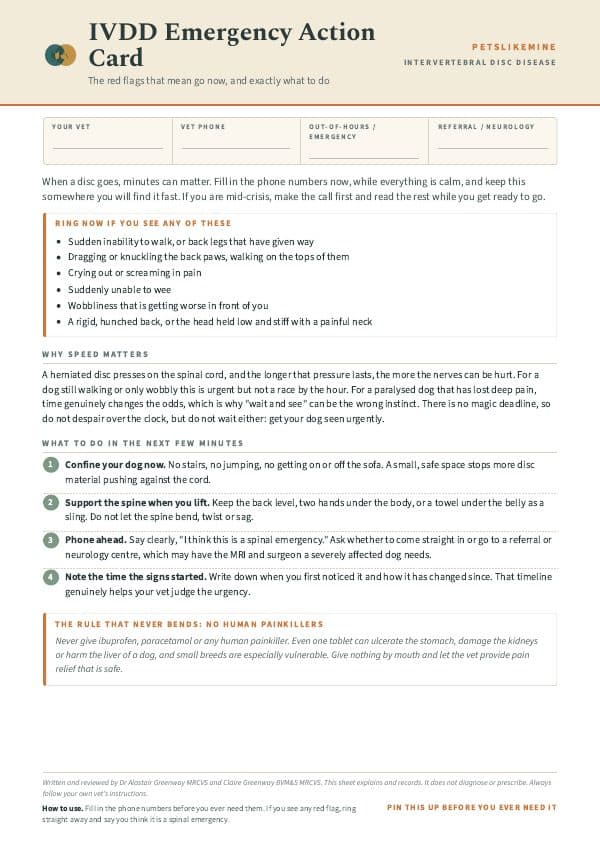
IVDD Emergency Action Card
PDF · 256 KBThe one to pin to the fridge before you ever need it. The red flags that mean go now, how to check deep pain and lift a dog with a hurt back safely, what to say when you phone the vet, and the rule that never bends: no human painkillers. When a disc goes, minutes matter, so the thinking is done for you here.
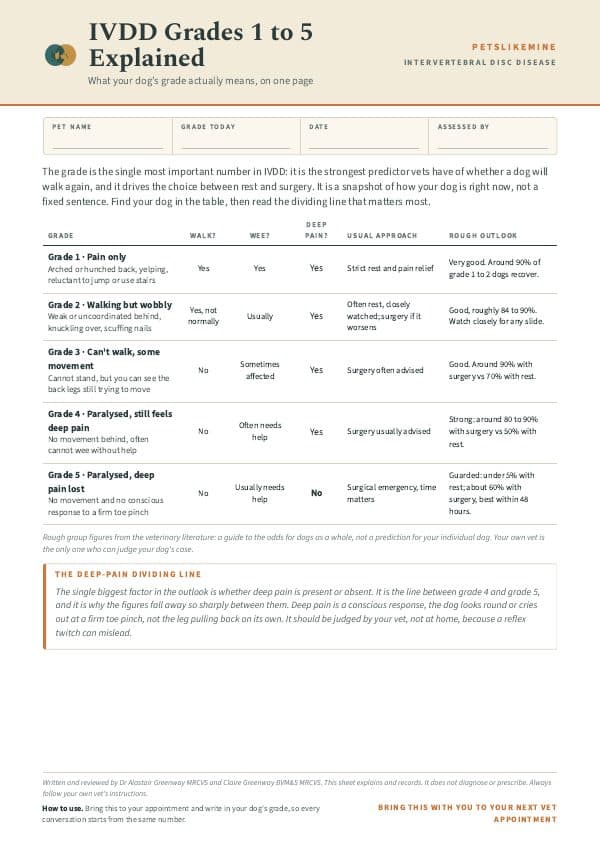
IVDD Grades 1 to 5 Explained
PDF · 289 KBWhat your dog's grade actually means, on one clear page. From a painful back with no weakness through to the loss of deep pain, each grade set out plainly alongside what it tends to mean for treatment and outlook. The grade, not a wobble or a bad day, is what drives every decision ahead, so it helps to know where your dog sits.
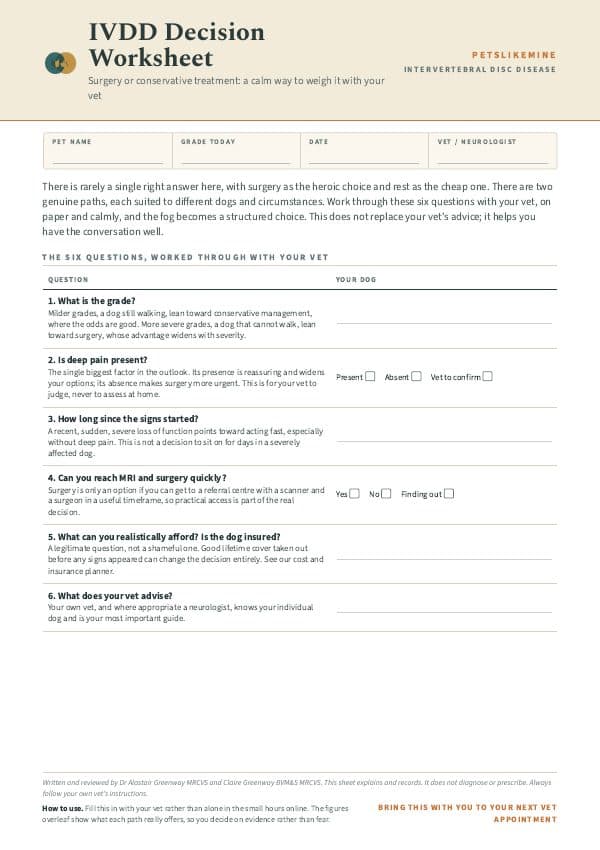
Surgery vs Conservative: Decision Worksheet
PDF · 284 KBA calm way to weigh the hardest choice in IVDD while the clock is ticking. Grade, deep pain, time since the signs began, cost and your own circumstances, laid out side by side so the decision is structured rather than panicked. Take it into the consult and fill it in together with your vet.
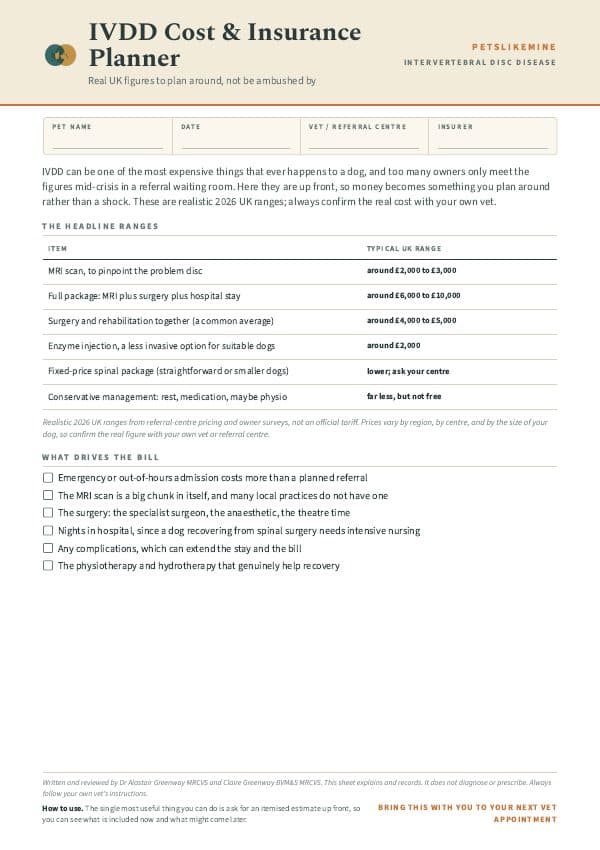
UK Cost & Insurance Planner
PDF · 306 KBTypical UK figures for the MRI, the surgery, the referral and the weeks of aftercare, with room to write in the quotes you are actually given. The insurance questions worth asking before you commit, and the practical ways to make it work. Money worries should never quietly make the medical decision for you.
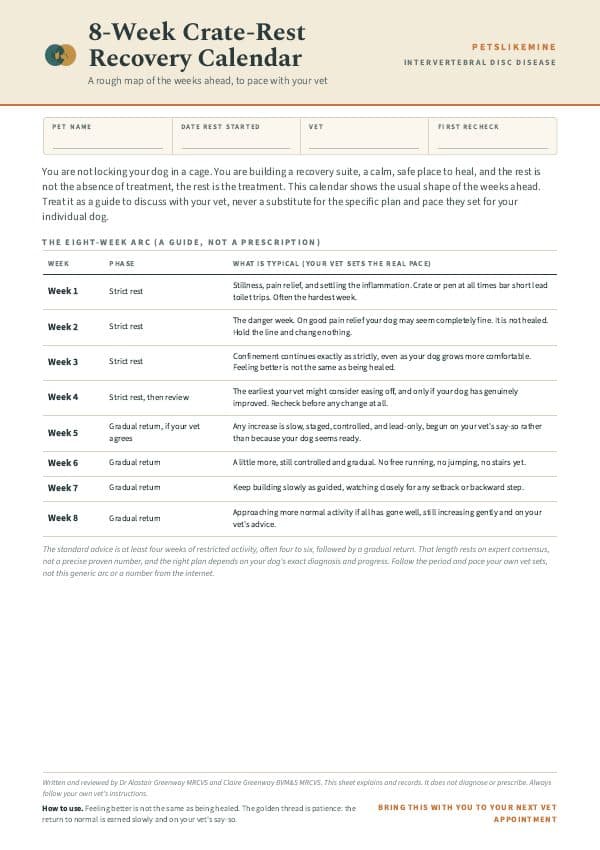
8-Week Crate-Rest Recovery Calendar
PDF · 269 KBThe eight weeks of crate rest mapped out so you always know what this week allows: the rest rules, the toilet trips, the first supported steps. A daily tick grid to keep you honest, and a column for the day's grade so progress is there in black and white. The single hardest part of conservative treatment, made survivable.
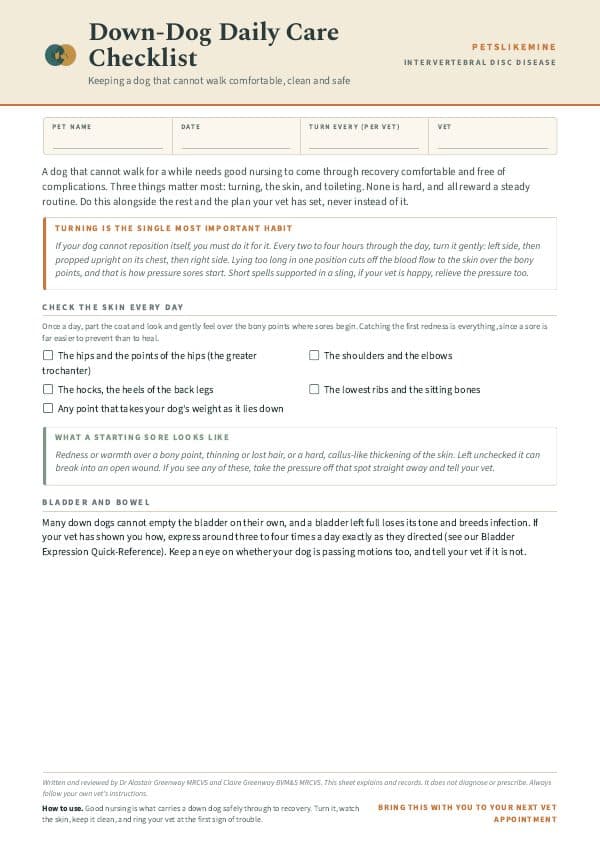
Down-Dog Daily Care Checklist
PDF · 230 KBCaring for a dog that cannot yet walk is a lot to hold in your head, so here it is on one page. Bladder emptying, turning, skin and bedding checks, meals and meds, each with its own tick box through the day. Nothing important slips when the days start to blur together.
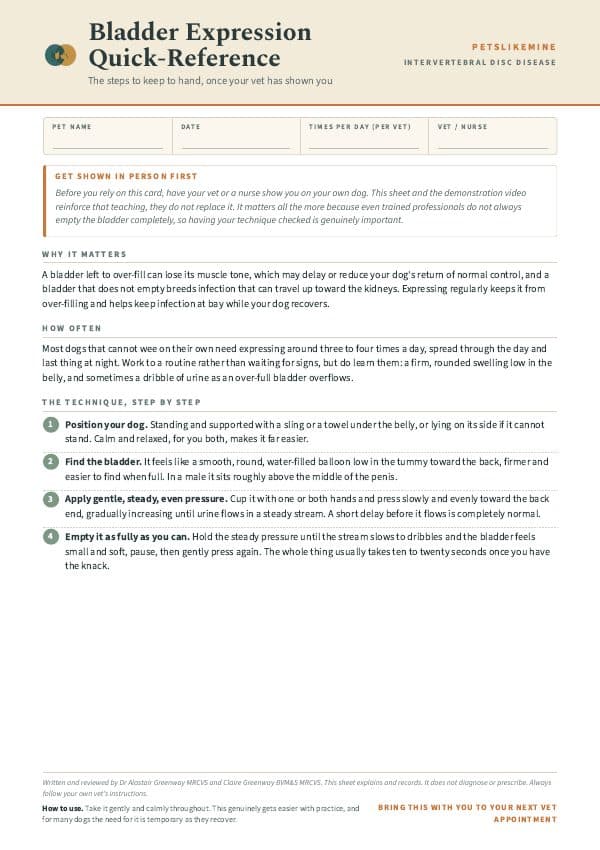
Bladder Expression Quick-Reference
PDF · 211 KBThe steps for emptying your dog's bladder, stripped back to a card you can prop up while your hands are busy. How to find the bladder, how much pressure, how often, and what should make you call the vet, with a QR code to the full how-to video. Frightening on day one, second nature by the end of the week.
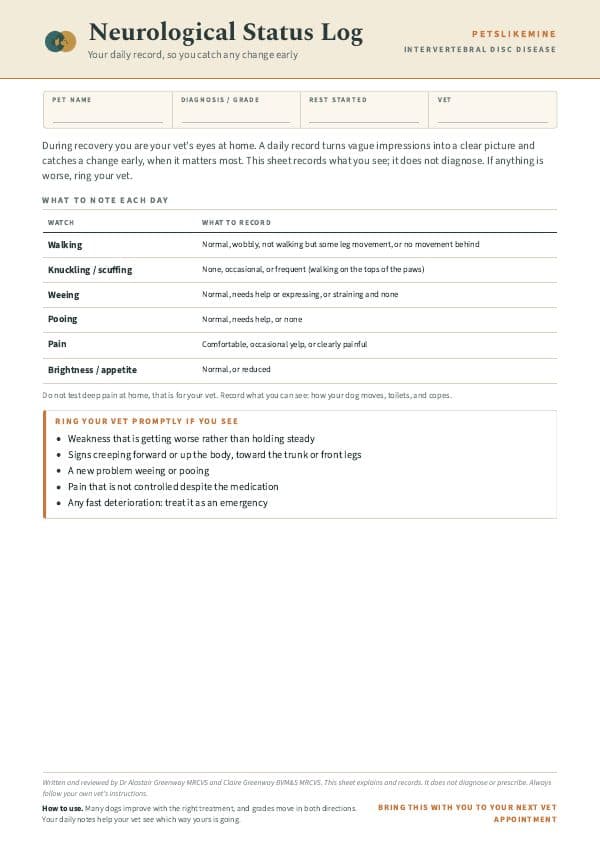
Neurological Status Log
PDF · 232 KBA simple daily record of the things your vet will want to know: deep pain, tail movement, leg position, toileting and how the back seems. The trend down the page is what tells you and your vet which way recovery is heading. Take it to every recheck so the conversation starts from facts, not memory.
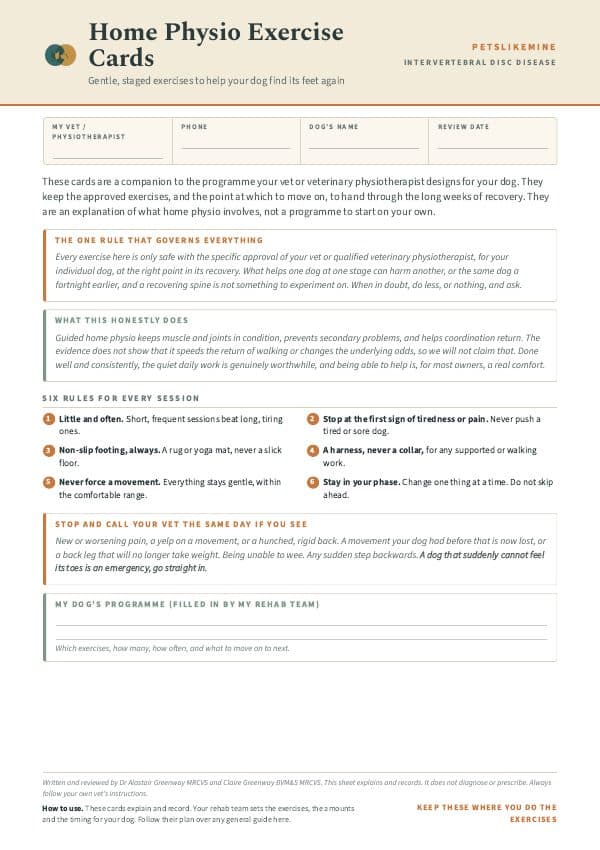
Home Physio Exercise Cards
PDF · 1.2 MBGentle, staged exercises to help your dog find their feet again, one card per movement with clear pictures and the point at which to progress. A companion to the home physio video, and strictly only ever started once your vet or physiotherapist has given the go-ahead. Done at the right time and the right way, this is how strength comes back.
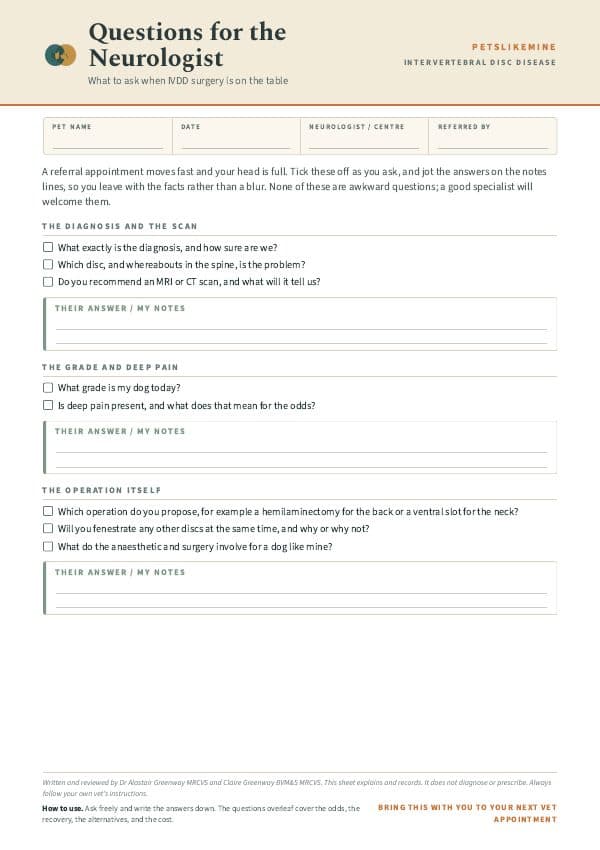
Neurologist Questions Checklist
PDF · 204 KBWalking into a referral appointment is easier with the right questions already written down. What the MRI showed, what each option really offers your dog, the honest odds, the aftercare and the cost, grouped so you leave understanding the plan. Tick the ones that matter to you and add your own.
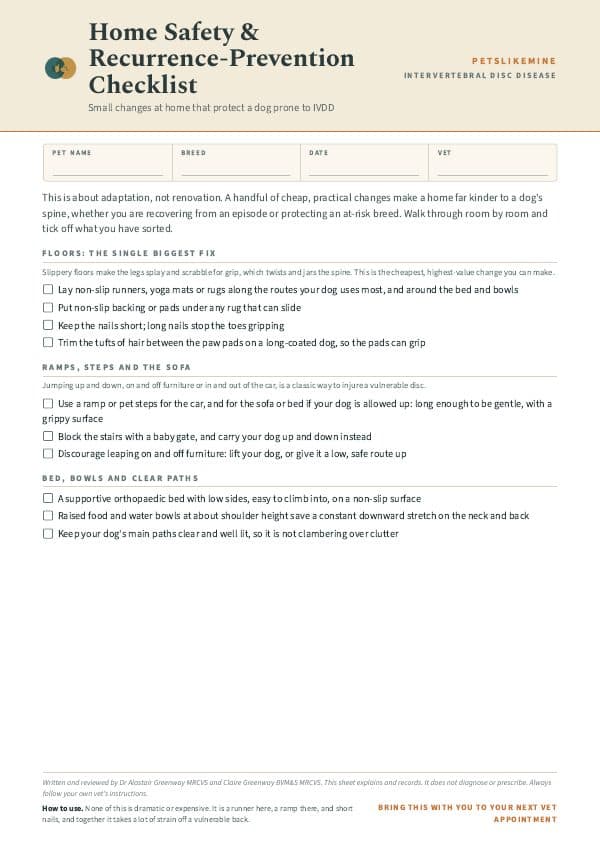
Home-Safety & Recurrence-Prevention Checklist
PDF · 244 KBOnce you are through an IVDD episode, the work turns to preventing the next one. A room-by-room sweep for the jumps, stairs and slippery floors that put a back at risk, the harness-not-collar habit, the weight and exercise points that genuinely matter, and the early signs never to ignore again. Calm, practical, and worth coming back to.
Connect with others managing Intervertebral Disc Disease (IVDD)
- 🐾
Find pets with the same condition and similar treatments
- 📊
Track symptoms, medications, and health trends over time
- 💬
Share experiences and learn from other pet owners
- 🩺
Get expert veterinary insights on community posts
A community that gets it
Part of the Osteoarthritis community
Intervertebral Disc Disease (IVDD) is supported in our Osteoarthritis space, a broader, livelier community for related conditions, so you are never posting into an empty room.
Visit the communityFree includes 1 pet, up to 2 condition spaces, daily tracking, and your top 2 matches