

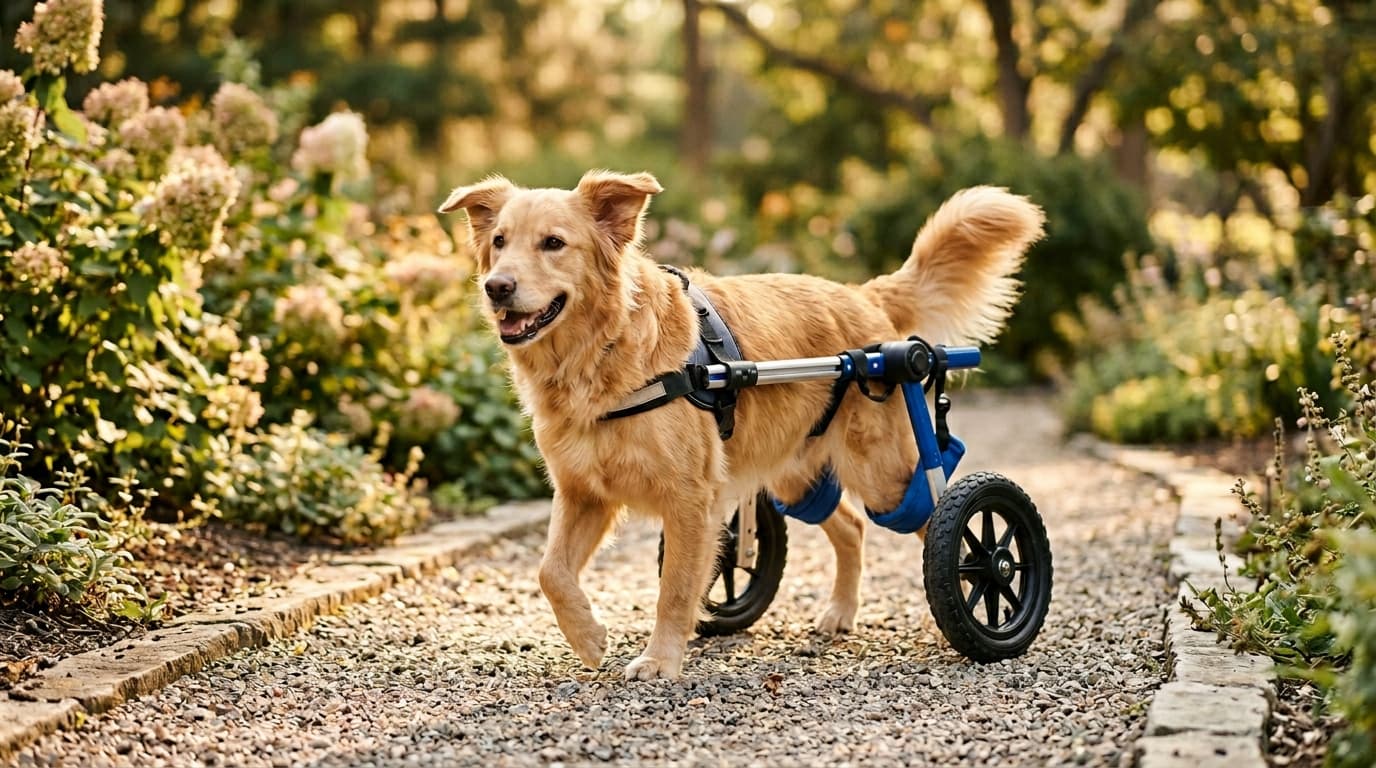
The Permanently Affected Dog: A Genuinely Good Life Is Still Possible
Alastair Greenway
BVM&S MRCVS
Once it becomes clear that your dog's disability is permanent, that the paralysis, the incontinence, the loss of normal mobility are not going to fully resolve, a hard and quiet question often surfaces: is it fair to carry on? Are you keeping your dog going for its sake or for your own? It is one of the most painful questions an owner can face, and it deserves a straight answer rather than either empty reassurance or quiet despair. So here is that answer, as plainly as I can give it: a permanent disability is not the same thing as a poor quality of life, and a great many permanently affected dogs are genuinely, observably happy. This guide looks squarely at what "permanent" really means, what the evidence says about these dogs' quality of life, the real workload involved, and how to know whether it is working, so that you can make your judgement clearly and kindly.
What "permanent" really means
It helps to be clear-eyed about what a permanent deficit actually involves, because the word "permanent" can sound more catastrophic than the daily reality is. For most permanently affected dogs, it means living with paralysis or weakness of the back legs, often together with a need for help managing the bladder and bowel. That is undeniably a significant disability, and the care it needs is real, which we come to squarely below. But, crucially, it is a manageable disability, not a death sentence and not, in itself, a life of suffering.
Why do these dogs do so much better than we instinctively expect? It comes down to a difference between dogs and us. We imagine our own response to losing the use of our legs, the grief, the frustration, the sense of a diminished life, and we project it onto our dogs. But dogs do not experience disability that way. They live in the present, they do not mourn the abilities they have lost or compare today's life to the one they used to have, and they adapt to a new normal with a matter-of-factness that humans find remarkable. A paralysed dog does not feel sorry for itself; it simply gets on with being a dog by the means available to it. That single fact, that dogs do not carry the psychological burden of disability the way we would, is why so many of them remain genuinely happy, and why your instinctive projection of how you would feel is not a reliable guide to how they feel.
What the evidence shows on quality of life
This is not just comforting sentiment; it is borne out by research into the quality of life of disabled dogs. Quality of life in dogs with spinal cord injury has been formally studied using a validated assessment tool, and while, unsurprisingly, dogs that can walk tend to score higher, good quality of life is reported across a range of disability, including in dogs with significant permanent deficits. In other words, when it is actually measured rather than assumed, the quality of life of permanently affected dogs is frequently good.
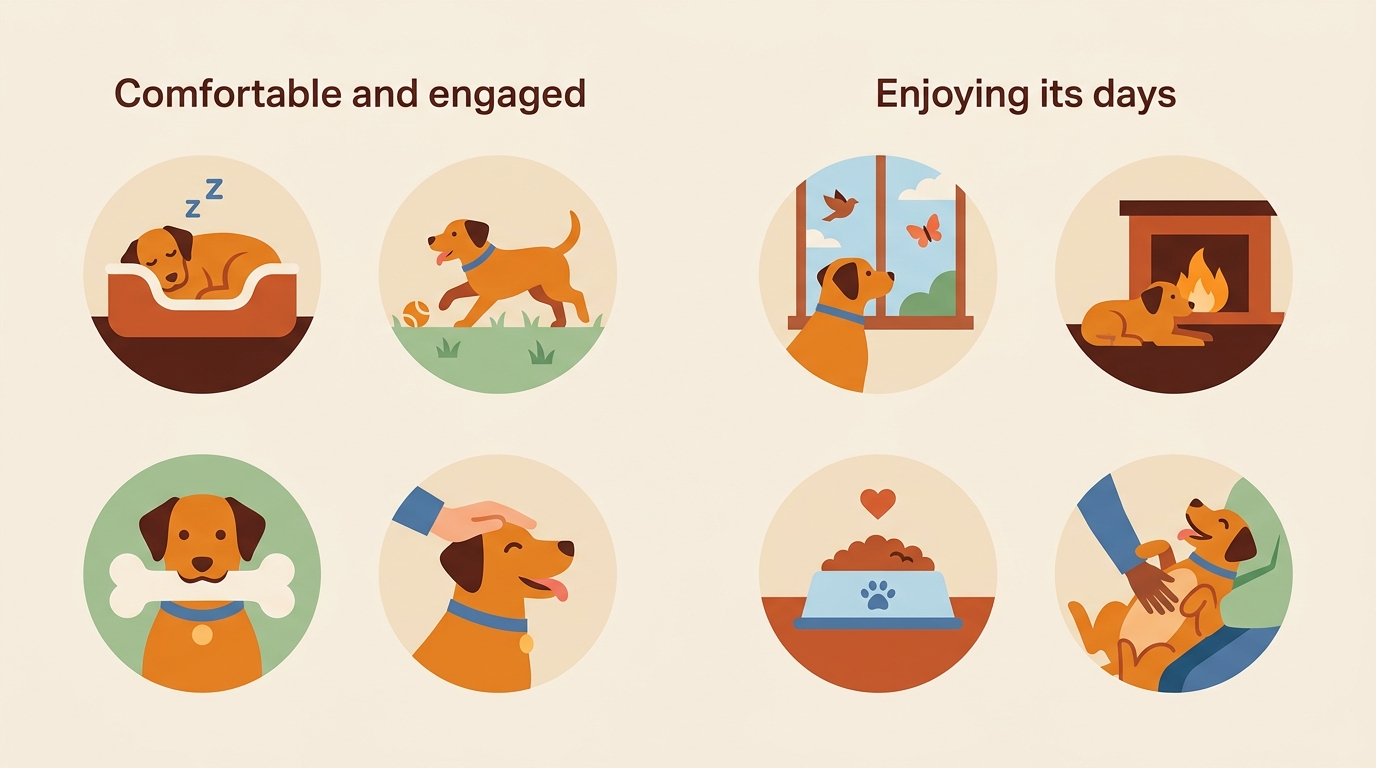
Research on wheelchairs tells the same balanced story. In a study of dogs using carts, the majority of owners, around sixty-two percent, reported that their dog's quality of life had improved with the cart, and around seventy-nine percent would recommend one to others in the same situation, which is a strong endorsement from the people best placed to judge. At the same time, the same study found that a substantial proportion of dogs, around sixty-four percent, had at least one complication, often skin or pressure-related. So the truthful picture is this: most owners of disabled and wheelchair-using dogs see a genuinely good quality of life and would do it again, while also dealing with real, ongoing care needs. Good life and real work, both true at once. What a good life looks like in practice is a dog that is comfortable and free of unmanaged pain, interested and engaged in its surroundings, eating well, enjoying the things it has always enjoyed in whatever adapted form, and showing the ordinary contentment you know in your own dog.
The real workload
The work it takes is real, and you deserve to know what you are taking on. Caring for a permanently affected dog means an ongoing daily routine: helping the bladder empty, often several times a day, as our guides to expressing the bladder and to long-term incontinence cover; protecting the skin from pressure sores and urine scald, as our skin-care guide covers; managing mobility with slings, a cart, or adapted spaces, as our home-adaptation guide covers; and the lifting, cleaning, and vigilance that go with all of it. Studies of owners doing exactly this confirm it is a substantial commitment of time and energy.
But, and this is the balancing truth, it is a commitment that the great majority of owners who take it on find genuinely worthwhile, and one that becomes routine far faster than you would imagine from the outside. Shared among a household, built into the day, and supported by the practical guides in this stage, the workload is manageable, not impossible. So go in with your eyes open, this is a real and ongoing commitment, not a light undertaking, and also with the encouragement that it is doable, that it gets easier, and that the dogs on the receiving end of it are so often happy. Knowing the workload clearly is part of making a good decision.
Knowing it's working, and when it isn't
Finally, the heart of the matter: how do you know whether your permanently affected dog genuinely has a good life, and what if, one day, it does not? The signs of a good life are the ones above, comfort, freedom from unmanaged pain, interest and engagement, appetite, and enjoyment of the things your dog loves, and most permanently affected dogs, well cared for, show them. Watching for these, closely and regularly, is how you keep checking that the life you are supporting is a good one for your dog, not just one you are reluctant to let go of.
And it is right to say, gently, that the answer is not always yes forever, and that this too is part of caring well. If a day comes when, despite everything, your dog's quality of life genuinely cannot be maintained, when the comfort, the engagement, the enjoyment are no longer there, then clearly recognising that is not a failure but a final act of love, and that conversation, with your vet, is a valid and important one. Our guide to quality of life and saying goodbye is there, gently, for if and when it is needed. But that is the far end of the road, and for most permanently affected dogs it is not where they are; for most, the truthful answer is that a genuinely good life is not only possible but probable, with the right care and a watchful eye.
A permanent disability is not a poor quality of life, and the evidence, not just hope, shows that most permanently affected and wheelchair-using dogs live genuinely good lives that their owners would choose again. The daily care is real, but it is manageable and it becomes routine. Watch closely for the signs of a good life, lean on this stage's practical guides to make the care doable, and trust that, for the great majority of these dogs, the answer to "is it fair to carry on?" is a clear and well-founded yes.
References
- Budke CM, Levine JM, Kerwin SC, Levine GJ, Hettlich BF, Slater MR. Evaluation of a questionnaire for obtaining owner-perceived, weighted quality-of-life assessments for dogs with spinal cord injuries. Journal of the American Veterinary Medical Association, 2008;233(6):925-930.
- Narum M, Miscioscia E, Repac J. Caretaker-reported quality of life, functionality, and complications associated with assistive mobility cart use in companion animals. Frontiers in Veterinary Science, 2024;11:1466405.
- Freeman PM, Holmes MA, Jeffery ND, Granger N. Time requirement and effect on owners of home-based management of dogs with severe chronic spinal cord injury. Journal of Veterinary Behavior, 2013;8(6):439-443.
Sister tool · Sightline
Track whether treatment is working
Sightline, a separate ConciergeVet tool, runs a short weekly check-in built on validated pain and mobility instruments, turns it into a single Sightline Score you can watch trend over weeks rather than judge on one bad day, and produces a report you can bring to your vet.
A written log, or our printable trackers, does much the same job.
See how Sightline tracks treatmentTrack the recovery, day by day
Recovery from a disc injury is all about the trend. Log the daily milestones through crate rest and rehab so you can see real progress, not just good and bad days.
Open the Recovery TrackerYou're not doing this alone
Compare treatment journeys and talk to owners managing IVDD. Free to join.
Join PetsLikeMine