
Downloads
Vet-authored PDFs for managing your pet's chronic condition. Print one, keep it in the kitchen drawer, take it to your next appointment. Free to use.
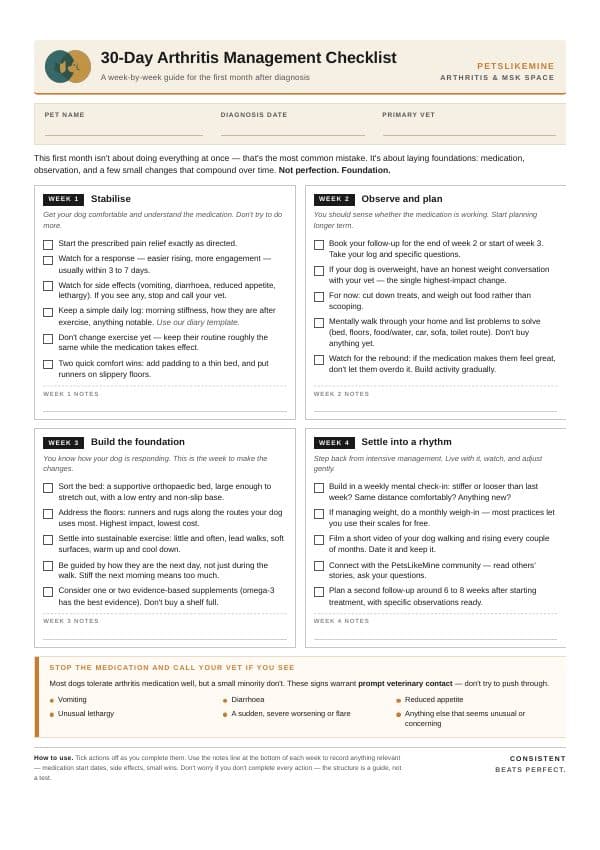
The First 30 Days: Week-by-Week Checklist
PDFA week-by-week guide for the first month after diagnosis. The conversations to have, the small changes to start, and the habits that compound across the years ahead.
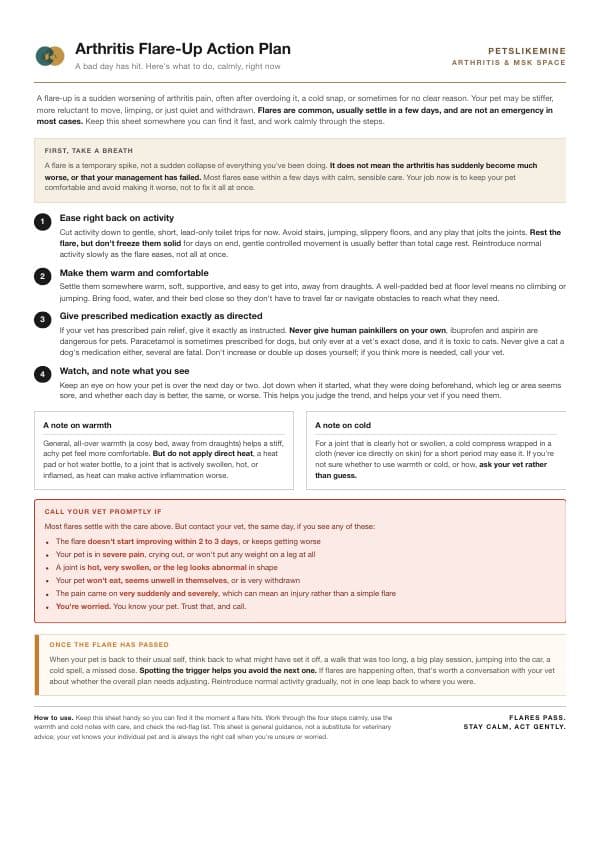
Arthritis Flare-Up Action Plan
PDFWhat to do when arthritis suddenly worsens. A calm, step-by-step plan for the first few days of a flare: ease back, keep them comfortable, give prescribed medication exactly as directed, and watch for the red flags that mean call the vet today. Flares are common and usually pass.
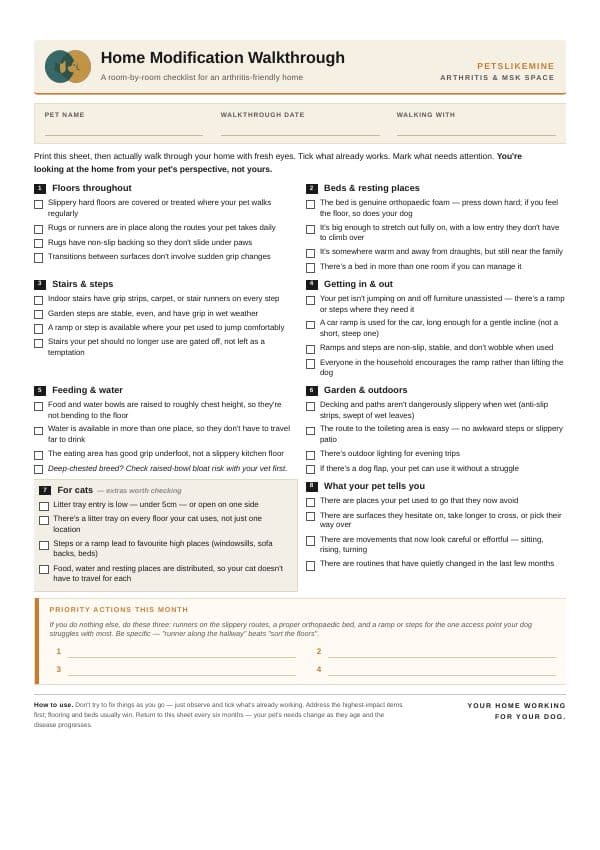
Home Modifications: Room-by-Room Walkthrough
PDFA room-by-room checklist for an arthritis-friendly home. The cheap wins, the bigger projects, and the small changes that matter most for an arthritic dog or cat.
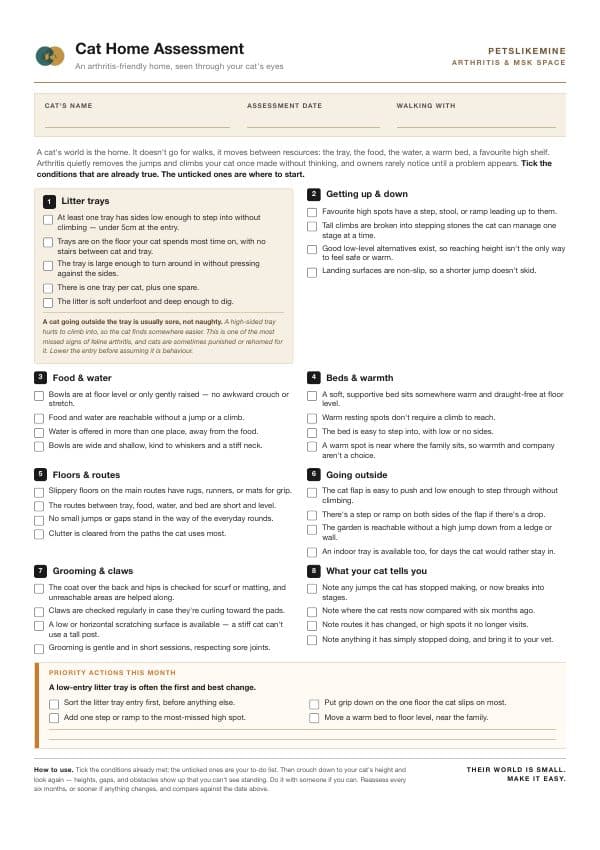
Cat Home Assessment Checklist
PDFA resource-by-resource home assessment for cats with arthritis. A cat's world is the home, and arthritis quietly removes the jumps and climbs between the litter tray, the food, the warm bed, and the favourite high shelf. Tick what's already easy; the rest becomes your plan, starting with the litter tray.
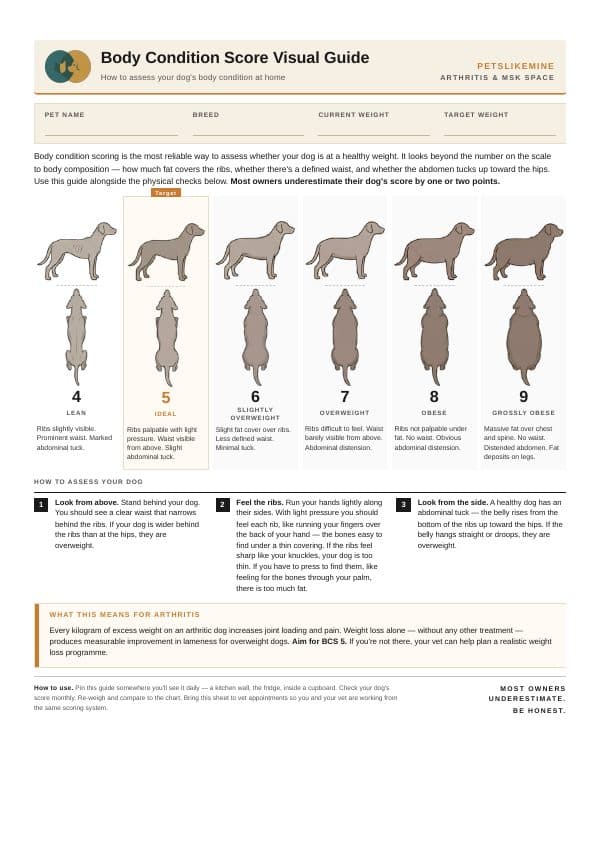
Body Condition Score: Visual Assessment Guide
PDFHow to assess your dog's body condition at home, with side-on and top-down silhouettes for the 1-9 BCS scale. Weight management is the single most effective thing you control, and this is the tool that makes it measurable.
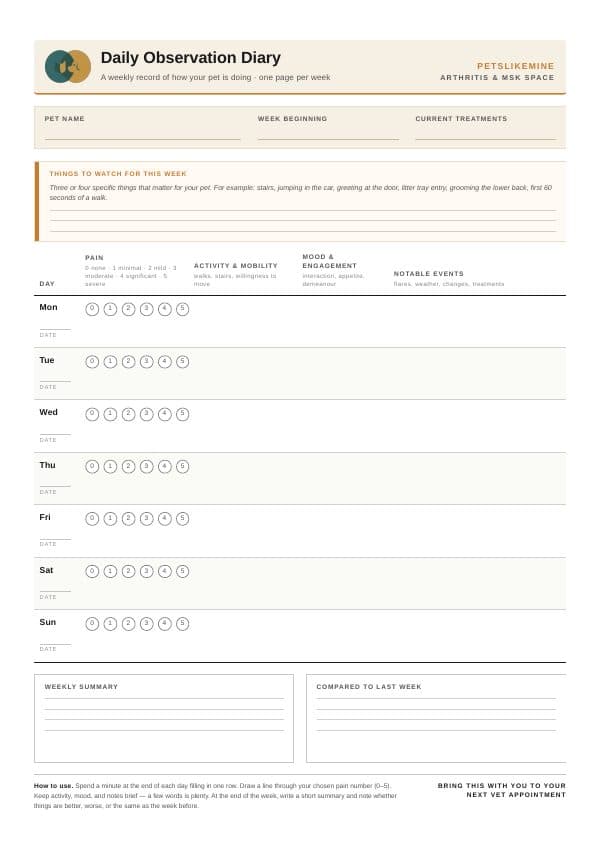
Daily Observation Diary
PDFA weekly record of how your pet is doing, one page per week. The small details that compound across months: stiffness on rising, willingness on walks, mood, appetite, and the moments your gut says something's shifted.
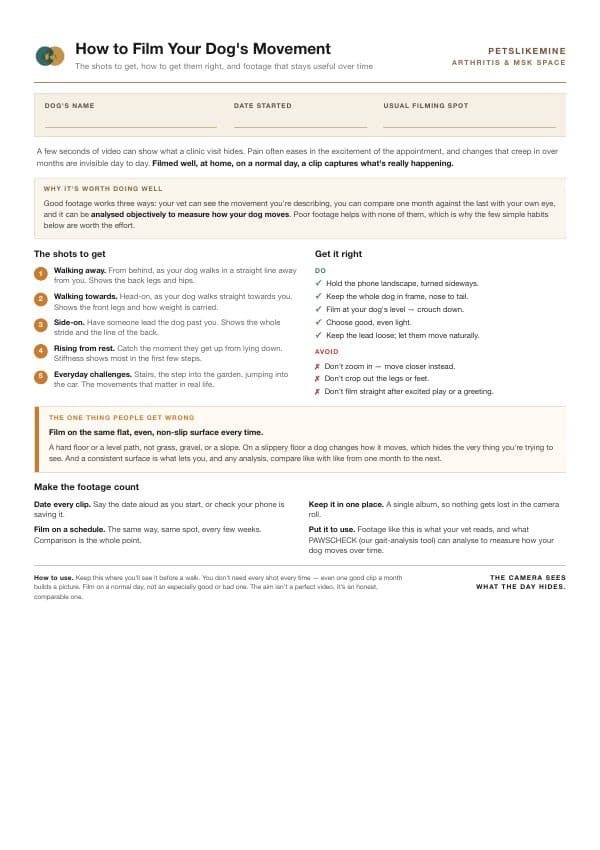
How to Film Your Dog's Movement
PDFA printable guide to capturing video your vet, and you, can actually use. The five shots that show how your dog really moves, how to get them right, and the one detail that makes or breaks the footage: the surface. Film on a normal day and the camera catches what a clinic visit often hides.
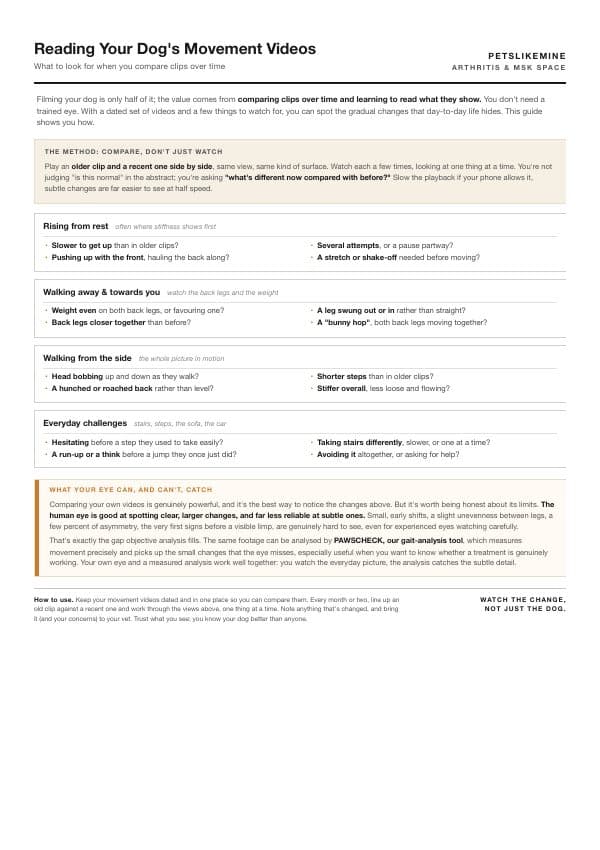
Reading Your Dog's Movement Videos
PDFThe companion to the filming guide: how to actually read the clips you have captured. Line up an older video against a recent one, watch one thing at a time across four everyday views, and spot the gradual changes day-to-day life hides. With an honest note on the subtle shifts the eye misses, and where objective gait analysis picks up.
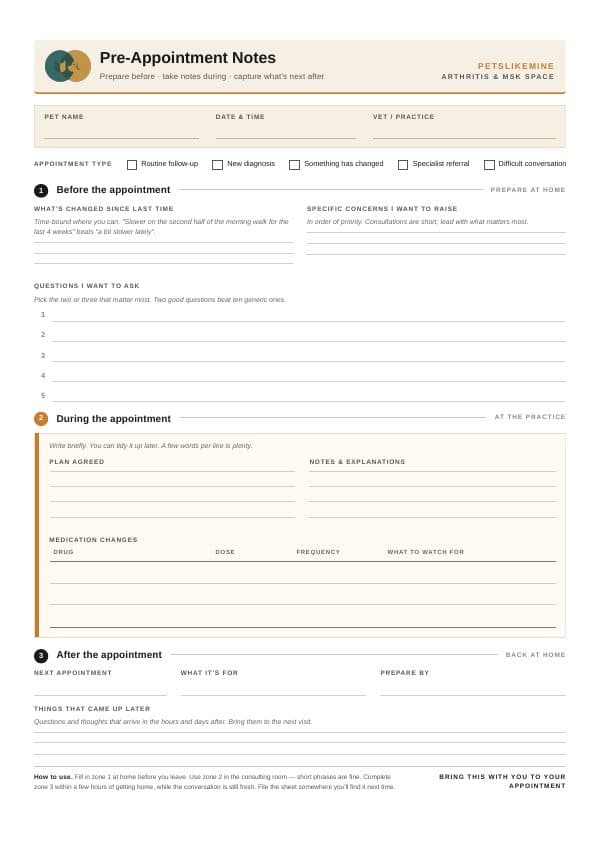
Pre-Appointment Notes
PDFPrepare before, take notes during, capture what's next after. A single sheet that turns a ten-minute vet appointment into one you'll actually remember properly a week later.
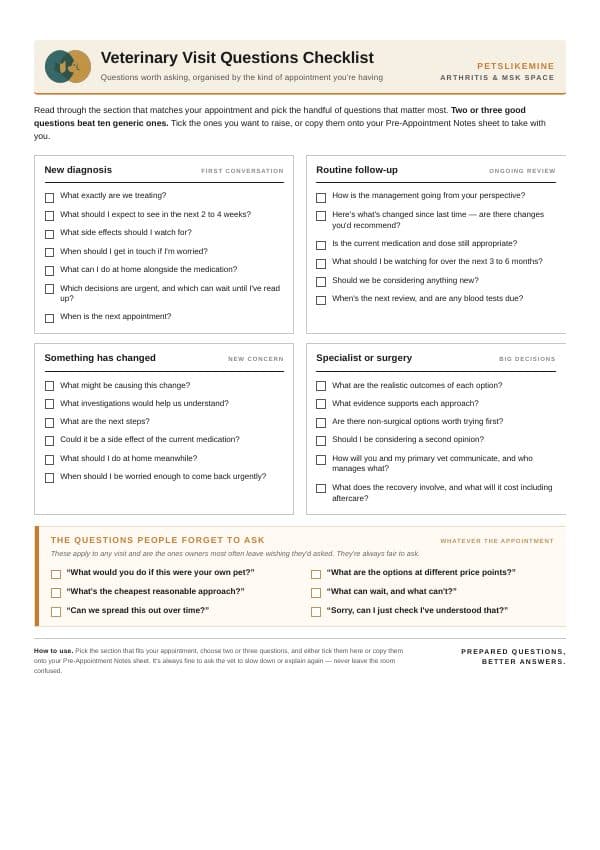
Vet Questions Checklist
PDFQuestions worth asking, organised by the kind of appointment you're having: diagnosis, treatment review, surgical consult, end-of-life conversation. Pick what fits and bring it with you.
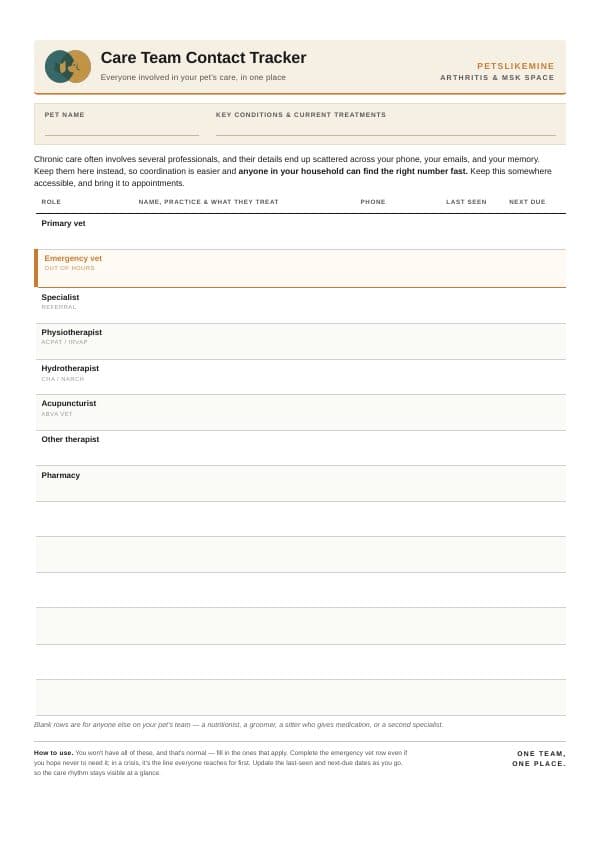
Care Team Tracker
PDFEveryone involved in your pet's care, in one place: primary vet, specialists, physiotherapist, hydrotherapist, behaviourist, end-of-life services. Contact details, last-seen dates, and what they're treating.
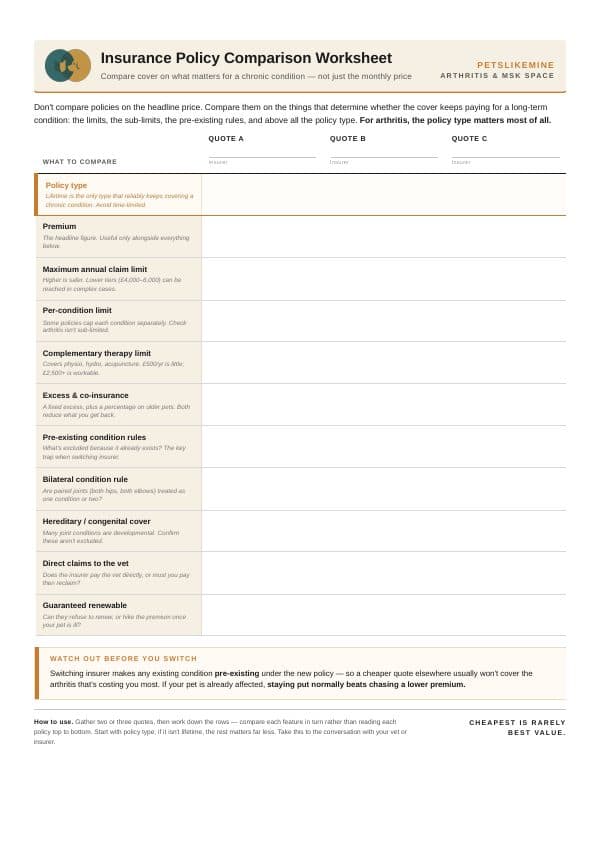
Insurance Comparison Worksheet
PDFCompare cover on what actually matters for a chronic condition: lifetime vs maximum-benefit vs annual vs accident-only, per-condition limits, excess structure, and the small print on continuing conditions.
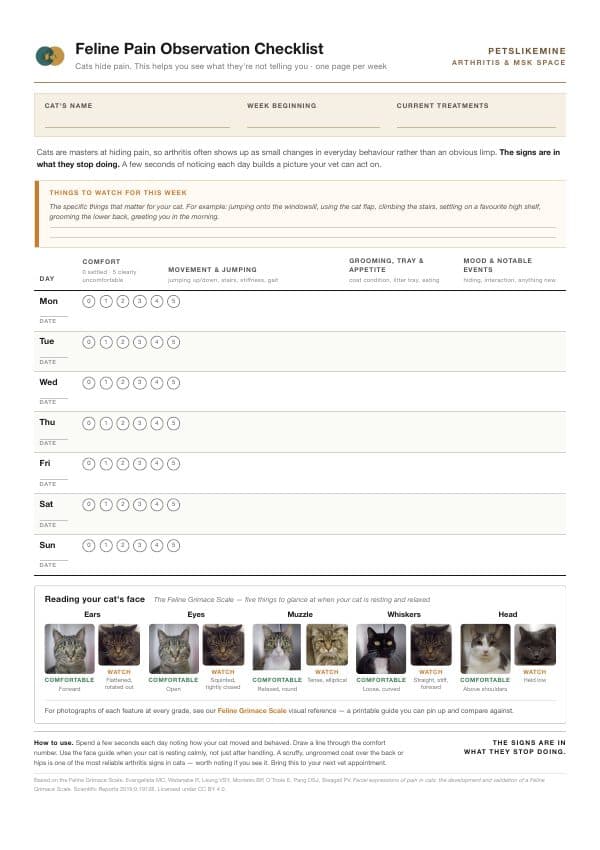
Feline Pain Observation Checklist
PDFA week-by-week record built around how cats really show pain. Not an obvious limp, but the things they quietly stop doing: jumping onto the windowsill, using the cat flap, grooming, settling on a favourite high shelf. A few seconds of noticing each day builds a picture your vet can act on.
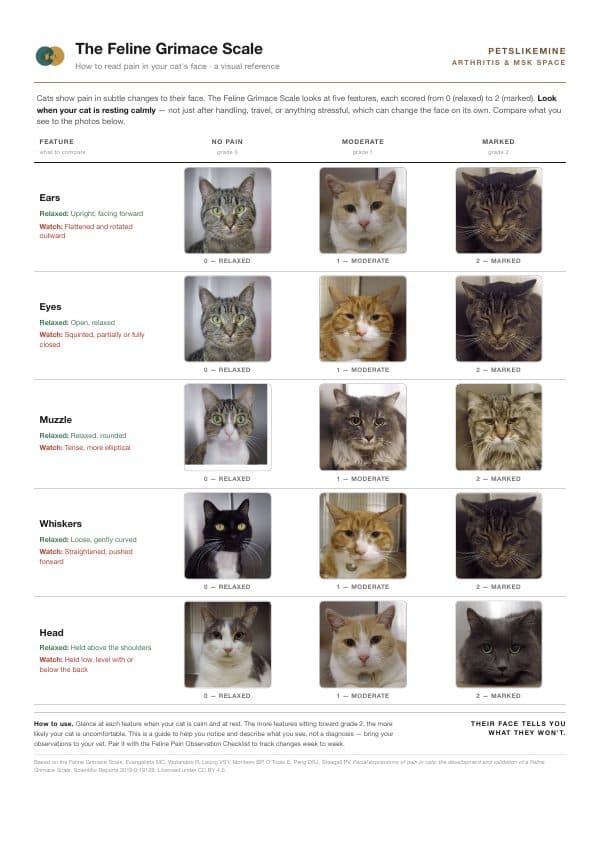
The Feline Grimace Scale
PDFHow to read pain in your cat's face. The Feline Grimace Scale scores five features, from the ears and eyes to the muzzle and whiskers, each from 0 to 2. A visual reference for spotting discomfort when your cat is resting calmly, with photos to compare against.
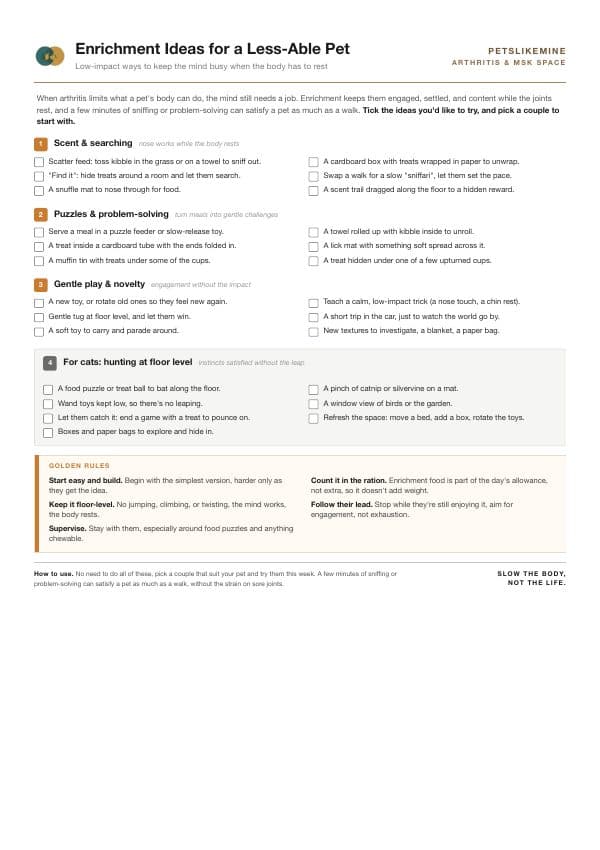
Enrichment Ideas for a Less-Able Pet
PDFA menu of low-impact ways to keep a pet's mind busy when arthritis limits the body. Scent work, puzzle feeders, gentle play, and a full feline section, mostly free and all at floor level. Tick what you'd like to try. Slow the body, not the life.
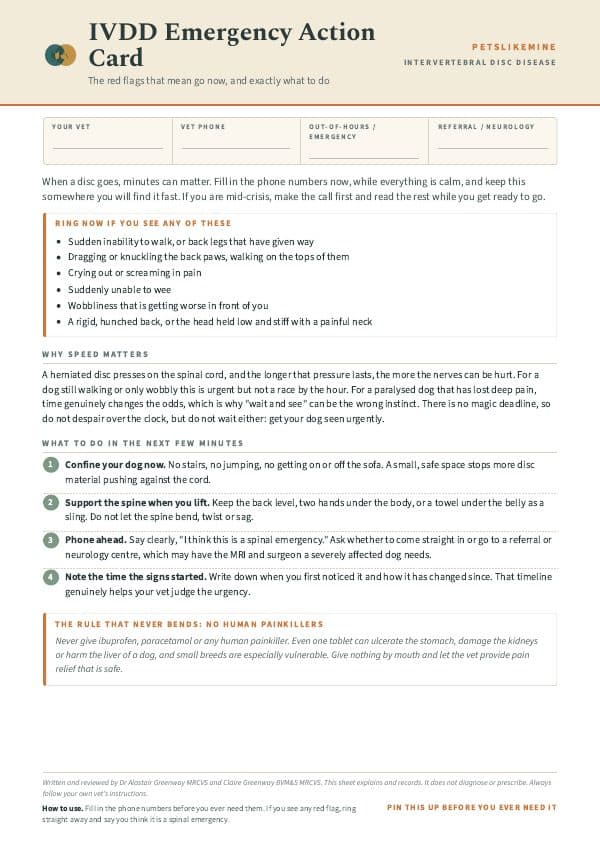
IVDD Emergency Action Card
PDFThe one to pin to the fridge before you ever need it. The red flags that mean go now, how to check deep pain and lift a dog with a hurt back safely, what to say when you phone the vet, and the rule that never bends: no human painkillers. When a disc goes, minutes matter, so the thinking is done for you here.
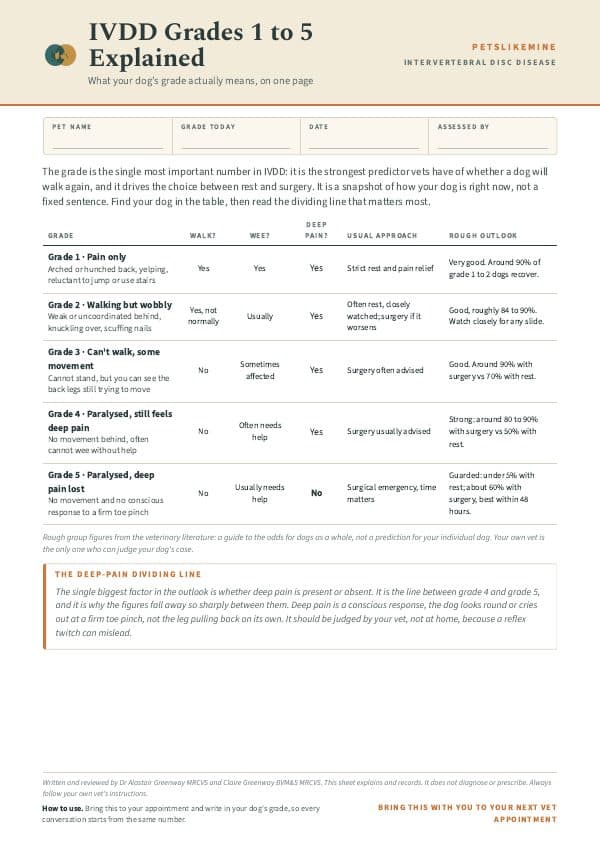
IVDD Grades 1 to 5 Explained
PDFWhat your dog's grade actually means, on one clear page. From a painful back with no weakness through to the loss of deep pain, each grade set out plainly alongside what it tends to mean for treatment and outlook. The grade, not a wobble or a bad day, is what drives every decision ahead, so it helps to know where your dog sits.
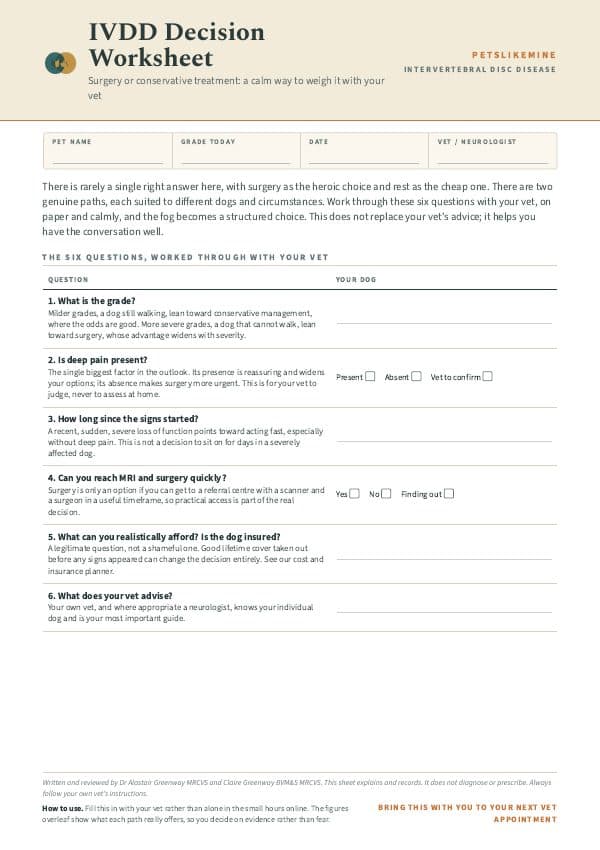
Surgery vs Conservative: Decision Worksheet
PDFA calm way to weigh the hardest choice in IVDD while the clock is ticking. Grade, deep pain, time since the signs began, cost and your own circumstances, laid out side by side so the decision is structured rather than panicked. Take it into the consult and fill it in together with your vet.
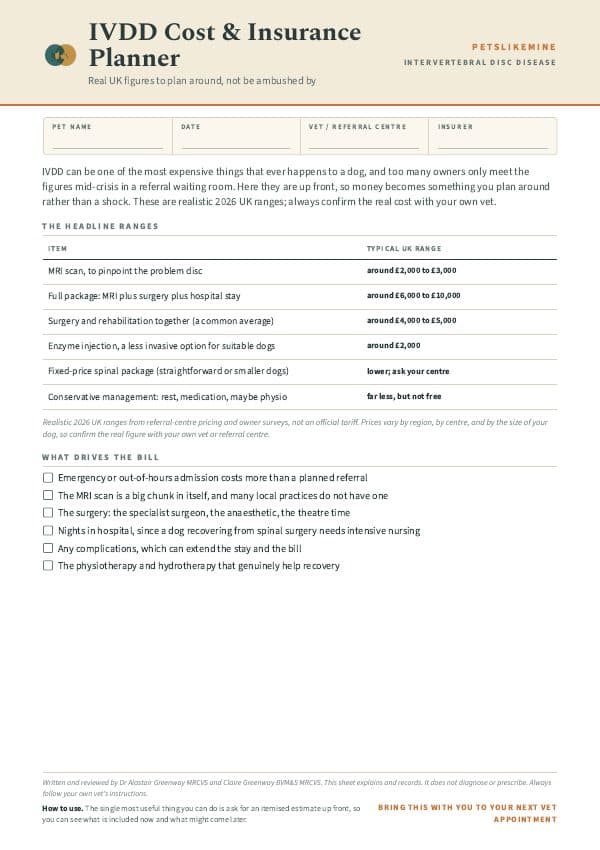
UK Cost & Insurance Planner
PDFTypical UK figures for the MRI, the surgery, the referral and the weeks of aftercare, with room to write in the quotes you are actually given. The insurance questions worth asking before you commit, and the practical ways to make it work. Money worries should never quietly make the medical decision for you.
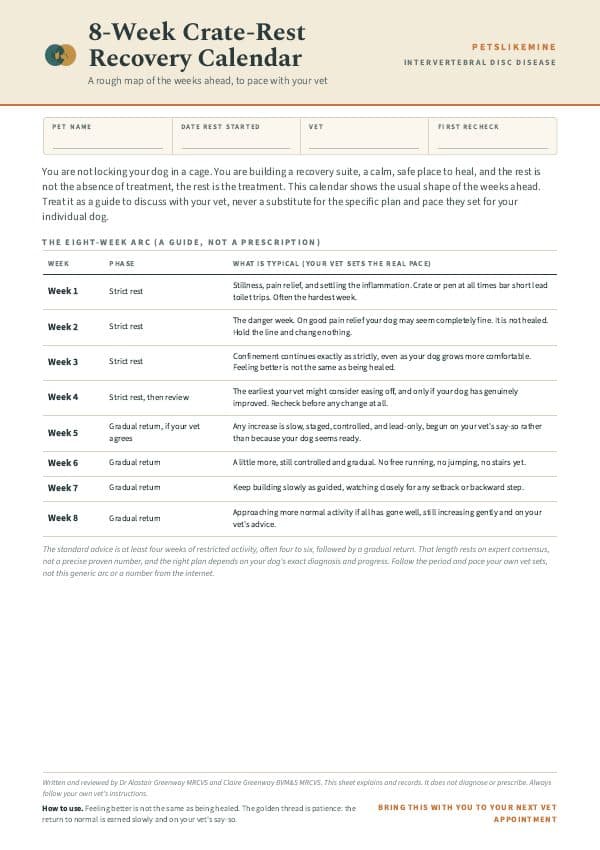
8-Week Crate-Rest Recovery Calendar
PDFThe eight weeks of crate rest mapped out so you always know what this week allows: the rest rules, the toilet trips, the first supported steps. A daily tick grid to keep you honest, and a column for the day's grade so progress is there in black and white. The single hardest part of conservative treatment, made survivable.
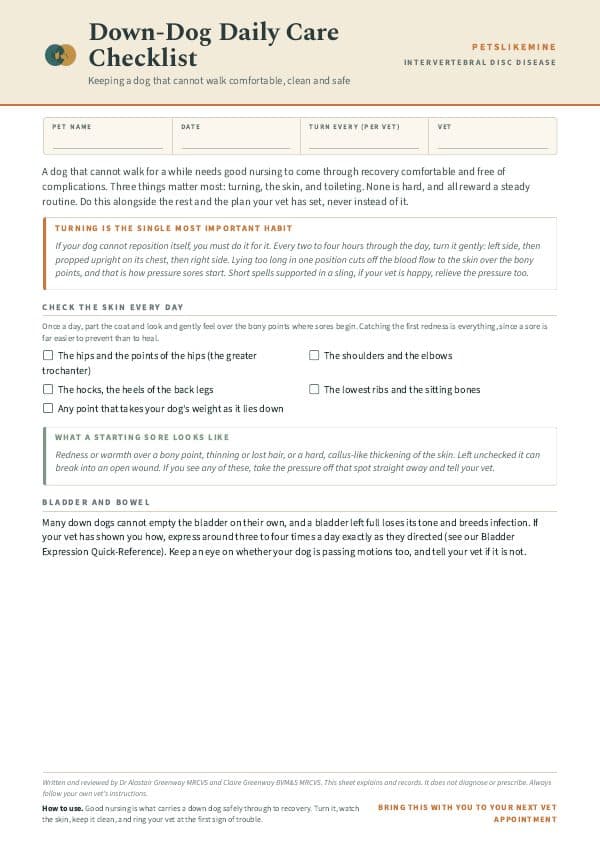
Down-Dog Daily Care Checklist
PDFCaring for a dog that cannot yet walk is a lot to hold in your head, so here it is on one page. Bladder emptying, turning, skin and bedding checks, meals and meds, each with its own tick box through the day. Nothing important slips when the days start to blur together.
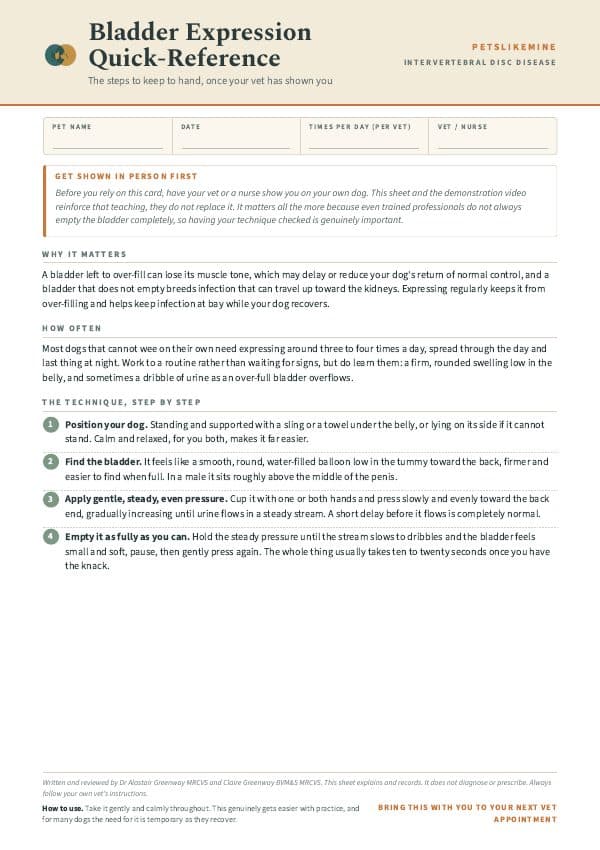
Bladder Expression Quick-Reference
PDFThe steps for emptying your dog's bladder, stripped back to a card you can prop up while your hands are busy. How to find the bladder, how much pressure, how often, and what should make you call the vet, with a QR code to the full how-to video. Frightening on day one, second nature by the end of the week.
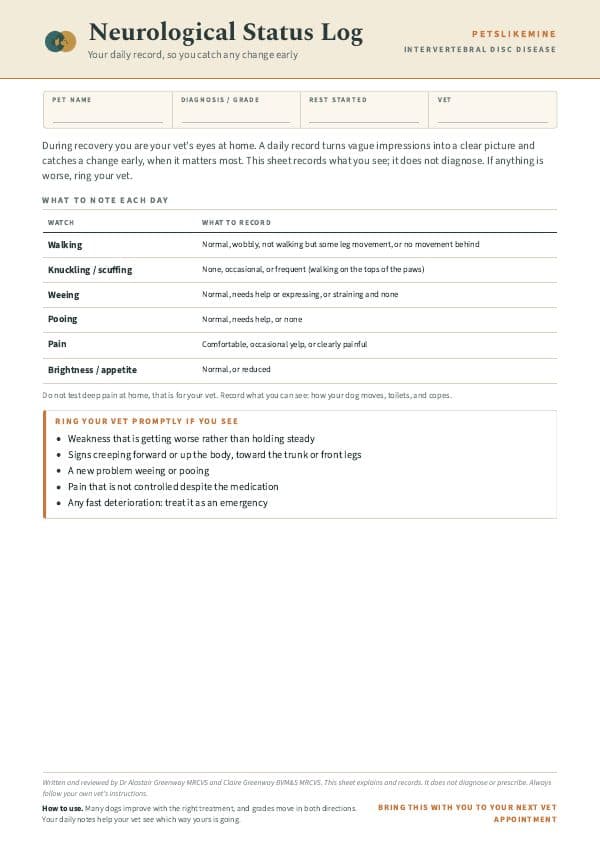
Neurological Status Log
PDFA simple daily record of the things your vet will want to know: deep pain, tail movement, leg position, toileting and how the back seems. The trend down the page is what tells you and your vet which way recovery is heading. Take it to every recheck so the conversation starts from facts, not memory.
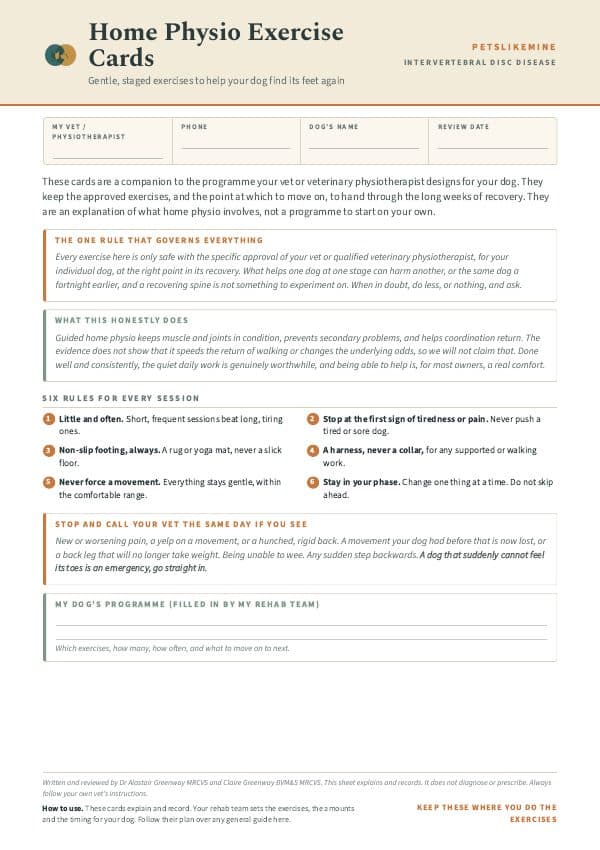
Home Physio Exercise Cards
PDFGentle, staged exercises to help your dog find their feet again, one card per movement with clear pictures and the point at which to progress. A companion to the home physio video, and strictly only ever started once your vet or physiotherapist has given the go-ahead. Done at the right time and the right way, this is how strength comes back.
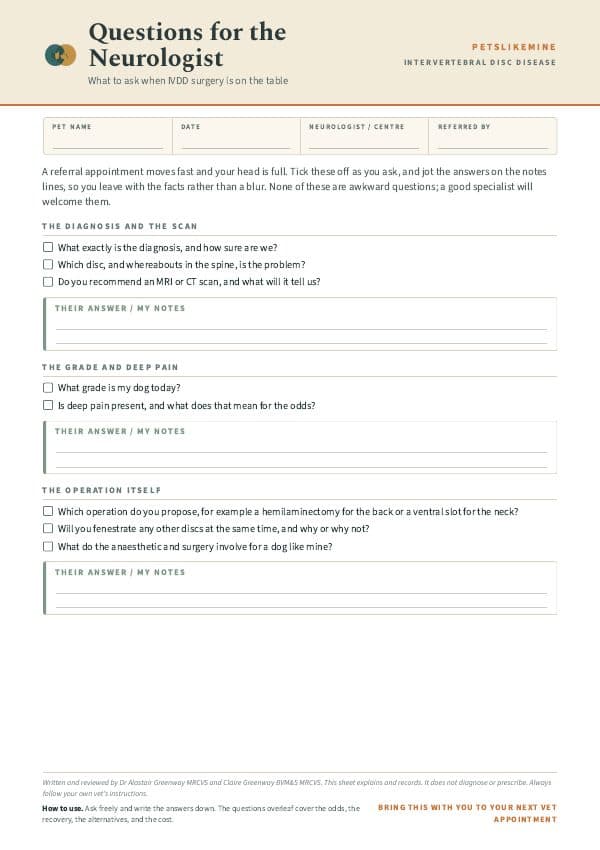
Neurologist Questions Checklist
PDFWalking into a referral appointment is easier with the right questions already written down. What the MRI showed, what each option really offers your dog, the honest odds, the aftercare and the cost, grouped so you leave understanding the plan. Tick the ones that matter to you and add your own.
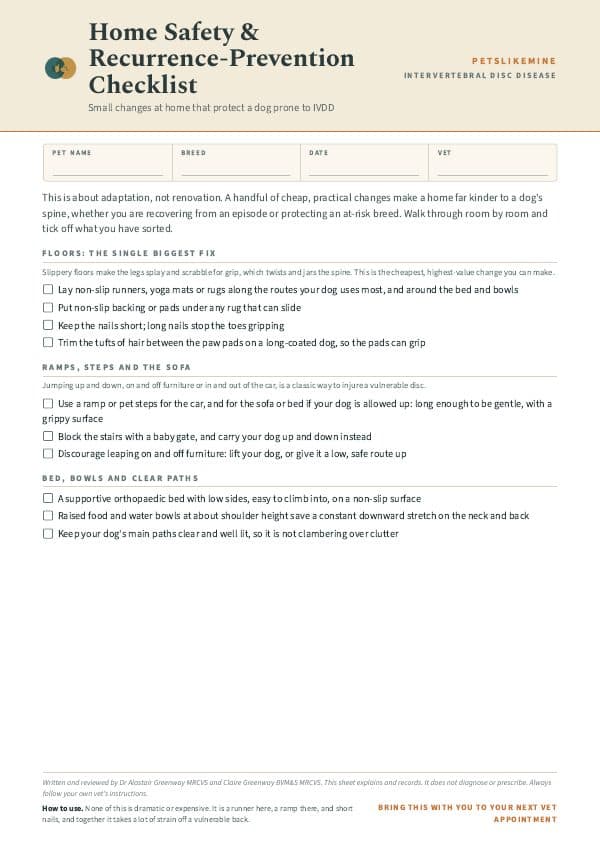
Home-Safety & Recurrence-Prevention Checklist
PDFOnce you are through an IVDD episode, the work turns to preventing the next one. A room-by-room sweep for the jumps, stairs and slippery floors that put a back at risk, the harness-not-collar habit, the weight and exercise points that genuinely matter, and the early signs never to ignore again. Calm, practical, and worth coming back to.
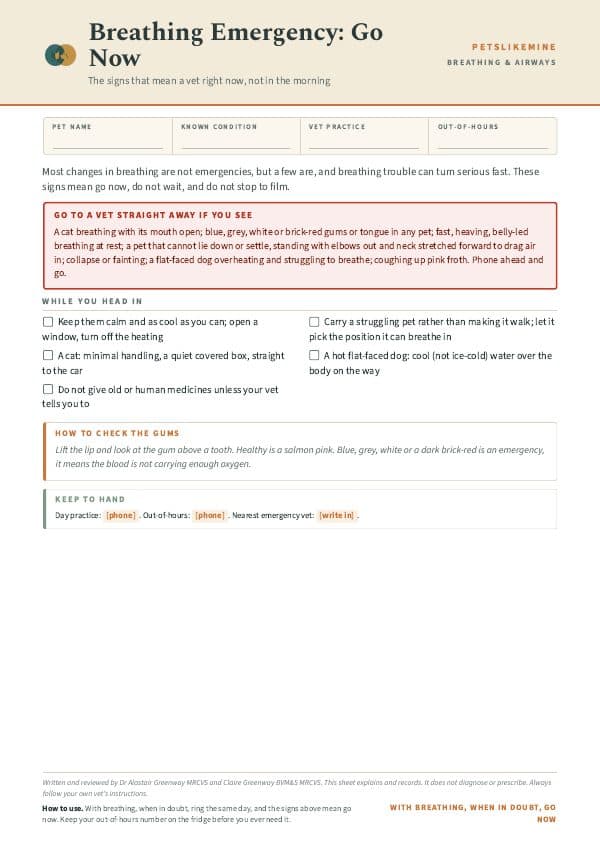
Breathing Emergency: Go Now
PDFThe breathing signs that mean a vet right now: an open-mouth cat, blue or grey gums, severe effort, a pet that cannot settle, collapse, plus what to do while you head in.
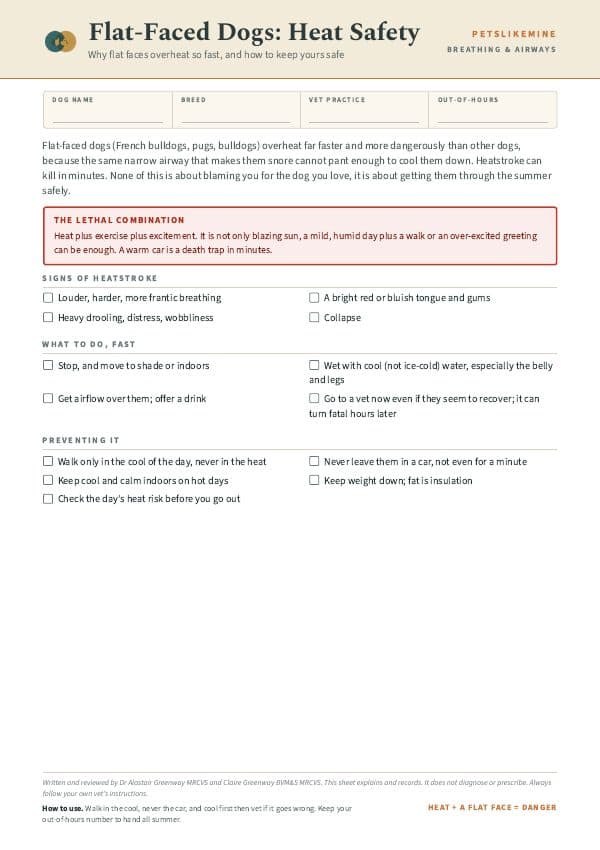
Flat-Faced Dogs: Heat Safety
PDFWhy flat-faced dogs overheat so fast, the signs of heatstroke, how to cool them safely, and how to prevent it through the summer.
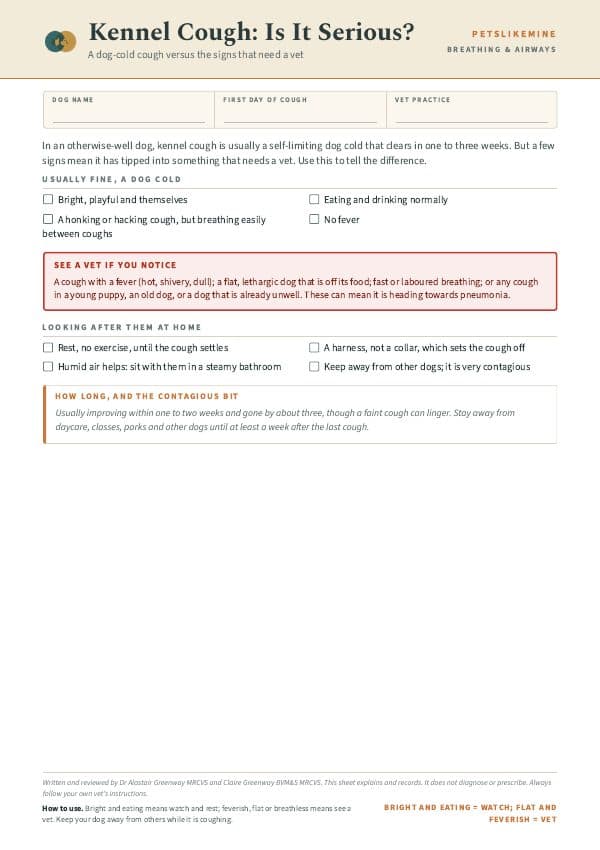
Kennel Cough: Is It Serious?
PDFHow to tell a self-limiting dog-cold cough from the feverish, flat or breathless dog that needs a vet, plus home care and the contagious period.
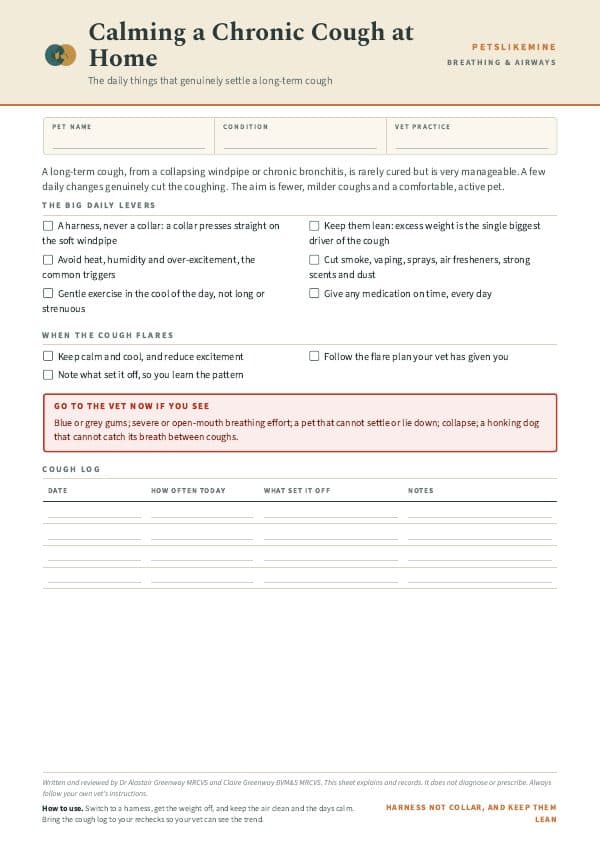
Calming a Chronic Cough at Home
PDFThe daily levers that settle a long-term cough (a harness not a collar, weight, clean air, calm), the flare red flags, and a write-on cough log.
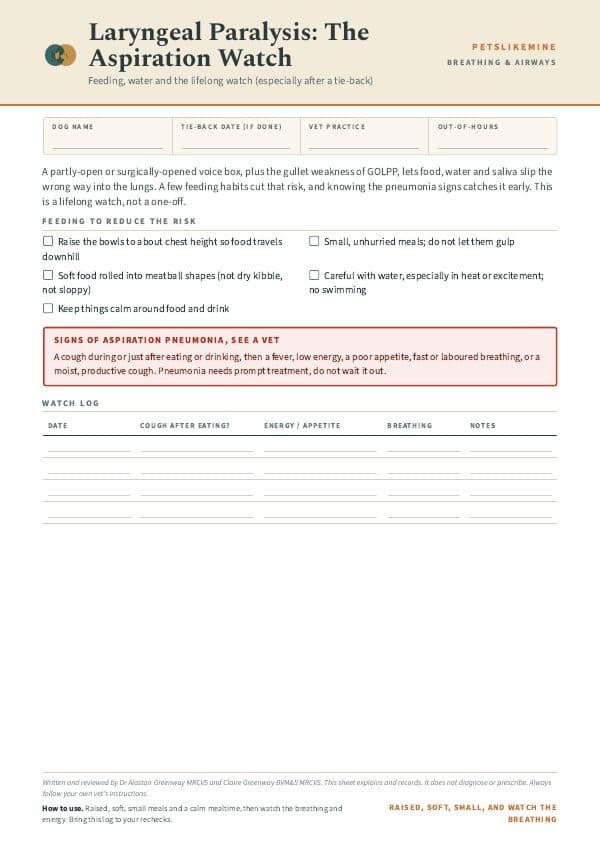
Laryngeal Paralysis: The Aspiration Watch
PDFFeeding, water and the lifelong watch that lowers the aspiration-pneumonia risk in laryngeal paralysis and after a tie-back, with a watch log.
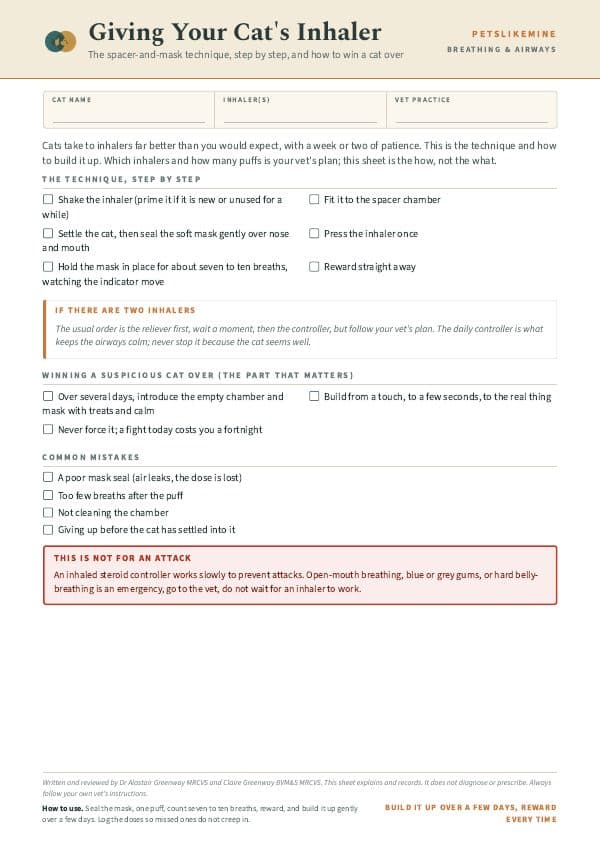
Giving Your Cat's Inhaler
PDFThe spacer-and-mask (AeroKat) inhaler technique step by step, how to win a suspicious cat over, and the common mistakes to avoid.
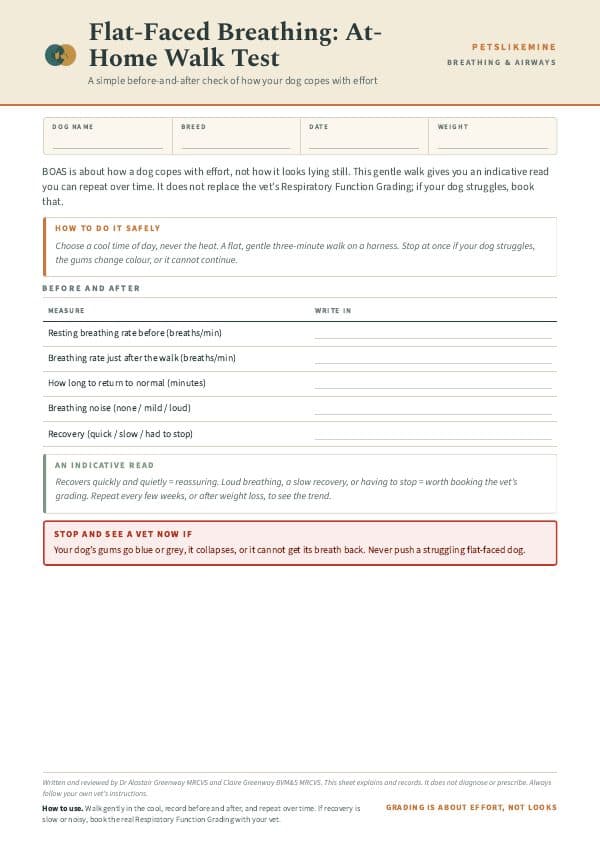
Flat-Faced Breathing: At-Home Walk Test
PDFA gentle before-and-after walk test to check how a flat-faced dog copes with effort, with an indicative read and a safety stop rule. Does not replace the vet's grading.
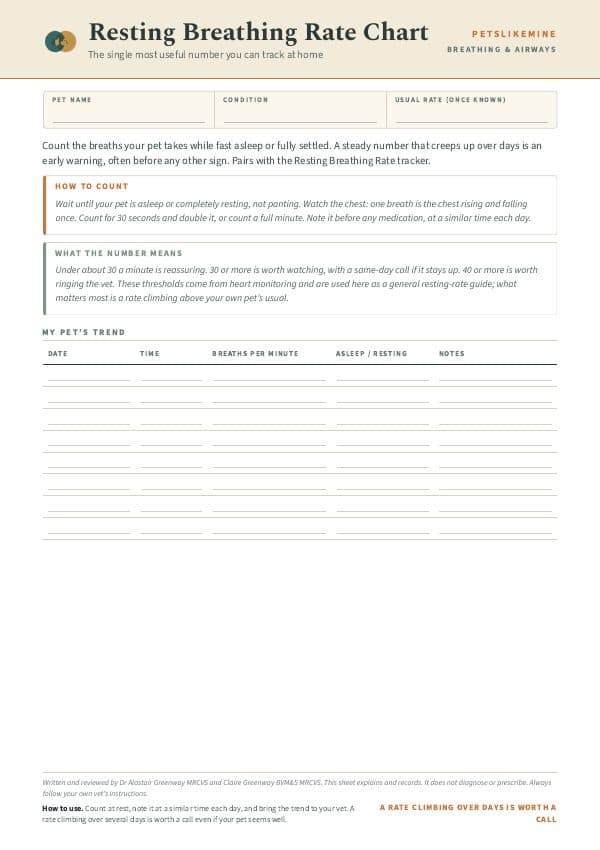
Resting Breathing Rate Chart
PDFHow to count your pet's sleeping breaths a minute, what the number means, and a write-on trend chart. The single most useful number to track at home.
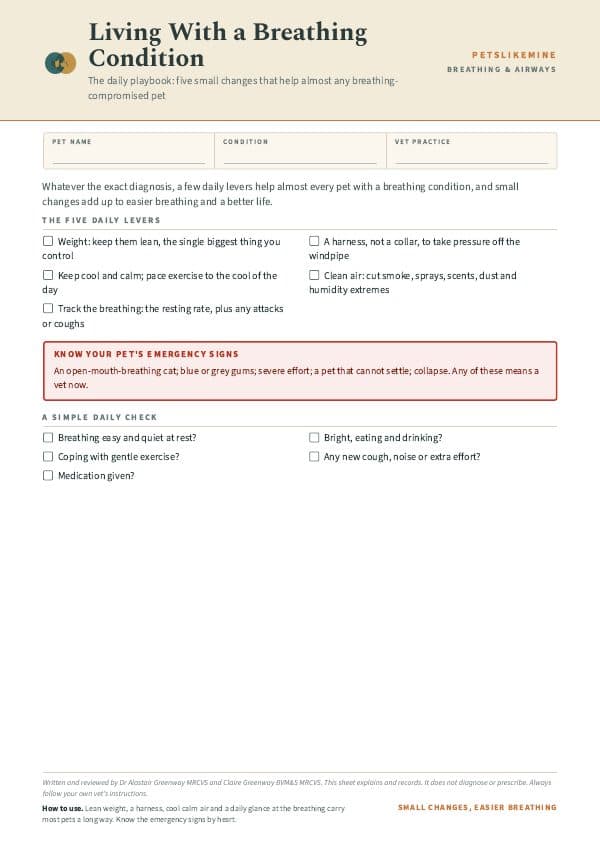
Living With a Breathing Condition: The Daily Playbook
PDFThe five daily levers that help almost any breathing-compromised pet, the emergency signs to know by heart, and a simple daily check.
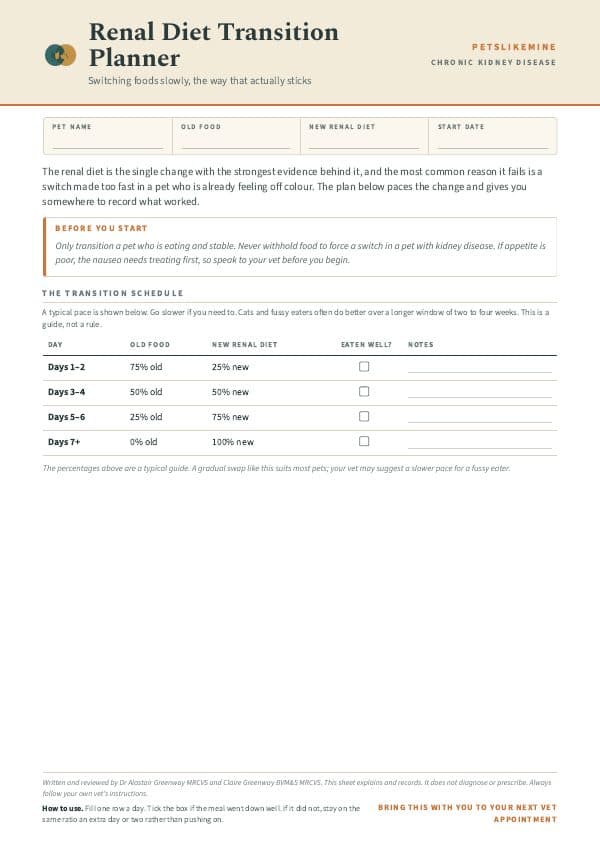
Renal Diet Transition Planner
PDFA day-by-day plan for moving your pet onto a renal diet at a pace that actually sticks. The transition ladder, tricks for winning round a fussy eater, and somewhere to record what worked. The renal diet is the change with the strongest evidence behind it, so it is worth getting right.
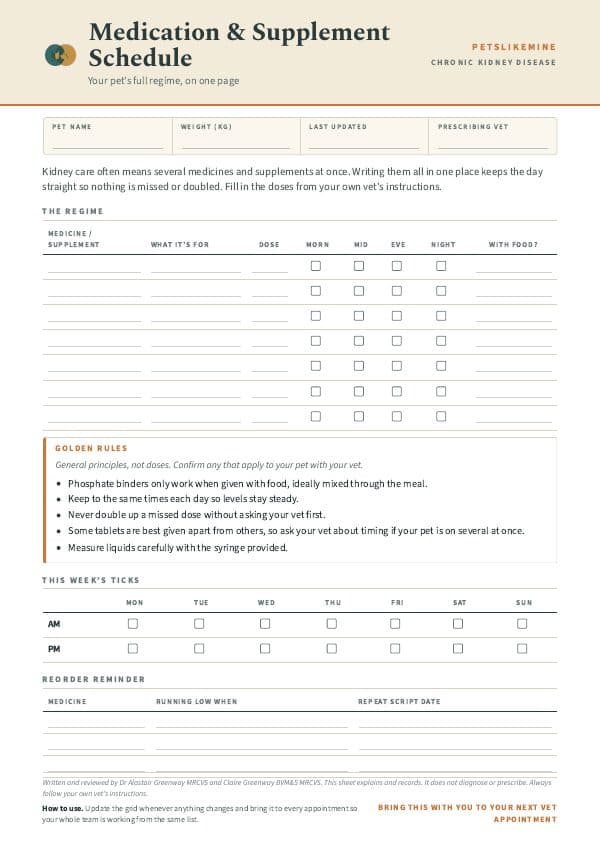
Medication & Supplement Schedule
PDFYour pet's whole kidney regime on one page: every medicine and supplement, what each is for, the dose you fill in from your vet, and a tick grid for the week. Keeps the day straight so nothing is missed or doubled.
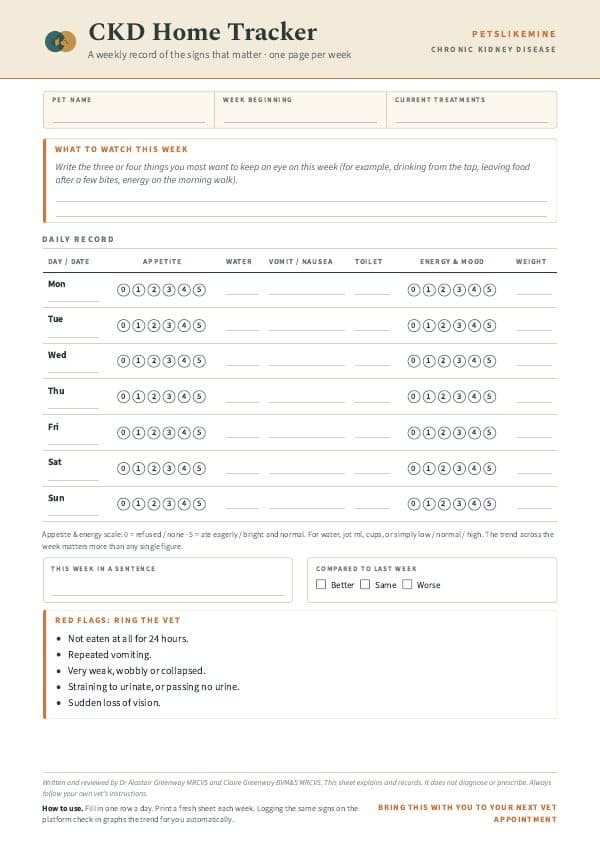
CKD Home Tracker
PDFA weekly record of the signs that matter in kidney disease: appetite, drinking, nausea, energy and weight, one page per week. The trend across the weeks tells you far more than any single day, and the red-flag list shows when to ring the vet.
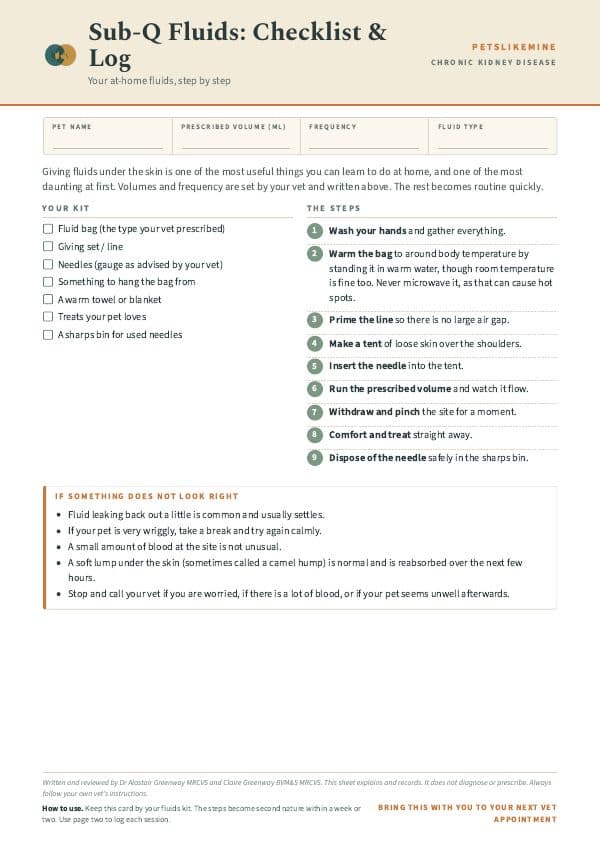
Sub-Q Fluids: Checklist & Log
PDFEverything you need to give fluids under the skin at home with confidence: a kit list, the steps in order, what is normal and what is not, and a running log to bring to rechecks. Daunting at first, routine within a fortnight.
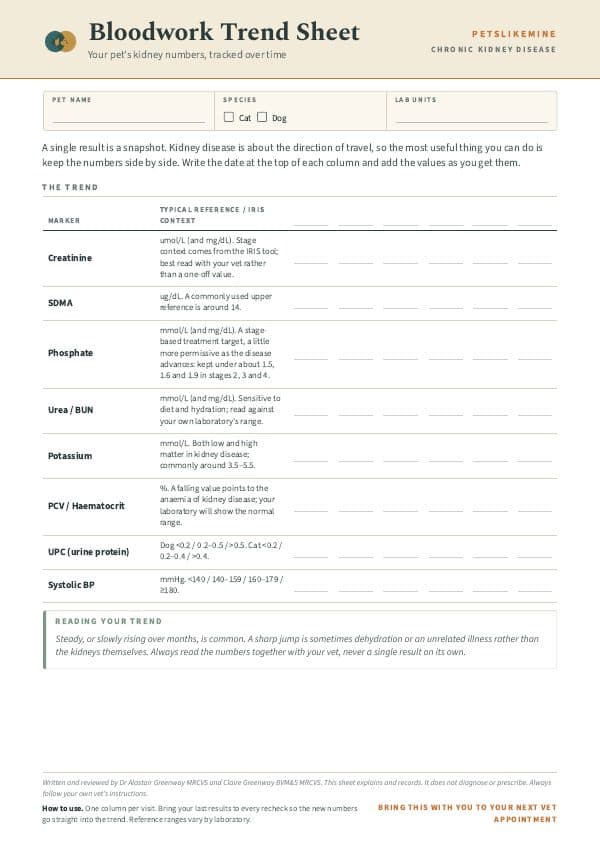
Bloodwork Trend Sheet
PDFYour pet's kidney numbers side by side over time, with plain-English context for each marker: creatinine, SDMA, phosphate, potassium, urine protein and blood pressure. Kidney disease is about the direction of travel, not a single snapshot.
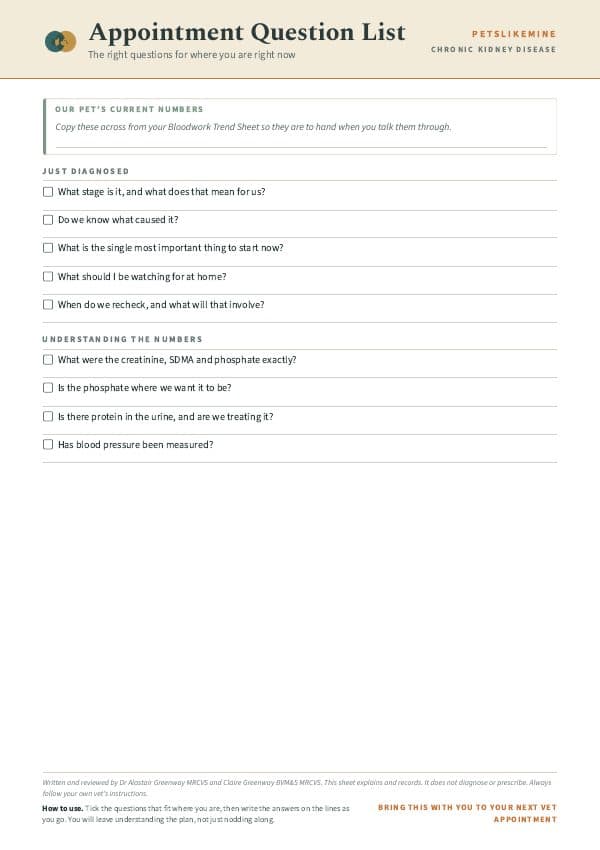
Appointment Question List
PDFThe right questions for where you are right now, from newly diagnosed to reviewing treatment and the longer view. Tick what fits, write the answers on the lines, and leave the consult understanding the plan rather than just nodding along.
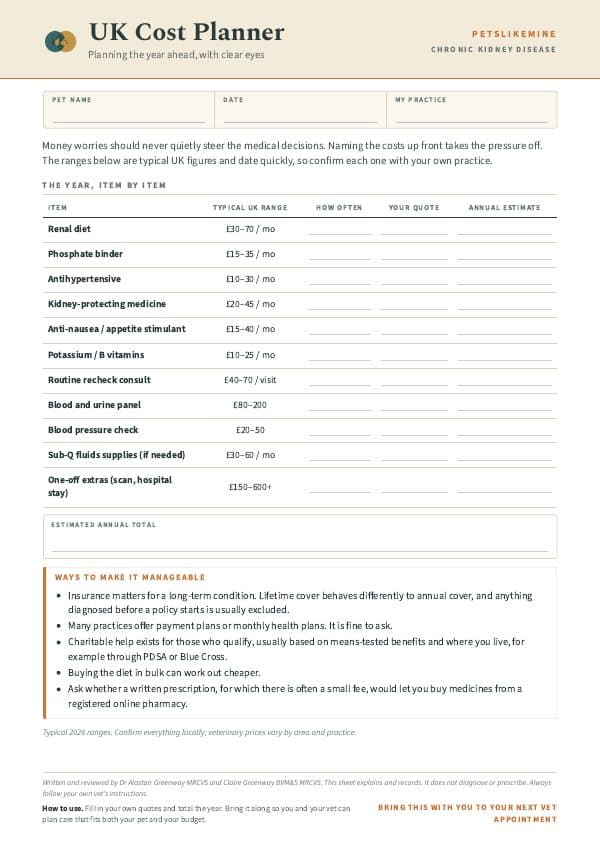
UK Cost Planner
PDFPlan the year ahead with clear eyes. Typical UK cost ranges for diet, medicines, monitoring and fluids, room for your own quotes, and the practical ways to make it manageable, from insurance to written prescriptions. Money worries should never quietly steer the medical decisions.
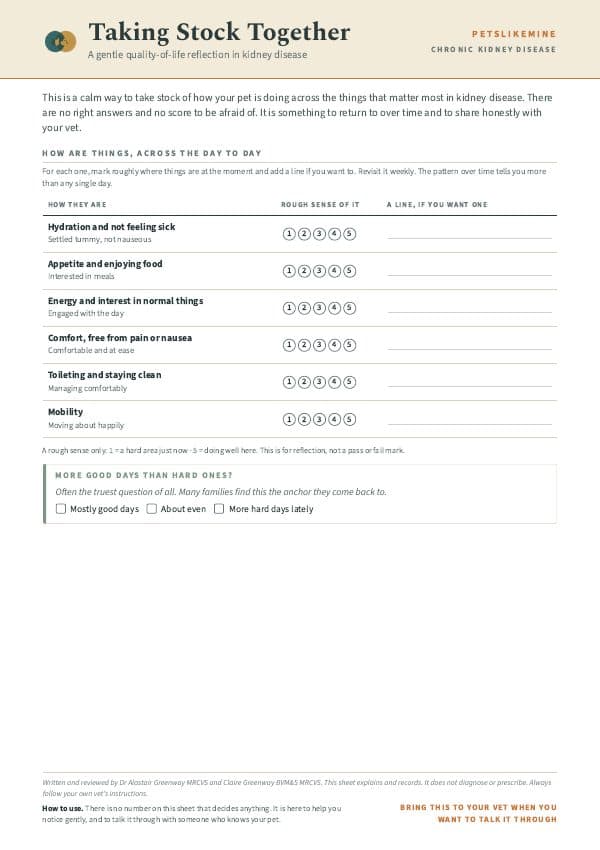
Quality-of-Life Assessment
PDFA gentle way to take stock of how your pet is really doing, across the things that matter most in kidney disease. There is no score to be afraid of here. Something to return to over time, and to share honestly with the people who know your pet.
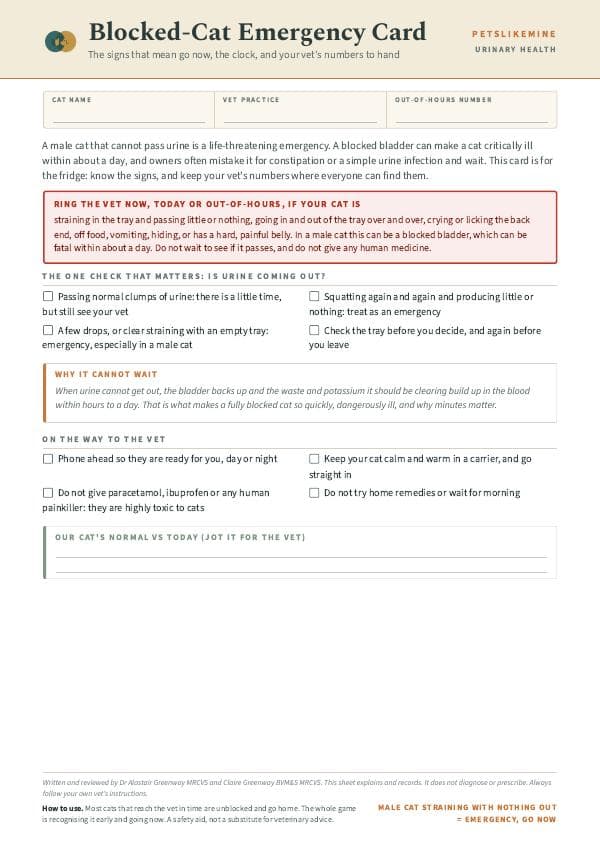
Blocked-Cat Emergency Card
PDFThe fridge card for the life-threatening emergency owners miss: the signs that mean go now, the make-or-break "is urine coming out?" check, why it cannot wait, and space for your vet and out-of-hours numbers.
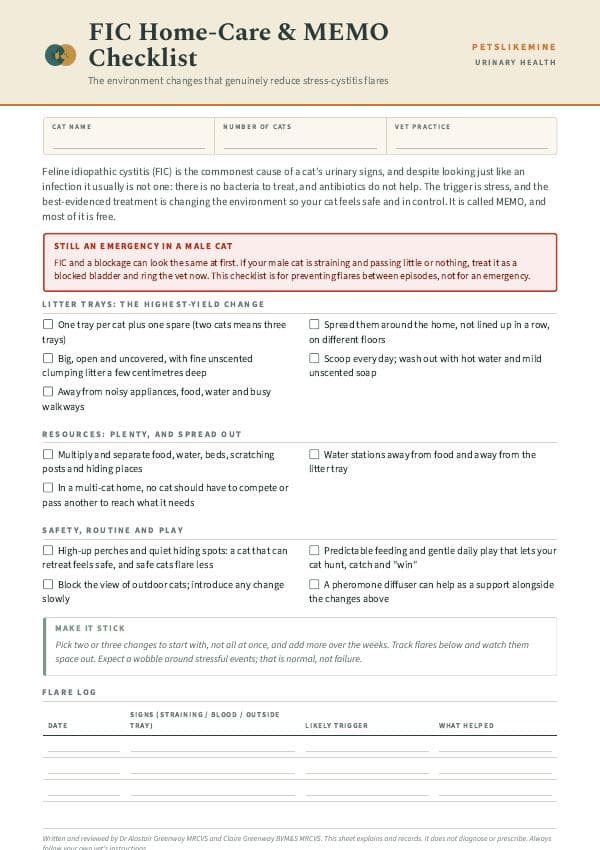
FIC Home-Care & MEMO Checklist
PDFThe environment changes that genuinely reduce stress-cystitis flares: the litter-tray rules, separated resources, hiding and high places, routine and play, plus a flare log. FIC is stress, not infection.
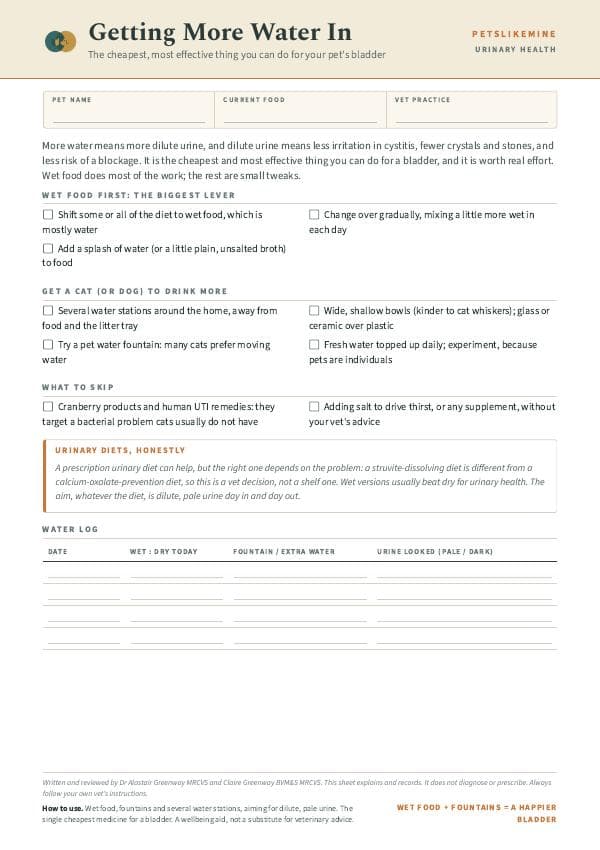
Getting More Water In
PDFThe cheapest, most effective thing you can do for a bladder: wet food first, fountains and water stations, what to skip, the honest take on urinary diets, and a simple water log.
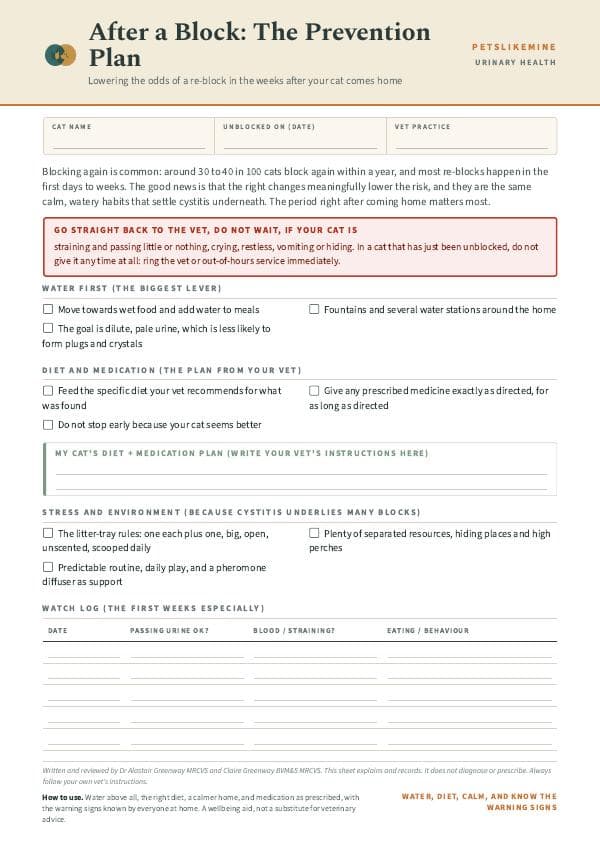
After a Block: Prevention Plan
PDFLowering the odds of a re-block in the high-risk weeks after a cat comes home: water, the right diet, stress and MEMO, medication as prescribed, the warning signs that mean go straight back, and a watch log.
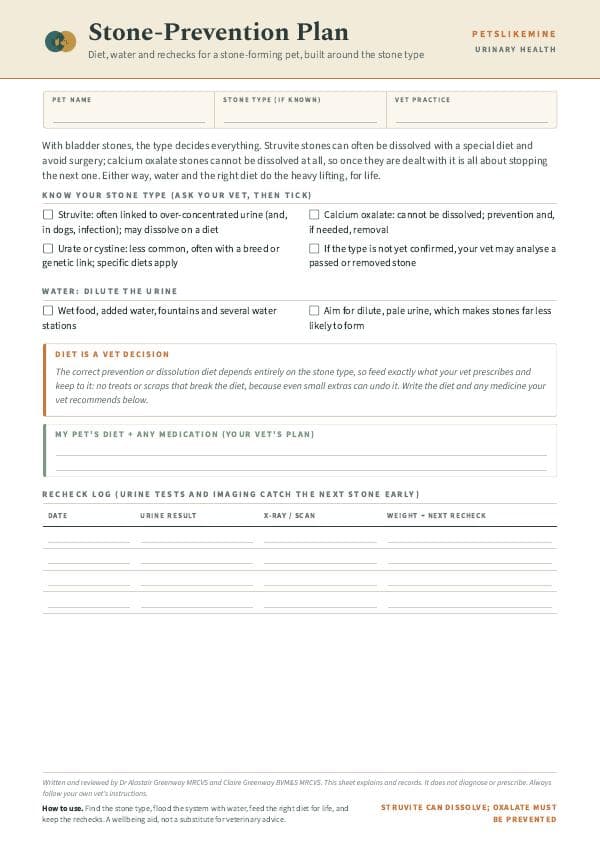
Stone-Prevention Plan
PDFDiet, water and rechecks for a stone-forming pet, built around the stone type: struvite can often be dissolved, calcium oxalate must be prevented. Includes a recheck log for urine tests and imaging.
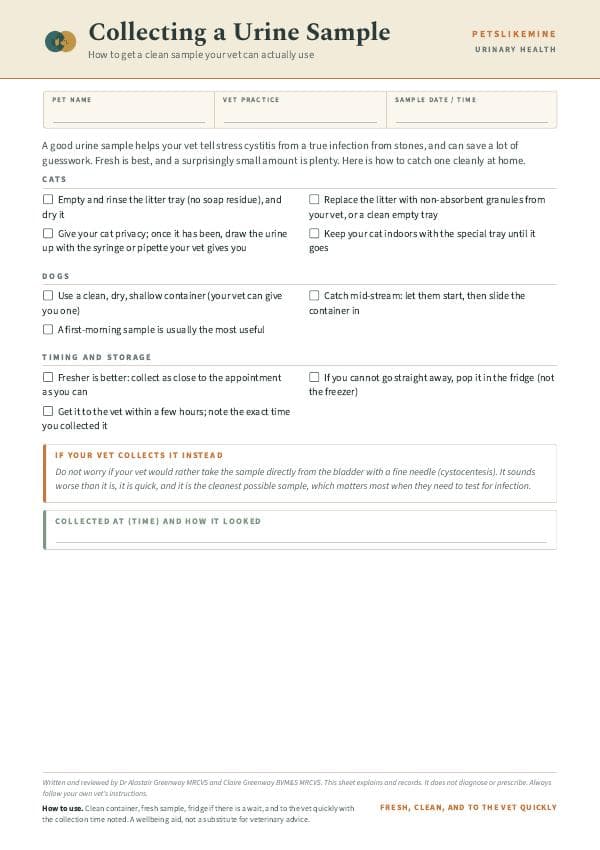
Collecting a Urine Sample
PDFHow to catch a clean sample your vet can actually use: the cat method (non-absorbent litter) and the dog method (mid-stream), timing and storage, and what cystocentesis is if your vet collects it instead.
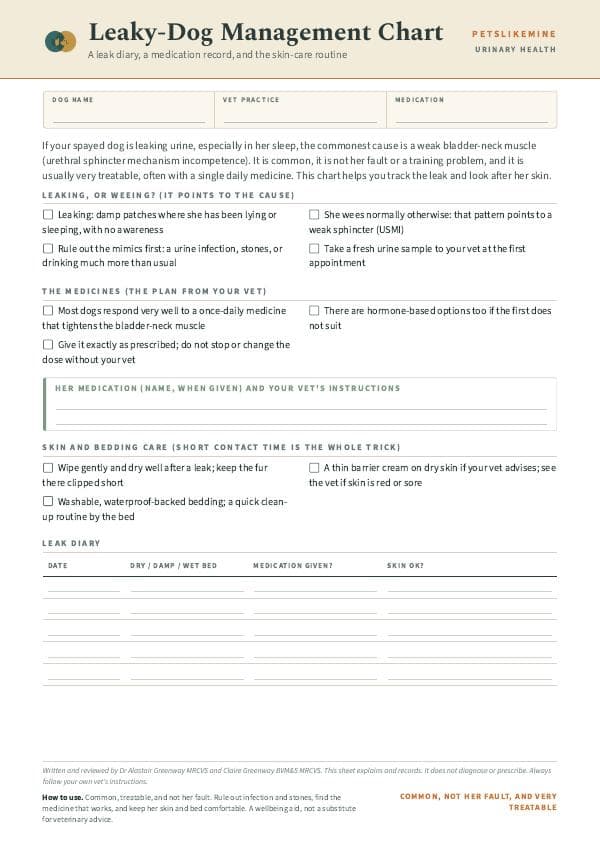
Leaky-Dog Management Chart
PDFFor the spayed-bitch leak (USMI): telling leaking from weeing, the once-daily medicines that work, the skin and bedding routine, and a leak diary. Common, not her fault, and very treatable.
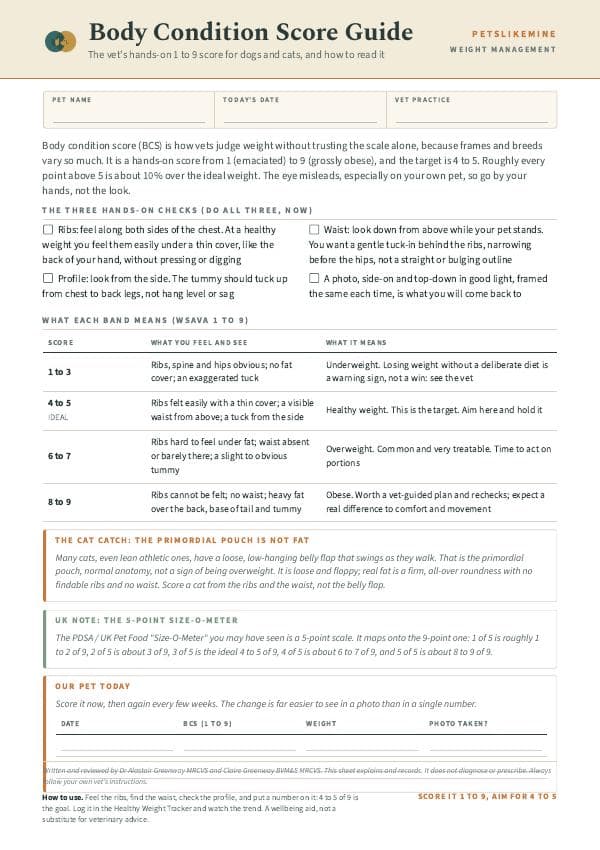
Body Condition Score Guide
PDFThe vet's hands-on WSAVA 1-to-9 body condition score for dogs and cats: feel the ribs, find the waist, check the profile, what each band means, and a write-on score for your pet.
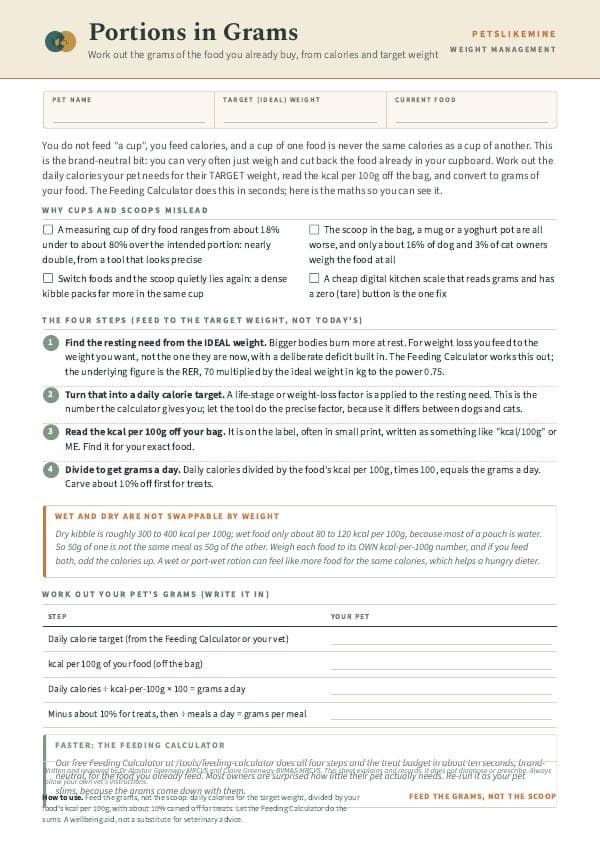
Portions in Grams
PDFWork out the grams of the food you already buy from its kcal/100g and your pet's target weight, why cups and scoops mislead, and a write-on calculation. Pairs with the Feeding Calculator.
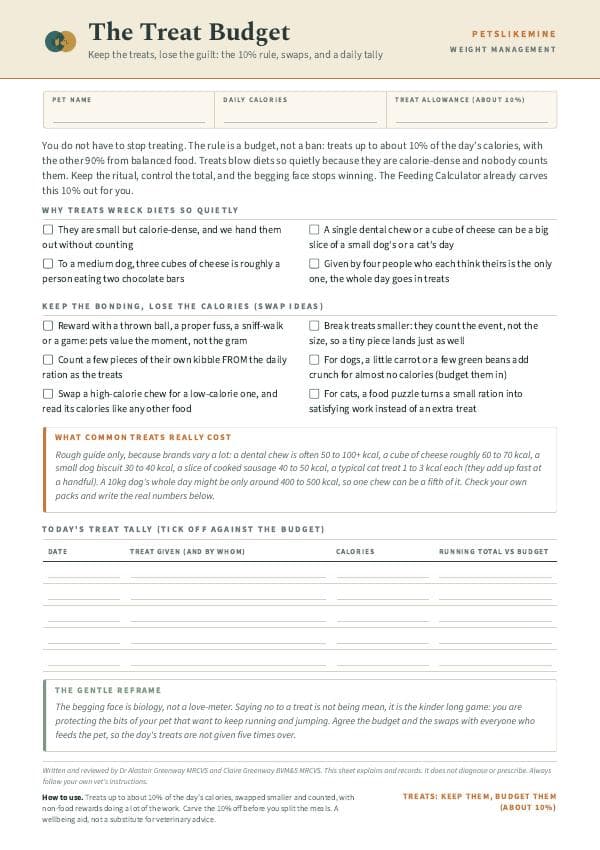
The Treat Budget
PDFKeep the treats without blowing the diet: the 10%-of-calories rule, treat-swap ideas, what common treats really cost in calories, and a daily treat tally.
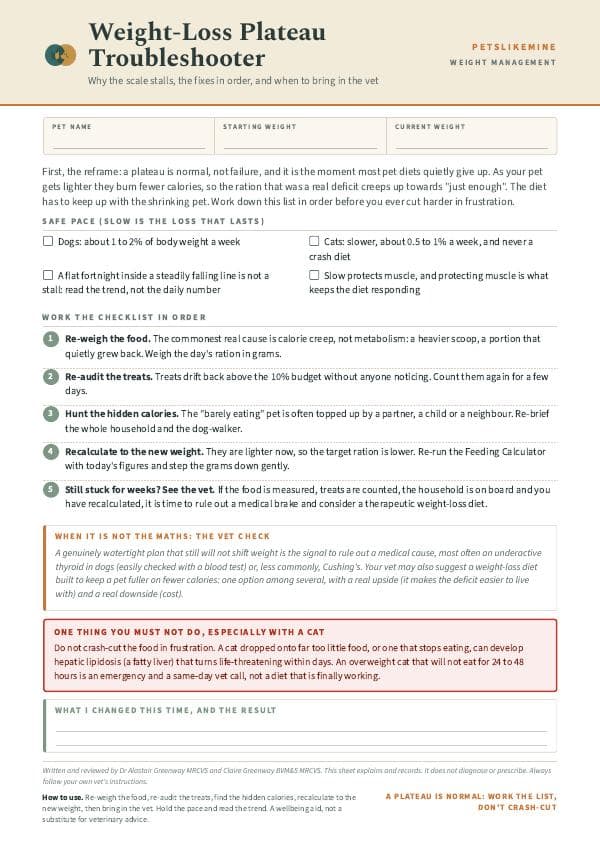
Weight-Loss Plateau Troubleshooter
PDFWhy weight loss stalls and the fixes in order: re-weigh the food, hidden calories, recalculate at the new weight, rule out hypothyroid/Cushing's, safe loss rate, and when to see the vet.
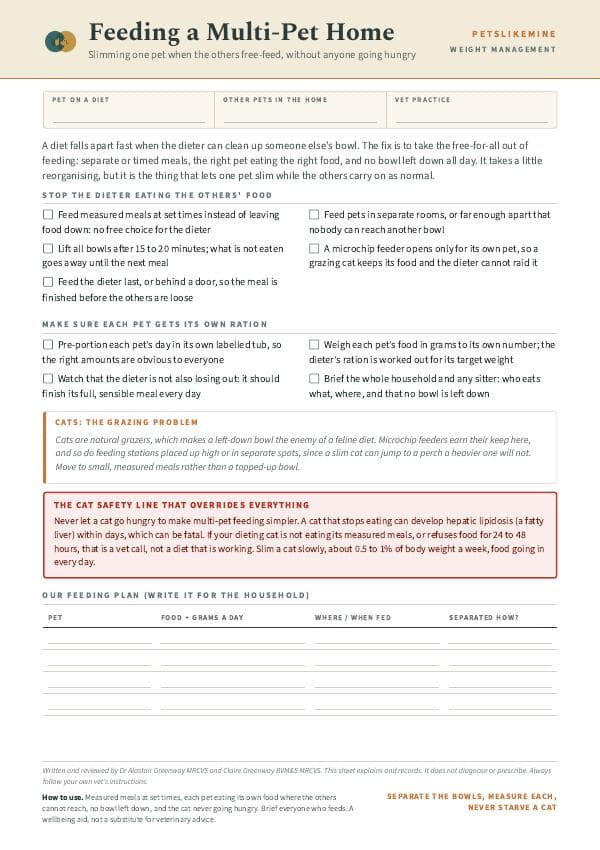
Feeding a Multi-Pet Home
PDFSlimming one pet when the others free-feed: separate and timed meals, microchip feeders, no bowl left down, cat-specific grazing notes, and the cat safety line.
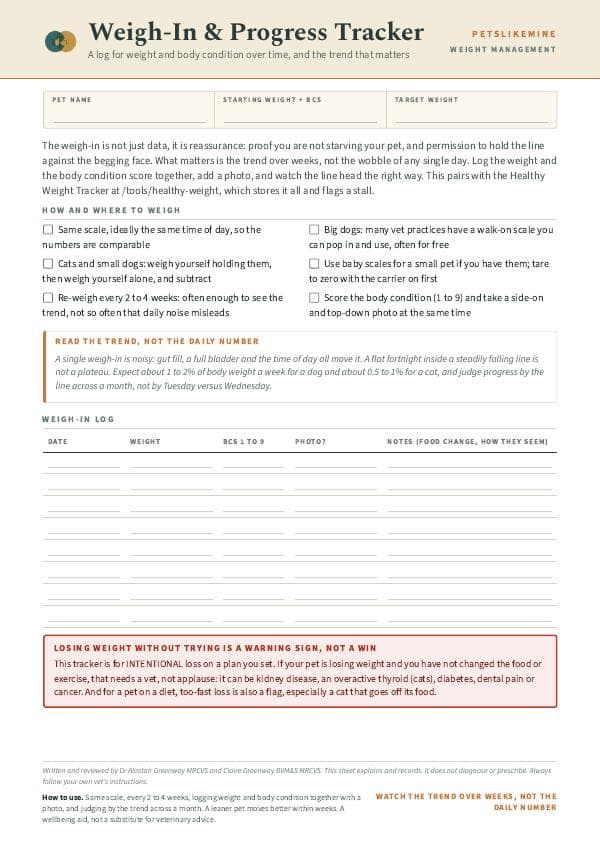
Weigh-In & Progress Tracker
PDFA log for weight and body condition score over time, how and where to weigh, a target line, and reading the trend that matters. Pairs with the Healthy Weight Tracker.
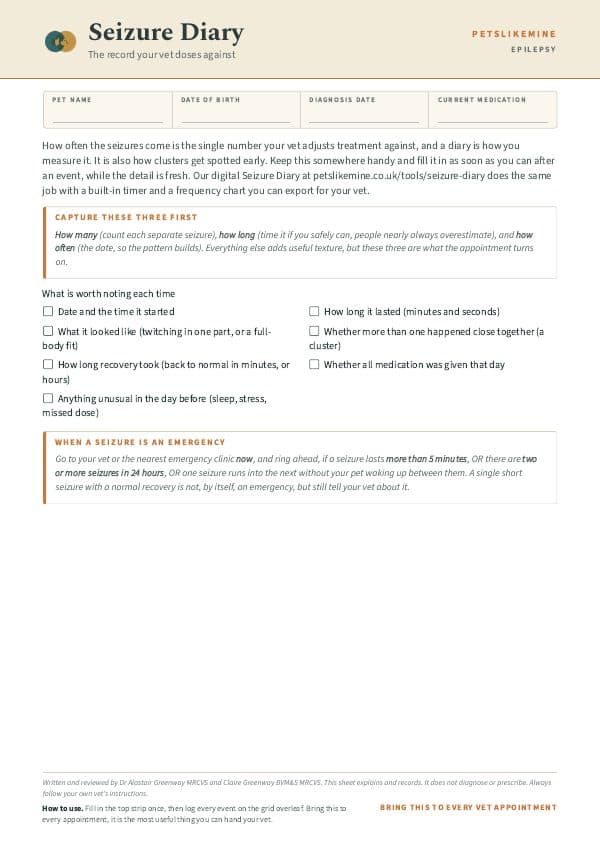
Seizure Diary
PDFThe record your vet doses against. Log every seizure: when it happened, how long it lasted, whether it came in a cluster, and how recovery went. Frequency is the number treatment is adjusted against, so a good diary is the single most useful thing you can bring to an appointment.
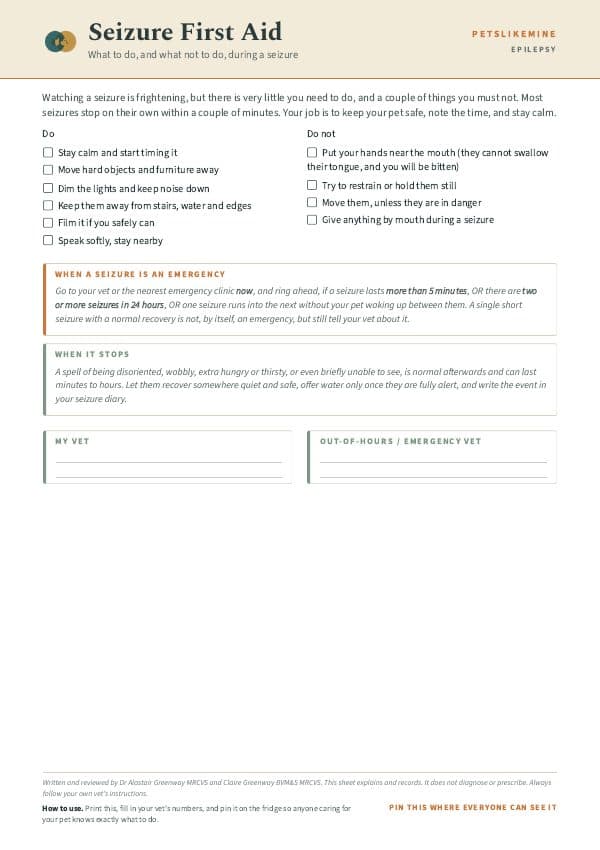
Seizure First-Aid Card
PDFWhat to do, and what not to do, during a seizure, on one fridge-ready card. The calm steps that keep your pet safe, the things to avoid (hands away from the mouth), and the clear line for when a seizure becomes an emergency.
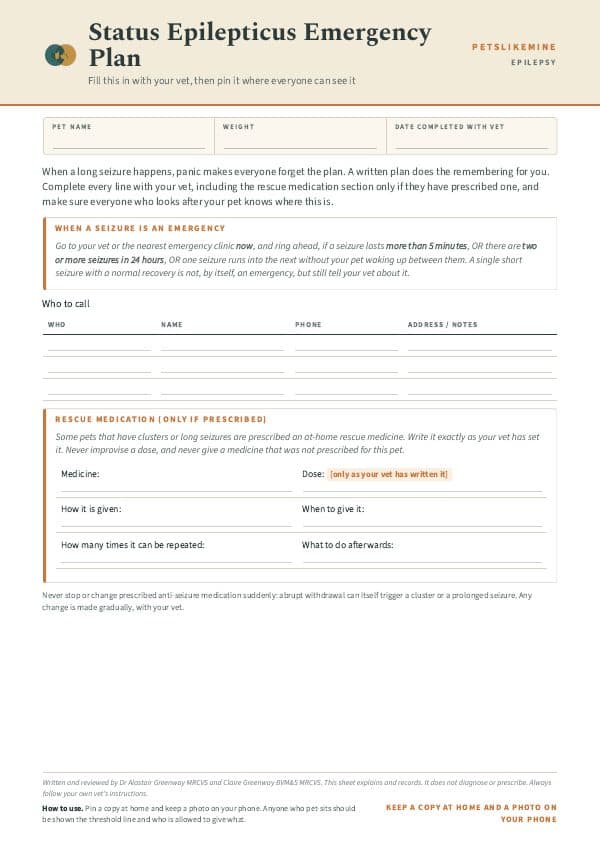
Status Epilepticus Emergency Plan
PDFA one-page plan to complete with your vet and pin up at home. The emergency thresholds, who to call, and a place to record any prescribed rescue medication exactly as your vet has set it, so panic never erases the plan when a long seizure happens.
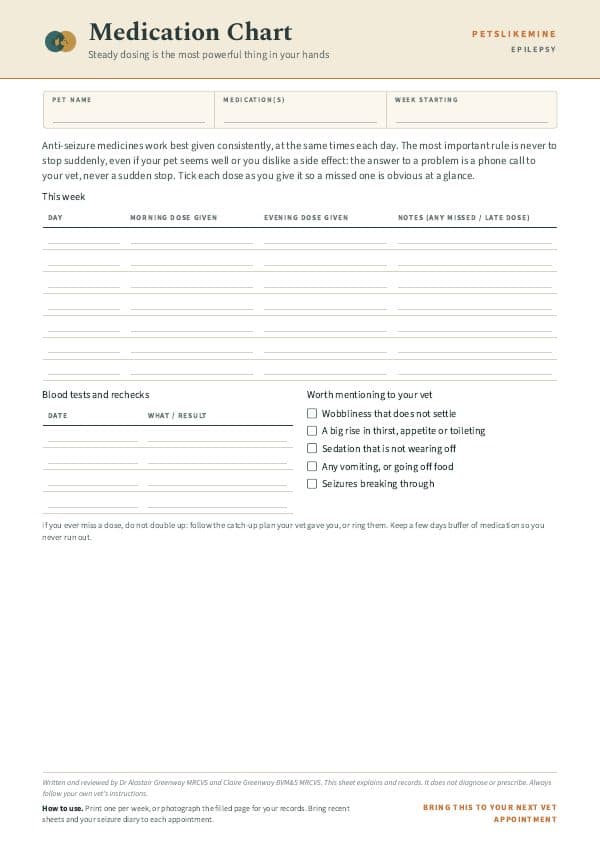
Medication Chart
PDFA weekly tick-sheet for anti-seizure medication, with space for blood-test dates and the side effects worth mentioning. Consistent dosing is the most powerful thing in your hands, never stop suddenly, and a missed dose shows at a glance.
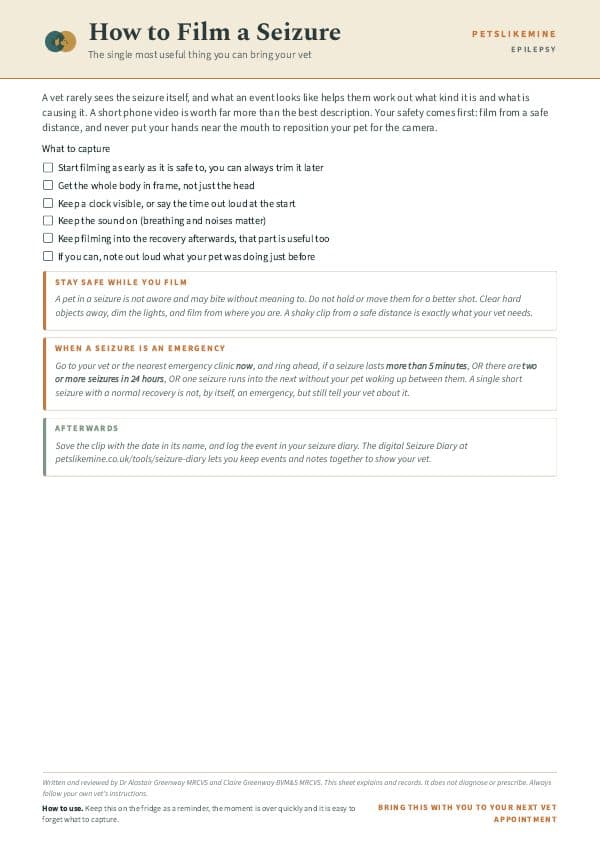
How to Film a Seizure
PDFA short video tells your vet more than any description. What to capture, how to stay safe while you film (never put your hands near the mouth), and why the recovery afterwards matters too.
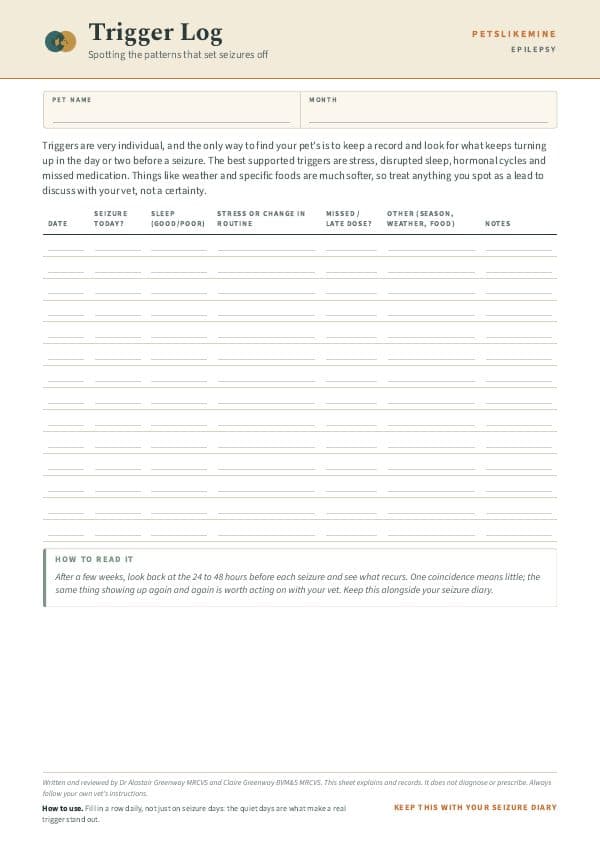
Trigger Log
PDFA daily log to spot the patterns that set seizures off. Track sleep, stress, missed doses and more alongside seizure days, then look for what keeps turning up in the day or two before. The best-supported triggers are stress, disrupted sleep, hormonal cycles and missed medication.
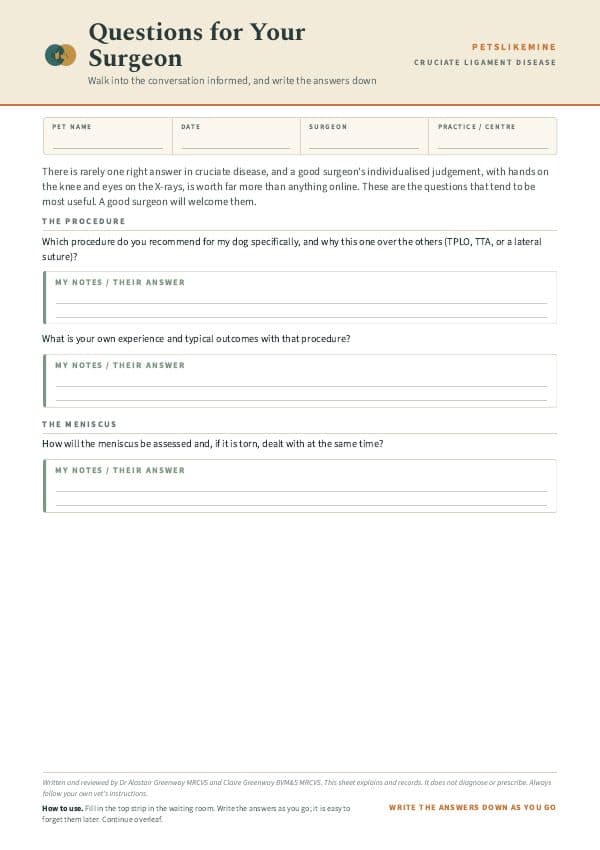
Questions for Your Surgeon
PDFWalk into the consult informed. The questions worth asking about the procedure, the meniscus, recovery, risks, cost and the other knee, each with room to write the answers down before you forget them. A good surgeon will welcome them.
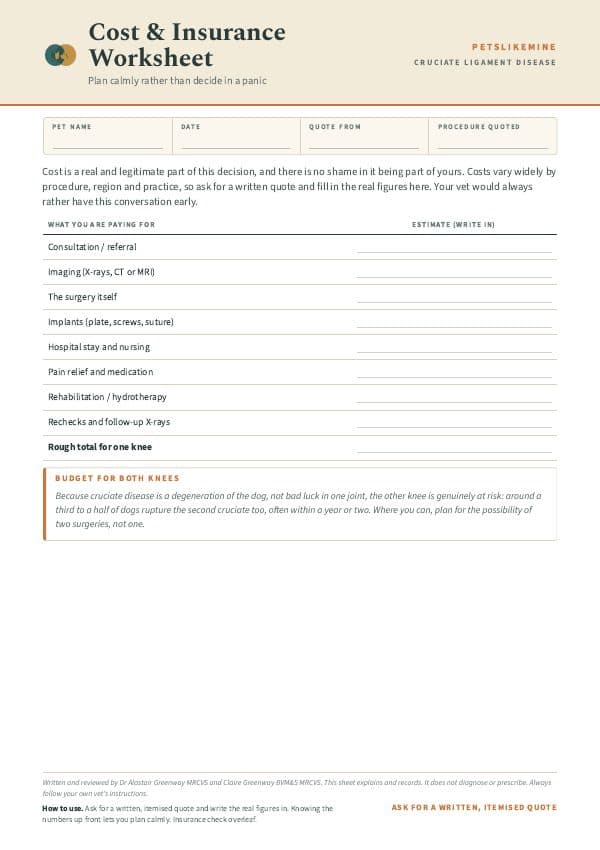
Cost & Insurance Worksheet
PDFPlan calmly instead of deciding in a panic. An itemised cost worksheet to fill in against a real quote, the reminder to budget for both knees, and the insurance questions worth asking before the operation, not after.
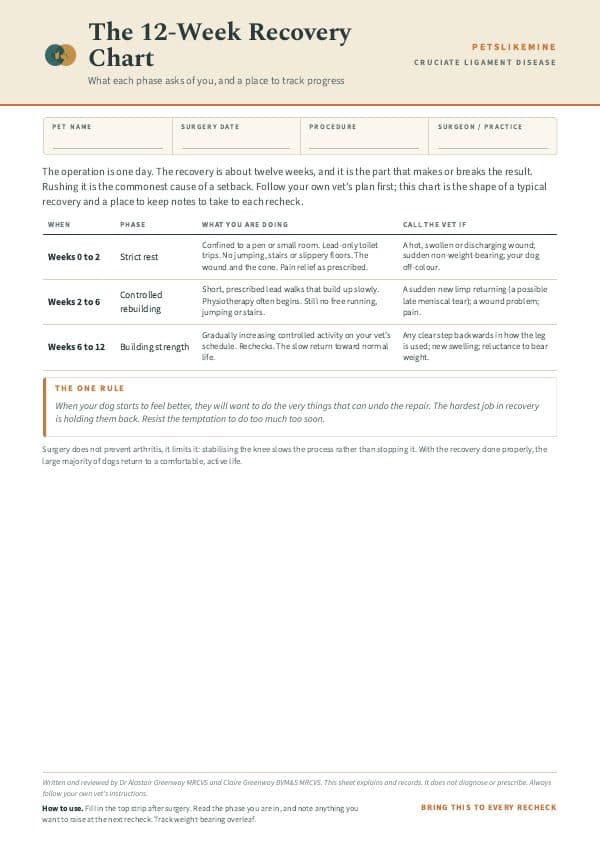
The 12-Week Recovery Chart
PDFThe whole recovery on two pages: what each phase asks of you across the twelve weeks, the red flags for each stage, and a weekly weight-bearing and lameness log to take to every recheck. The part owners most underestimate, made navigable.
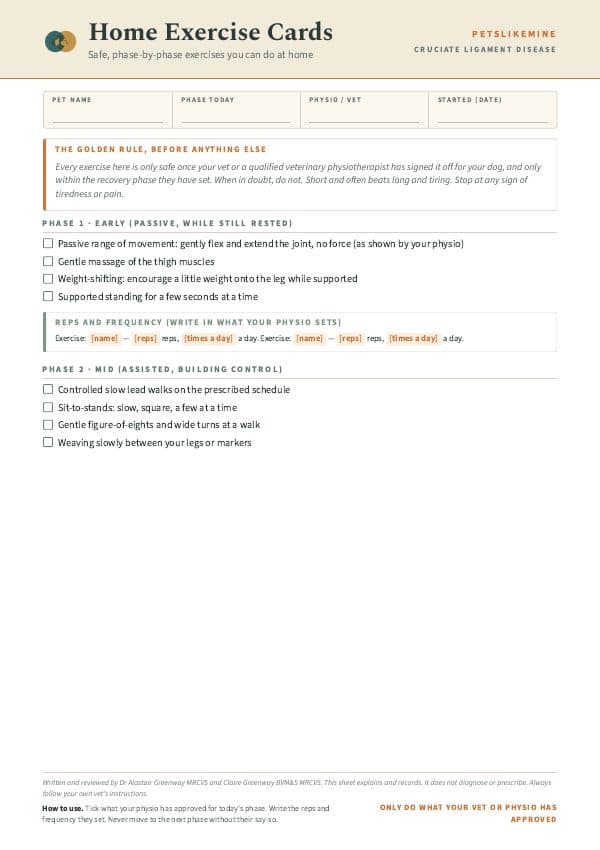
Home Exercise Cards by Phase
PDFSafe, phase-by-phase home physiotherapy you can actually do, with the golden rule front and centre: only what your vet or physiotherapist has approved, and stop at tiredness or pain. Early, mid and late-phase exercises with space to write in the reps they set.
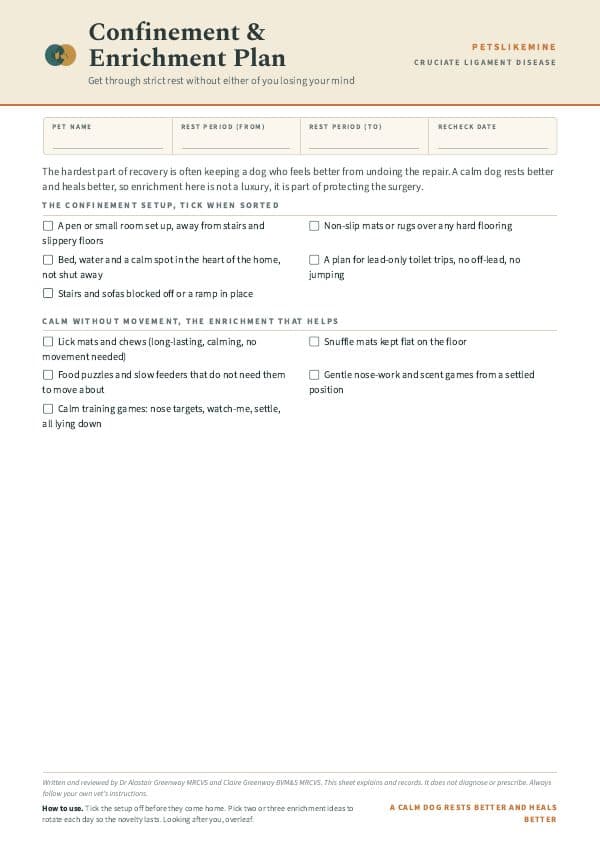
Confinement & Enrichment Plan
PDFGet through strict rest without either of you losing your mind. A confinement setup checklist, enrichment that keeps a recovering dog calm without breaking the rest rules, a daily-routine planner, and a reminder to look after yourself too.
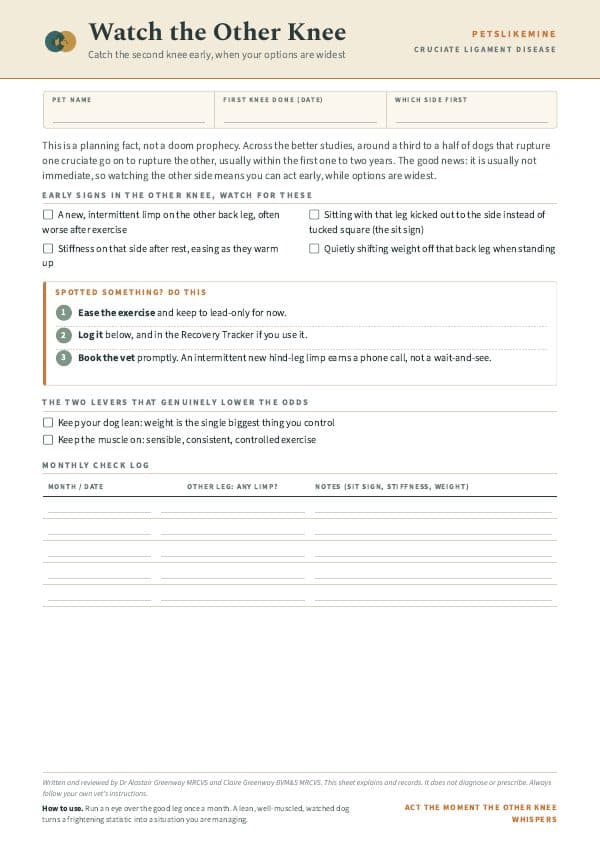
Watch the Other Knee Checklist
PDFBecause around a third to a half of dogs rupture the other cruciate too, usually within a year or two. The early signs to watch for, what to do if you spot one, the two levers that genuinely lower the odds, and a monthly check log. Honest, not alarmist.
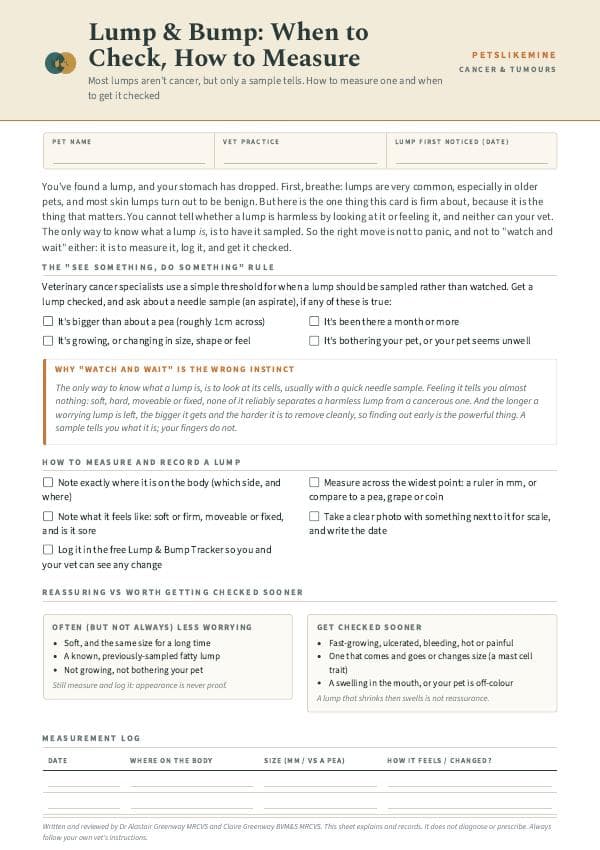
Lump & Bump: When to Check, How to Measure
PDFHow to measure a lump and when it needs a vet: the WSAVA 'sample early, don't watch and wait' rule, reassuring vs worrying signs, and a measurement log. Pairs with the Lump & Bump Tracker.
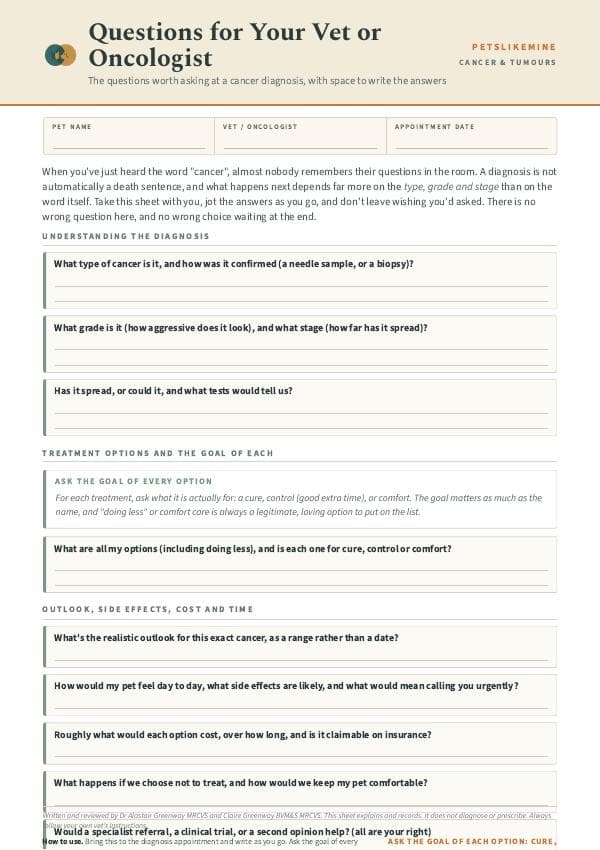
Questions for Your Vet or Oncologist
PDFThe questions to ask at a cancer diagnosis (type, grade, stage, spread, options and the goal of each, outlook, side effects, cost, doing nothing) with write-on answer space.
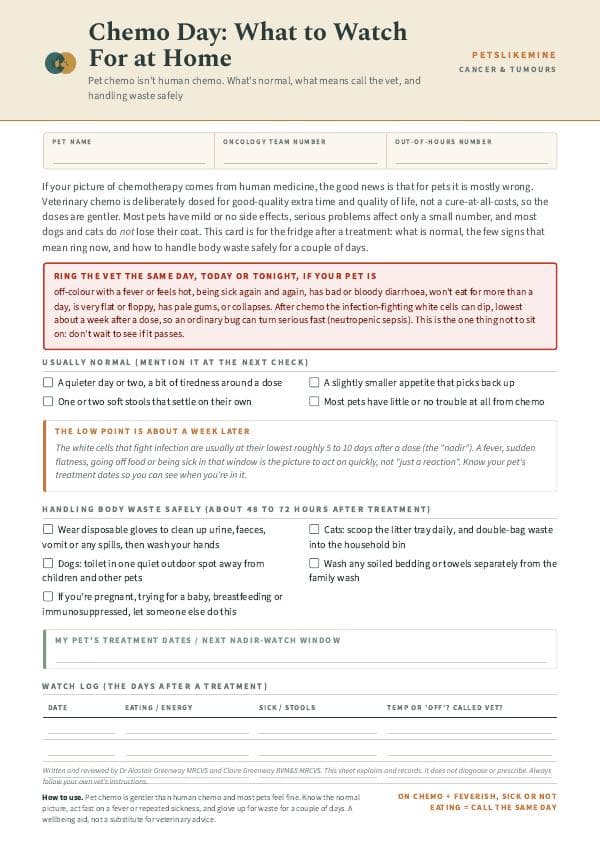
Chemo Day: What to Watch For at Home
PDFPet chemo isn't human chemo: what's normal vs call-the-vet after treatment, the week-later nadir, handling body waste safely for 48-72h, and a watch log.
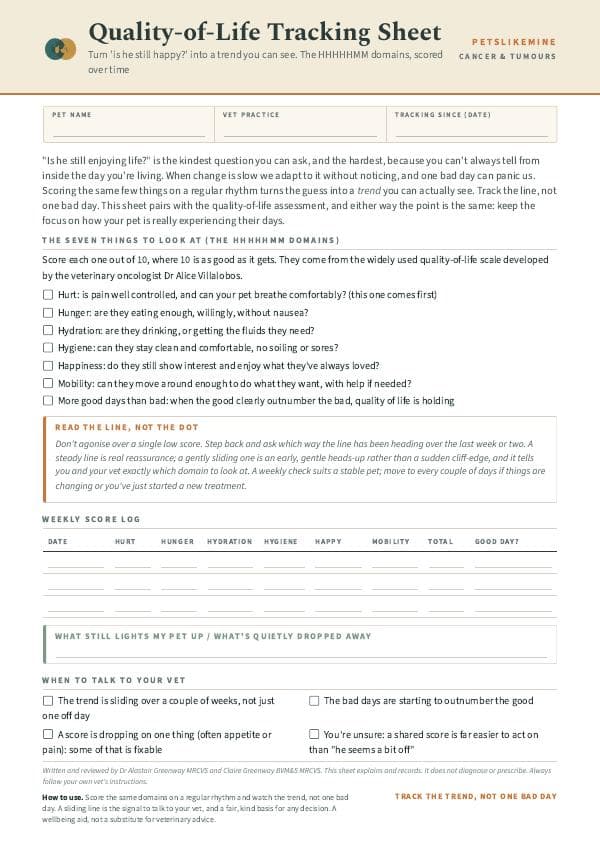
Quality-of-Life Tracking Sheet
PDFThe HHHHHMM quality-of-life domains scored over time, a weekly log, the 'track the trend, not one bad day' message, and when to talk to your vet. Pairs with the QoL assessment.
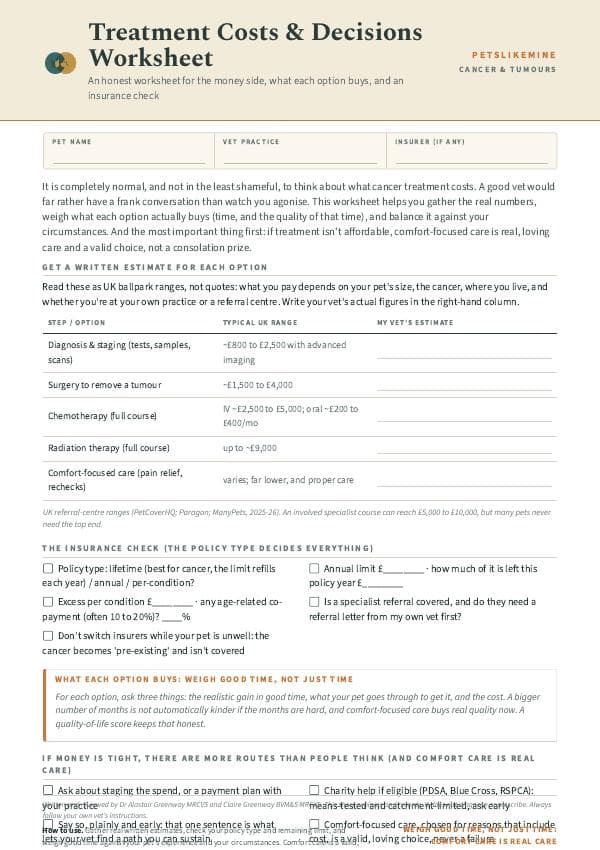
Treatment Costs & Decisions Worksheet
PDFA frank worksheet: UK cost ranges with write-on for your vet's quotes, an insurance check, what each option buys (time vs quality), and that comfort/do-nothing is a valid, loving choice.
The Socialisation Checklist: Weeks 3 to 14
PDFA tickable exposure poster for people, sounds, surfaces, handling and vaccinated-dog play, built around carrying your puppy to socialise safely before the vaccination course finishes, with a kitten 2 to 9 week handling panel.
Your Puppy or Kitten's First-Year Health Schedule
PDFA fill-in wall planner for vaccinations, worming and flea control by age, explaining the 10-week versus 16-week finish and leaving the exact dates for your vet to set.
The New Puppy and Kitten Shopping List
PDFWhat you actually need before collection day, in parallel dog and cat columns, plus baby-proofing and the first-few-days jobs (vet visit, microchip transfer, insurance).
Buying Well: The Puppy Contract and Kitten Checklist, Explained
PDFThe bad-seller red flags and what good documentation looks like, pointing to the AWF/RSPCA Puppy Contract and the Cat Group/iCatCare Kitten Checklist as the real tools, with Lucy's Law and microchip-law notes.
Surviving Adolescence: A One-Page Survival Guide
PDFThe teenage-regression reality with reward-based reminders: go back to basics, protect recall with a long line, meet the needs behind the behaviour, never give up and never turn to aversives.
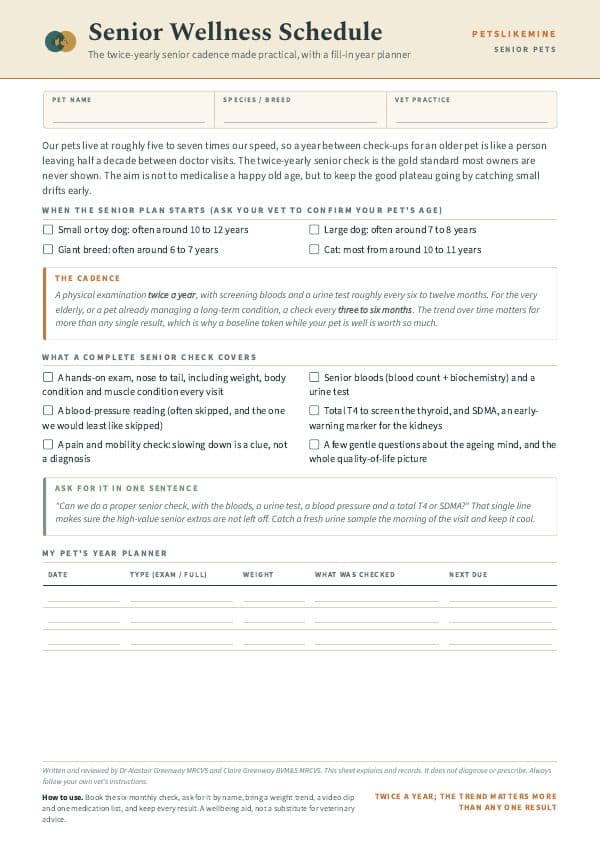
Senior Wellness Schedule
PDFThe twice-yearly senior cadence made practical: when the plan starts by species, what a complete check covers (bloods, urine, blood pressure, total T4, SDMA), how to ask for it, and a fill-in year planner.
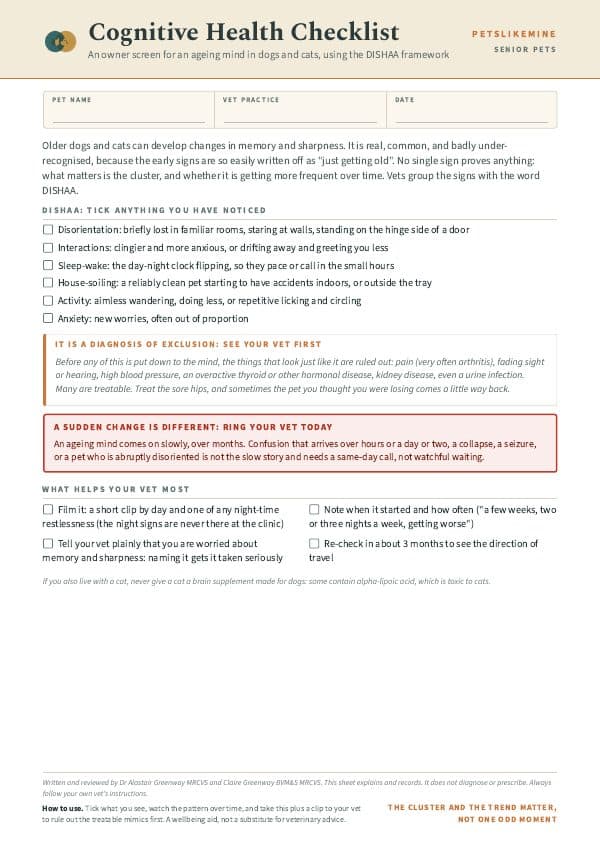
Cognitive Health Checklist
PDFAn owner screen for an ageing mind in dogs and cats using the DISHAA framework (disorientation, interactions, sleep-wake, house-soiling, activity, anxiety), the treatable mimics to rule out first, and a re-check-in-3-months prompt.
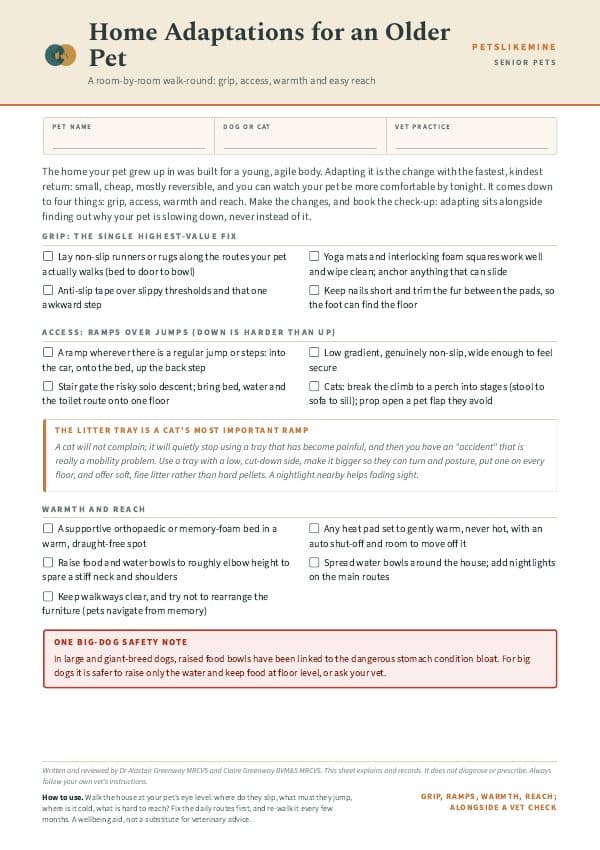
Home Adaptations for an Older Pet
PDFA room-by-room walk-round of small, cheap, reversible changes: grip on the routes they walk, ramps over jumps, a low cut-down litter tray, raised bowls, a warm orthopaedic bed and nightlights for failing sight.
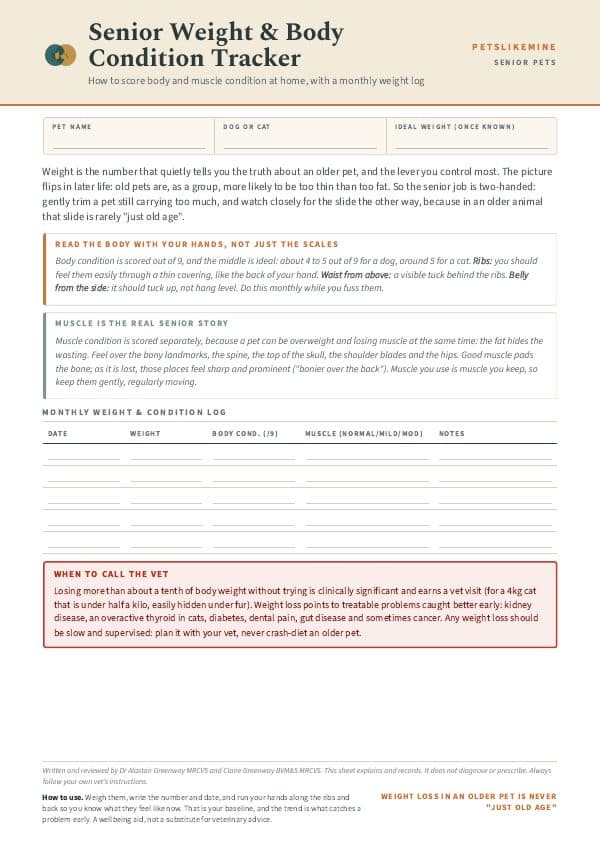
Senior Weight & Body Condition Tracker
PDFHow to body-condition-score (out of 9) and muscle-condition-score an older pet at home, a monthly weight log, and what unexplained loss or gain means, with the >10 per cent rule for calling the vet.
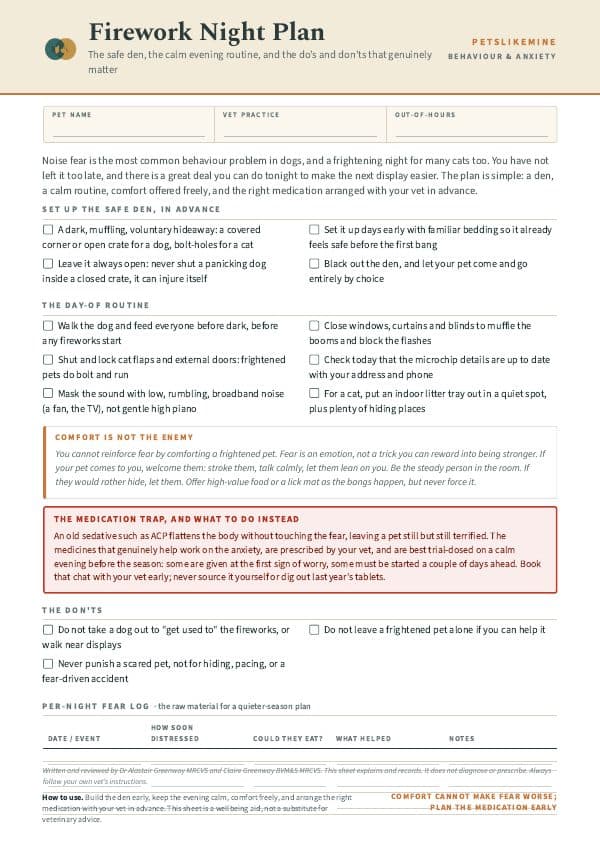
Firework Night Plan
PDFThe safe-den setup, the calm evening routine, the comfort-is-not-the-enemy truth, vet-prescribed medication timing, the do's and don'ts, and a per-night fear log.
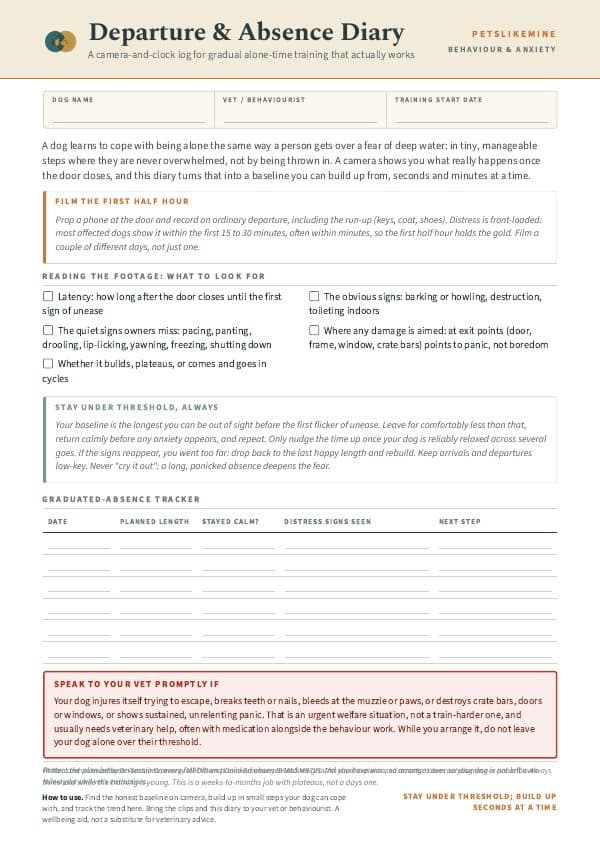
Departure & Absence Diary
PDFA camera-and-clock separation-training log: filming the first half hour, finding the baseline, the signs to read, staying under threshold, and a graduated-absence tracker.
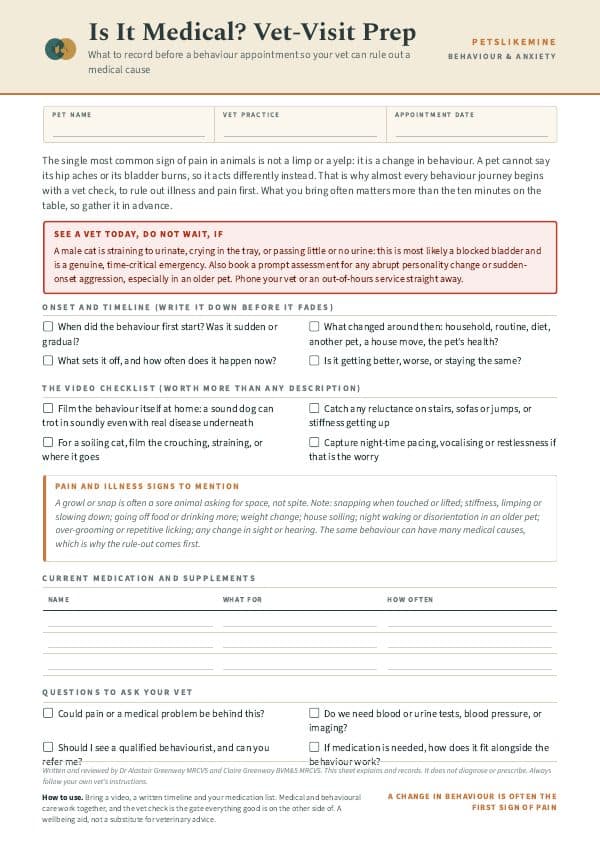
Is It Medical? Vet-Visit Prep
PDFWhat to record before a behaviour appointment so your vet can rule out a medical cause: onset timeline, a video checklist, pain and illness signs, current medication, and questions to ask.
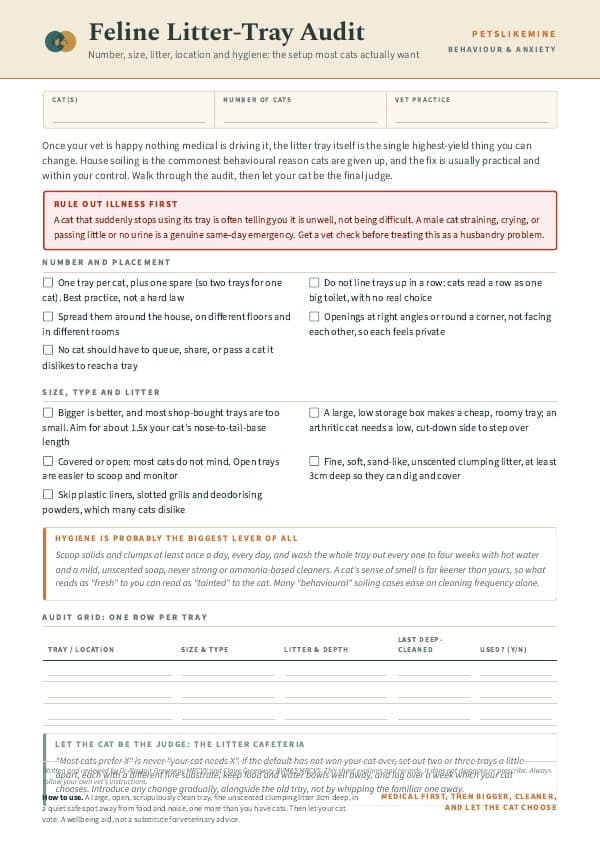
Feline Litter-Tray Audit
PDFTray number (one per cat plus one), placement, size and type, litter substrate and depth, hygiene cadence, a per-tray audit grid, and the same-day red flag of a blocked male cat.
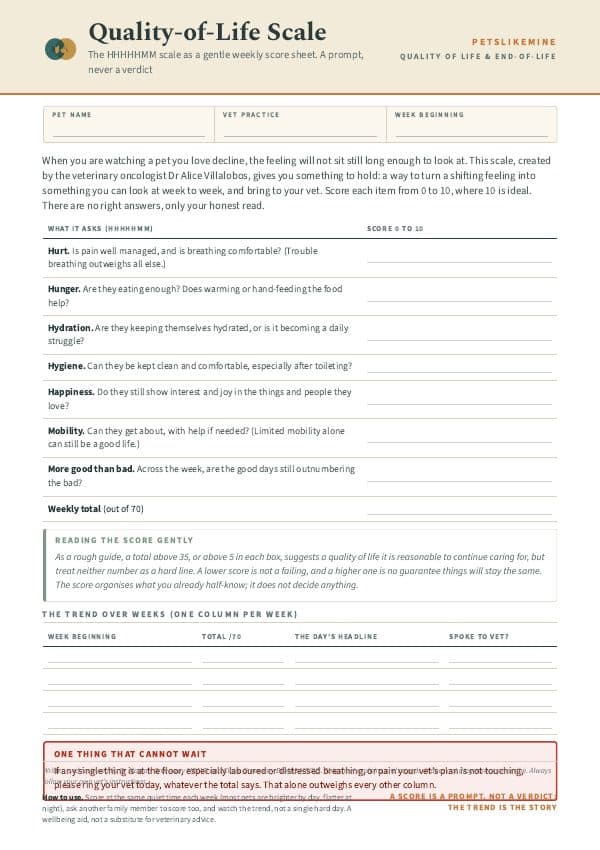
Quality-of-Life Scale
PDFThe HHHHHMM framework (Hurt, Hunger, Hydration, Hygiene, Happiness, Mobility, More good days than bad) as a gentle weekly score sheet, each item 0 to 10, with a multi-week trend grid. A prompt, never a verdict; the trend matters more than any single day.
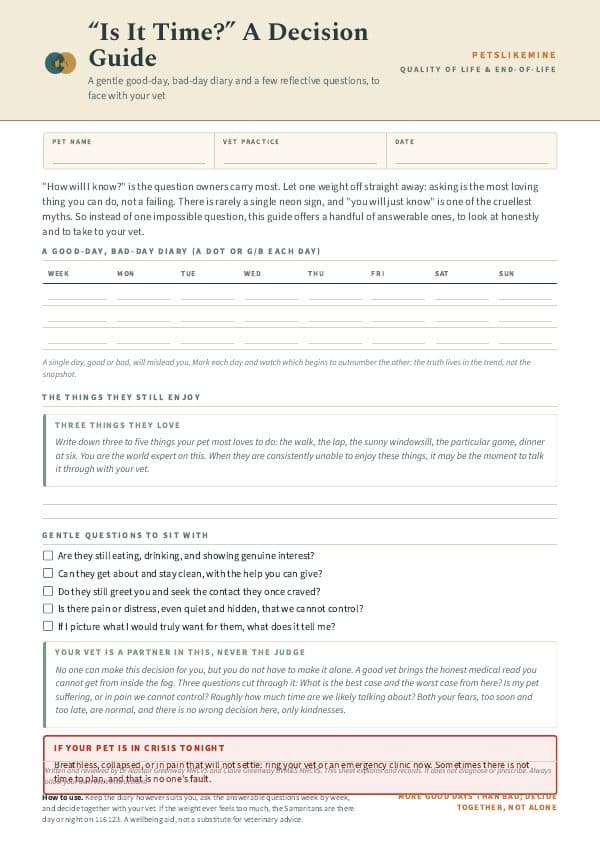
"Is It Time?" A Decision Guide
PDFA gentle good-day, bad-day diary plus reflective questions (the things they still enjoy, a three-things-they-love list, what you would want for them). There is no single right answer: decide together with your vet.
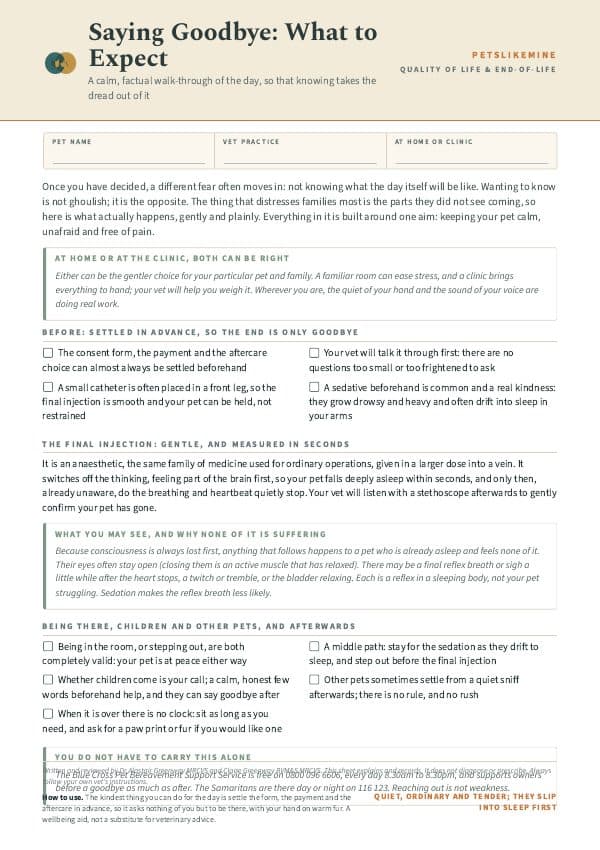
Saying Goodbye: What to Expect
PDFA calm, factual walk-through of euthanasia: at home or at the clinic, what happens step by step (a sedative, then the final injection), how gently and quickly it works, being present or not (both okay), children and other pets, and aftercare.
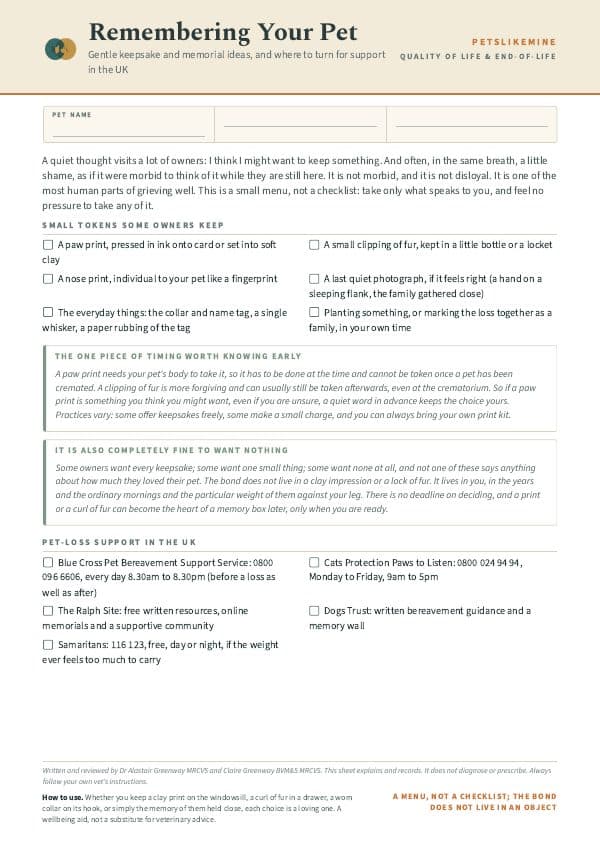
Remembering Your Pet
PDFGentle keepsake and memorial ideas: paw prints, fur clippings, photos, a memory box, planting something, marking the loss as a family, and where to turn for UK pet-loss support. A menu, not a checklist; wanting none is just as loving.
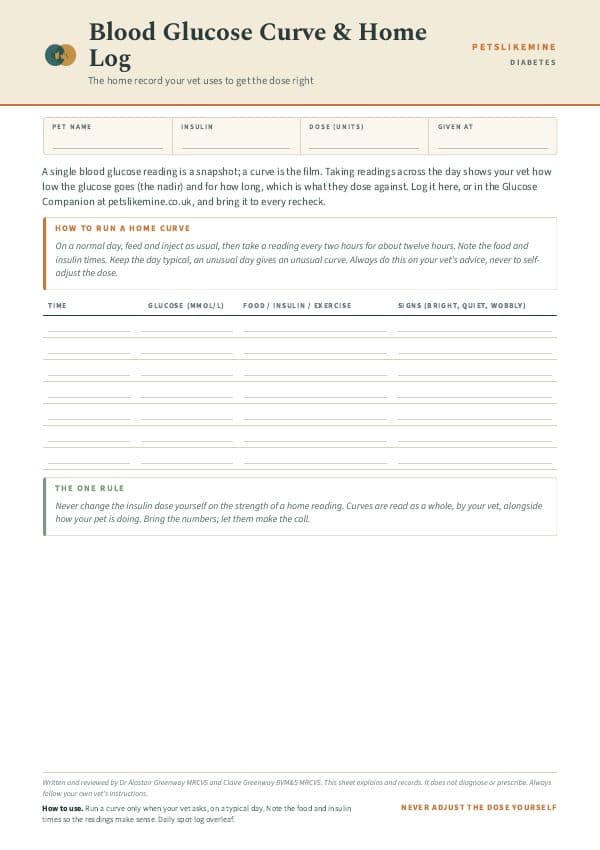
Blood Glucose Curve & Home Log
PDFThe home record your vet uses to get the insulin dose right. A blood glucose curve sheet, with a reading every couple of hours to show how low the glucose goes and for how long, plus an everyday log for readings, appetite, thirst and energy. Pairs with the Glucose Companion. It shows your data, never a dose to change.
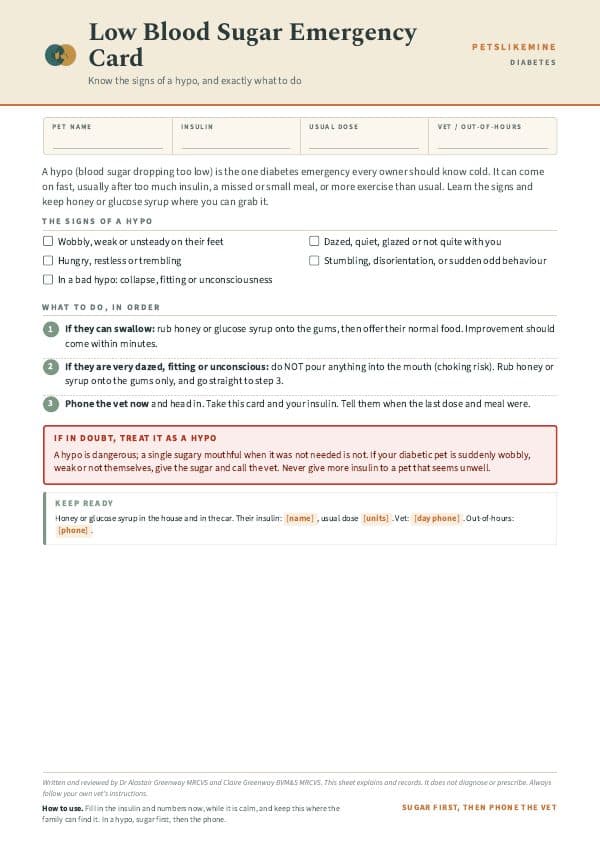
Low Blood Sugar Emergency Card
PDFThe one diabetes emergency to know cold. The signs of a hypo, low blood sugar, exactly what to do in order, when to rush to the vet, and a space for your insulin and emergency numbers. Print it and keep it where the whole family can find it fast.
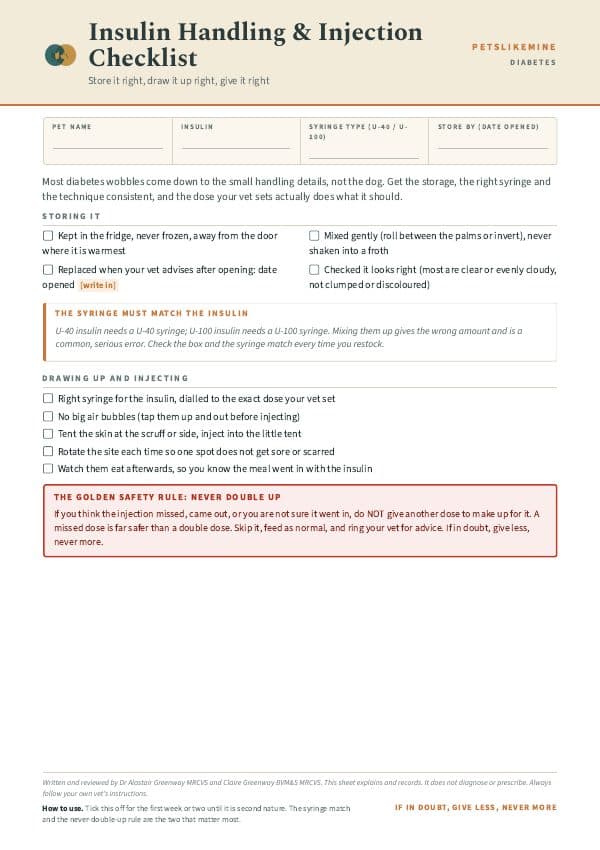
Insulin Handling & Injection Checklist
PDFStore it right, draw it up right, give it right. Fridge storage, matching the U-40 or U-100 syringe to the insulin, injection technique and rotating the site, and the golden safety rule: never give a second dose to make up for a missed one. If in doubt, give less, not more.
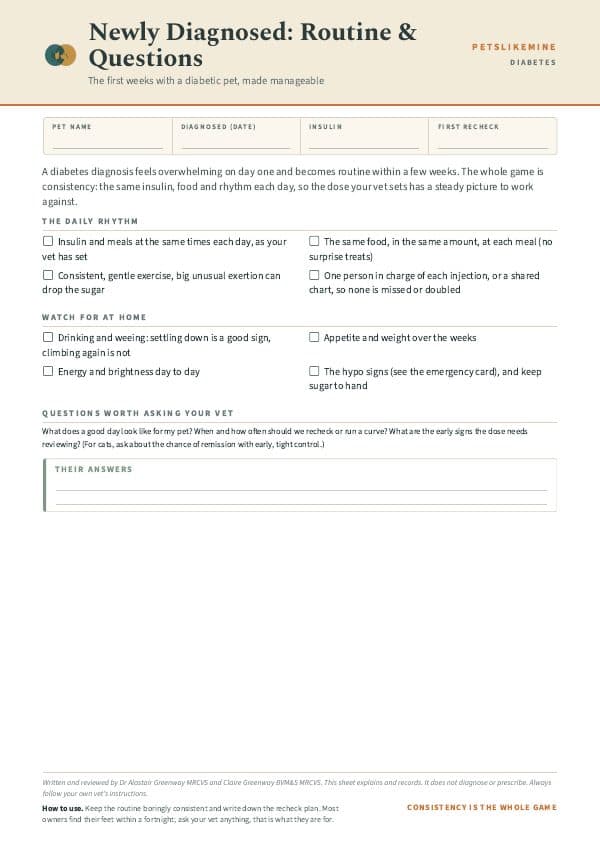
Newly Diagnosed: Routine & Questions
PDFThe first weeks with a diabetic pet, made manageable. The daily rhythm that keeps blood sugar steady, what to watch for at home, and the questions worth asking your vet (including the chance of remission for cats). Diagnosis feels overwhelming on day one and becomes routine within a fortnight.
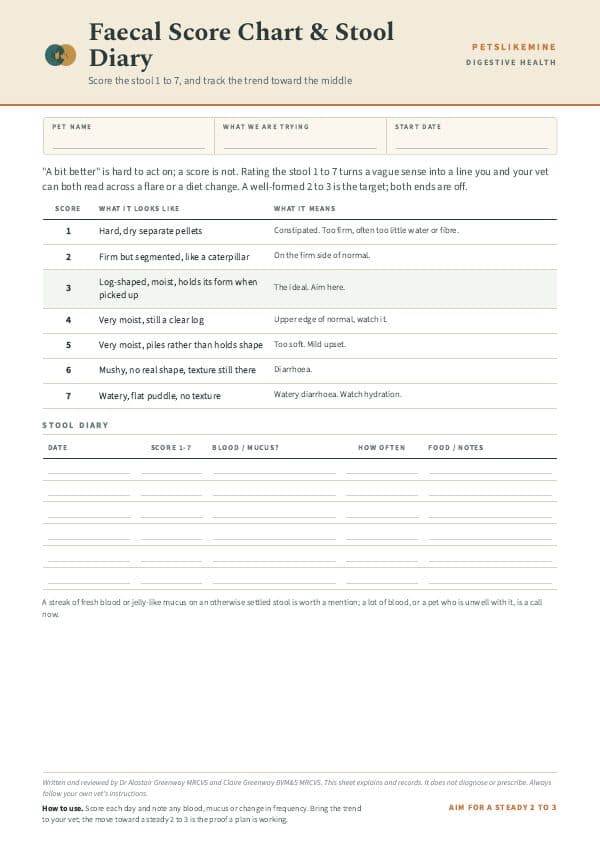
Faecal Score Chart & Stool Diary
PDFScore the stool 1 to 7 and track the trend toward the healthy middle. A plain-language reference for every score (1 hard pellets, a well-formed 2 to 3 the target, 7 watery) plus a diary to log the score, any blood or mucus, frequency and food. Pairs with the Faecal Score Tracker; the move toward a steady 2 to 3 is the proof a plan is working.
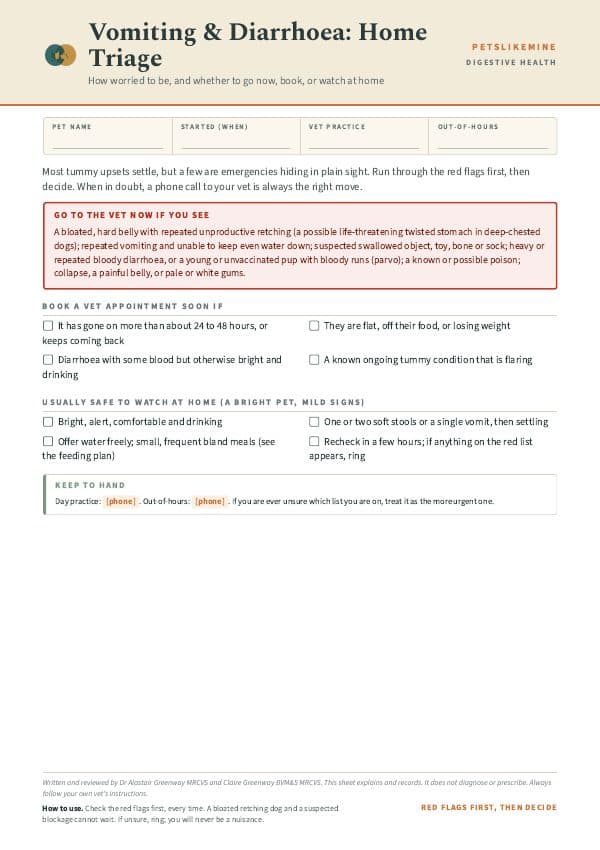
Vomiting & Diarrhoea: Home Triage
PDFYour pet is being sick or has the runs and you are not sure how worried to be. The genuine emergencies to act on now (a bloated retching dog, a suspected blockage, parvo, sudden bloody diarrhoea, a swallowed toxin), what to book soon, and what is usually safe to watch at home. Print it and keep your vet numbers on it.
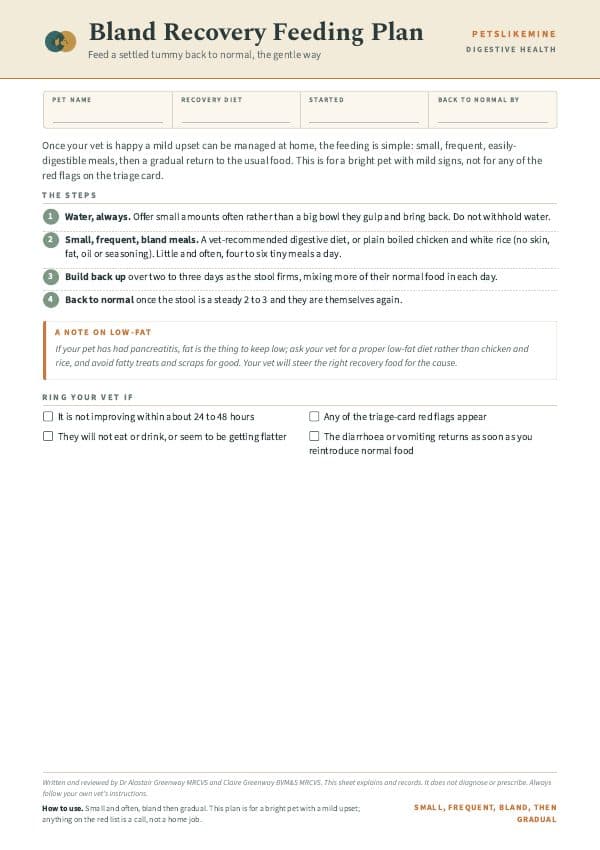
Bland Recovery Feeding Plan
PDFOnce your vet is happy a mild upset can be managed at home, the feeding is simple. Small, frequent, easily-digestible meals, then a gradual return to normal over a few days, with a note on keeping fat low after pancreatitis and the signs that mean ring the vet instead. For a bright pet with mild signs, not for any red flag.
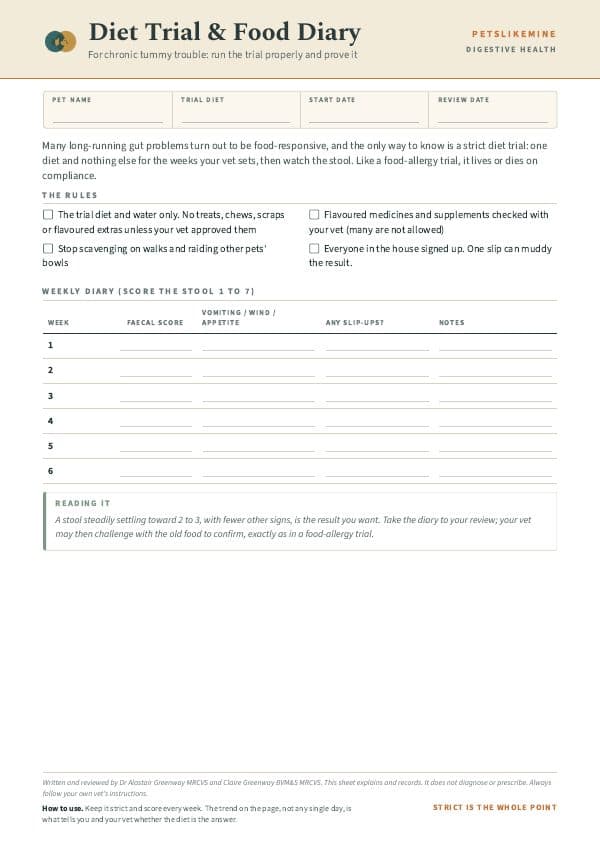
Diet Trial & Food Diary
PDFMany long-running gut problems turn out to be food-responsive, and the only way to know is a strict diet trial. The rules that keep it honest, and a weekly diary to score the stool 1 to 7 alongside vomiting, wind, appetite and any slip-ups. Like a food-allergy trial, it lives or dies on compliance.
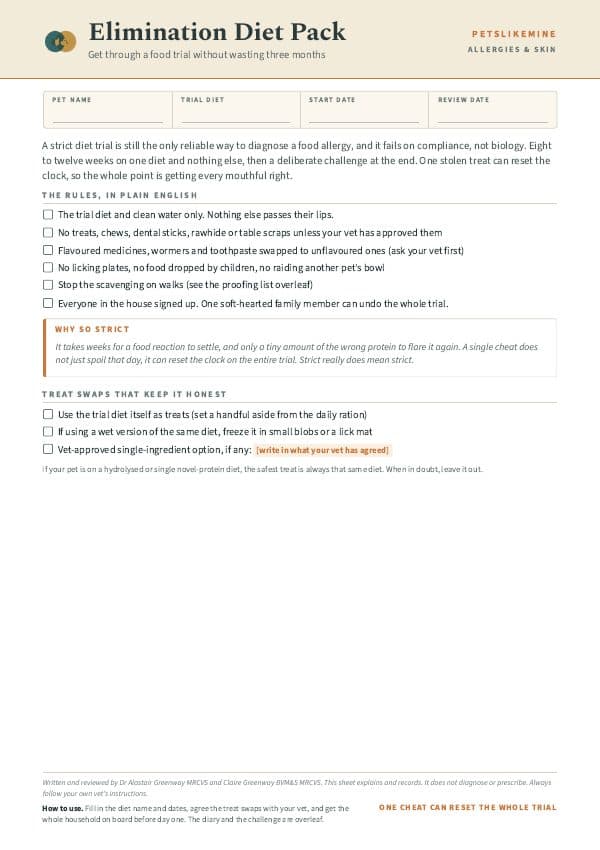
Elimination Diet Pack
PDFEverything you need to get through a food trial without wasting three months. The strict-trial rules in plain English, an eight-week food-and-itch diary, treat swaps that keep the diet honest, and a scavenging-proofing checklist for the house and garden. Food trials fail on compliance, not biology, so this is the page that gets you to the finish line.
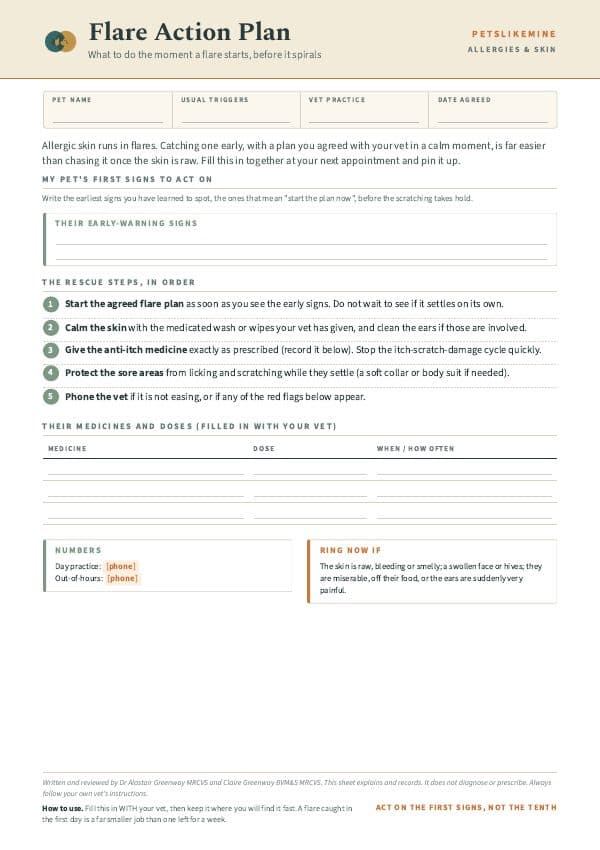
Flare Action Plan
PDFWhat to do the moment a flare starts, before it spirals. A simple step-by-step you fill in with your vet: the first signs to act on, the rescue steps in order, your pet''s usual medicines and doses, and the clinic and out-of-hours numbers. Pin it up so that when the itch flares at 11pm you are not guessing.
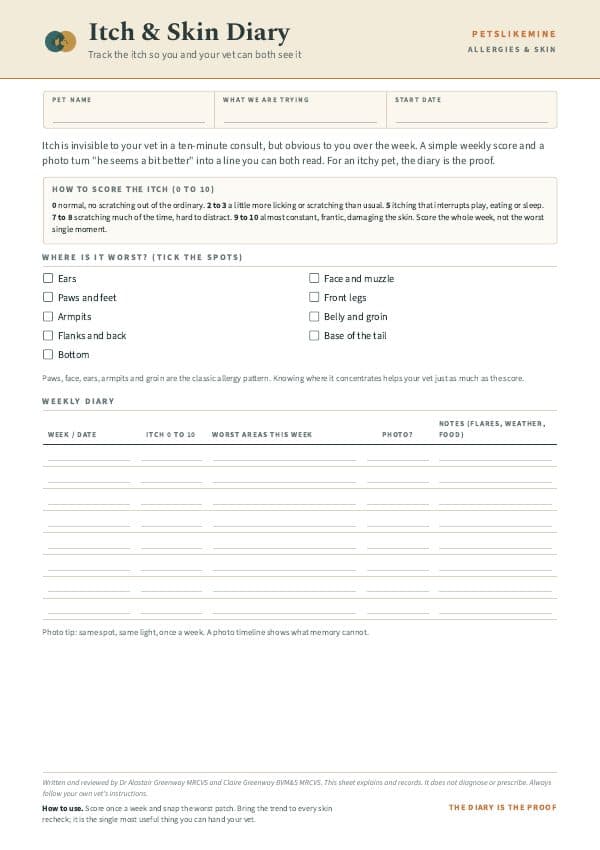
Itch & Skin Diary
PDFThe paper version of the Skin & Itch Tracker for owners who would rather keep it on the fridge. A printable 0 to 10 itch score, a body map to mark where it is worst, and a photo-log grid so you and your vet can both see the trend over the weeks. For an itchy pet, the diary is the proof.
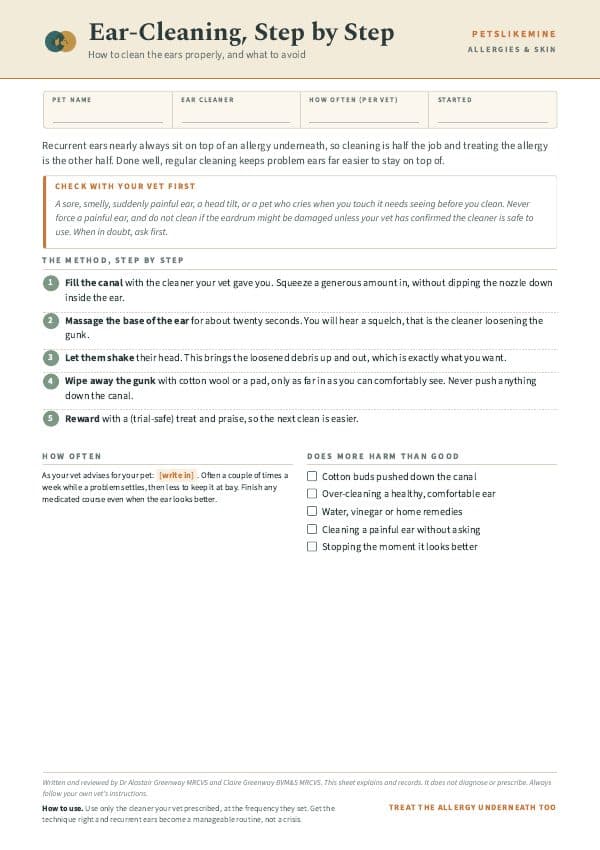
Ear-Cleaning, Step by Step
PDFHow to clean your pet''s ears properly, with pictures: how much cleaner, the massage-and-let-them-shake technique, how often, and the things that do more harm than good (cotton buds, over-cleaning a healthy ear). Get the technique right and recurrent ears are far easier to keep on top of, alongside treating the allergy underneath.
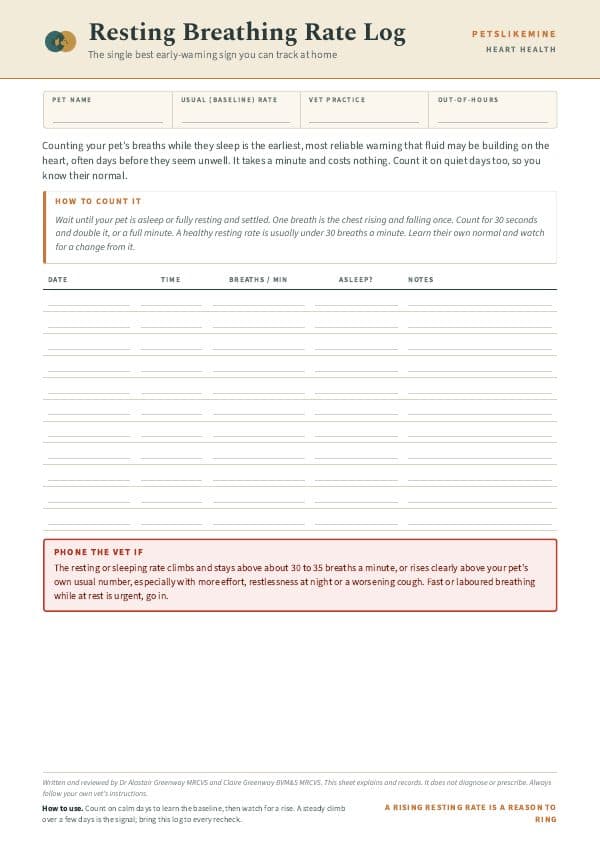
Resting Breathing Rate Log
PDFThe single best early-warning sign you can track at home. Counting your pet's breaths while they sleep can flag fluid building on the heart days before they seem unwell. How to count it, the under-30-a-minute guide, a log to learn their own baseline, and when a rising trend means call the vet. Pairs with the Resting Respiratory Rate tracker.
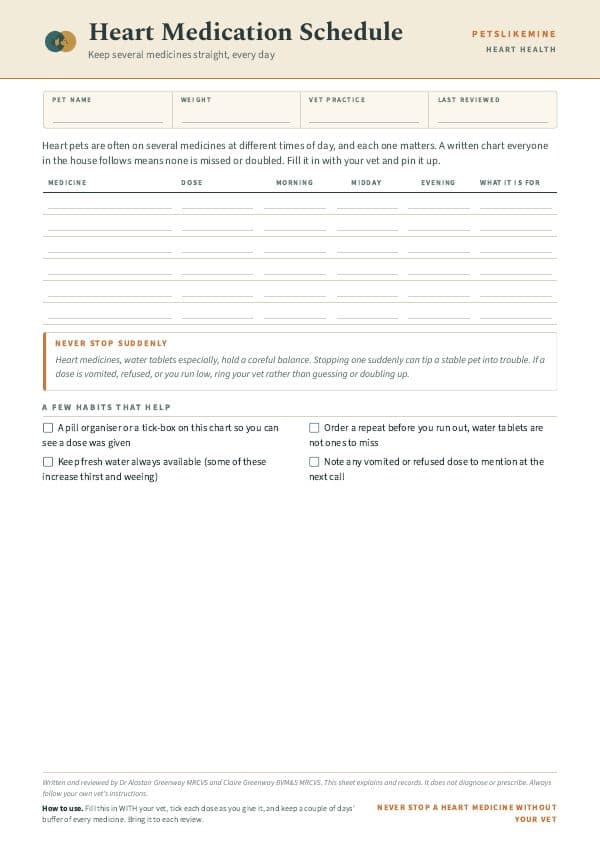
Heart Medication Schedule
PDFHeart pets are often on several medicines at different times of day, and each one matters. A daily morning/midday/evening chart you fill in with your vet so nothing is missed or doubled, room for what each medicine is for, and the golden rule: never stop a heart medicine suddenly.
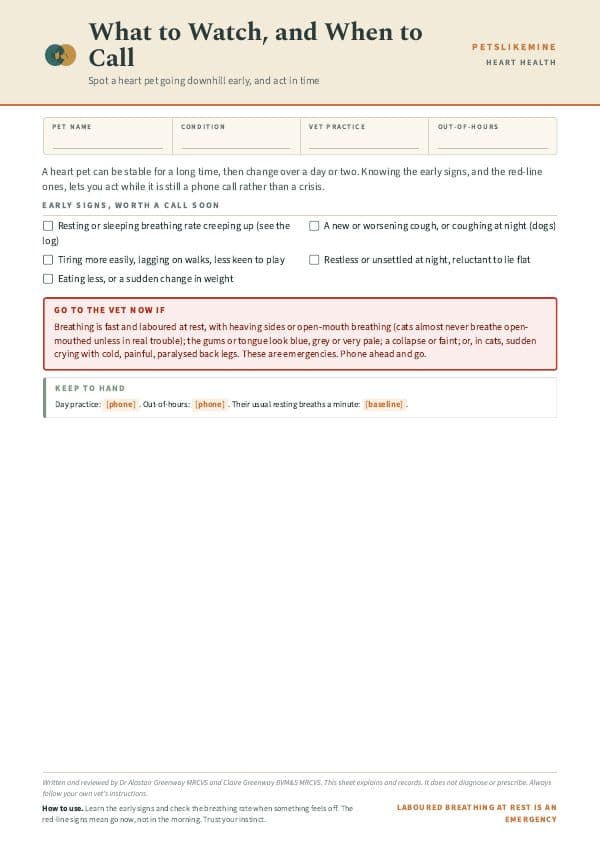
What to Watch, and When to Call
PDFA heart pet can be stable a long time, then change over a day or two. The early signs worth a call soon (a rising breathing rate, a new cough, tiring easily) and the red-line emergencies that mean go now (laboured breathing at rest, blue or grey gums, collapse). Print it and keep your vet numbers on it.
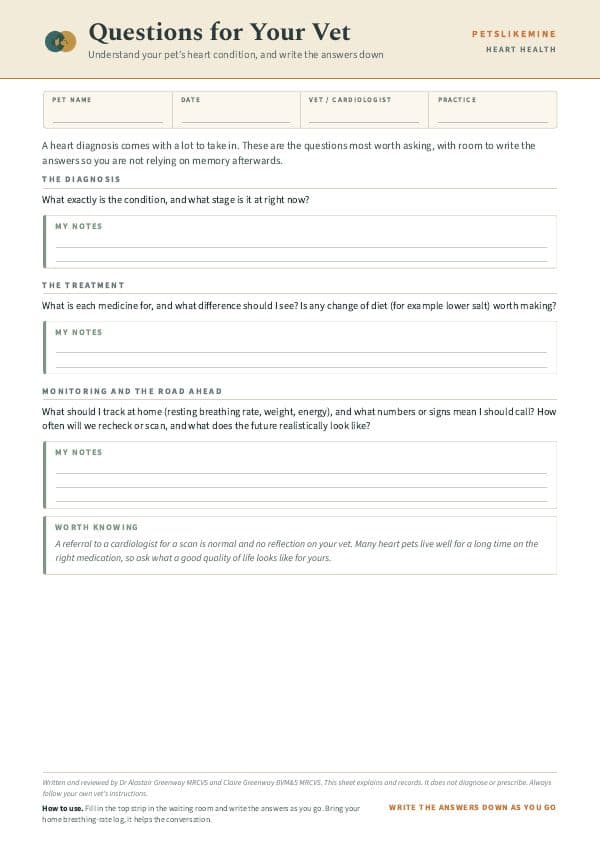
Questions for Your Vet
PDFA heart diagnosis comes with a lot to take in. The questions most worth asking, on the diagnosis and stage, what each medicine is for, what to monitor at home, and the road ahead, with space to write the answers so you are not relying on memory afterwards.
Your Pet's Year-Round Prevention Calendar
PDFA fill-in annual wall-planner for the tasks that keep a well pet well: vaccination and boosters, quarterly worming, flea and tick, the annual health check, microchip-detail review and insurance renewal, each sorted by how often it truly recurs. Pairs with the Preventive Care Scheduler.
Your Risk-Based Parasite Plan
PDFA take-to-the-vet worksheet: work through the lifestyle and region questions (hunting, swimming, lungworm areas, raw diet, multi-pet, young children, indoor-only cat) and write down the plan you agree together. Roundworm control stays non-negotiable. Pairs with the parasite risk quiz.
My Pet's Vaccination Record
PDFA personal write-on record of which vaccines were given and when, core versus lifestyle, and what is next due, with a plain note on what a titre can and cannot tell you (it covers only parvo, distemper and hepatitis, never lepto or kennel cough).
Getting the Most From the Annual Health Check
PDFWhat to bring, what your vet actually examines nose to tail, and the questions to ask (which core-versus-lifestyle vaccines are due, weight and body condition, dental, the parasite plan), with space to write the answers.
Brushing: A Week-by-Week Desensitisation Plan
PDFThe gentle, gradual way to teach a dog or cat to accept toothbrushing: finger and paste-taste first, then a finger on the gums, then gauze or a finger-brush, then the brush. A tick-off week-by-week plan with the two safety rules (never human toothpaste, never a sore mouth) and the habit tricks that get you past the fortnight where most owners give up.
The At-Home Mouth Check
PDFA calm two-minute guide to lifting the lip and reading your pet's mouth: how to look without a fight (dogs and cats), what healthy pink gums and clean teeth look like, and a green, amber and red list of what to book a check for versus what needs a same-day call. A home look is triage, not diagnosis, because most disease hides below the gumline.
After a Dental: Recovery Checklist
PDFThe days after extractions, made simple: soft food, no chews or tug toys while the gum heals, a write-on space for the pain relief your vet dispensed, the signs that mean ring the practice, and the recheck to book.
Questions to Ask Before Your Pet's Dental
PDFA one-page prompt for the pre-dental conversation, with room to write the answers: pre-anaesthetic bloods, whether full-mouth x-rays are included, the extraction-and-consent conversation, the pain-relief and anaesthetic-safety plan, and an itemised cost estimate. Includes the real anaesthesia-risk numbers and a plain warning that anaesthesia-free dentistry is not a substitute for a proper dental.

Thirst & Wee Log
PDFDrinking and weeing more is one of the first signs of a hormone problem, and one of the easiest to measure. How to measure the water properly, the rough polydipsia line (above about 100 ml/kg a day in dogs, 50 in cats), and a log to bring to your vet. Pairs with the Thirst & Wee Tracker, which works out the ml per kg for you.
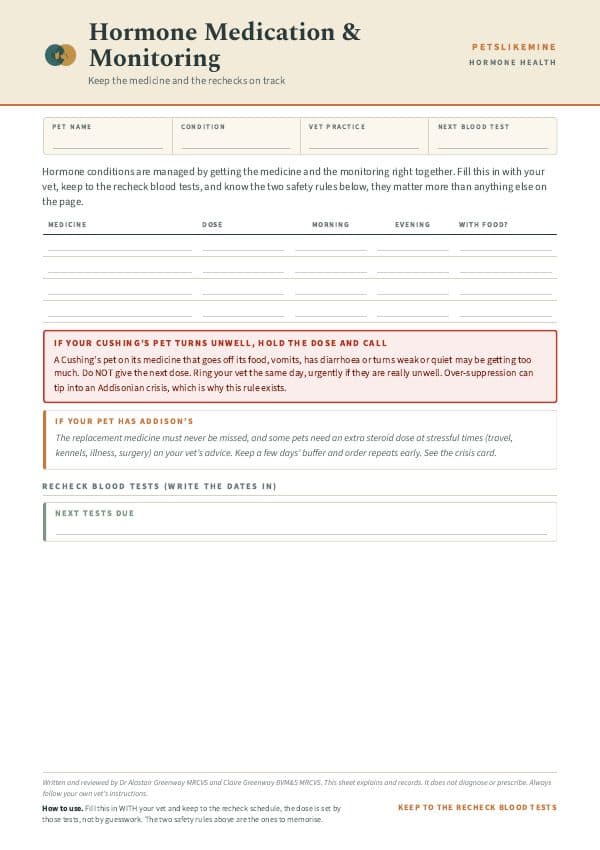
Hormone Medication & Monitoring
PDFHormone conditions are managed by getting the medicine and the monitoring right together. A daily medication chart you fill in with your vet, a place for the recheck blood-test dates, and the two safety rules that matter most: hold the dose and call if a Cushing's pet turns unwell, and never miss an Addison's pet's replacement.
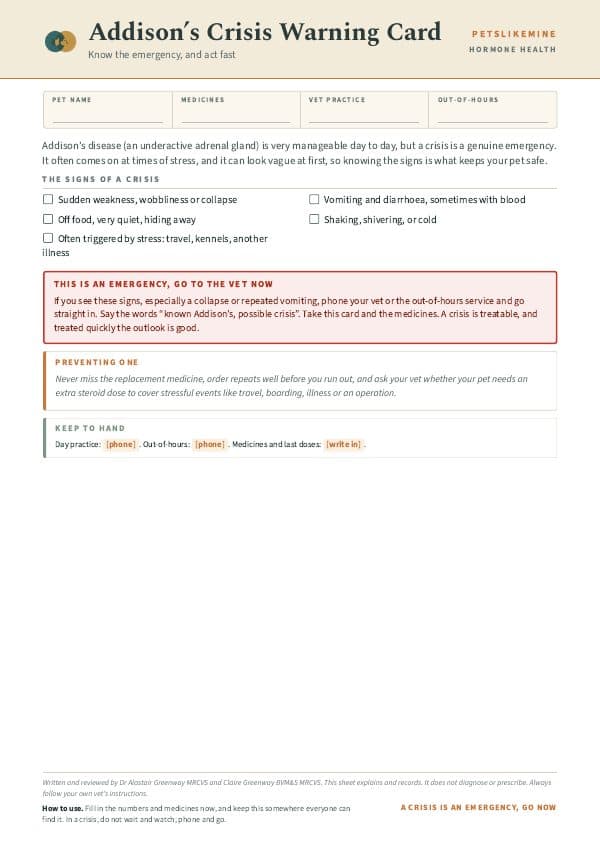
Addison's Crisis Warning Card
PDFAddison's disease is very manageable day to day, but a crisis is a genuine emergency, and it often comes on at times of stress. The signs to know (sudden weakness or collapse, vomiting, going off food), exactly what to do, and how to prevent one. Print it and keep your vet numbers on it.
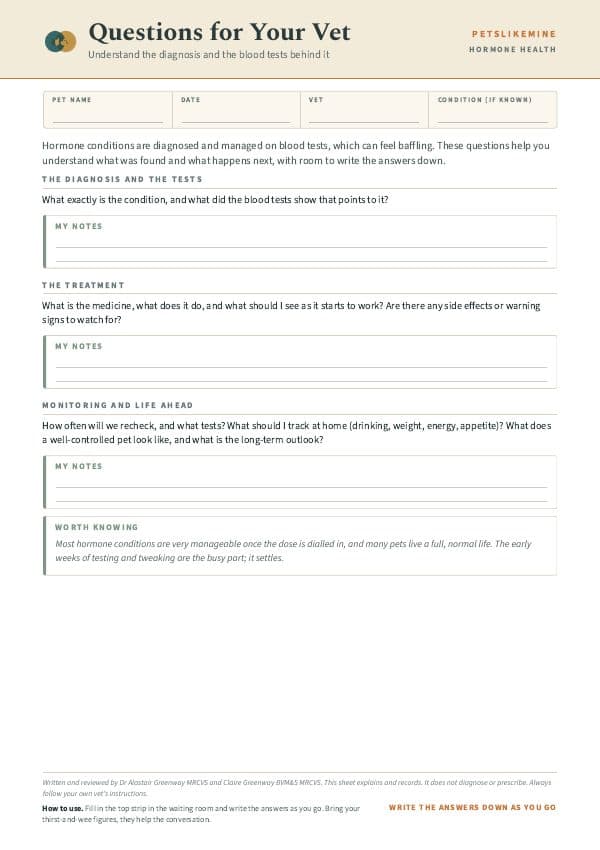
Questions for Your Vet
PDFHormone conditions are diagnosed and managed on blood tests, which can feel baffling. The questions most worth asking, on what the tests showed, what the medicine does and what to watch for, and how monitoring works, with space to write the answers so you are not relying on memory afterwards.
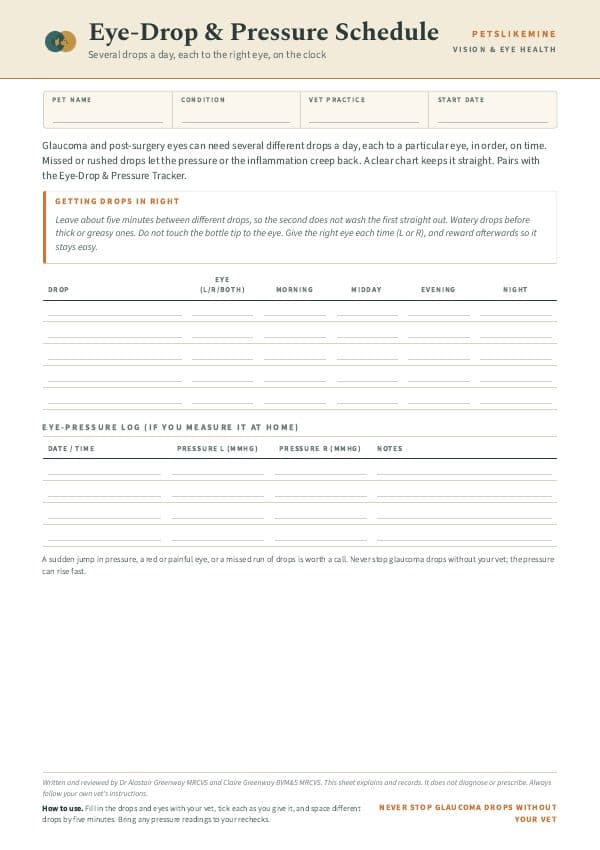
Eye-Drop & Pressure Schedule
PDFGlaucoma and post-surgery eyes can need several different drops a day, each to a particular eye, in order, on time. A clear daily chart so none is missed or rushed, the technique for getting drops in (space different drops by five minutes, watery before greasy), and a home eye-pressure log. Pairs with the Eye-Drop & Pressure Tracker.
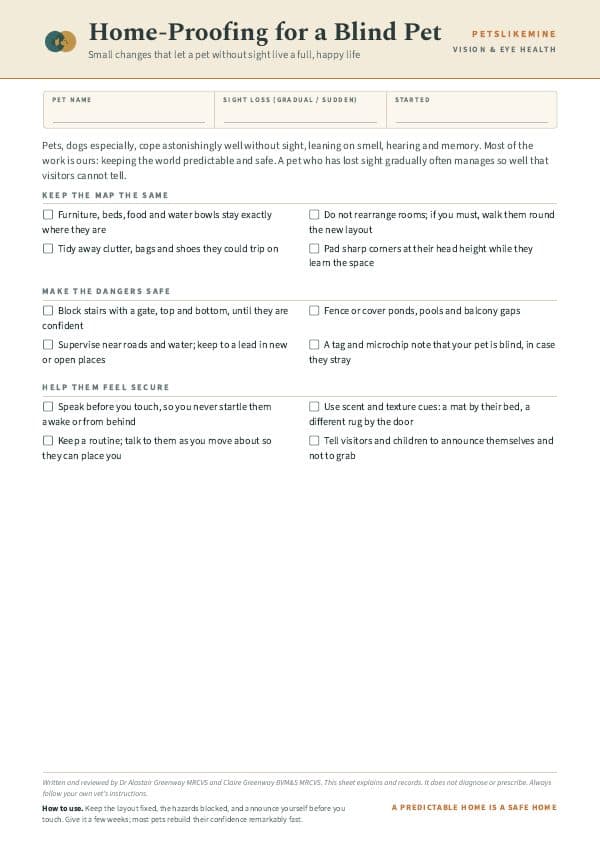
Home-Proofing for a Blind Pet
PDFPets cope astonishingly well without sight, leaning on smell, hearing and memory, and most of the work is ours: keeping the world predictable and safe. A room-by-room checklist to keep the layout fixed, make the hazards safe, and help a pet without sight feel secure and live a full, happy life.
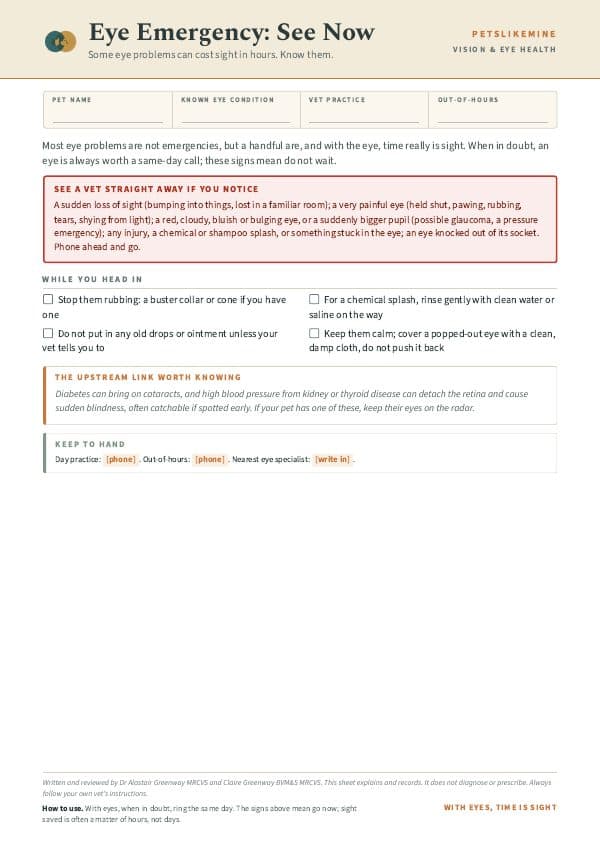
Eye Emergency: See Now
PDFMost eye problems are not emergencies, but a handful can cost sight in hours. The sight-threatening signs to act on now (sudden blindness, a very painful or red or cloudy eye, possible glaucoma, an injury or chemical splash), what to do while you head in, and the diabetes and blood-pressure links worth knowing. Print it and keep your vet numbers on it.
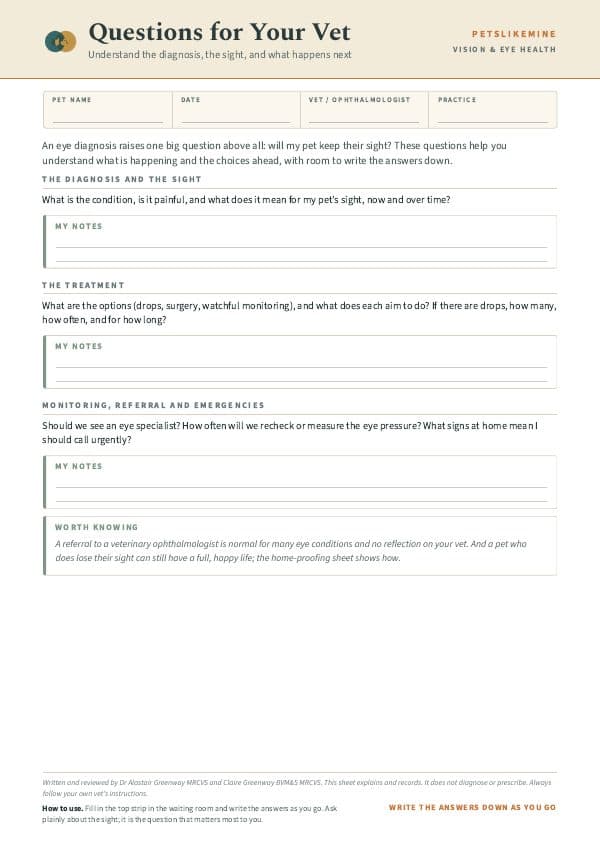
Questions for Your Vet
PDFAn eye diagnosis raises one big question above all: will my pet keep their sight? The questions most worth asking, on the diagnosis and whether it is painful, the treatment options, and when to see an eye specialist or call urgently, with space to write the answers down.
FIP Daily Treatment Log
PDFThe daily record for the 84-day treatment course. One line a day: tick that the vet-prescribed dose went in, and note weight, temperature, appetite and energy. Pairs with the FIP Treatment Companion. It records the dose your vet set; it never tells you how much to give.
The 84-Day Observation Window
PDFA week-by-week tracker for the post-treatment watch period, with the relapse red-flags checklist: returning fever, off food or flat, wobbliness or head tilt, eye changes, a swollen belly or laboured breathing. Any one of these means contact your vet.
Questions to Ask Your Vet About FIP Treatment
PDFFIP is treatable now, legally, through your own vet. The questions worth asking about the legal UK route, the treatment plan, the monitoring and bloodwork checkpoints to expect, and the cost, with space to write the answers.
Liver Values: A Serial-Labs Tracking Sheet
PDFA write-on sheet to line up repeat liver bloods over time (ALT, ALP, AST, GGT, bilirubin, albumin, bile acids) so you and your vet watch the trend, not a single number. Pairs with the Liver Values Tracker.
High Liver Enzymes: What They Mean (and Don't)
PDFThe calm one-pager on a raised liver result: enzymes are a sign not a diagnosis, ALT (damage now) versus ALP (often not the liver), the watch-versus-work-up rule, and the recheck to bile acids to ultrasound to biopsy ladder.
Liver Red Flags: When to Ring the Vet
PDFA tiered fridge-door checklist that sorts the genuine liver emergencies (jaundice, ascites, hepatic encephalopathy, a cat that stops eating, bleeding) from the signs that earn a prompt recheck.