

Breeding & the Genetics of IVDD
Alastair Greenway
BVM&S MRCVS
Nearly everything written about IVDD deals with coping once it has already happened: the emergency, the surgery decision, the weeks of crate rest. This article is about the other direction: prevention at its deepest level, which is breeding. Because IVDD in the at-risk breeds is so strongly genetic, the breeding choices made today shape how many dogs suffer from it in years to come, and there is genuine, hopeful news here. The same science that explains why these breeds are at risk is now putting real tools in breeders' hands to reduce that risk, generation by generation. It is a long game, played out over decades rather than litters, but it is winnable, and it matters. One note on who this is for: the tools below are breeders' tools, aimed at decisions about which dogs to breed from, and they are different from the day-to-day advice for an individual pet owner, which our guide to protecting an at-risk dog covers.
Why the deepest prevention happens in the whelping decision
Start with the root of the problem, which our articles on dachshunds and the other at-risk breeds explain in full. IVDD in these breeds is not bad luck or bad handling; it is largely written into their genes. The same genetic feature that gives the short-legged breeds their distinctive shape, an FGF4 retrogene on chromosome 12, also causes their discs to degenerate and calcify abnormally early, and it is passed from parents to puppies. In dachshunds, around one in five dogs is affected by disc herniation, a painful, hereditary condition that is typically preceded by disc calcification, which is exactly why breeding selection can work.
That heritability is what makes breeding the most powerful lever of all. An individual owner can keep their dog lean and careful and lower the odds a little, which is genuinely worth doing, but the disc disease is already built in. Breeding works further upstream: by choosing which dogs become parents, breeders influence what genetic hand the next generation is dealt in the first place. Reduce the risk in the breeding population, and you reduce it in every puppy born thereafter. It is slower than any treatment, but it is the only approach that addresses the cause rather than the consequences, which is exactly why it deserves attention and why it offers such real, if patient, hope.
The breeder's toolkit
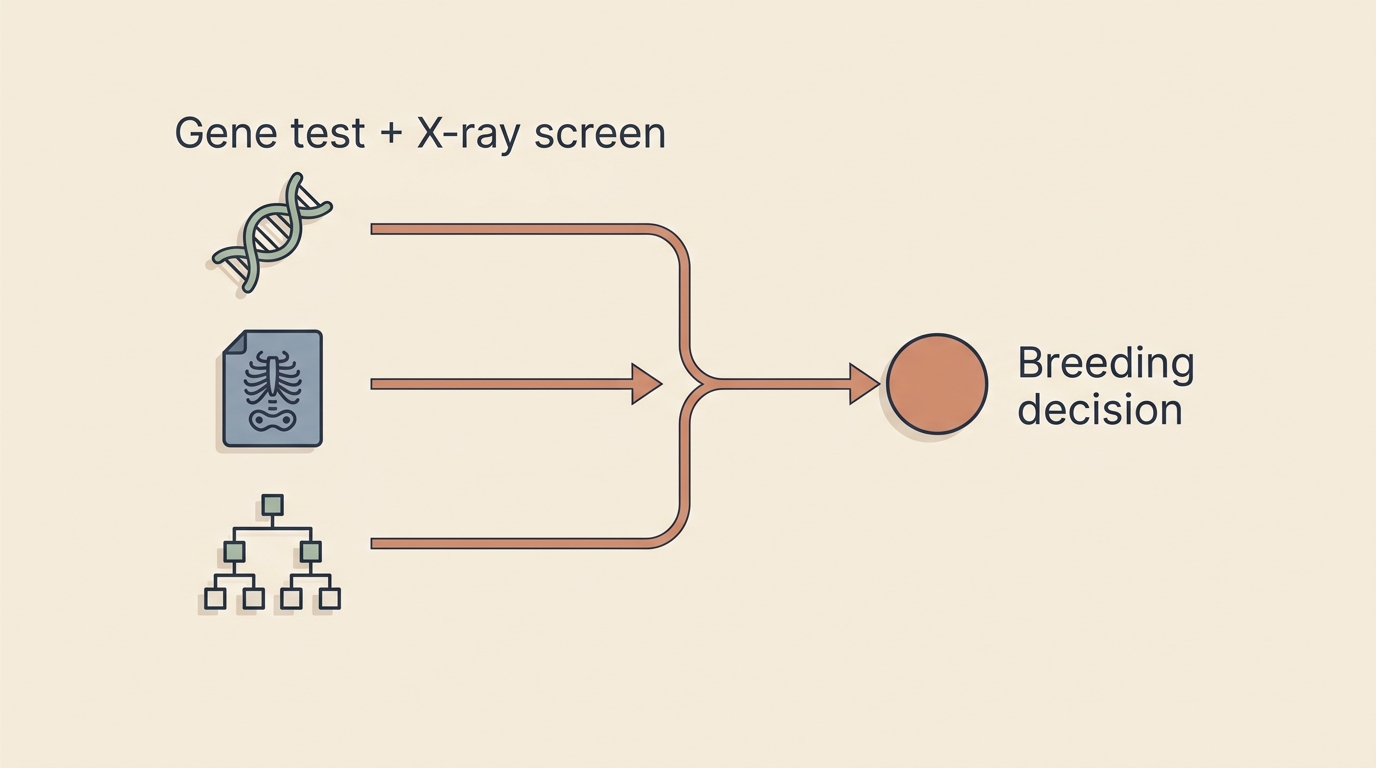
Modern breeders working to reduce IVDD have three complementary tools, and they work best together rather than in isolation. Understanding them shows just how far this has come from simply hoping for the best.
Start with the oldest and most established of the three, radiographic back-screening, which has the longest track record. It has been found that the number of calcified discs visible on a spinal X-ray of a young adult dog is a good indicator of how affected that dog's discs are, and this trait is strongly heritable, meaning it passes reliably to offspring. So screening programmes X-ray breeding dogs, typically at around two to four years old, count their disc calcifications, and use that count to guide breeding decisions. The established rule of thumb is that dogs with no or few calcifications are good breeding candidates, dogs with a moderate number should only be bred to a very low-scoring mate, and dogs with many calcifications should not be bred from at all. The evidence behind this is concrete: using a cut-off of five or more calcifications as the marker of high risk has been found to predict disc herniation well, with a relative risk of around fifteen between dogs above and below that line. This kind of X-ray screening has been running in some countries for around two decades and is the established backbone of IVDD reduction breeding, and a formal scheme now runs in the UK too, jointly operated by the Kennel Club and the dachshund health community.
Next comes the genetic test. Because the FGF4 retrogene behind the risk has been identified, dogs can be DNA-tested for it, through laboratories such as the veterinary genetics laboratory at UC Davis. But here is a crucial and somewhat counter-intuitive point: in dachshunds, the DNA test on its own is not a reliable way to rank risk, because the risk gene is so common in the breed, it is the very thing that makes a dachshund a dachshund, that in some types nearly every dog carries it. Researchers who compared the two approaches directly concluded that relying on the DNA test alone would exclude almost the entire breed from breeding while doing little to separate higher-risk dogs from lower-risk ones, and that radiographic calcification screening remains the more reliable breeding scheme for dachshunds. The genetic test has its place, particularly in understanding the wider genetics and in breeds where the gene is less universal, and in the most ambitious national programmes it is beginning to be used to very gradually reduce how common the risk variant is, but for an individual dachshund breeder today, screening is the more useful guide.
The third tool sharpens the other two: estimated breeding values, or EBVs. An EBV is a statistical estimate of the genetic risk a dog will pass on, calculated not just from that dog's own screening result but from the results of all its relatives too. This is powerful because it gives a more accurate picture of a dog's true genetic worth than its individual X-ray alone, and it even allows a sensible estimate for dogs that have not themselves been screened, by drawing on the family record. Used to guide selection, EBVs let a breed make genetic progress faster and more reliably than screening individual dogs in isolation. Together, these three, the X-ray screen, the gene test used wisely, and the EBV, give a breeder a genuinely informed basis for the most consequential choices they make.
Steering clear of early-onset lines
Beyond the formal tools, one principle of responsible breeding is simple and important: pay attention to family history, and avoid breeding from lines in which disc disease has struck early and often. Because the risk is heritable, a dog from a family with a strong history of early, severe IVDD is more likely to carry and pass on that tendency, even before any test is run. So a conscientious breeder looks not only at the dog in front of them but at its parents, siblings, and previous offspring, and steers away from lines marked by young dogs with serious disc episodes. This is common sense alongside the science: the dogs least likely to produce IVDD-prone puppies are those from healthy, late-or-unaffected families, screened to confirm it. It is also why openness within the breeding community matters so much, since these decisions can only be made well when disc disease in a line is acknowledged and recorded rather than hidden.
A hopeful long game
Be clear-eyed about the timescale, because this is where realism and hope meet. Breeding out a deeply embedded genetic risk does not happen in a generation or two; it is the work of decades, of sustained, coordinated effort across many breeders and, ideally, whole national programmes. The genetic improvements seen so far in the longest-running screening schemes have been real but gradual, and progress depends on enough breeders taking part, because a scheme that only a small fraction of breeders follow can only move the breed slowly.
Gradual, though, is not the same as futile, and the direction of travel is genuinely hopeful. The very fact that we now understand the cause, can measure it on an X-ray, can test for the gene, and can estimate risk across families, means the tools exist to bend the curve downward over time, which simply was not possible a couple of decades ago. The same science that this space uses to explain why your dachshund or French bulldog is at risk is the science now being turned toward making future generations less so. For prospective puppy buyers, there is a practical thread in all this too: choosing a breeder who screens, breeds thoughtfully, and is open about their lines, and asking to see the evidence of it, both protects your own future puppy and rewards and strengthens exactly the responsible breeding that will, over the long run, reduce this condition across the breeds.
So, while most of caring for IVDD is about responding to it, breeding is the one place where the condition can genuinely be reduced at its source. The tools are real, the radiographic screen, the gene test used wisely, and the estimated breeding value, and the principle is sound: breed from the dogs least likely to pass on the risk, lean on screening rather than the DNA test alone in dachshunds, avoid early-onset lines, and play the patient long game. If you are a breeder, taking part in the available screening schemes is one of the most valuable things you can do for the breed's future. And if you are buying a puppy from an at-risk breed, ask your breeder what screening they have done and to see the results, because that single question, asked by enough people, helps drive the whole breed toward fewer dogs facing this condition in the years to come.
References
- Brown EA, Dickinson PJ, Mansour TA, et al. FGF4 retrogene on CFA12 is responsible for chondrodystrophy and intervertebral disc disease in dogs. Proceedings of the National Academy of Sciences, 2017;114(43):11476-11481.
- Bruun CS, Bruun C, Marx T, Proschowsky HF, Fredholm M. Breeding schemes for intervertebral disc disease in dachshunds: is disc calcification score preferable to genotyping of the FGF4 retrogene insertion on CFA12? Canine Medicine and Genetics, 2020;7:18.
- Lappalainen AK, Mäki K, Laitinen-Vapaavuori O. Estimate of heritability and genetic trend of intervertebral disc calcification in Dachshunds in Finland. Acta Veterinaria Scandinavica, 2015;57:78.
- Veterinary Genetics Laboratory, University of California, Davis. Chondrodystrophy (CDDY with IVDD risk) and Chondrodysplasia (CDPA).
- The Kennel Club. IVDD Scheme for Dachshunds.
Free downloads
Companion worksheets to put what you've read into practice. Free PDFs, print at home.
Sister tool · Sightline
Track whether treatment is working
Sightline, a separate ConciergeVet tool, runs a short weekly check-in built on validated pain and mobility instruments, turns it into a single Sightline Score you can watch trend over weeks rather than judge on one bad day, and produces a report you can bring to your vet.
A written log, or our printable trackers, does much the same job.
See how Sightline tracks treatmentTrack the recovery, day by day
Recovery from a disc injury is all about the trend. Log the daily milestones through crate rest and rehab so you can see real progress, not just good and bad days.
Open the Recovery TrackerYou're not doing this alone
Compare treatment journeys and talk to owners managing IVDD. Free to join.
Join PetsLikeMine