

Strict Crate Rest for IVDD, Done Properly (and How to Survive It)
Alastair Greenway
BVM&S MRCVS
Weeks of strict rest is the centrepiece of conservative treatment for intervertebral disc disease, and it is quite possibly the most daunting thing your vet has ever asked of you. Keeping a dog still for weeks, when every instinct of theirs and yours rebels against it, is genuinely tough. But the encouraging truth is simple: this is the treatment, and doing it properly gives your dog the best possible chance of healing well. This guide walks you through how to do strict rest correctly, keep your dog comfortable and safe, and, just as importantly, stay sane yourself while you do it.
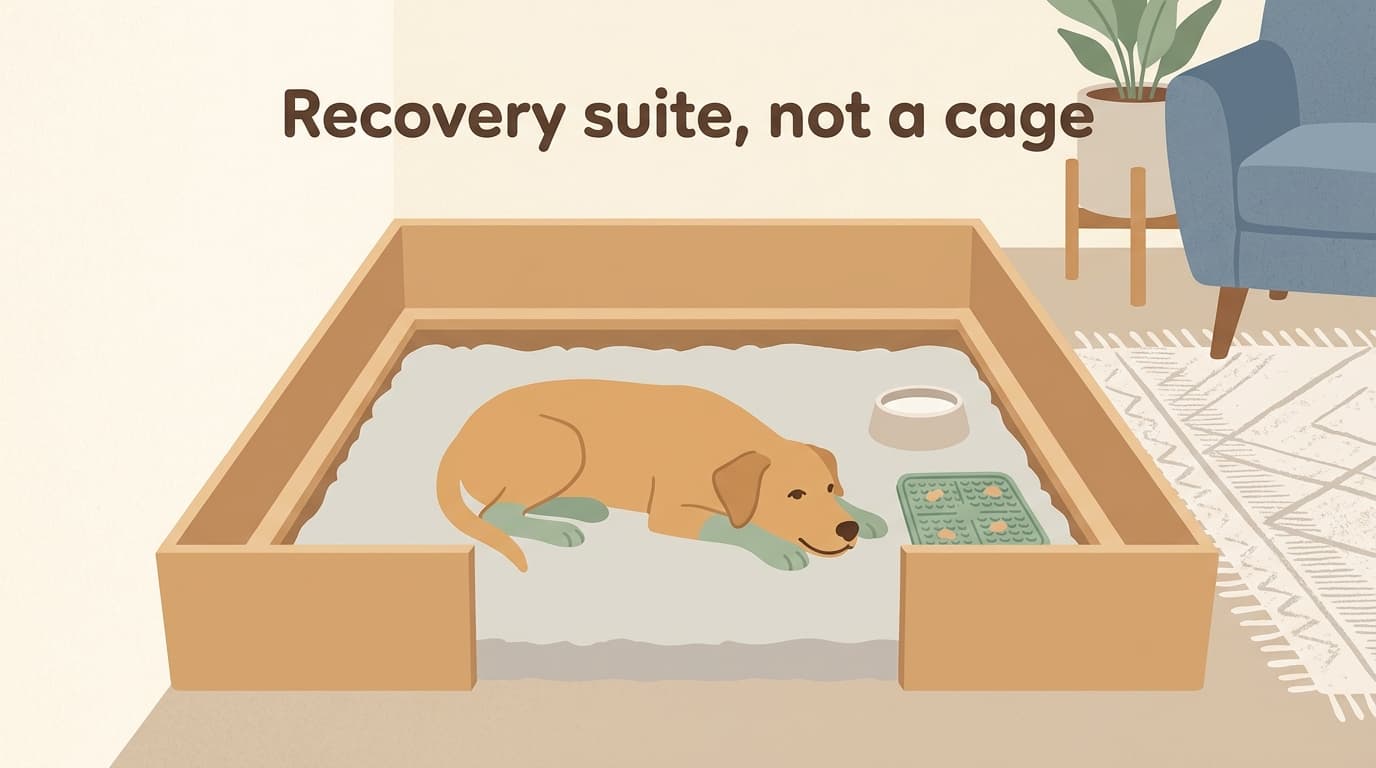
You are not locking your dog in a cage as a punishment. You are building them a recovery suite, a calm, safe, comfortable place to heal, much as a person with a back injury needs a period of rest. The rest is not the absence of treatment; the rest is the treatment. With that in mind, let us make it work, and let us be clear about what the evidence does and does not tell us along the way.
Why keeping still does the healing
It helps to understand why something as simple as keeping still is the centrepiece of non-surgical treatment, because it makes the discipline easier to sustain. When a disc has herniated, the idea behind rest is to give the injured, weakened outer ring of the disc, the annulus, time to heal and stabilise, undisturbed by movement, so that more disc material is not pushed out against the spinal cord. I will admit that the precise length of rest rests on expert consensus rather than hard proof, and we will come to that, but the underlying principle, that stability allows healing and that movement risks re-injury, is sound and universally followed.
It also helps to know that the odds with conservative management are genuinely good for the right dog, because that makes the weeks of effort feel worthwhile. In a study of over two hundred dogs managed with cage rest and medication, around fifty-five percent had a successful recovery with no recurrence, while roughly fifteen percent did not improve and went on to surgery. In dachshunds specifically, managed with rest, medication, and rehabilitation, around eighty-five percent reached "functional pet" status within twelve weeks, and every dog that still had motor function at the start recovered. So strict rest, done properly, works for a great many dogs, which is exactly why it is worth doing it right.
What "strict" really means
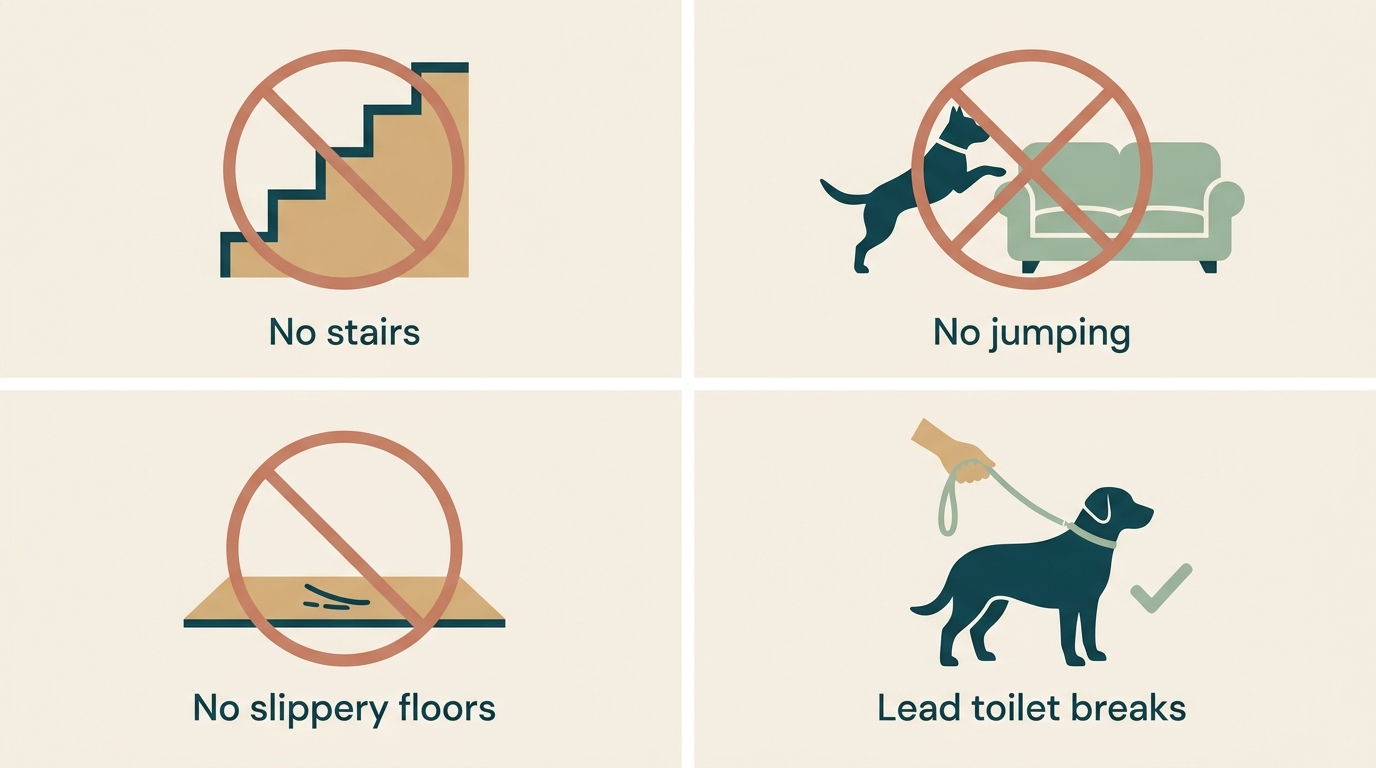
Owners most often underestimate this part, so let me be specific about what strict rest actually involves, drawing on the formal veterinary recommendation, because half-measures genuinely risk your dog's recovery. The expert consensus is for confinement to a restricted area, ideally a crate or a small room without furniture, at all times except for rehabilitation exercises and lead-only trips outside to toilet. Within that, the rules are clear and specific: no off-leash walking, no jumping on or off furniture, and no access to stairs for the whole period.
In practice that means a space just big enough to stand up, turn around, and lie down comfortably, but not big enough to build up any speed or to play. It means no slippery floors, where a scramble for grip can wrench the spine. It means you carry your dog up and down steps and in and out of the house rather than letting them do it themselves. And it means toilet breaks are tightly controlled: short trips outside on a lead, with your dog supported, to wee and poo and come straight back in, never loose in the garden where a squirrel could undo weeks of healing in a single bound. For a dog with neck disease especially, use a harness rather than a collar for these lead breaks, so there is no pull on the neck. A small but vital habit: if you need to get up, put your dog safely back in the pen first, because it takes only a split second of an unsupervised leap off the sofa to cause real harm. This level of strictness feels harsh, but it is exactly what gives the healing its best chance, and it is kinder than a relapse.
How long, really
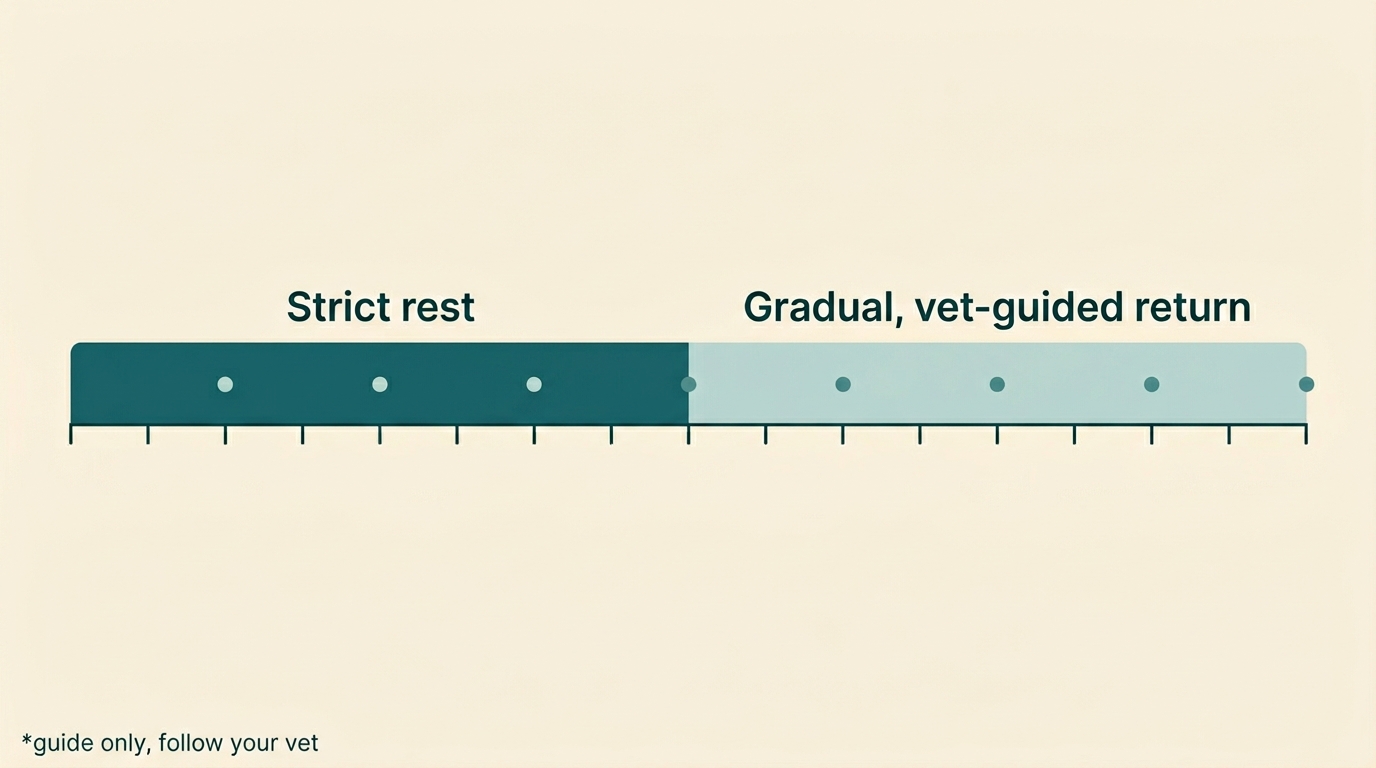
How long does strict rest need to last? The realistic answer, and one worth understanding properly, is that the standard recommendation is for at least four weeks of restricted activity, and in practice many vets advise four to six weeks. But I want to be straight with you about the strength of that figure: this duration is based on expert consensus supported by a low level of hard evidence, not on a large proven trial, and it is reasoned from how long the annulus is thought to take to heal rather than from a precisely measured number. That does not make it arbitrary, it is the best-judged advice of the specialists who treat this condition, and you should absolutely follow the period your own vet sets, which they will tailor to your dog. But it does mean the right length is individualised, decided by your vet based on your dog's progress, rather than a universal law, so the key is to follow your vet's specific instruction rather than a number from the internet.
One important nuance belongs here, because it affects whether strict rest is even the right approach. Strict rest is the cornerstone for the common compressive, extruded disc, the Hansen Type I "burst" disc. But for certain other, less common spinal events, in particular the non-compressive "missile disc" and similar conditions our article on what IVDD is describes, there is recent evidence that strict exercise restriction may not actually change the outcome, because the injury is a one-off bruise rather than ongoing instability. This is exactly why you should follow your own vet's instruction for your dog's specific diagnosis rather than a blanket rule: for most extruded-disc dogs, strict rest genuinely matters, but the right plan depends on precisely what has happened in your dog's spine, which your vet will know.
The weekly arc
Strict rest is not a flat, unchanging block; it is followed by a gradual return, and knowing the shape helps you pace it and recognise progress. The consensus pattern is restricted activity for at least the first four weeks, followed by increasing levels of physical activity, rather than a sudden release back to normal life. The crucial rule throughout is that any increase is gradual and vet-guided, never decided on your own because your dog "seems ready."
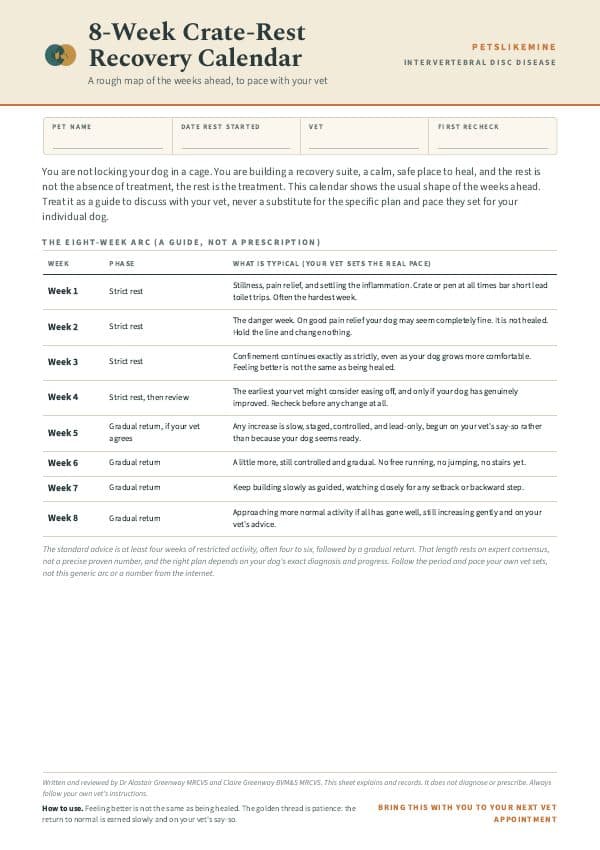
In the earliest phase, the first week or two, the priority is simply stillness, pain control, and preventing any further injury while the inflammation settles. Through the middle weeks, your dog should grow more comfortable as healing progresses, but the confinement continues just as strictly, because feeling better is not the same as being healed. Then, typically from around the four-week mark and only if your dog has genuinely improved, your vet may guide a slow, staged return to more activity over the following weeks, with very gradual, controlled increases. Our eight-week recovery calendar lays this arc out week by week so you can see what is typically allowed when, but treat it as a guide to discuss with your vet, since the right pace depends entirely on your individual dog and how they are progressing. The golden thread is patience: the return to normal is earned slowly and on your vet's say-so.
Medication and rehabilitation
Alongside the rest, your dog will usually be on medication and, increasingly, some gentle rehabilitation, and a few points matter. The modern approach to pain relief in IVDD is built around an anti-inflammatory drug, an NSAID, often combined with gabapentin and sometimes the muscle relaxant methocarbamol, exactly as prescribed by your vet, and our medications guide explains it in full. Two safety essentials: never give human painkillers, which can be dangerous or fatal to dogs, and be aware that steroids are not part of the modern routine approach and must never be combined with an NSAID, so simply give what your vet has prescribed and do not add anything yourself.
On rehabilitation, the picture has shifted in recent years, and it is worth knowing. Specialists now recommend including gentle physical rehabilitation, things like passive movement of the joints and massage, alongside the rest in conservatively managed dogs, even though the evidence base for it is still developing. This is something to do under veterinary or veterinary-physiotherapist guidance, not to improvise, and your vet can show you what gentle movements, if any, are appropriate during the confinement and what to keep for later. The point is that "rest" no longer always means doing absolutely nothing; for some dogs it means strict confinement combined with specific, gentle, guided exercises, so ask your vet what is right for your dog.
Monitoring is the other half of your job during rest, because you are your vet's eyes at home. Watch closely for any signs of deterioration, and treat these as a reason to contact your vet promptly: any worsening of weakness, signs creeping forward or upward, new problems with weeing or pooing, or pain that is not controlled despite the medication. A daily check-in, noting how your dog is moving, eating, toileting, and coping, turns vague impressions into a clear record, and our recovery tracker is built for exactly this.
Toileting, hygiene, and comfort
A dog on strict rest, especially one that is weak or cannot walk well, needs some extra practical care, and there are dedicated guides for each part of it so I will keep this to signposts. If your dog cannot stand or move easily, our guide to caring for a down dog covers the day-to-day of looking after a dog that is off its feet. If your dog cannot wee on its own, our step-by-step guide to expressing the bladder, with its demonstration video, shows you how to keep them comfortable and safe. Because a recumbent or incontinent dog is at risk of pressure sores and of urine scald on the skin, keeping them clean, dry, and well-padded matters, and our guide to preventing sores and scald covers it. And our guide to safe lifting shows you how to move your dog without twisting the spine. Lean on those for the detail; the point here is that these practical needs are manageable, and there is clear help for each.
Set up the recovery space, and keep a confined dog (and you) sane
Getting the space right makes the whole period easier. Choose a pen or a large crate over a tiny one where you can, so your dog can stretch out and turn comfortably while still being unable to charge about. Line it with comfortable, supportive, non-slip bedding, place water within reach, and, crucially, put the whole setup somewhere your dog still feels part of the family, in the lounge or kitchen where life is happening, not shut away alone in a back room. A dog that can see and hear its people settles far better than one isolated, and that emotional comfort genuinely matters.
Now for the part the clinical advice often skips, and it matters as much as the rest itself: the boredom and frustration are real, for your dog and for you, and managing them is part of doing this well. A bored, understimulated dog is harder to keep calm, so the answer is gentle, calm enrichment that exercises the mind without the body, lick mats and stuffed food toys, gentle scent games where they sniff out a treat without rushing about, a chew, and plenty of quiet company. Mental tiredness helps a physically restricted dog settle. And do not overlook your own wellbeing, because weeks of confinement, broken sleep, and the guilt of seeming to deny your dog their freedom genuinely wear owners down. Please know that the restriction is an act of love, not cruelty, even when your dog gazes at you reproachfully from the pen, and it is genuinely common to find this hard. Owners of the mildly affected dogs often struggle most, because a dog that feels well wants its normal life back and does not understand why it cannot have it. Be kind to yourself, accept help where you can, and remember that the boredom your dog is enduring is the treatment doing its work.
Coming out of rest, and the week-2 trap
The end of strict rest is not a switch you flip but a slope you ease down, and getting this transition right is as important as the rest itself, because it is where a successful recovery can still be undone. The return to normal activity should be slow and structured, increasing gradually under your vet's guidance, not a sudden return to walks, stairs, and play the moment the weeks are up.
Here lurks the single most dangerous trap in the whole process, and it is worth naming plainly: the dog that "seems completely fine" at week two. Because dogs on good pain relief often feel much better long before they are healed, the temptation to ease off the restriction early is enormous, and giving in to it risks a relapse, potentially worse than the original injury. Hold the line even, especially, when your dog seems recovered, and complete the full course of rest your vet has set. It is worth remembering, too, that recurrence is a real feature of this condition whichever route you take, conservatively managed dogs have recurrence rates broadly similar to surgically treated ones, so finishing the rest properly is part of giving your dog the best long-term odds, not just getting through the next few weeks. As you do come out of it, our rehabilitation guidance covers how to rebuild strength safely.
So, to carry you through the weeks ahead: lean on our eight-week recovery calendar to pace the rest and see what is typically allowed when, use our recovery tracker to log your dog's progress day by day and catch any change early, and above all follow the specific plan your own vet has set for your dog rather than a fixed number from elsewhere. The confinement is hard, there is no pretending otherwise, but the odds it buys are genuinely good, and every quiet, boring day in the recovery suite is the healing happening. When you are tired of it, hold onto that thought: the boredom is the treatment working, and you are giving your dog the best chance to walk back out of that pen and into a normal life.
References
- Olby NJ, Moore SA, Brisson B, Fenn J, Flegel T, Kortz G, Lewis M, Tipold A. ACVIM consensus statement on diagnosis and management of acute canine thoracolumbar intervertebral disc extrusion. Journal of Veterinary Internal Medicine, 2022;36(5):1570-1596.
- Jeffery ND, Barker AK, Hu HZ, Alcott CJ, Kraus KH, Scanlin EM, Granger N, Levine JM. Factors associated with recovery from paraplegia in dogs with loss of pain perception in the pelvic limbs following intervertebral disk herniation. Journal of the American Veterinary Medical Association, 2016;248(4):386-394.
- Levine JM, Levine GJ, Johnson SI, Kerwin SC, Hettlich BF, Fosgate GT. Evaluation of the success of medical management for presumptive thoracolumbar intervertebral disk herniation in dogs. Veterinary Surgery, 2007;36(5):482-491.
- Sedlacek J, Rychel J, Giuffrida M, Wright B. Nonsurgical rehabilitation in dachshunds with T3-L3 myelopathy: prognosis and rates of recurrence. Frontiers in Veterinary Science, 2022;9:934789.
- Phillips K, Freeman P. Exercise restriction does not change outcome in dogs after diagnosis of acute non-compressive nucleus pulposus extrusion, fibrocartilaginous embolism, or hydrated nucleus pulposus extrusion. Journal of Veterinary Internal Medicine, 2025;39(4):e70135.
Free downloads
Companion worksheets to put what you've read into practice. Free PDFs, print at home.
Sister tool · Sightline
Track whether treatment is working
Sightline, a separate ConciergeVet tool, runs a short weekly check-in built on validated pain and mobility instruments, turns it into a single Sightline Score you can watch trend over weeks rather than judge on one bad day, and produces a report you can bring to your vet.
A written log, or our printable trackers, does much the same job.
See how Sightline tracks treatmentTrack the recovery, day by day
Recovery from a disc injury is all about the trend. Log the daily milestones through crate rest and rehab so you can see real progress, not just good and bad days.
Open the Recovery TrackerYou're not doing this alone
Compare treatment journeys and talk to owners managing IVDD. Free to join.
Join PetsLikeMine