

Slings, Harnesses and Safe Lifting
Alastair Greenway
BVM&S MRCVS
A dog that cannot walk, or is weak and unsteady on its feet, needs lifting, supporting and moving many times a day, for toilet breaks, position changes and simply getting about. How you do that genuinely matters. Done carelessly, lifting can twist a recovering spine and undo healing, and it can wreck your own back into the bargain. Done correctly, it protects both of you, and it quickly becomes second nature. This guide covers the technique of safe lifting and the kit that helps, slings, support harnesses, and the case for a harness over a collar, so you can move your dog confidently and safely through the weeks of recovery.
Keeping the back level
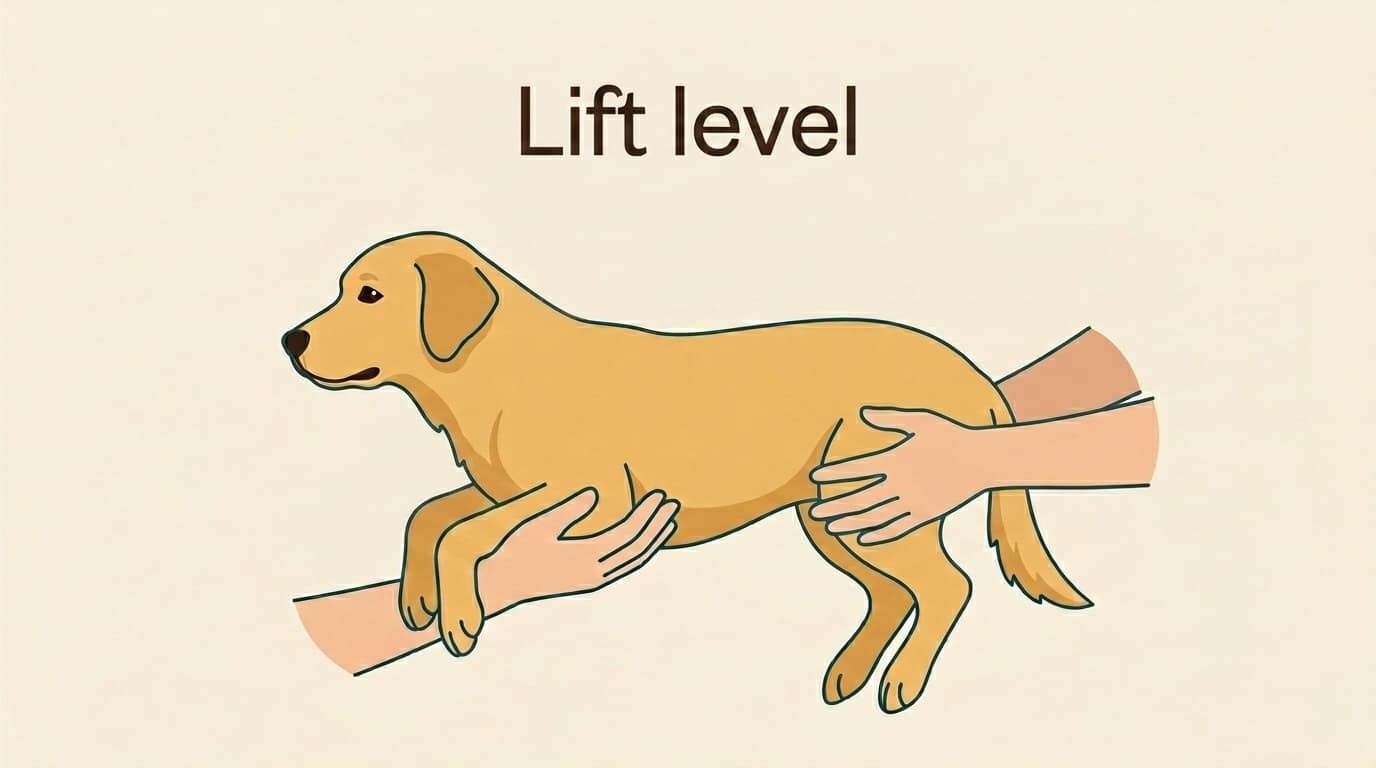
The single most important principle when lifting a dog with a spinal problem is to keep the back straight and level, never letting it bend, twist or sag, because it is exactly that movement of the spine that risks the injury. A recovering disc needs the spine kept stable, and a dog scooped up carelessly, with its back curving or its hind end dangling, gets precisely the movement the rest is meant to prevent.
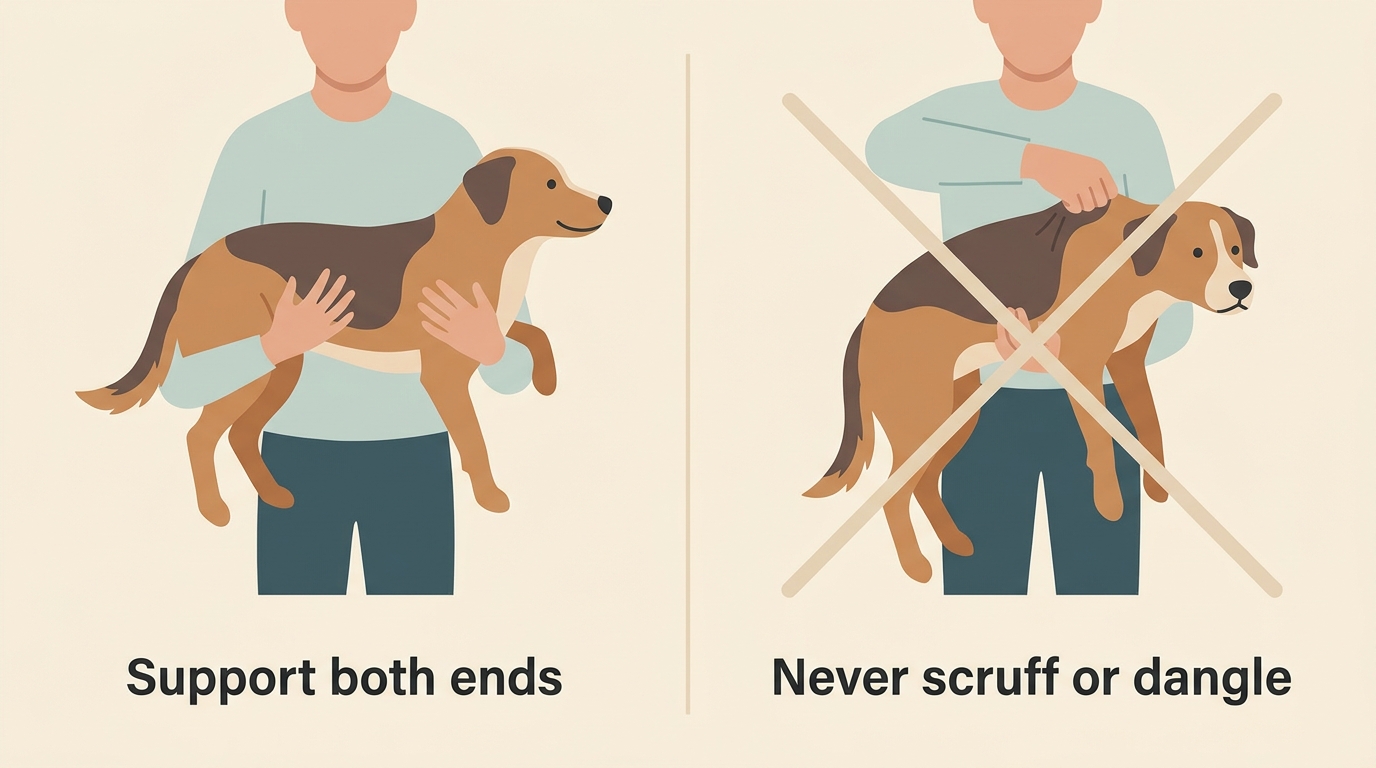
The technique, then, is to support the whole body, both ends at once, when you lift. For a smaller dog, that means one arm or hand supporting the chest and front end and the other supporting the hindquarters and belly, lifting them as a single level unit, like carrying a tray you must not tip. For a larger dog, it means supporting along the length of the body, and getting a second person to help so that one of you takes the front and one the back, keeping the spine level between you. Never lift a dog by the scruff, never let the back legs or hind end dangle below the front, and never drag the dog. Scoop, support, and keep it level. Move smoothly and without rushing, and set the dog down just as carefully as you lifted it. Once you have the feel of "keep the back level, support both ends", it becomes automatic, but it is worth being deliberate about from the very first lift, because every careless lift is a risk and every careful one protects the healing.
Support slings and towels
A great deal of the daily handling is not about lifting your dog fully off the ground at all, but about supporting it, taking the weight of weak hindquarters while the dog uses its front end. That is where a sling comes in. A support sling is a band of fabric passed under the dog's belly, in front of the back legs, with handles you hold to take some of the hindquarter weight, so the dog can stand and move its front legs while you support the back. It is invaluable for toilet trips, letting a dog that cannot bear its own back-end weight get outside, position itself, and do its business with your support, and for the short, supported standing that is part of recovery and rehabilitation.
No commercial sling to hand? A simple towel folded lengthways and passed under the belly does the same job perfectly well. The technique is to position the sling or towel under the belly just in front of the back legs, lift gently to take some of the weight, not to hoist the dog off its feet, and let the dog walk its front legs while you support and guide the back end, keeping the body level. The crucial thing is not to let the back feet drag along the ground, which can scuff and injure them, so support enough that the feet clear the ground or are placed deliberately. Used well, a sling turns the awkward, risky business of getting a weak dog outside into a manageable, safe routine, and saves your back from trying to manhandle the whole dog.
Harnesses, not collars
For guiding and supporting a dog with a spinal problem, and especially one with any neck involvement, a harness is preferable to a collar, and it is worth understanding the reasoning clearly. A collar concentrates any pull or pressure directly on the neck, whereas a well-fitted harness spreads it across the chest and body, away from the neck and spine. For a dog with neck disc disease, or recovering from any spinal problem, avoiding loading the neck in this way is a sensible precaution.
Let me be candid about the strength of this, because it is easy to overstate. The evidence that a harness prevents disc disease is not established, so this is a reasonable, common-sense measure rather than a proven protective intervention, and I would not want you to think a harness will stop a disc problem happening. What it sensibly does is avoid putting pressure on a part of the body you would rather not stress, which is exactly why a harness is the better choice for guiding, supporting, and walking a dog with a spinal condition. A front-clip or support-style harness, well fitted so it does not rub or restrict, is ideal, and for a recovering dog it should be put on and taken off without making the dog twist or contort to get into it. So: harness rather than collar, as a sensible precaution, with realistic expectations of what it does.
Look after your own back too
It is easy, in all the focus on the dog, to forget that lifting and supporting a dog many times a day is hard on you, and protecting your own back matters, because an injured owner cannot nurse a dog. The principles are the familiar ones of any safe lifting. Bend your knees and use your legs rather than stooping and lifting with your back. Keep the dog close to your body rather than at arm's length. Avoid twisting as you lift, turn your feet instead. And, importantly, get help for a larger or heavier dog rather than struggling alone, because a big dog lifted single-handedly is a recipe for a hurt back.
A few practical adjustments make a real difference too. Raising surfaces helps, lifting the dog onto a raised, padded surface for some care tasks saves you bending repeatedly to the floor. Planning the route and clearing obstacles before you lift means you are not shuffling awkwardly with a dog in your arms. And spreading the load, sharing the lifting between household members and pacing yourself, treats the weeks of nursing as the marathon they are. Looking after your own back is not selfish; it is part of being able to look after your dog for the whole of its recovery.
So: lift by supporting both ends and keeping the back level, never scruffing or letting the hind end dangle; use a sling or a folded towel under the belly to take hindquarter weight for toilet trips and supported standing, without letting the feet drag; choose a harness over a collar as a sensible precaution that keeps pressure off the neck, while knowing it is a precaution rather than a guarantee; and protect your own back with good technique, raised surfaces, and help for the heavy lifts. These are learned skills that feel awkward on day one and automatic within a week, and getting them right keeps both your dog's spine and your own back safe through the recovery. Our guides to nursing a down dog and to re-teaching walking pick up where the lifting leaves off.
References
Sister tool · Sightline
Track whether treatment is working
Sightline, a separate ConciergeVet tool, runs a short weekly check-in built on validated pain and mobility instruments, turns it into a single Sightline Score you can watch trend over weeks rather than judge on one bad day, and produces a report you can bring to your vet.
A written log, or our printable trackers, does much the same job.
See how Sightline tracks treatmentTrack the recovery, day by day
Recovery from a disc injury is all about the trend. Log the daily milestones through crate rest and rehab so you can see real progress, not just good and bad days.
Open the Recovery TrackerYou're not doing this alone
Compare treatment journeys and talk to owners managing IVDD. Free to join.
Join PetsLikeMine