

Spondylosis in Dogs: What That X-Ray Finding Actually Means
Alastair Greenway
BVM&S MRCVS
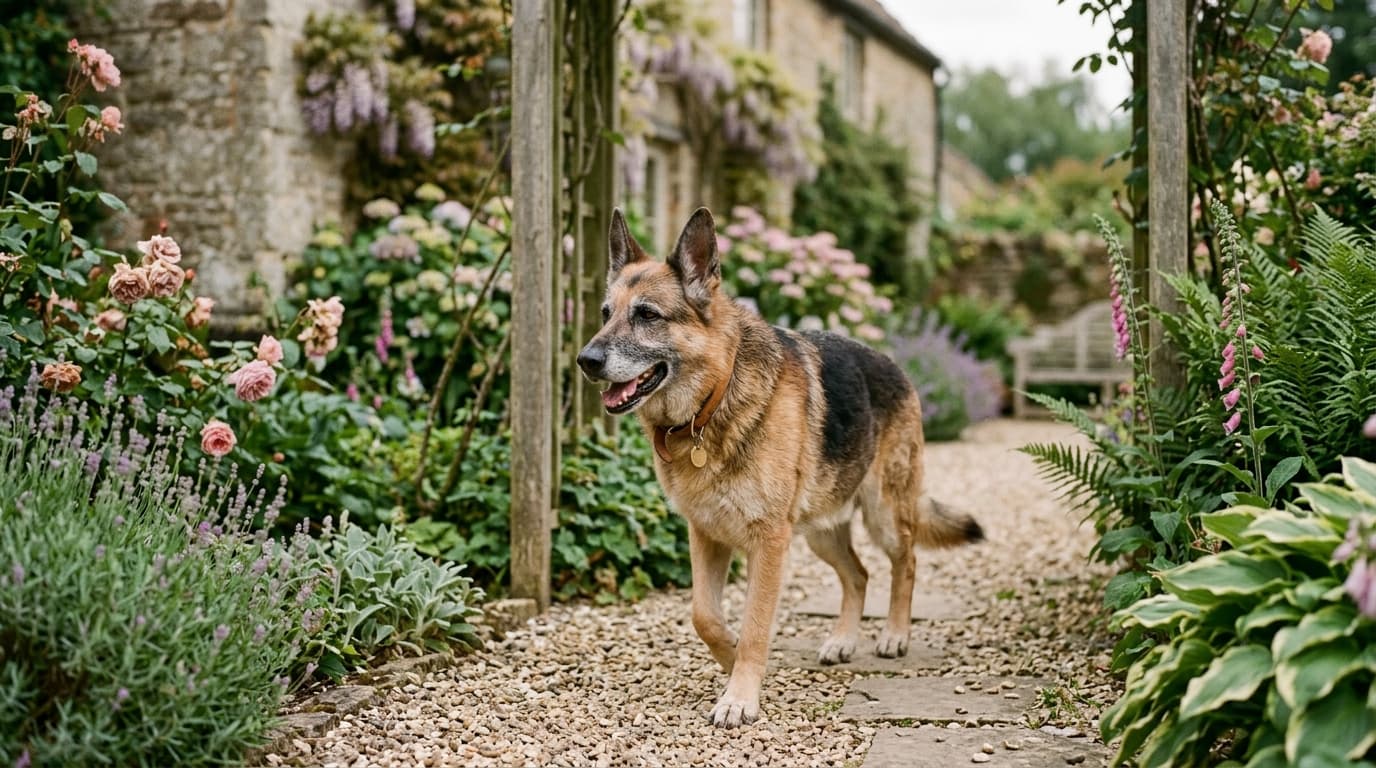
Spondylosis usually turns up by accident, on an X-ray taken for something else entirely, and the word alone is enough to set a frightening picture going: a dog's spine slowly fusing into a solid rod. The internet, when you look, rarely helps. In most dogs, spondylosis is common and often completely harmless, a finding rather than an illness. There are specific situations where it does matter, though, and it is worth knowing which is which.
How the X-ray looks and how your dog feels are two different things. Spondylosis can look dramatic on a film, all bony spurs and bridges, while the dog it belongs to feels absolutely nothing and trots around perfectly happily. Hold onto that, because it is the key to not being frightened by a picture.
What spondylosis actually is
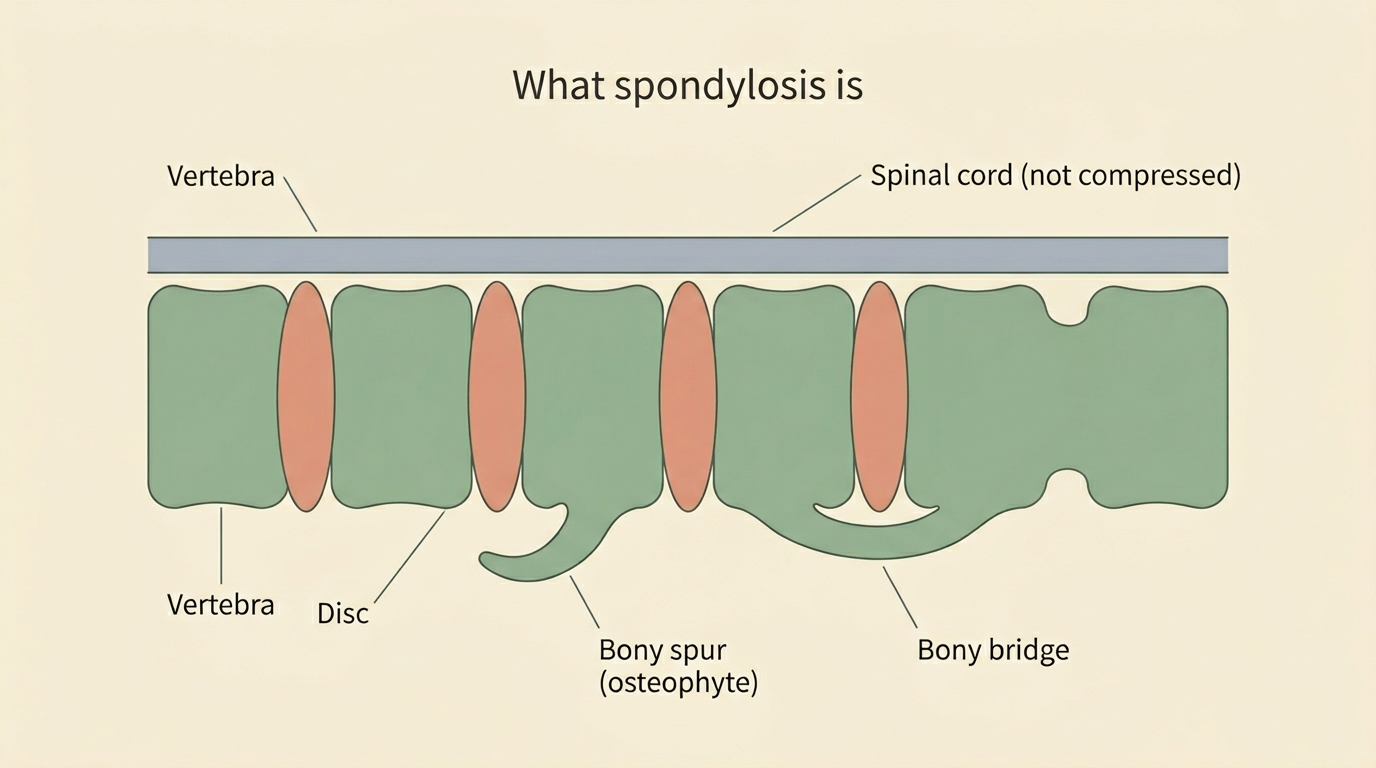
Spondylosis, more properly spondylosis deformans, is the growth of new bony spurs, called osteophytes, along the edges of the vertebrae, the bones of the spine. These spurs form at the margins of the vertebrae near the discs, and in more advanced cases they grow toward each other and can bridge across the gap between two vertebrae, sometimes joining them with a bony bridge. On an X-ray this can look quite alarming, and in their classic form the spurs develop a hooked shape that radiologists sometimes call a "parrot's beak."
Spondylosis is not a disease attacking your dog's spine. It is the spine's own stabilising response to wear in the discs over the years. As the cushioning discs between the vertebrae gradually age and become a little less supportive, the spine responds by laying down these bony spurs to brace and stabilise the slightly loosened joints, rather as a body might splint a joint that has become a touch too mobile. The bony spurs are the body's repair-and-reinforce reflex, not an attack and not an infection. It tends to occur in the chest, lower back, and especially at the junction where the spine meets the pelvis, and understanding it as stabilisation rather than destruction is the first step to seeing it in proportion.
Why it's so common, and why your dog has it
A dog with spondylosis is in very large company, because it is extremely common, particularly in older and larger dogs. The biggest driver is simply age and a lifetime of normal wear on the spine, which is why it turns up so often in senior dogs, and the figures bear this out: depending on how it is looked for, spondylosis is reported in roughly a fifth to a third of dogs on X-rays, and in the majority of dogs at post-mortem examination, which tells you just how ordinary a feature of the ageing spine it is.
Breed matters too. There is a well-recognised hereditary form in the Boxer, in which spondylosis is strikingly common and runs in families, and studies have found it in around half of Boxers by six years of age and three-quarters by nine. German Shepherds and other large breeds are also more prone, and a few other breeds such as the Cocker Spaniel and Airedale Terrier are noted as predisposed. So if you have an older dog, or a Boxer or German Shepherd of any age, finding spondylosis is close to expected rather than alarming. It is one of the most ordinary things a spine does as it ages, and its presence alone tells you your dog has a normal, ageing spine, not that something is wrong.
Usually an incidental finding
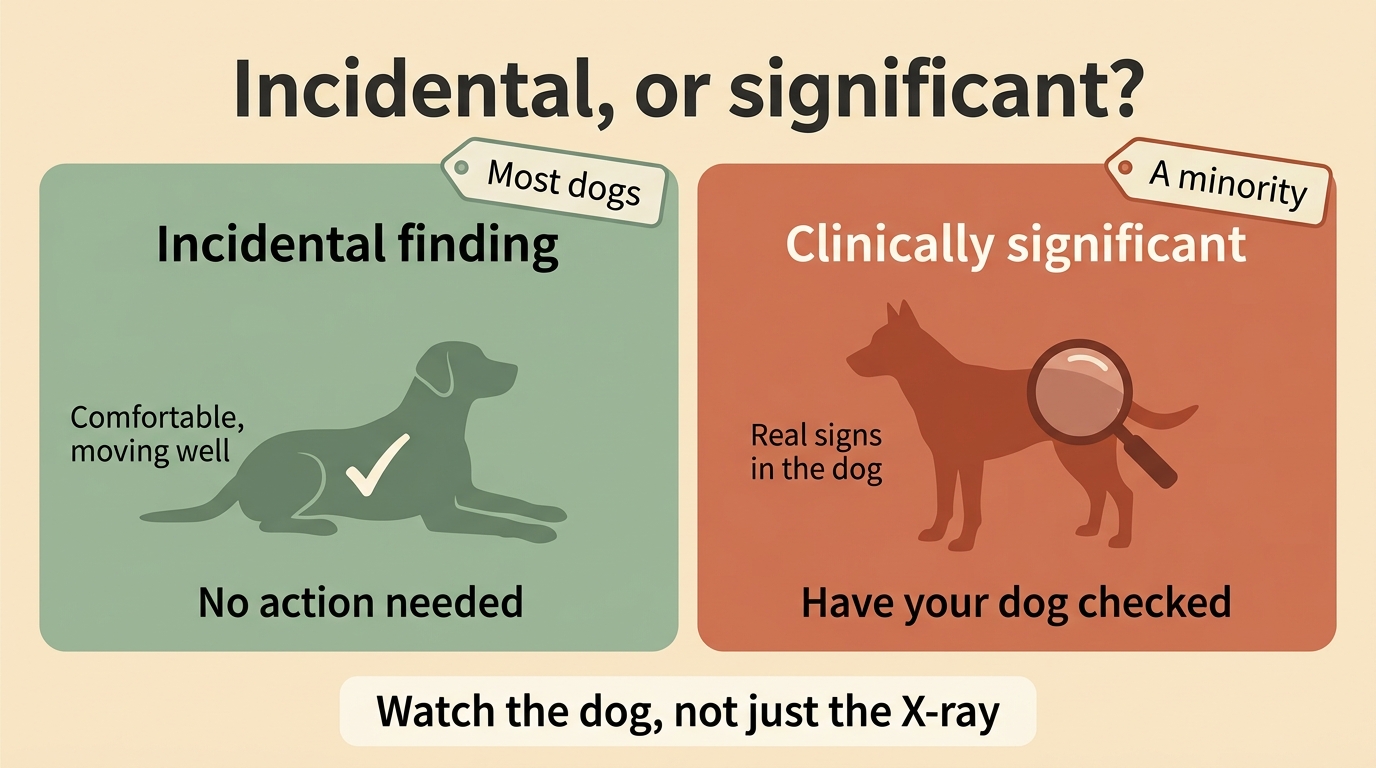
In most dogs, spondylosis causes no problems at all and is discovered entirely by accident. It is one of the classic "incidental findings," picked up on an X-ray taken to investigate something completely unrelated, a dog X-rayed for a tummy upset, a pre-anaesthetic chest film, an investigation of a limp, and there, incidentally, is the spondylosis, quietly present and bothering no one.
The appearance and the dog genuinely do not correlate. The bony spurs sit on the outer margins of the vertebrae and, in the great majority of cases, do not press on the spinal cord or nerves, so even quite dramatic-looking bridging frequently causes the dog no pain or trouble whatsoever. A spine can look heavily affected on the film while its owner is romping in the park without a care. So if your vet has described impressive-sounding changes but your dog is comfortable and moving well, those two facts are not in conflict. They are the normal state of affairs with spondylosis. The picture is not the patient.
When spondylosis does cause problems
The other half of the story has to be told, because while spondylosis is usually harmless, it is not always. In a minority of dogs it does cause trouble, and knowing the signs lets you act when it matters.
Where spondylosis causes problems, the signs are usually those of a stiffer, less comfortable back: reduced flexibility, a reluctance to jump, turn, or twist, a stiff or slightly roached posture, and sometimes back pain or a general loss of suppleness. These can be subtle and easy to attribute simply to "getting old." There is also one region that more often turns clinically significant than the rest, and it is worth knowing about specifically: the junction at the very base of the spine where the last lumbar vertebra meets the pelvis, the lumbosacral junction. This area bears a great deal of movement and stress, and when degenerative changes here, which can include spondylosis alongside disc and ligament changes, narrow the space where nerves exit, they can pinch those nerve roots, a condition called degenerative lumbosacral stenosis or cauda equina syndrome. The signs of this are more specific and worth watching for: difficulty rising, a sore lower back, reluctance to climb stairs or jump into the car, weakness or scuffing of the hind legs, and sometimes changes in the tail or in toileting. If you see these, that is the cue to have your dog checked properly, because this is the form of the problem that genuinely benefits from attention. For most dogs none of this applies, but knowing the warning signs means you will recognise the uncommon case if it is yours.
What it isn't: the conditions it gets confused with
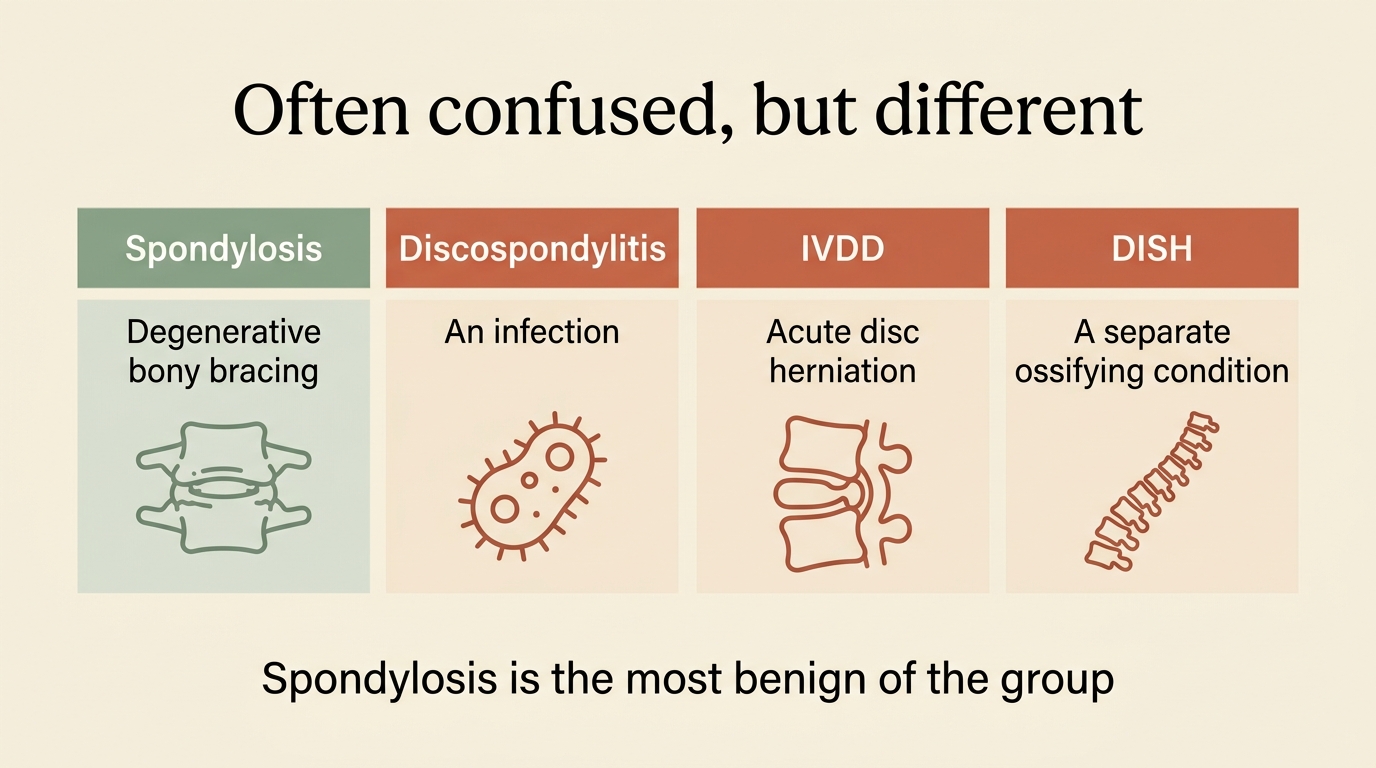
This is where careful information really matters, because spondylosis is frequently muddled up with other, more serious spinal conditions, both by worried owners reading online and occasionally in casual conversation, and the distinctions are important. Getting these straight is genuinely reassuring, because the frightening things people imagine are usually not what spondylosis is.
The most common and most important confusion is between spondylosis and discospondylitis. The names sound almost identical, but they could hardly be more different. Spondylosis is a non-inflammatory, degenerative reaction, the harmless bony bracing we have described, whereas discospondylitis is an infection of the disc and adjacent bone, a genuinely serious condition that makes a dog painful and often unwell in itself, sometimes feverish, and that needs prompt veterinary treatment with antibiotics. Spondylosis is not spondylitis: degeneration is not infection. Spondylosis is also distinct from intervertebral disc disease, or IVDD, in which a disc itself herniates and presses on the spinal cord, which can come on acutely and, in its severe forms, be an emergency causing sudden pain or even paralysis. Spondylosis, by contrast, is the slow, bony bridging of the disc margins, a different process entirely, and, tellingly, studies have found that dogs with disc herniation do not have more spondylosis than other dogs, so the bony bridges are not a sign that a disc is about to "go." There is also a separate, more extensive bone-forming condition called DISH, diffuse idiopathic skeletal hyperostosis, which produces more widespread ossification along the spine and is sometimes mistaken for severe spondylosis but is a distinct entity. And the spinal joints can develop their own arthritis at the small facet joints, which is a different thing again from the disc-margin spurs of spondylosis. The reassuring thread through all of this is that spondylosis is the mildest and most benign of the spinal findings it gets confused with, so clearing up the confusion almost always means there is less to worry about, not more.
Reaching a diagnosis
Spondylosis is usually diagnosed on plain X-rays, which show the bony spurs and bridges very clearly, and, as we have said, it is most often spotted incidentally on films taken for some other reason. For the straightforward, symptom-free case, an X-ray is generally all that is involved, and often the diagnosis is made simply by noticing it on a film taken anyway.
More advanced imaging, such as CT or MRI, is reserved for the situations where it is genuinely needed, in particular when a dog has signs that suggest nerve involvement, or when lumbosacral compression at the base of the spine is suspected, because these scans show the discs, nerves, and soft tissues that plain X-rays cannot, and MRI in particular is the gold standard for assessing nerve compression. One diagnostic point matters above the rest, and it follows directly from everything above: finding spondylosis on an X-ray does not automatically explain a dog's pain. Because it is so common and so often harmless, its mere presence on a film is not proof that it is the cause of any given problem, and a good vet does not simply blame the back pain on the first abnormality they see. Instead they correlate the film with the actual dog in front of them, asking whether the dog's signs genuinely fit the findings, or whether the spondylosis is just an innocent bystander and the real cause lies elsewhere. That careful correlation, the picture read alongside the patient, is exactly what stops an incidental finding being mistaken for the diagnosis.
Treatment, and why "doing nothing" is often right
For the many dogs whose spondylosis is an incidental, symptom-free finding, the correct treatment is genuinely no treatment at all, and that is not neglect, it is good medicine. These dogs need nothing more than to carry on their normal lives, and the most useful things you can do for them are the general good-health basics that help any ageing dog: keeping them lean and keeping them moving. There is no benefit in treating an X-ray that is not troubling the dog.
For the minority of dogs whose spondylosis is genuinely causing stiffness or pain, the approach is the familiar toolkit we use for arthritis and back discomfort generally, which our other guides cover in depth. Weight control is the single biggest lever, because excess weight loads the spine and every other joint, so keeping your dog slim does more than almost anything else, as our weight-management guide explains. Controlled, regular exercise keeps the spine mobile and the supporting muscles strong, since a moderately active back stays more comfortable than a stiff, under-used one, and our exercise guide describes how to pitch it. Pain relief has a clear role where there is genuine discomfort, including the anti-inflammatory medicines and the newer arthritis treatments such as the monthly antibody injection that our medication guide and our article on Librela describe, always chosen with your vet. Physiotherapy can help keep an affected back supple and well-supported. Hydrotherapy can be useful too, but with an important spinal caveat that our hydrotherapy guide explains: for a painful spine, free swimming in a pool can sometimes aggravate things, whereas the controlled, supported movement of an underwater treadmill is usually the safer modality, so this is one to approach on professional advice. And for the uncommon dog with significant nerve compression at the lumbosacral junction that does not respond to conservative care, surgery to relieve the pressure is an option, discussed with a specialist, as our article on when pain needs a specialist describes. The great majority of dogs, though, never need anything beyond lean weight and steady exercise, if that.
The outlook
So, how worried should you actually be? For most dogs with spondylosis, the plain and happy answer is: much less than that scary word made you fear. In the great majority of cases this is a common, incidental finding that will quietly accompany your dog through a normal, comfortable life without ever causing a problem, and the right response is simply to carry on, keep your dog lean, and keep them gently and regularly active, which keeps the whole spine and body in the best shape to stay comfortable.
If, on the other hand, you have noticed real signs, stiffness, a reluctance to jump or turn, difficulty rising, a sore lower back, or any of the hind-end or tail changes that point to the lumbosacral region, then that is your cue to talk to your vet, specifically about pain relief and about having the lower back assessed properly, because that is the situation where attention genuinely helps. Watch your dog, not just the X-ray. The film is only part of the story, and a dramatic-looking spine on a calm, comfortable dog is, far more often than not, nothing to fear at all.
References
- VCA Animal Hospitals. Spondylosis Deformans in Dogs.
- Levine GJ, Levine JM, Walker MA, Pool RR, Fosgate GT. Evaluation of the association between spondylosis deformans and clinical signs of intervertebral disk disease in dogs: 172 cases (1999-2000). Journal of the American Veterinary Medical Association, 2006.
- Carnier P, Gallo L, Sturaro E, Piccinini P, Bittante G. Prevalence of spondylosis deformans and estimates of genetic parameters for the degree of osteophytes development in Italian Boxer dogs. Journal of Animal Science, 2004.
- Langeland M, Lingaas F. Spondylosis deformans in the boxer: estimates of heritability. Journal of Small Animal Practice, 1995.
- Kranenburg HJC, Voorhout G, Grinwis GCM, Hazewinkel HAW, Meij BP. Diffuse idiopathic skeletal hyperostosis (DISH) and spondylosis deformans in purebred dogs: a retrospective radiographic study. The Veterinary Journal, 2011.
- Meij BP, Bergknut N. Degenerative lumbosacral stenosis in dogs. Veterinary Clinics of North America: Small Animal Practice, 2010.
- BSAVA Manual of Canine and Feline Musculoskeletal Disorders, 2nd ed. (2018), eds. Arthurs, Brown and Pettitt. ISBN 978-1-905319-69-5.
Sister tool · Sightline
Track whether treatment is working
Sightline, a separate ConciergeVet tool, runs a short weekly check-in built on validated pain and mobility instruments, turns it into a single Sightline Score you can watch trend over weeks rather than judge on one bad day, and produces a report you can bring to your vet.
A written log, or our printable trackers, does much the same job.
See how Sightline tracks treatmentSee where your pet stands today
Tracking is the other half of managing arthritis. Take the 2-minute Mobility Check to see your pet's stage, then watch it shift as treatment takes effect.
Take the Mobility CheckYou're not doing this alone
Compare treatment journeys and talk to owners managing arthritis. Free to join.
Join PetsLikeMine