

Deep Pain Sensation: The Single Most Important Test
Dr. Alastair Greenway
MRCVS
When a dog can't walk after a spinal injury, one piece of information matters more than almost any other for what happens next and for the odds of recovery: whether the dog still has what vets call deep pain sensation. It's the single most important test in the whole situation, the line that separates a hopeful outlook from a guarded one, and it drives urgent decisions about surgery. This guide explains what deep pain sensation is, how your vet tests it, and, above all, the one distinction the entire concept rests on, a distinction that's genuinely easy to get wrong and that you deserve to understand clearly. The aim is to help you follow what your vet is checking and why it matters so much, not to test your dog at home instead of getting them seen.
What deep pain sensation is
Deep pain sensation, also called deep pain perception or DPP, is the deepest, most fundamental layer of feeling in the body, the ability to sense a strong, deep pinch right down to the bone. It's carried by nerve fibres buried deep within the spinal cord, and these are the most resilient fibres of all: they are the last to be lost when the spinal cord is severely damaged.
That resilience is exactly what makes the test so revealing. Because deep pain is the last sensation to disappear, its presence or absence tells your vet how severely the spinal cord has been affected. A dog that has lost the ability to walk but can still feel deep pain has a spinal cord that, though injured, is still functioning at that deepest level, with the connection between the legs and the brain at least partly intact. If even deep pain has gone, it signals that the cord has been damaged severely enough to interrupt that deepest connection. So this one test acts as a window onto how badly the cord has been hurt, which is why it carries so much weight.
How it's tested
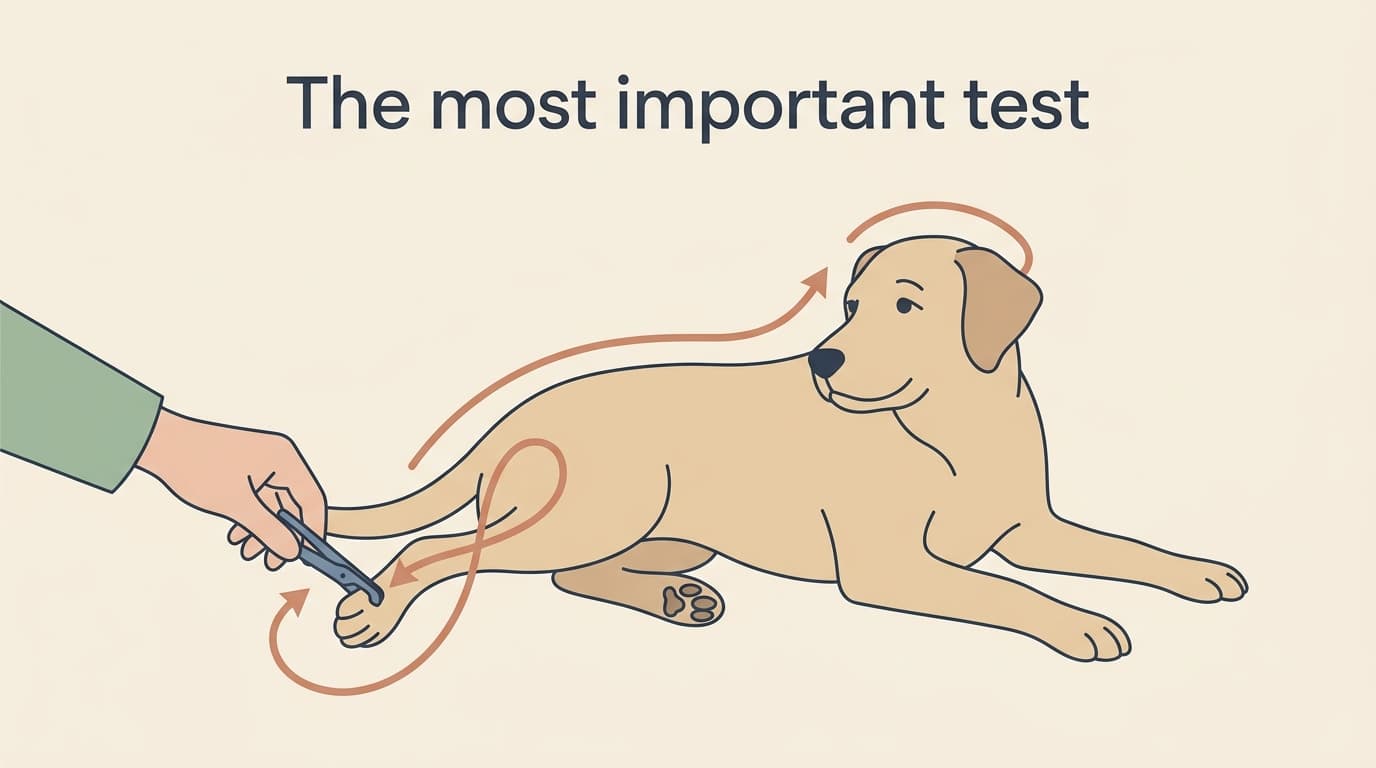
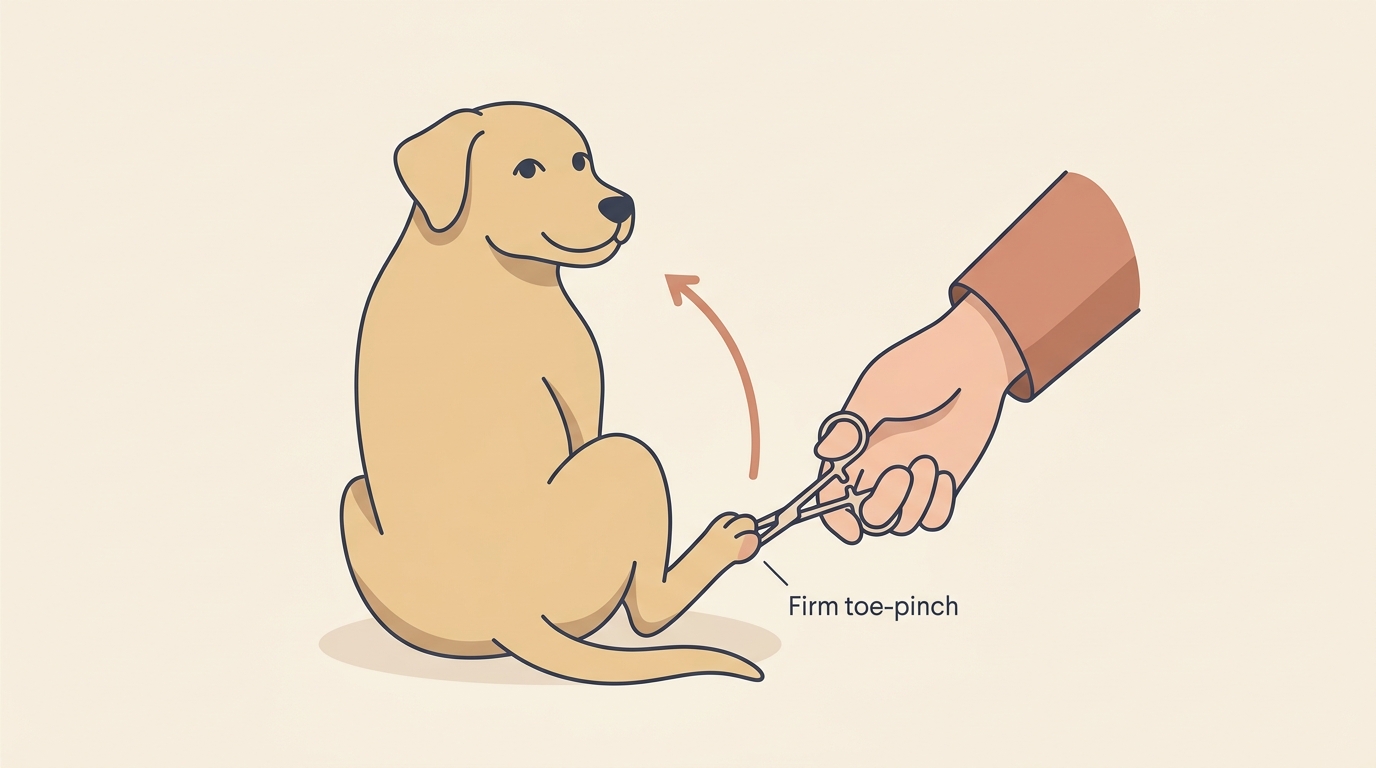
The test itself is simple, though it should be done by your vet, and it looks for one specific thing. Your vet applies a firm, deliberate pinch to the dog's toe, typically using an instrument such as a haemostat clamped across the nail bed or the web of the toe, applying genuine, strong pressure right to the bone. This is a meaningful pinch, not a gentle squeeze, because the whole point is to test the deepest layer of sensation, and a light touch wouldn't do it.
What your vet is watching for is the dog's reaction to that pinch, specifically a sign that the sensation has travelled all the way up the spinal cord to the brain and that the dog has consciously registered it.
Conscious response, not reflex
Here is the distinction the entire concept hinges on, and getting it right is genuinely important, because owners, and even some clinicians, get it wrong, and a mistake here can give false hope at the worst possible moment.
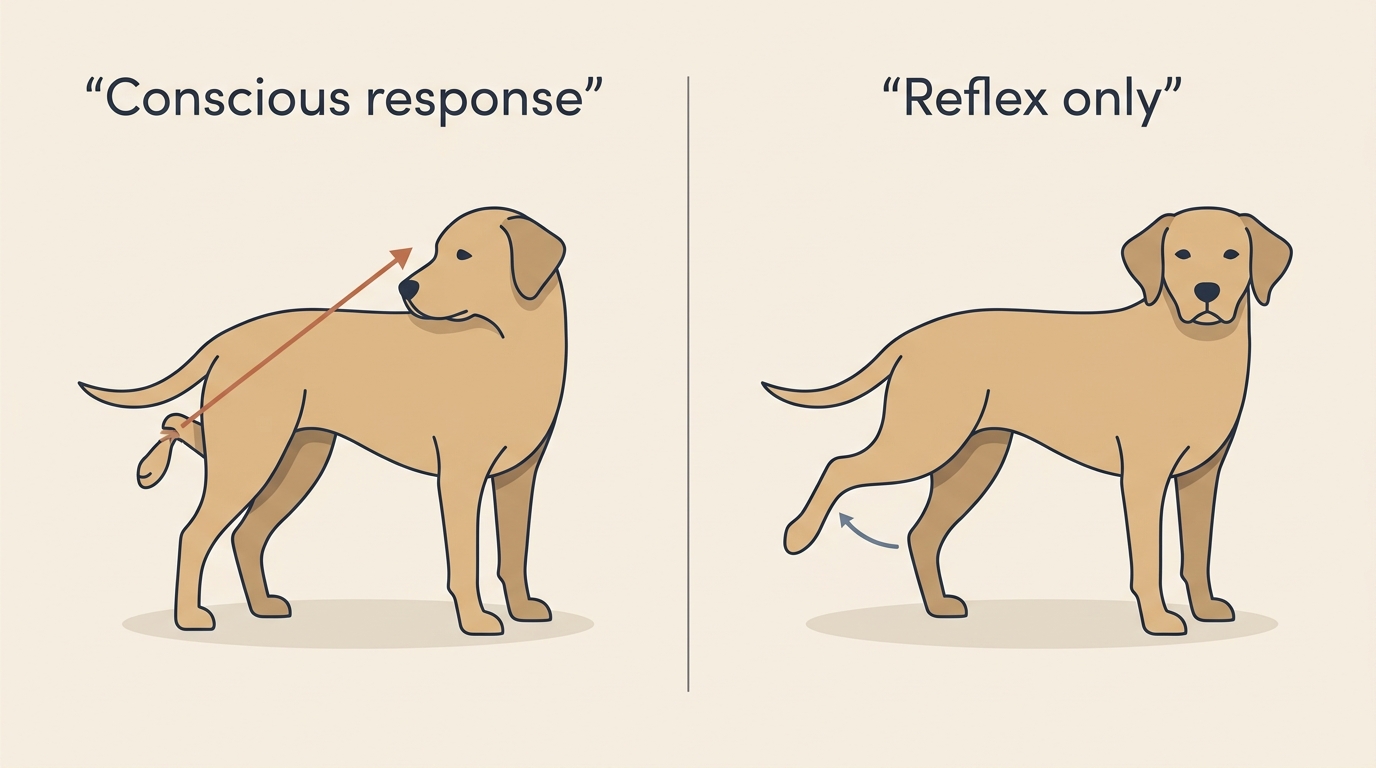
A positive deep pain response is a conscious reaction to the pinch: the dog turns its head toward the source, cries out or yelps, tries to bite, or otherwise clearly shows that it has felt and registered the sensation in its brain. That conscious acknowledgement is the thing that counts, because it proves the message has reached the brain.
What does not count, and this is the crucial part, is the leg simply pulling back. When you pinch the toe, the leg may flex and withdraw on its own, jerking away from the pinch. This looks for all the world like the dog feeling it and pulling away, and it's the most natural thing in the world to see that and think "he can still feel it, that's a good sign." But it isn't deep pain sensation. That leg-withdrawal is a spinal reflex, a local, automatic loop that happens entirely within the spinal cord at the level of the leg, without the message ever needing to reach the brain at all. Critically, this reflex can still happen, the leg can still pull back briskly, even in a dog whose spinal cord has been so severely damaged that no sensation is getting through to the brain, a dog that has genuinely lost deep pain. The reflex persists because the local loop is still intact, even though the long pathway up to the brain has been cut off.
So the leg pulling back tells you almost nothing about the prognosis on its own. The only thing that counts as true deep pain sensation is the conscious response, the head turn, the cry, the look round, the attempt to bite, proof positive that the brain has received the message. This is precisely why the test should be done and interpreted by your vet, who knows to look past the reflex twitch for the conscious reaction, and why you should never reassure yourself at home that your paralysed dog "can still feel it" because a leg moved. A moving leg isn't the same as a feeling dog. The withdrawal reflex isn't deep pain, and only the conscious response counts.
Why it's the line in the sand
Deep pain matters so enormously because it's the strongest single predictor of whether a dog will walk again, and the figures make the stakes plain. A dog that has lost the ability to walk but still has deep pain present has an excellent outlook with surgery, with recovery reported in over ninety percent of cases. Even managed conservatively, the difference is striking: in one study of dogs managed without surgery, ninety-six percent of those with deep pain present recovered the ability to walk, at a median of around eleven days, compared with forty-eight percent of those without deep pain, at a median of around twenty-five days. In studies of other causes of spinal injury the gap is wider still, with one finding that dogs with deep pain were many times more likely to walk again than those without. A dog that has lost deep pain faces a more serious situation, with recovery after surgery reported at around half to sixty percent.
This is where deep pain meets the clock. For a dog that has lost deep pain, time becomes critical, because the chance of recovery is best when the pressure on the cord is relieved by surgery as soon as possible. This is the situation our guide to the red flags describes as a true emergency, where waiting and seeing can quietly cost a dog its chance. I want to be precise, though, and avoid a frightening myth: the loss of deep pain does not mean there is a rigid deadline of a day or two after which surgery is pointless, recovery remains possible even after some delay, but the odds are better the sooner it happens, so the right response is urgency, not panic, getting the dog to a vet or neurologist without delay rather than concluding all is lost. Our guides to the grades and to the surgery decision pick up the story from here, because deep pain is the factor that sits beneath both.
A note of hope, and of caution
Two final things, because a complete picture includes both. The hopeful one: even some dogs that never regain deep pain are not necessarily dogs that will never walk, because with dedicated physiotherapy a proportion develop a reflex-driven "spinal walking" of their own over months, and others do beautifully on wheels, as our guide to life on wheels describes. So a deep-pain-negative result, while serious, isn't the end of a good life. The sobering one: the loss of deep pain is also associated with a rare but grave complication in which the spinal cord tissue itself begins to break down, which your vet will be watching for in the first few days, and which is part of why these dogs need urgent specialist care. Your vet will talk you through both the hope and the risk for your own dog.
Deep pain sensation is the deepest layer of feeling, the last to be lost, and therefore the clearest sign of how severely the spinal cord has been damaged, which is why it's the single most important test in a non-walking dog. The one thing to understand above all is that only a conscious response to the pinch counts, the head turn, the cry, the look round, and never the mere reflex of a leg pulling back, which can persist even when deep pain is gone. And if your dog can't walk, the practical takeaway is simple: this is something for your vet to assess urgently, because both the answer and the timing genuinely shape your dog's chance of walking again. If you're unsure whether your dog is affected, our triage checker can help you judge how quickly to act, but when a dog has gone off its legs, the safest assumption is always to treat it as an emergency and get them seen now.
References
- Olby NJ, Moore SA, Brisson B, Fenn J, Flegel T, Kortz G, Lewis M, Tipold A. ACVIM consensus statement on diagnosis and management of acute canine thoracolumbar intervertebral disc extrusion. Journal of Veterinary Internal Medicine, 2022;36(5):1570-1596.
- Khan S, Jeffery ND, Freeman P. Recovery of ambulation in small, nonbrachycephalic dogs after conservative management of presumptive acute thoracolumbar intervertebral disc extrusion. Journal of Veterinary Internal Medicine, 2024;38(5):2603-2611.
- Togawa G, Lewis MJ, Devathasan D, et al. Outcome of conservative and surgical management in dogs with acute non-compressive nucleus pulposus extrusion and fibrocartilaginous embolic myelopathy. Frontiers in Veterinary Science, 2024;11:1406843.
- Moore SA, Tipold A, Olby NJ, Stein V, Granger N. Current approaches to the management of acute thoracolumbar disc extrusion in dogs. Frontiers in Veterinary Science, 2020;7:610.
- Jeffery ND, Barker AK, Hu HZ, et al. Factors associated with recovery from paraplegia in dogs with loss of pain perception in the pelvic limbs following intervertebral disk herniation. Journal of the American Veterinary Medical Association, 2016;248(4):386-394.
Free downloads
Companion worksheets to put what you've read into practice. Free PDFs, print at home.
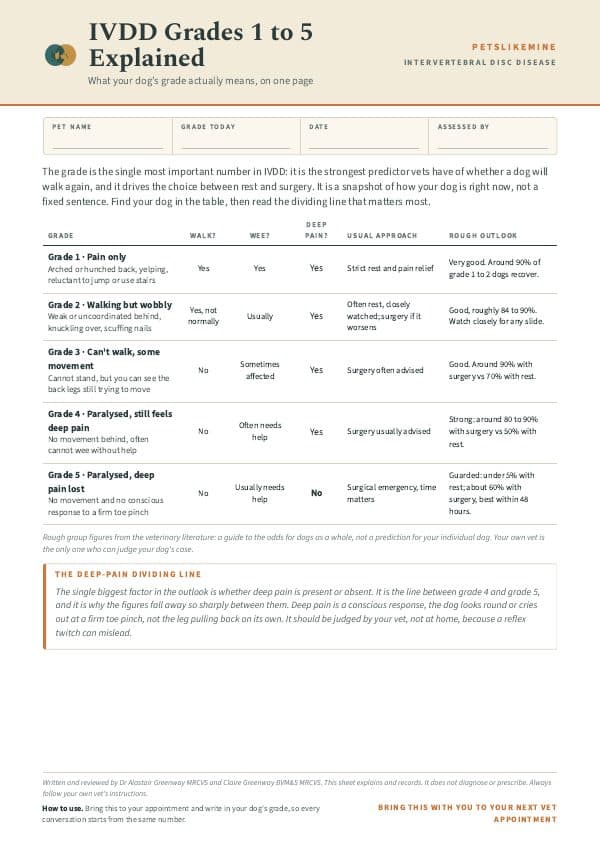
IVDD Grades 1 to 5 Explained
PDF · 289 KBWhat your dog's grade actually means, on one clear page. From a painful back with no weakness through to the loss of deep pain, each grade set out plainly alongside what it tends to mean for treatment and outlook. The grade, not a wobble or a bad day, is what drives every decision ahead, so it helps to know where your dog sits.
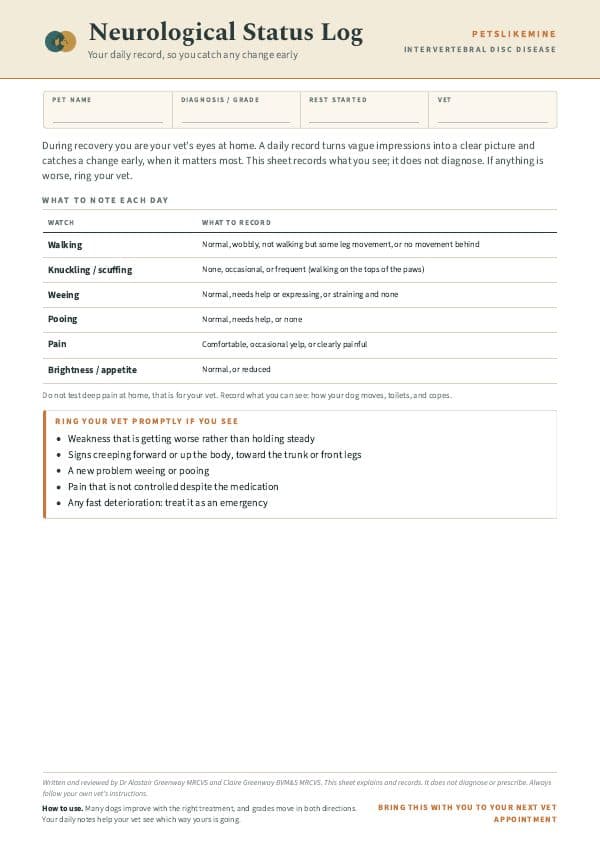
Neurological Status Log
PDF · 232 KBA simple daily record of the things your vet will want to know: deep pain, tail movement, leg position, toileting and how the back seems. The trend down the page is what tells you and your vet which way recovery is heading. Take it to every recheck so the conversation starts from facts, not memory.
Sister tool · Sightline
Track whether treatment is working
Sightline, a separate ConciergeVet tool, runs a short weekly check-in built on validated pain and mobility instruments, turns it into a single Sightline Score you can watch trend over weeks rather than judge on one bad day, and produces a report you can bring to your vet.
A written log, or our printable trackers, does much the same job.
See how Sightline tracks treatmentTrack the recovery, day by day
Recovery from a disc injury is all about the trend. Log the daily milestones through crate rest and rehab so you can see real progress, not just good and bad days.
Open the Recovery TrackerYou're not doing this alone
Compare treatment journeys and talk to owners managing IVDD. Free to join.
Join PetsLikeMine