

Nursing a Down Dog at Home: The Complete Guide
Alastair Greenway
BVM&S MRCVS
A dog that cannot walk, whether home after spinal surgery or to be nursed through conservative recovery, suddenly needs help with the most basic things: weeing, staying clean, changing position. That is a daunting amount to take on, and a daunting amount to learn at once. Nursing a down dog is genuinely a lot at first, there is no pretending otherwise, but it settles into a daily rhythm that quickly becomes routine, and it breaks down into a manageable set of jobs, each of which has its own detailed guide. You really can do this.
A day in the life
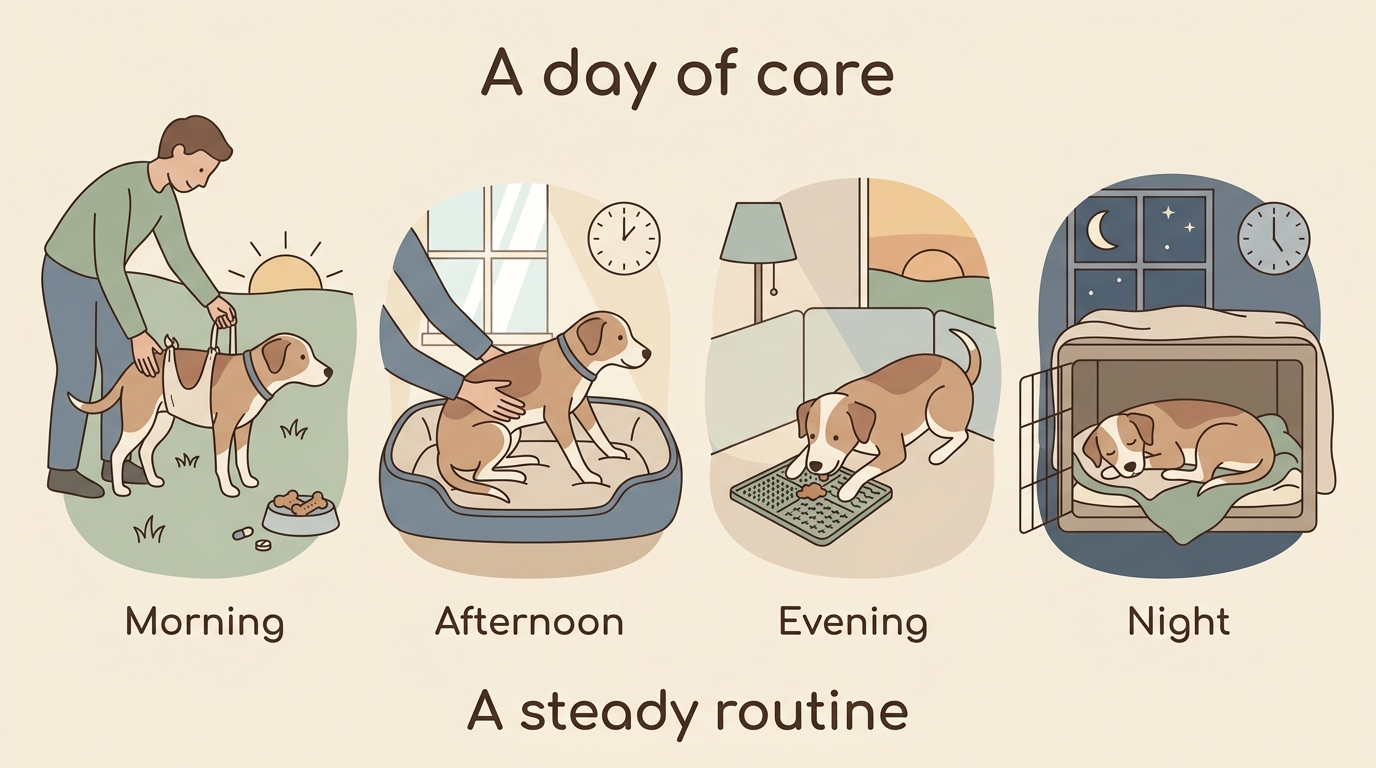
The single most helpful shift is to think of nursing care not as a constant, formless demand but as a daily rhythm of specific tasks slotted into fixed points. A realistic day looks something like this: emptying the bladder a few times across the day and last thing at night, turning your dog every few hours so no part of the body is under pressure too long, checking the skin over the bony points each day, giving medications at their set times, offering short comfort breaks and gentle company, and managing feeding and water. Built into a routine, these stop being a vague worry and become a checklist you work through, and most of them take only a few minutes each.
It genuinely helps to write the routine down, especially at first, and to share it if more than one person is caring for the dog, so that turns and medications are not missed or doubled. Our recovery tracker is built for exactly this, letting you log the daily jobs and your dog's progress, and a printable daily care checklist can sit on the fridge. The shape of the day matters more than perfection: a dog that is reliably emptied, turned, checked, medicated, and kept clean and comfortable, on a routine, is a dog being nursed well. Once the rhythm is established, what felt overwhelming on day one becomes second nature within a week or two, which almost every owner who has done it will tell you.
Bladder and bowel
A dog that cannot walk often cannot wee or poo normally either, and managing this is central to nursing care, so it gets the first place in the daily routine. Many down dogs need their bladder emptied by hand, a few times a day, to keep it from over-filling and to protect against infection, and our step-by-step guide to expressing the bladder covers the technique in full, ideally after your vet or nurse has shown you on your own dog.
One important point belongs here, because it affects your dog's health: emptying the bladder by hand often does not empty it completely, even when done well, so do not assume the job is fully done, and keep your vet involved in how it is going. Learn to recognise a full bladder, a firm swelling low in the belly, and stay alert for the signs of a urinary infection, a strong smell, cloudy or bloody urine, or your dog seeming unwell, which our guide to long-term incontinence also covers. Bowel movements are usually more straightforward and often happen with gentle handling or stimulation, but mention any difficulty to your vet. The detail of all this is in the linked guides; the point here is that bladder care leads the daily routine and is very learnable.
Protecting the skin
Because a down dog spends its time lying down, protecting the skin is the next pillar of nursing care, and it pairs naturally with the turning. The two big risks are pressure sores, which develop where bony points press against the surface for too long, and urine scald, where leaked urine irritates the skin, and our guide to preventing pressure sores and urine scald covers both in detail.
In the daily routine, this means turning your dog every few hours, rotating between lying on each side and resting upright on its chest, so no single set of bony points stays under pressure, and checking the skin over those points, the hips, shoulders, elbows, hocks, and the lowest ribs, every day to catch any redness before it breaks down. The surface matters too: a thick, supportive, moisture-wicking bed, rather than a thin blanket on a hard floor, does much of the protective work. Keeping your dog clean and dry, promptly cleaning any leaked urine, ties the skin care and the bladder care together. Again, the linked guide has the full how-to; in the rhythm of the day, "turn and check the skin" is simply one of the recurring jobs.
Lifting and moving safely
Moving a dog that cannot move itself, for toilet breaks, position changes, or simply to be near you, is a physical part of nursing care, and doing it correctly protects both your dog's spine and your own back. The principles are to support the whole body and keep the back level and straight, never letting it twist or sag, and never lifting by the scruff or letting the dog dangle, and our guide to slings, harnesses, and safe lifting covers the technique and the kit.
A support sling or a towel under the belly is invaluable for taking the weight of the hindquarters during toilet breaks and any supported standing, and a harness rather than a collar protects the neck. Plan your lifts, bend your knees, raise surfaces where you can, and get help for a larger dog, because nursing is a marathon and protecting your own back matters as much as protecting your dog's. The linked guide shows exactly how; in the daily rhythm, safe lifting is simply how every move is done.
Keeping your dog clean and comfortable
Beyond the specific tasks, a down dog needs general comfort and cleanliness, and attending to this is part of nursing well. Keep your dog clean and dry, with gentle grooming to keep the coat in good order and to give you a regular close look at the skin. Keep them warm and draught-free, since a dog that cannot move cannot adjust its own warmth. And keep them company, positioned in the heart of the household rather than isolated, because a down dog that can see and hear its family settles far better and stays in better spirits than one shut away. Small comforts, a favourite blanket, gentle fuss, a calm presence, matter to a recovering dog's wellbeing as much as the practical care does. Comfort is not separate from nursing; it is part of it.
Don't forget yourself
This is the part that is easy to neglect and genuinely important: nursing a down dog is demanding on you, and your own wellbeing matters. The work is real, several tasks a day, broken sleep, constant vigilance, the physical effort of lifting, and the emotional weight of seeing your dog vulnerable, and studies of owners who have nursed dogs through severe spinal injury confirm that it is a significant commitment of time and energy. And yet those same owners, overwhelmingly, find it worthwhile, so this is demanding but doable, and not a thankless slog.
The practical wisdom is to treat it as a marathon, not a sprint: share the rota if there is more than one of you, accept help when it is offered, lower the bar on the rest of life for a while, and do not expect yourself to do it all flawlessly. Our guide to keeping a confined dog calm and content covers the emotional side, for your dog and for you, in more depth. Please do not feel you have to be a trained nurse or a martyr to do this well; you need a steady routine, the linked guides for the detail, your vet on the end of the phone, and a bit of kindness toward yourself.
When to call the vet
Nursing care also includes knowing when something has changed and needs the vet, and this matters enough to have its own guide. In short, contact your vet promptly if your dog gets weaker rather than stronger, if signs seem to creep forward up the body, if there is a marked increase in pain, if the bladder cannot be emptied or shows signs of infection, if a surgical wound looks hot, swollen, or discharging, or if your dog suddenly seems distressed or unwell. Our guide to recovery red flags sets out exactly what is a normal bump in the road and what warrants a call, so you can tell the difference without either panicking or missing something. The simple rule is that getting worse rather than better, or anything that genuinely worries you, is always worth a phone call.
So, to pull it all together: nursing a down dog comes down to a daily rhythm of emptying the bladder, turning and checking the skin, giving medications, lifting safely, and keeping your dog clean, comfortable, and in good company, with each of those covered in detail by its own guide and the whole thing made easier by writing the routine down and sharing the load. It is a lot on day one and routine by week two. Use the linked guides for the how-to of each task, our recovery tracker to keep the routine and watch the progress, and your vet for anything that worries you.
References
- Carwardine DR, Rose JH, Harcourt-Brown TR, Granger N. Effectiveness of manual bladder expression in paraplegic dogs. American Journal of Veterinary Research, 2017;78(1):107-112.
- Freeman PM, Holmes MA, Jeffery ND, Granger N. Time requirement and effect on owners of home-based management of dogs with severe chronic spinal cord injury. Journal of Veterinary Behavior, 2013;8(6):439-443.
Sister tool · Sightline
Track whether treatment is working
Sightline, a separate ConciergeVet tool, runs a short weekly check-in built on validated pain and mobility instruments, turns it into a single Sightline Score you can watch trend over weeks rather than judge on one bad day, and produces a report you can bring to your vet.
A written log, or our printable trackers, does much the same job.
See how Sightline tracks treatmentTrack the recovery, day by day
Recovery from a disc injury is all about the trend. Log the daily milestones through crate rest and rehab so you can see real progress, not just good and bad days.
Open the Recovery TrackerYou're not doing this alone
Compare treatment journeys and talk to owners managing IVDD. Free to join.
Join PetsLikeMine