

"Is This Normal?" Red Flags to Watch For During Recovery
Alastair Greenway
BVM&S MRCVS
Recovery from a disc problem turns most owners into close observers of every twitch, every off day, every change. Is that stiffness this morning a setback or just a normal bump? Is the wobble as function returns a good sign or a worrying one? That worry is completely understandable, and this guide is here to settle it, by drawing a clear line between the ordinary ups and downs of recovery, which are normal and to be expected, and the genuine red flags that mean you should pick up the phone. Knowing which is which protects your dog against the two opposite dangers: panicking over every minor wobble, and missing something that genuinely needs attention.
Normal bumps in the road
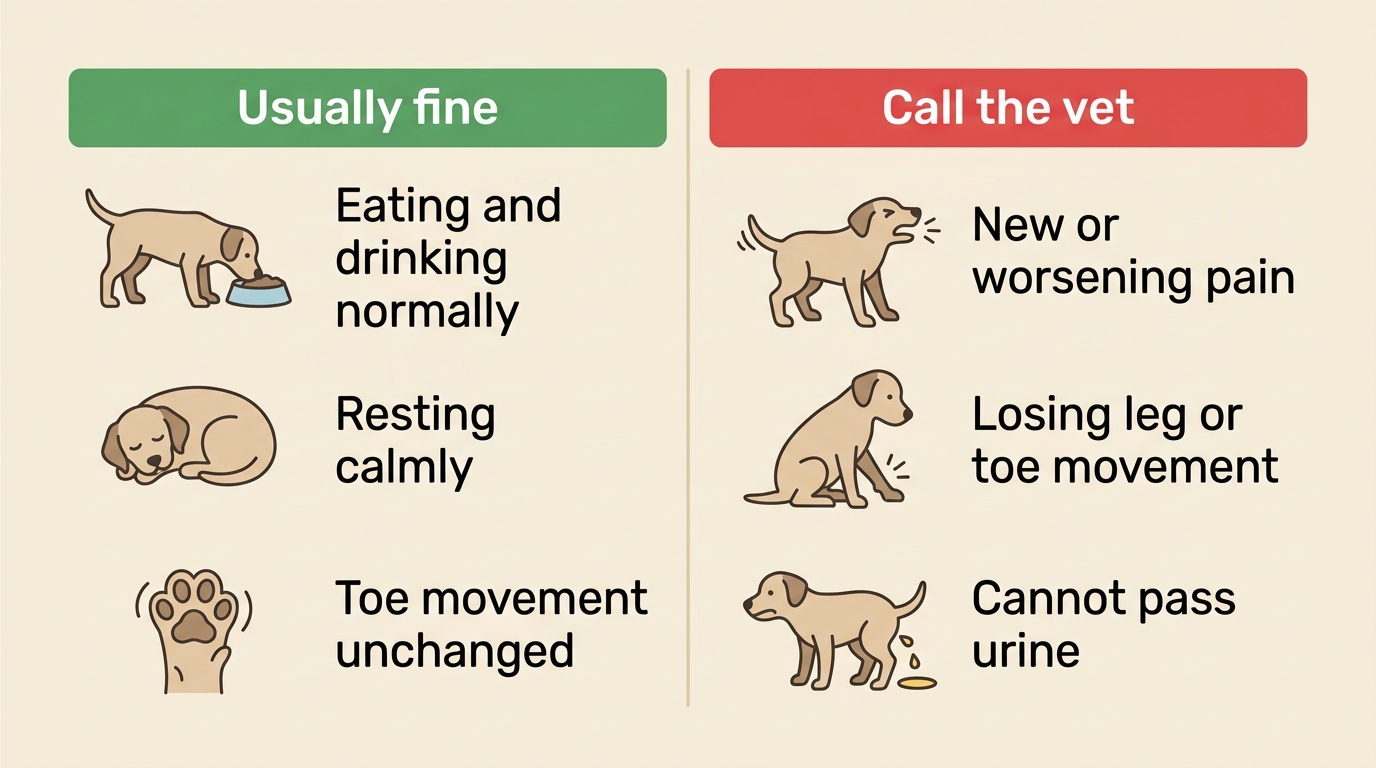
Start with the reassuring part, because most of what worries owners during recovery is normal. Recovery from a spinal injury is rarely a smooth, steady climb; it comes with ordinary fluctuations that can look alarming if you do not know to expect them.
A slightly stiff day, where your dog seems a little less comfortable or willing than yesterday, is common and not usually cause for alarm. Plateaus are normal too: stretches of days, even a couple of weeks, where nothing seems to be improving, which do not mean recovery has stalled, just that progress is non-linear. Fluctuating energy, brighter some days than others, is to be expected in a recovering dog. And, perhaps surprisingly, some early wobbliness as function returns is actually a good sign rather than a bad one, because a dog regaining movement often goes through a clumsy, unsteady stage on the way back to coordinated walking. So a degree of day-to-day variation, the odd stiff or flat day, the frustrating plateau, the wobbly early steps, is the normal texture of recovery, and not something to ring the vet about each time. Our recovery tracker helps here, because logging the days lets you see the overall direction through the daily noise, and an overall trend that is flat or gently upward, even with bumps, is reassuring.
Red flags: call your vet promptly
Now the part that matters most: the signs that are not normal bumps and that warrant a prompt call to your vet. If you see any of these, do not wait and see, get in touch.
Worsening weakness or new paralysis, your dog becoming less able to move or stand than it was, rather than more, is a clear red flag, because recovery should trend toward more function, not less. Signs that seem to be creeping forward, up the body, for example weakness or altered sensation moving from the back legs toward the trunk or the front of the body, are particularly important and need urgent attention, for reasons we come to below. A marked increase in pain, especially pain that is not controlled by the prescribed medication, needs a call. Loss of deep pain, if a dog that could feel a firm toe-pinch no longer responds to one, is a serious development your vet needs to know about straight away. A bladder that cannot be emptied, or signs of a urinary infection, a strong smell, cloudy or bloody urine, or your dog seeming generally unwell, warrants prompt attention. A surgical wound that becomes hot, swollen, red, or starts discharging may be infected and needs checking. And any sudden collapse, severe distress, or your dog seeming acutely unwell is an emergency. None of these is a "wait until the next check-up" sign; all of them mean phone your vet.
The serious one to understand
One of those red flags deserves explaining properly, because it is the reason that signs "creeping forward" are treated so urgently: a rare but grave complication called progressive myelomalacia. I want to explain it plainly without alarming you, because the great majority of recovering dogs will never face it, but understanding it helps you see why your vet takes ascending signs so seriously.
Progressive myelomalacia is a process in which the spinal cord tissue itself begins to break down and the damage spreads, ascending and descending along the cord from the original injury. It occurs almost entirely in the most severely affected dogs, those that have lost deep pain perception, and it is uncommon: across all dogs with thoracolumbar disc extrusion it affects only around two percent, though the figure is higher, in the region of fifteen percent or more, among the deep-pain-negative group specifically. When it happens, it typically comes on within the first few days after the injury, with signs that ascend up the body over hours to a few days, often about half within the first couple of days, which is exactly why weakness or altered sensation that seems to be moving forward, up toward the chest and front legs, is treated as an urgent sign. This is the reason your vet watches a severely affected dog so carefully in the early days, and our guide on when surgery is not the right choice discusses it further in that context. The message is twofold: it is uncommon and you are not likely to meet it, but it is serious, and ascending signs are precisely why "creeping forward" sits high on the red-flag list.
A simple rule
If all of that feels like a lot to hold in your head, here is the simple rule that captures it: if your dog is getting worse rather than better, or if anything genuinely worries you, phone your vet. Recovery should, over time and through its bumps, trend toward improvement; a sustained move in the wrong direction, or any of the specific red flags above, is your cue to call. And please do not ever worry about being a nuisance, vets would far rather take a call about something that turns out to be a normal bump than have you sit at home worrying, or worse, miss something that mattered. You will never be told off for checking.
So, to settle the anxiety that this whole stage tends to bring: most of the ups and downs you will see, the stiff days, the plateaus, the wobbly returning steps, are entirely normal, and the recovery tracker will help you see the reassuring overall trend through them. A specific set of red flags, worsening weakness, signs creeping forward, uncontrolled pain, loss of deep pain, bladder problems, a wound gone wrong, sudden distress, means pick up the phone promptly.
References
- Balducci F, Canal S, Contiero B, Bernardini M. Prevalence and Risk Factors for Presumptive Ascending/Descending Myelomalacia in Dogs after Thoracolumbar Intervertebral Disk Herniation. Journal of Veterinary Internal Medicine, 2017;31(2):498-504.
- Castel A, Olby NJ, Ru H, Mariani CL, Munana KR, Early PJ. Risk factors associated with progressive myelomalacia in dogs with complete sensorimotor loss following intervertebral disc extrusion: a retrospective case-control study. BMC Veterinary Research, 2019;15(1).
Sister tool · Sightline
Track whether treatment is working
Sightline, a separate ConciergeVet tool, runs a short weekly check-in built on validated pain and mobility instruments, turns it into a single Sightline Score you can watch trend over weeks rather than judge on one bad day, and produces a report you can bring to your vet.
A written log, or our printable trackers, does much the same job.
See how Sightline tracks treatmentTrack the recovery, day by day
Recovery from a disc injury is all about the trend. Log the daily milestones through crate rest and rehab so you can see real progress, not just good and bad days.
Open the Recovery TrackerYou're not doing this alone
Compare treatment journeys and talk to owners managing IVDD. Free to join.
Join PetsLikeMine