

IVDD in Dachshunds: Why Your Breed Is at Risk (and What the Genetics Really Say)
Alastair Greenway
BVM&S MRCVS
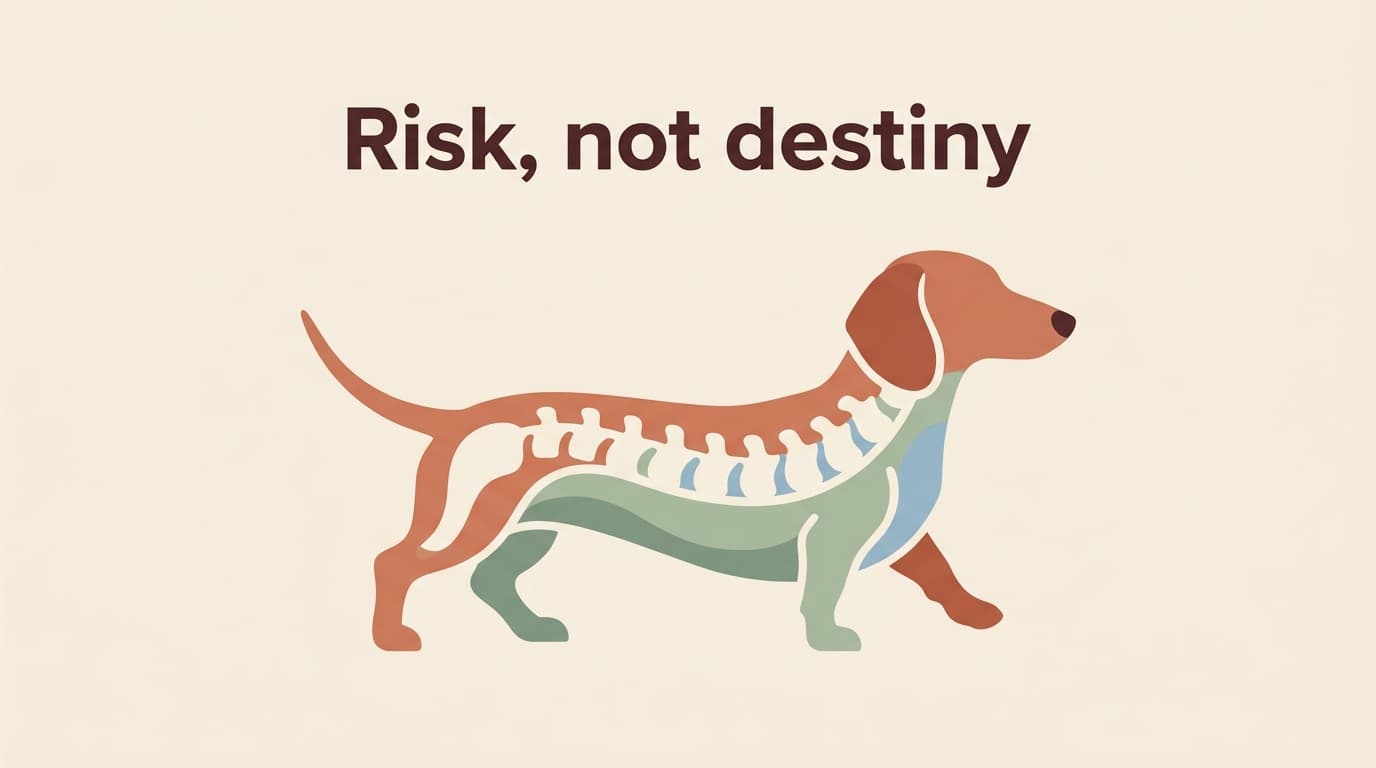
"Dachshunds get back problems." Every dachshund owner has heard it, usually delivered with a knowing nod and a remark about their long backs. The real story is more interesting than the folklore, more reassuring, and genuinely more useful for protecting your dog. Intervertebral disc disease is indeed common in dachshunds, but it is not inevitable. It is driven by their genetics rather than the long back, and there are real, evidence-based things you can do to lower the odds. Here is what the science actually says.
The numbers, plainly
Start with the figures, because real numbers are more reassuring than vague dread. Across studies, somewhere around one in five to one in seven dachshunds will have an IVDD episode in their lifetime; one large study of Danish dachshunds put the overall incidence at eighteen percent, with no meaningful difference between the long-haired, smooth-haired, and wire-haired types. Compared with the average dog, a dachshund's risk is roughly ten to twelve times higher, and by some measures more.
The crucial word, though, is "common," not "inevitable." That same set of figures means the majority of dachshunds will not have a significant IVDD episode in their lives, and even among those that do, many recover well with the right care. So the right frame is neither complacency nor dread: it is informed vigilance. Your dachshund is at a genuinely raised risk that is worth taking seriously and acting on, but a diagnosis is not written into their future, and there is a great deal you can do to tilt the odds in their favour.
It's not the long back, it's the genetics
The thing almost everyone believes is wrong: a dachshund's IVDD risk is not really caused by the long back. It is caused by their genetics, and the long back is a clue, not the culprit.
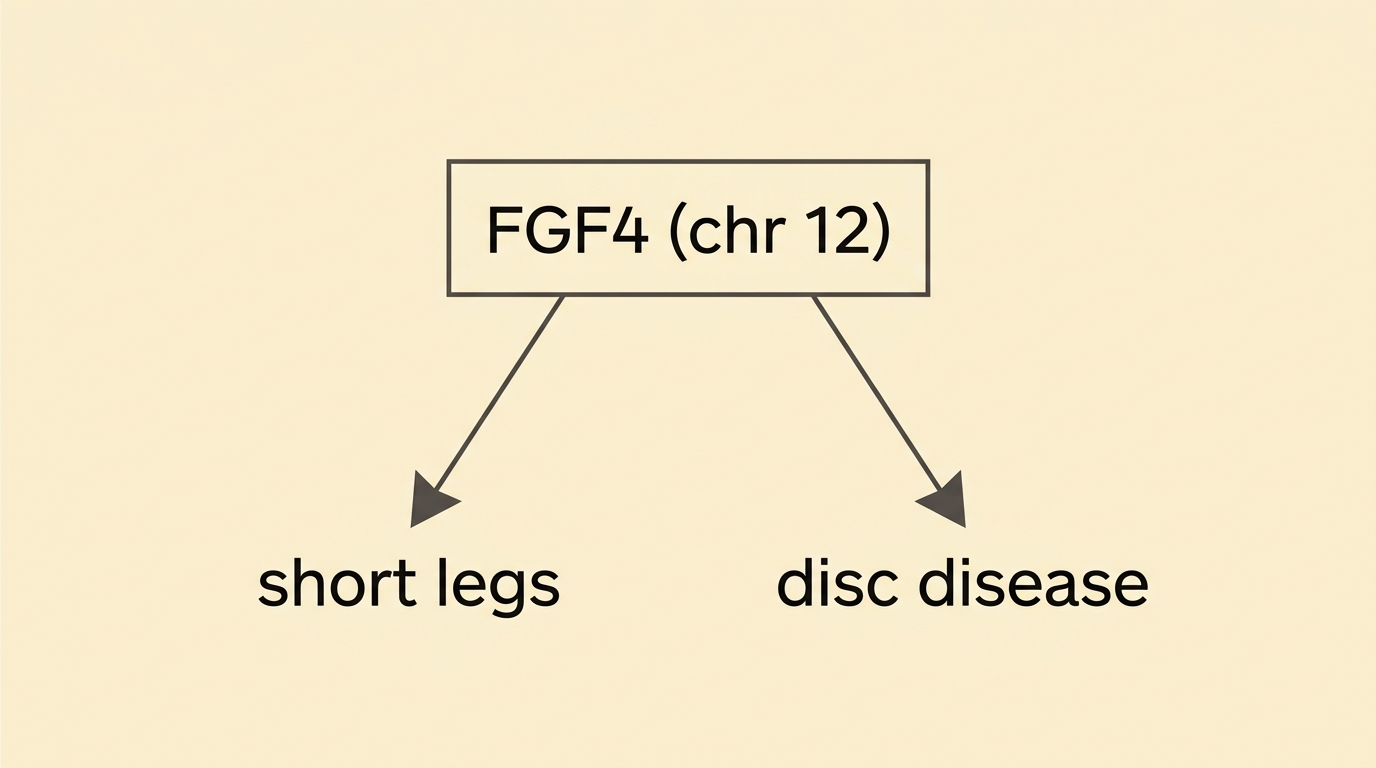
How this works is genuinely elegant. Researchers at the University of California, Davis identified a particular genetic feature, a so-called FGF4 retrogene on chromosome 12, that does two things at once. It gives dachshunds their characteristic short legs, and, in the very same stroke, it causes their intervertebral discs to degenerate and harden, to calcify, abnormally early in life. In other words, the short legs and the disc disease are not cause and effect, they are two results of the same underlying gene. The disc problem comes from the gene, not from the shape of the back the gene happens to produce.
Just how strong is the effect? The figures are striking, and worth giving with care because they are measured in different ways. The original study found this retrogene carried an odds ratio of around fifty for IVDD, while a later analysis focused specifically on disc herniation put the figure at around eighteen, and dogs with many calcified discs on X-ray have been found to have roughly eighteen times the odds of IVDD signs compared with dogs with none. However it is measured, the message is the same: this is a powerful genetic risk factor, and it raises the risk in a dominant way, meaning even a single copy of the gene is enough to matter.
That changes how you should think about your dog. The popular belief that "the long spine is the problem," as though the back were a shelf under too much strain, gets the mechanism wrong, and it can lead owners to fixate on the wrong things. A dachshund's discs are, in effect, programmed by their genetics to age and harden prematurely, becoming brittle and prone to the sudden herniation that causes IVDD, and this would be true regardless of exactly how long the back was. So when you picture why your dachshund is vulnerable, picture the discs themselves, primed by their genes to degenerate early, rather than a long back straining under its own length. It is a small shift in understanding, but it points you toward what actually helps.
What the genetic test can and can't tell you
Because there is an identified gene, there is also a genetic test for it, and it is worth understanding what that test can and cannot tell you, because it is more nuanced than the marketing suggests. Testing for the relevant variants, often labelled CDDY and CDPA, is available, for example through the veterinary genetics laboratory at UC Davis, and is sometimes included in the broader DNA panels many owners now run.
Now the important nuance, because it is easy to over-read a genetic result. The test tells you about risk, not destiny, and in dachshunds it has a particular limitation. The risk gene is so common in the breed, it is the very thing that makes dachshunds dachshund-shaped, that in some dachshund types nearly every dog carries it, which means the DNA test on its own cannot meaningfully separate higher-risk dogs from lower-risk ones within the breed. Researchers who have studied this directly have concluded that, for dachshunds specifically, an X-ray-based assessment of how many discs have calcified is a more reliable guide than the DNA test for predicting risk and guiding breeding. So while the test is interesting, and useful in the wider breeding picture, do not treat a result as the last word: a "clear-ish" result should not lull you into ignoring the everyday precautions, and a high-risk result should not frighten you, because for an individual pet owner the sensible, protective advice, keep them lean, keep them appropriately active, know the warning signs, applies to all dachshunds regardless of their exact genotype.
Other at-risk breeds
Dachshunds may be the poster breed for IVDD, but they are far from alone, and it is worth knowing the wider picture briefly, because the same underlying genetics appears across a number of breeds. French bulldogs, in particular, carry notably high risk and are increasingly seen with disc disease, and other breeds with raised risk include the Pembroke Welsh corgi, the beagle, the shih tzu, the cocker spaniel, and the basset hound, among others. These are mostly the short-legged, long-bodied breeds in which that same FGF4 genetic feature is common, which makes sense given what we now know about the cause. We cover the other breeds in more detail elsewhere; the point here is that if you have one of these breeds, much of this dachshund-focused advice applies to your dog too.
What actually lowers the risk
Now the genuinely empowering part: while you cannot change your dachshund's genes, the evidence suggests there are real things you can do that are associated with a lower risk of IVDD, and they are worth taking seriously. A large survey of dachshunds and their owners found two factors in particular linked to lower odds: keeping a dog at a healthy body condition, that is, lean rather than overweight, and keeping a dog more physically active in everyday life. In other words, a lean, fit, active dachshund appears to be at lower risk than a heavy, sedentary one, which is encouraging because both of those are within your control.
One finding in that survey deserves a word of caution, because it is easily misread and I would rather you had the careful version. The same survey found that dogs whose stair access was restricted had a higher rate of IVDD, which sounds, at first, as though stairs protect against disc disease. Almost certainly that is not the right reading. This is a correlation, not proof of cause, and the most likely explanation is the reverse: owners tend to restrict stairs for dogs that are already showing back problems or are known to be vulnerable, so the restriction is a response to risk rather than a cause of it. So the sensible, defensible message is this: keep your dachshund lean and active, avoid encouraging repetitive high-impact jumping, for instance on and off high furniture, but do not panic about your healthy young dachshund using the occasional gentle flight of stairs in normal life. Do not over-restrict a well dog on the strength of a misread statistic. It is also worth distinguishing this everyday prevention advice from the strict rules that apply after an episode: a dog recovering from IVDD genuinely must avoid stairs and jumping during its rest, as our crate-rest guide explains, but that is a different situation from sensible lifelong prevention in a healthy dog.
Breeding responsibly
For anyone involved in breeding dachshunds, modern genetics opens up a real opportunity to improve the breed's health over time, and it is worth a brief mention. Because the risk is genetic and partly measurable, breeders can use the available tools to make informed choices. Best established of these is radiographic screening, X-raying breeding dogs at around two to four years old and counting how many of their discs have calcified, a trait that is strongly heritable and that has proven, over years of use, to reduce IVDD risk when bred against. In the UK there is a formal scheme for exactly this, run jointly by the Kennel Club and the dachshund health community, and the science behind it continues to be refined. The crucial principle, which our piece on breeding and prevention covers more fully, is to breed away from lines with early, severe disc disease, and to use screening rather than relying on the DNA test alone, for the reason we saw above. It is a long game played across generations rather than something an individual pet owner does, but it is genuinely hopeful: the same science that explains the risk also offers a route to reducing it in future dachshunds.
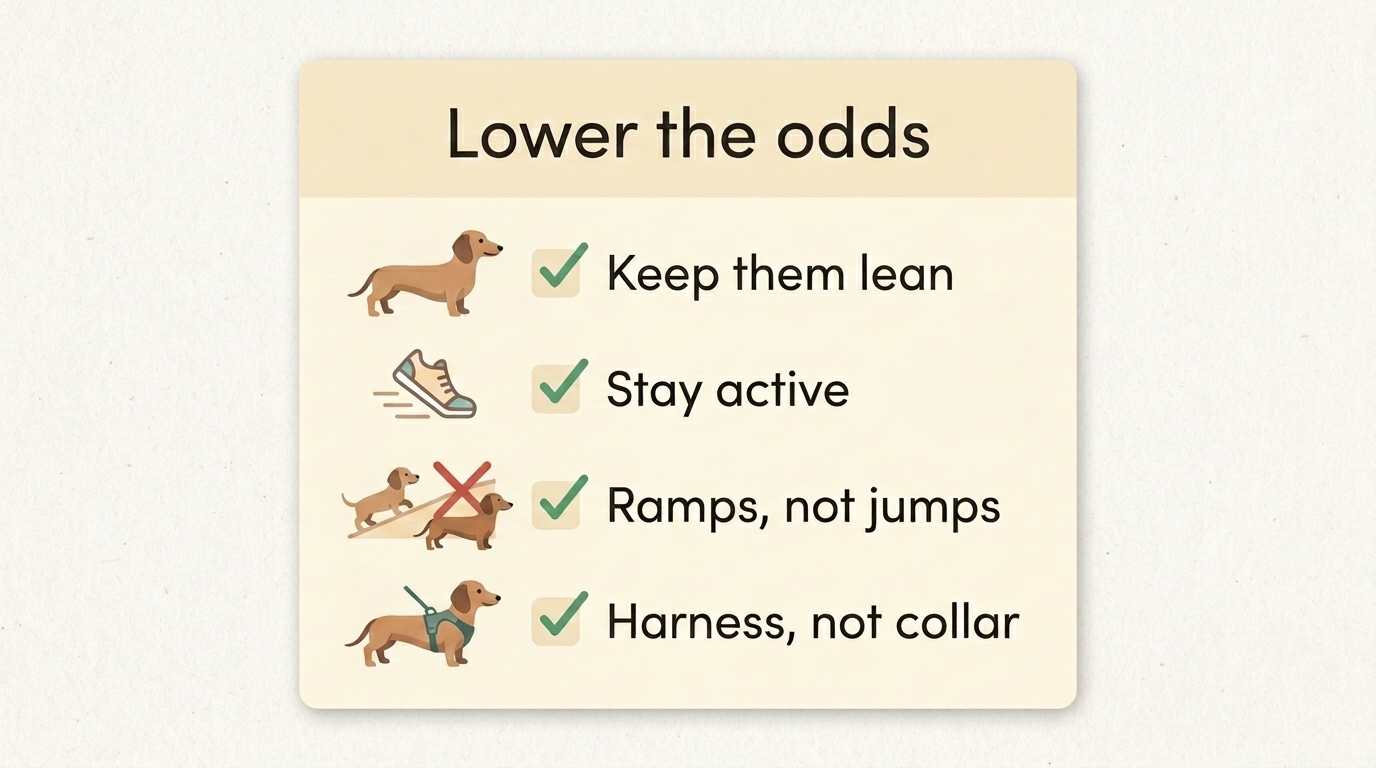
So, if you have a healthy dachshund and want to do right by their back, here is the practical checklist that actually matters, drawn from everything above. Keep them lean, since a healthy body condition is one of the clearest protective factors. Keep them appropriately active rather than sedentary, with sensible everyday exercise. Use ramps or steps to help them on and off the sofa and in and out of the car, to spare them repetitive jumping down from heights. Walk them on a harness rather than a collar, to avoid strain on the neck and spine. And, above all, learn the warning signs of an IVDD episode so that if anything ever does happen, you recognise it fast and act, which our guide to the red flags and our triage checker are there to help with. Do those things, and you are doing everything a loving owner reasonably can to protect an at-risk dog, without letting the breed's reputation overshadow what should be a happy, active life together.
References
- Brown EA, Dickinson PJ, Mansour TA, et al. FGF4 retrogene on CFA12 is responsible for chondrodystrophy and intervertebral disc disease in dogs. Proceedings of the National Academy of Sciences, 2017;114(43):11476-11481.
- Packer RMA, Seath IJ, O'Neill DG, De Decker S, Volk HA. DachsLife 2015: an investigation of lifestyle associations with the risk of intervertebral disc disease in Dachshunds. Canine Genetics and Epidemiology, 2016;3:8.
- Demographic and lifestyle characteristics impact lifetime prevalence of owner-reported intervertebral disc disease: 43,517 companion dogs in the United States. Journal of the American Veterinary Medical Association, 2025;263(5).
- Batcher K, Dickinson P, Giuffrida M, et al. Phenotypic effects of FGF4 retrogenes on intervertebral disc disease in dogs. Genes, 2019;10(6):435.
- Bruun CS, Bruun C, Marx T, Proschowsky HF, Fredholm M. Breeding schemes for intervertebral disc disease in dachshunds: is disc calcification score preferable to genotyping of the FGF4 retrogene insertion on CFA12? Canine Medicine and Genetics, 2020;7:18.
- Veterinary Genetics Laboratory, University of California, Davis. Chondrodystrophy (CDDY with IVDD risk) and Chondrodysplasia (CDPA).
Sister tool · Sightline
Track whether treatment is working
Sightline, a separate ConciergeVet tool, runs a short weekly check-in built on validated pain and mobility instruments, turns it into a single Sightline Score you can watch trend over weeks rather than judge on one bad day, and produces a report you can bring to your vet.
A written log, or our printable trackers, does much the same job.
See how Sightline tracks treatmentTrack the recovery, day by day
Recovery from a disc injury is all about the trend. Log the daily milestones through crate rest and rehab so you can see real progress, not just good and bad days.
Open the Recovery TrackerYou're not doing this alone
Compare treatment journeys and talk to owners managing IVDD. Free to join.
Join PetsLikeMine