

What IVDD Treatment Costs in the UK
Alastair Greenway
BVM&S MRCVS
MRI, surgery, weeks of medication, hydrotherapy: intervertebral disc disease can be one of the most expensive things that ever happens to a dog. Far too often, owners only discover the figures at the worst possible moment, mid-crisis, in a referral waiting room, trying to make a huge decision with no sense of the numbers. That helps no one. So this guide does the opposite. It lays out real UK figures, up front and plainly, so that money becomes something you can plan around rather than a source of shame or panic when the clock is already ticking.
One caveat before the numbers, and it matters. The figures here are drawn from UK referral-centre pricing and owner surveys rather than from any official tariff, and veterinary prices vary considerably by region, by centre, and by the size of your dog. Treat them as realistic 2026 ranges to plan around, and always confirm the actual cost with your own vet or referral centre. With that said, here are the real numbers.
The headline ranges, up front
These are the figures most owners are searching for, clearly labelled as the estimates they are.
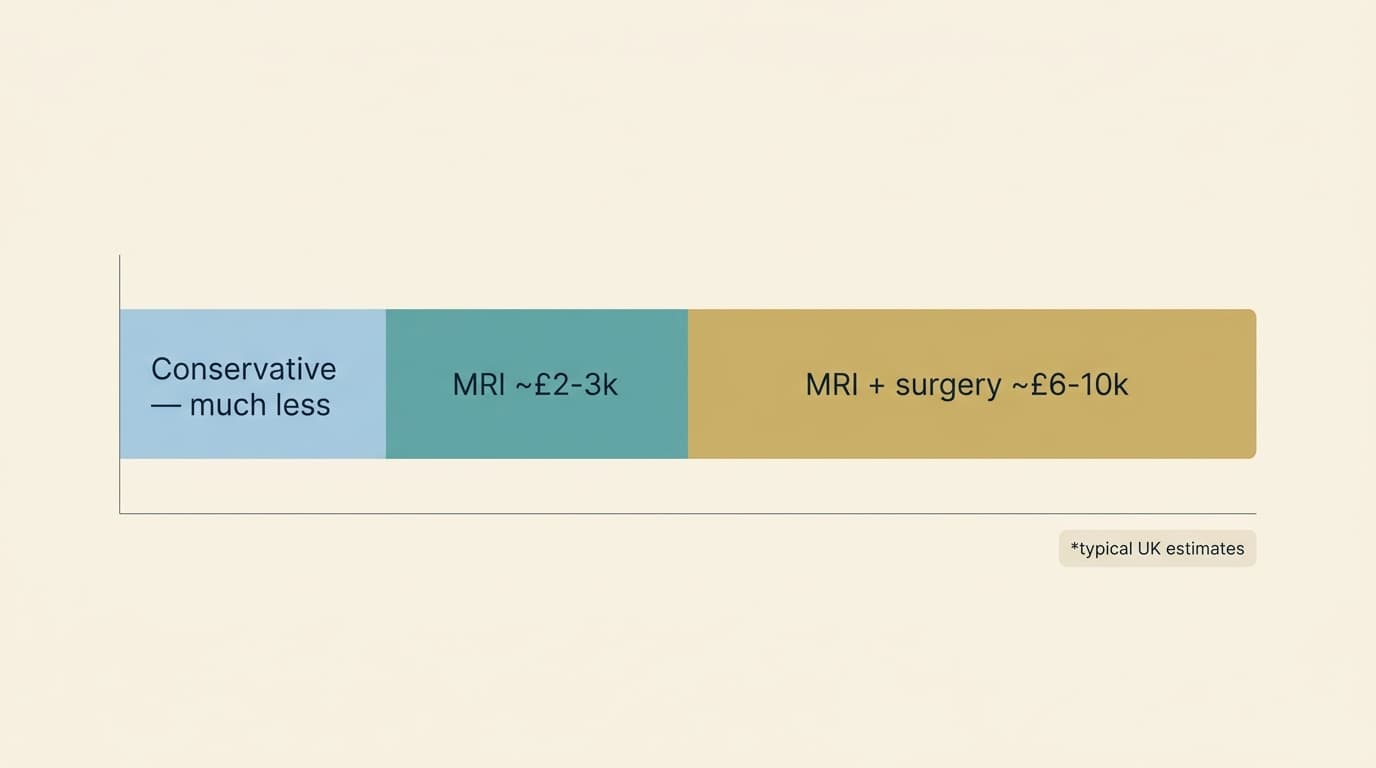
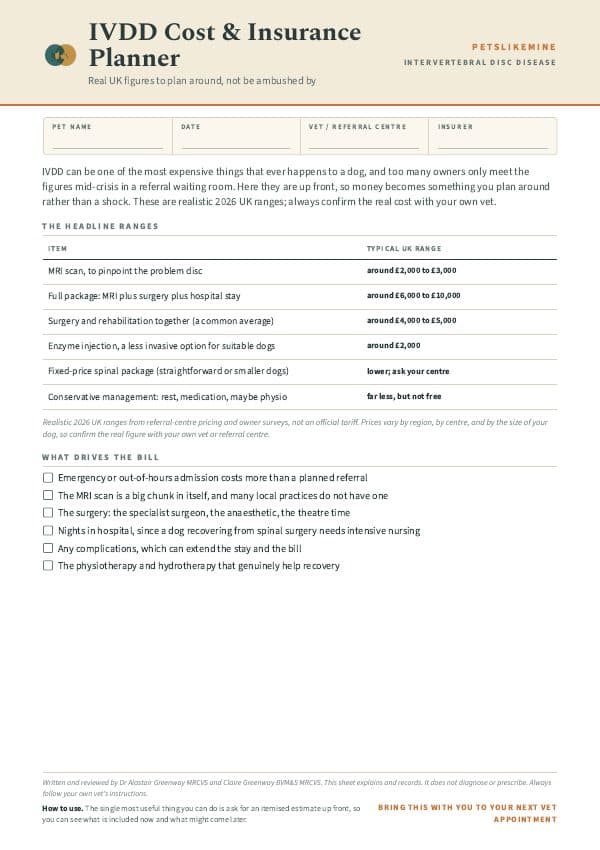
An MRI scan, the imaging usually needed to pinpoint the problem disc before surgery, commonly costs in the region of two to three thousand pounds on its own. The full package of MRI plus surgery plus the hospital stay together commonly runs to somewhere around six to ten thousand pounds. For surgery and rehabilitation taken together, a figure of around four to five thousand pounds is a common average, though severe or complicated cases cost more. Some referral centres offer lower fixed-price packages for the more straightforward cases, particularly in smaller dogs, and these can bring the all-in cost down. As a concrete example, one UK university veterinary hospital offers a fixed-price spinal package covering the consultation, anaesthetic, MRI or CT, the spinal surgery itself, up to three nights in hospital, and physiotherapy at discharge, with dogs over fifteen kilograms quoted separately. And conservative management, the non-surgical route of strict rest and medication, is far cheaper than any of these, though, as we will see, it is not free either.
So the spread is wide, from a few hundred pounds for conservative management at the low end to ten thousand pounds for complex surgery at the high end, and where your dog falls depends on what it needs. Knowing these ranges in advance is exactly what lets you think clearly when the moment comes.
What drives the number
Understanding what actually makes up a big IVDD bill demystifies the figure and shows you where the costs sit. Several things drive it.
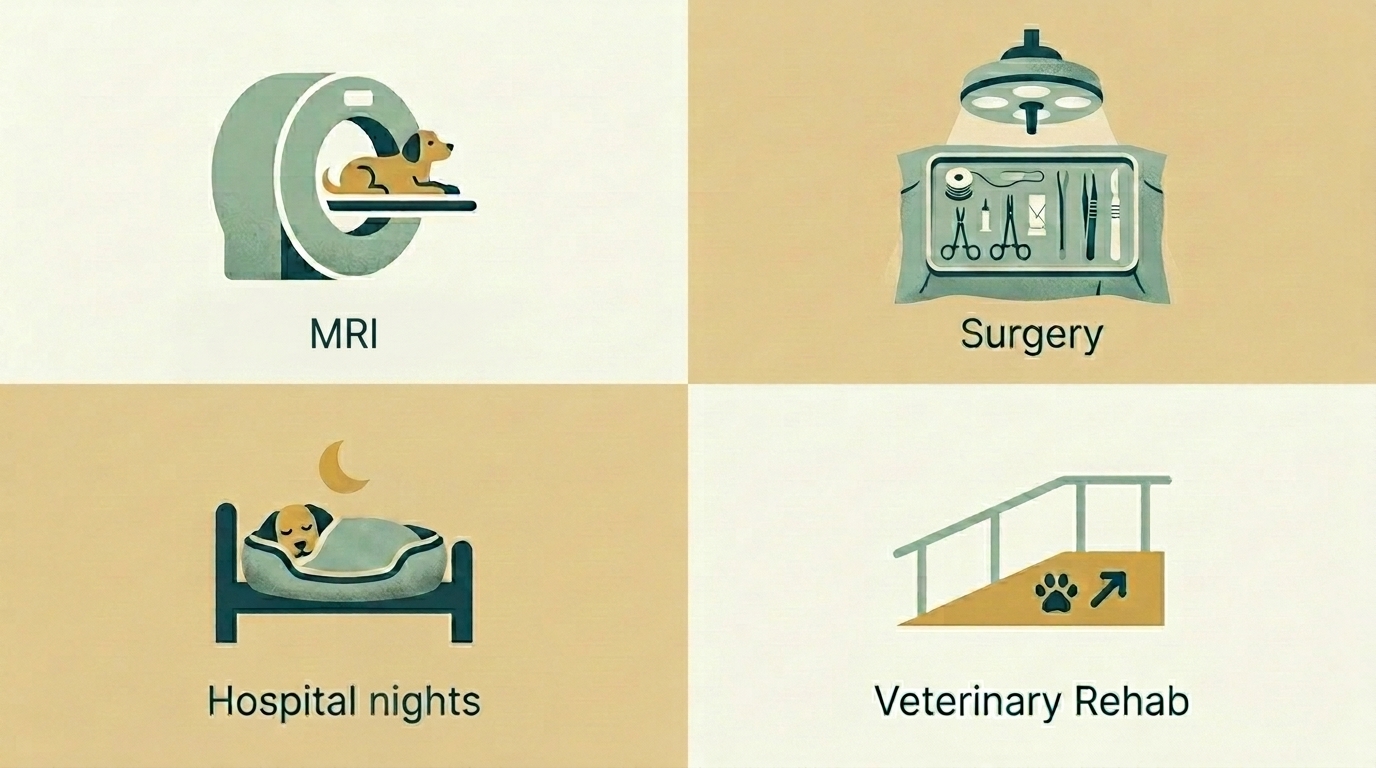
Whether your dog presents as an emergency or a planned case matters, because out-of-hours and emergency admission cost more than a scheduled referral. The MRI scan is a substantial chunk in itself, as above, and many local practices do not have one, so this often means a referral to a specialist centre. The surgery is the major component, reflecting the specialist neurosurgeon's expertise, the anaesthetic, and the theatre time. The days spent in hospital afterwards add up, since a dog recovering from spinal surgery needs intensive nursing, and each night of that care has a cost. Any complications can extend the stay and the bill. And the post-operative rehabilitation, the physiotherapy and hydrotherapy that genuinely improve recovery, is a further cost on top. Add these together and you can see how a severe case needing emergency admission, MRI, surgery, several nights of nursing, and weeks of rehab reaches the upper end of the range, while a more straightforward case sits lower. The single most useful thing you can do to keep costs clear is to ask for an itemised estimate up front, so you can see what is included now and what might come later.
A lower-cost surgical option to ask about
Surgery is not the only interventional option. A newer, less invasive and considerably cheaper treatment exists for suitable cases, and it is worth asking your specialist whether your dog might be a candidate. Some centres offer an enzyme injection, a procedure in which an enzyme is injected directly into the affected disc, as an alternative to open surgery in certain dogs, at a fixed price well below that of full decompressive surgery, in the region of around two thousand pounds at one UK university hospital. This is not right for every dog, and your specialist will advise whether it suits your dog's particular problem, but it is a genuine option that can reduce the cost for the right candidate, and one many owners do not know to ask about.
Conservative management isn't free either
It is tempting to think of the non-surgical route as the cheap option, and it is certainly far less expensive than surgery, but it is worth being clear that it is not free, and the costs are easy to underestimate. Conservative management still involves veterinary consultations to diagnose and monitor the problem, weeks of medication, the anti-inflammatory and pain-relief drugs that a dog needs throughout the rest period, and very possibly the cost of a proper crate or pen to confine the dog safely. Many dogs also benefit from some physiotherapy or hydrotherapy as they recover, which adds to the total.
And there is one cost that does not show up on any invoice but is very real: your own time and energy. Weeks of strict confinement, lead-only toilet breaks, careful lifting, and constant supervision are a significant demand on you, as our guide to crate rest makes clear. So conservative management is much cheaper than surgery, but go into it understanding that it still costs money and asks a great deal of your time, rather than expecting it to be free.
Insurance: the part that matters most
For IVDD, insurance is very often the difference between a decision made on clinical grounds and a decision forced by money. Getting this right, ideally long before your dog ever has a problem, matters enormously.
The single most important rule is to insure your dog before any signs appear, because, as with all pet insurance, conditions that already exist are excluded. A dog that has already had a back problem cannot then be insured against that back problem, so cover has to be in place beforehand. For an at-risk breed especially, the time to sort insurance is when the dog is young and healthy, not when the trouble starts.
The type of policy matters just as much as having one. A lifetime policy, which renews the cover for an ongoing condition each year as long as you keep renewing, is the kind that genuinely protects you against a chronic, recurring condition like IVDD, whereas annual, time-limited, or per-condition-capped policies can stop covering the problem after twelve months or once a set limit is reached, leaving you to fund the rest. Given that IVDD treatment can reach eight to ten thousand pounds, and that recurrence is a real possibility, the practical advice from the dachshund-health community is concrete: insure for a minimum of around eight thousand pounds of cover, and preferably over ten thousand, and check specifically whether the policy covers more than one incident, since a second disc can go and the second event may cost as much as the first, and whether there is a maximum pay-out per condition that could leave a gap. As a sense of the running cost, the PDSA estimates that lifetime cover for a dog starts at something like sixty-five pounds a month and can exceed eleven thousand pounds over a lifetime, and at-risk breeds typically sit above average.
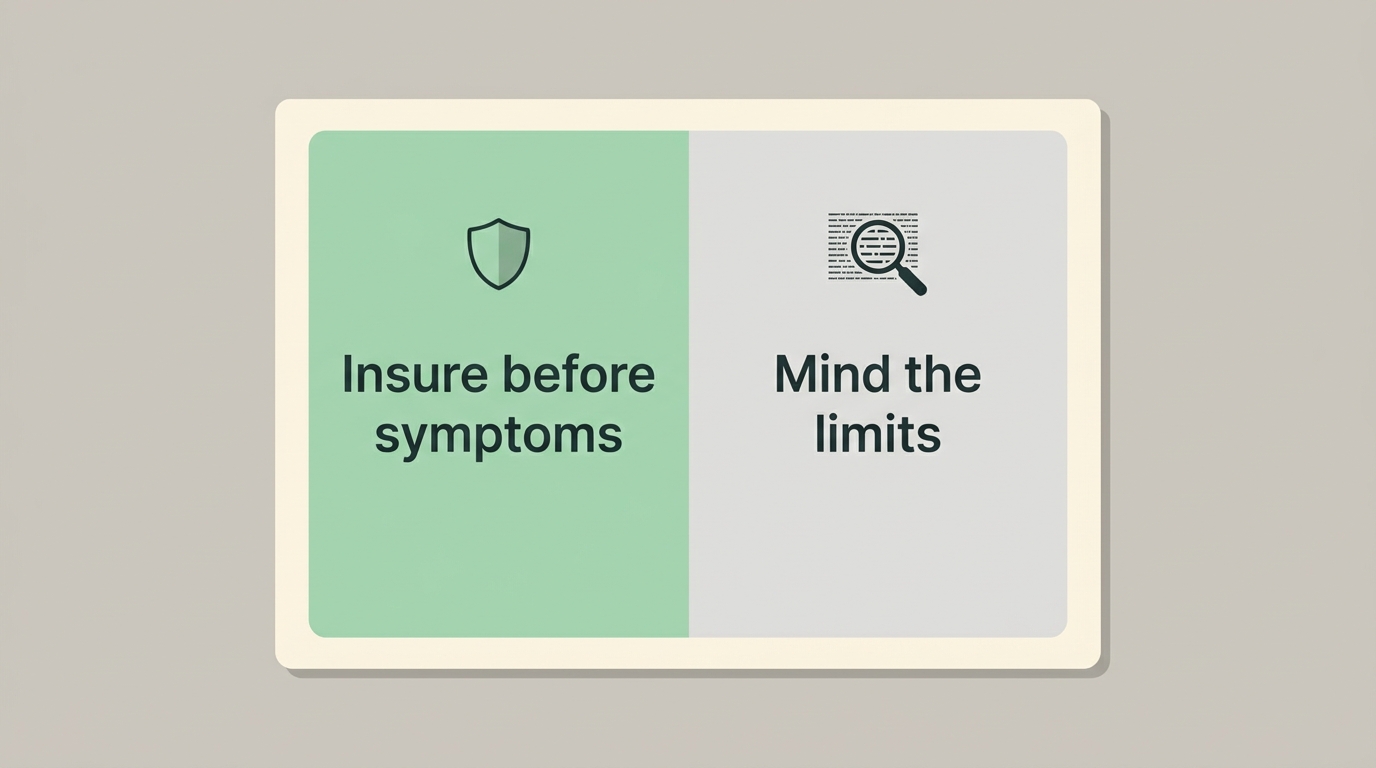
Two traps are worth naming. First, many owners discover too late that their policy did not provide the cover they assumed: in one survey, one in three owners had a claim declined for exactly this reason, so it is worth reading the small print on limits and exclusions before you need it. Second, do not switch insurers after a first episode expecting the same protection, because the new insurer will treat the now-known disc problem as pre-existing and exclude it, which is why staying with a suitable lifetime policy taken out early is so valuable. Sort good lifetime insurance early, check it is genuinely adequate, and you turn a potentially ruinous bill into a manageable one.
If you're not insured
An uninsured dog, or cover that falls short, is not the end of the road, so please don't despair or assume surgery is automatically off the table. There are still options worth exploring. Some referral centres offer payment plans that let you spread the cost over time, so it is always worth asking directly whether that is possible, though it is not available everywhere. The fixed-price packages and the lower-cost enzyme injection mentioned earlier can bring the cost of a suitable case down significantly, so ask whether your dog might qualify. There are veterinary charities, but it is fair to say their help is limited here: the PDSA, RSPCA, and Blue Cross have very low income-eligibility thresholds and, importantly, do not normally fund a procedure as major as IVDD surgery, so they are worth investigating only if you are on a low income and should not be counted on for this. And conservative management remains a legitimate, often clinically appropriate route that costs far less than surgery, so for a suitable dog it may be both the affordable choice and a sound one. For those with multiple dogs, or who cannot get affordable cover, some owners choose to self-insure, setting aside a fixed sum regularly to build a fund for emergencies, though this only works if the pot is realistically large enough by the time it is needed.
The plain reality is that being uninsured constrains the options, but it does not always close them, and a frank conversation with your vet about what you can afford, and what the realistic choices are within that, is the right place to start. There is no shame in that conversation.
Planning, not panicking
Money is a legitimate part of the IVDD decision, and there is genuinely no shame in it. A loving owner who must weigh the cost, who chooses conservative management because surgery is out of reach, or who has to make hard decisions within real financial limits, is not failing their dog; they are doing their level best within their circumstances, which is all any of us can do. The purpose of laying out these figures is not to frighten you but to hand you the information that turns money from a source of panic into a factor you can plan around.
So the practical steps are these: if your dog is young and healthy, especially an at-risk breed, sort a good lifetime insurance policy now, insure for at least eight to ten thousand pounds, and check the small print on multi-incident and per-condition limits. If you are facing a decision today, ask your vet or referral centre directly for an itemised estimate, ask about fixed-price options, the enzyme injection, and payment plans, and factor the real figures into the decision alongside the clinical ones, using our IVDD cost and insurance planner and our decision worksheet to work it through. Money is one real part of a hard choice, you are allowed to weigh it openly, and planning for it calmly is one of the kindest things you can do for both your dog and yourself.
References
- Olby NJ, Moore SA, Brisson B, Fenn J, Flegel T, Kortz G, Lewis M, Tipold A. ACVIM consensus statement on diagnosis and management of acute canine thoracolumbar intervertebral disc extrusion. Journal of Veterinary Internal Medicine, 2022;36(5):1570-1596.
- Dachshund IVDD UK. Insurance and the cost of IVDD treatment.
- Dachshund Health UK. Insurance.
- The Queen's Veterinary School Hospital, University of Cambridge. Chondroitinase injection treatment for dogs with IVDD.
- The Queen's Veterinary School Hospital, University of Cambridge. Fixed price services.
Free downloads
Companion worksheets to put what you've read into practice. Free PDFs, print at home.
Sister tool · Sightline
Track whether treatment is working
Sightline, a separate ConciergeVet tool, runs a short weekly check-in built on validated pain and mobility instruments, turns it into a single Sightline Score you can watch trend over weeks rather than judge on one bad day, and produces a report you can bring to your vet.
A written log, or our printable trackers, does much the same job.
See how Sightline tracks treatmentTrack the recovery, day by day
Recovery from a disc injury is all about the trend. Log the daily milestones through crate rest and rehab so you can see real progress, not just good and bad days.
Open the Recovery TrackerYou're not doing this alone
Compare treatment journeys and talk to owners managing IVDD. Free to join.
Join PetsLikeMine