


Acupuncture and Laser for IVDD: What the Evidence Actually Says
Alastair Greenway
BVM&S MRCVS
Once a dog is recovering from a disc problem, the suggestions start to arrive. Someone mentions acupuncture; an article turns up about laser therapy; and the question you actually want answered is simple. Do these things work? It is a fair question, and it tends to draw out two unhelpful answers. The enthusiast promises miracles, the sceptic dismisses the lot, and neither is fair to you or to the evidence. So this guide tries for something more useful. It sets out what the research really shows for acupuncture and laser in IVDD, without overselling or sneering, and helps you decide whether to consider them. The honest headline: there is some genuine, if limited, evidence for these as adjuncts, alongside proper veterinary treatment, and that is exactly how to think about them.
Electroacupuncture
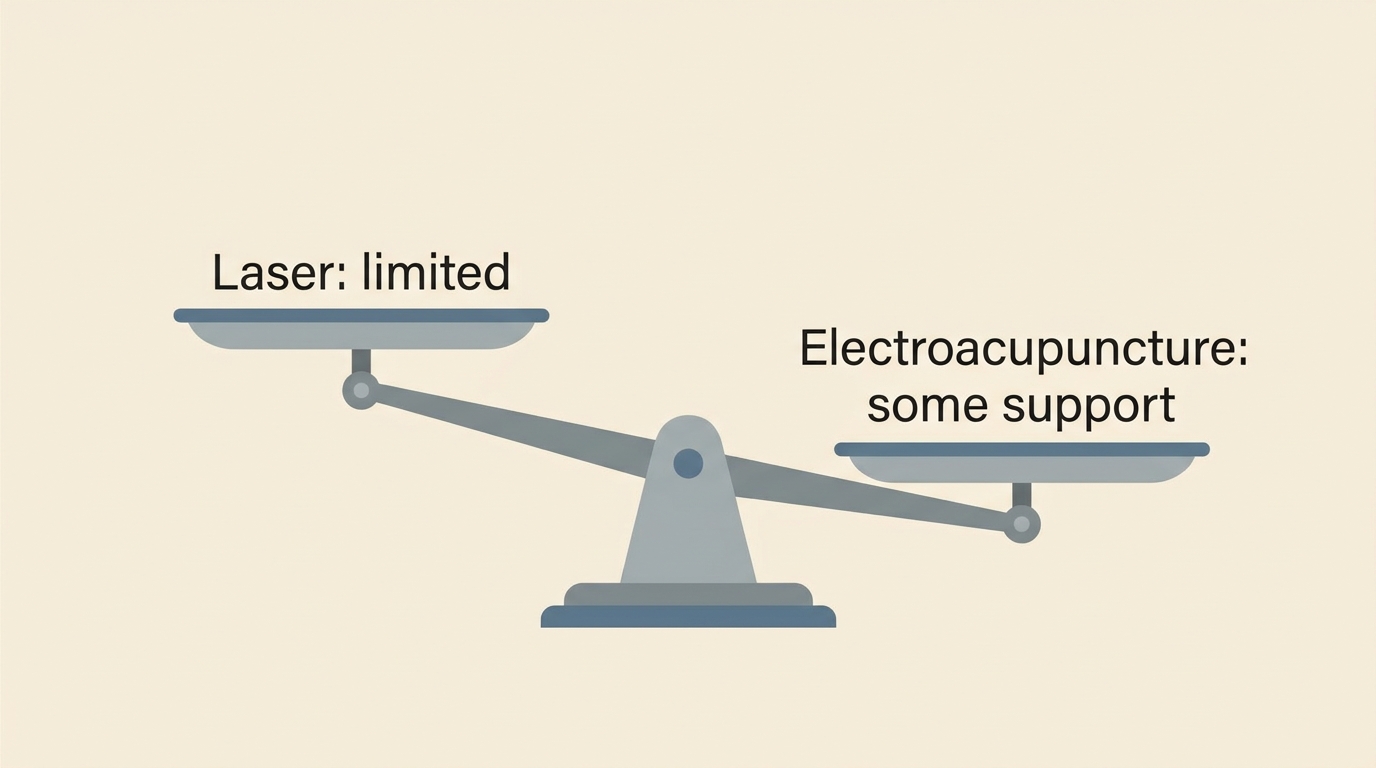
Of the complementary therapies, electroacupuncture, a form of acupuncture in which a small electrical current is passed between the needles, has the comparatively better evidence base for IVDD, though it is worth being clear-eyed about how modest that evidence still is.
Some controlled work does suggest a benefit. In one study comparing treatments, dogs that received electroacupuncture recovered at a better rate than those treated without it, which is an encouraging signal. But that signal has to be weighed against the quality of the evidence, which is limited: the studies tend to be small, conducted at single centres, and not blinded, all of which means the findings, while genuinely promising, are not the kind of robust proof that would let anyone promise it works. So the fair summary of electroacupuncture is this: it has the most supportive evidence of the complementary options, that evidence is real but weak, and it is reasonably positioned as an adjunct to standard care, something that may help alongside proper treatment, rather than a proven therapy or a replacement for anything.
Therapeutic laser (photobiomodulation)
Therapeutic laser, also called photobiomodulation or low-level laser therapy, involves applying particular wavelengths of light to the tissues, with the aim of reducing inflammation and supporting healing. It is increasingly offered in rehabilitation settings, and owners often ask about it.
The fair appraisal here is that the evidence is weaker and more preliminary than for electroacupuncture. There is a small amount of encouraging work, including one study in which dogs treated with laser after spinal surgery became able to walk again sooner than those who were not. That is a striking-sounding result, but it comes from a small, single-centre, preliminary study, and the overall body of evidence for laser in IVDD is genuinely thin, so it would be wrong to present it as established. The fair summary of laser is therefore: promising but limited, an option some rehabilitation practitioners use, with early evidence that does not yet amount to proof. If it is offered to your dog as part of a rehabilitation programme, it is reasonable, but go in understanding that the evidence behind it is preliminary rather than solid.
Three principles for any add-on therapy
More useful than a verdict on each therapy is a sensible way to think about complementary treatments in general, because the same principles apply to both and to others you might encounter. Three things matter.
First, they are adjuncts, not alternatives. This is the crucial point and the firm line: acupuncture and laser may have a place alongside proper veterinary treatment, but neither is a substitute for the things that genuinely matter in IVDD, the decompression where surgery is indicated, the appropriate pain relief, and the strict rest. Choosing a complementary therapy instead of, or as a reason to delay, the treatment your vet has advised would be a serious mistake. Second, use a safe, qualified practitioner, and keep your own vet in the loop, so that whatever is done is coordinated with your dog's actual medical treatment rather than happening in a separate silo. Third, manage your expectations: approach these as things that may help a bit, as part of a wider plan, rather than as treatments that will turn a recovery around, because the evidence simply does not support the latter.
Where that leaves a sensible owner
So, where does that leave you? It is entirely reasonable to consider these therapies as part of your dog's rehabilitation, in discussion with your vet, and electroacupuncture in particular is a defensible thing to try in the right case given that it has the better evidence. There is no need to feel foolish for being interested in them, nor to be talked into them as miracle cures. The one firm rule is the one above: never let a complementary therapy take the place of, or delay, the decompression, pain relief, and rest that are the real backbone of IVDD treatment, and never let it become a reason to break the strict rest your dog needs. Keep them as what the evidence supports, possible helpful adjuncts, coordinated with your vet, and they can have a reasonable place in a recovery.
To close, then: acupuncture, especially electroacupuncture, and to a lesser and more preliminary extent laser, have some genuine but limited evidence as adjuncts in IVDD recovery, and considering them alongside proper treatment, with your vet's involvement and a qualified practitioner, is a reasonable thing to do. Our rehabilitation roadmap shows where adjuncts like these sit within the wider recovery.
References
- Joaquim JGF, Luna SPL, Brondani JT, Torelli SR, Rahal SC, de Paula Freitas F. Comparison of decompressive surgery, electroacupuncture, and decompressive surgery followed by electroacupuncture for the treatment of dogs with intervertebral disk disease with long-standing severe neurologic deficits. Journal of the American Veterinary Medical Association, 2010;236(11):1225-1229.
- Draper W, Schubert T, Clemmons R, Miles S. Low-level laser therapy reduces time to ambulation in dogs after hemilaminectomy: a preliminary study. Journal of Small Animal Practice, 2012;53(8):465-469.
Sister tool · Sightline
Track whether treatment is working
Sightline, a separate ConciergeVet tool, runs a short weekly check-in built on validated pain and mobility instruments, turns it into a single Sightline Score you can watch trend over weeks rather than judge on one bad day, and produces a report you can bring to your vet.
A written log, or our printable trackers, does much the same job.
See how Sightline tracks treatmentTrack the recovery, day by day
Recovery from a disc injury is all about the trend. Log the daily milestones through crate rest and rehab so you can see real progress, not just good and bad days.
Open the Recovery TrackerYou're not doing this alone
Compare treatment journeys and talk to owners managing IVDD. Free to join.
Join PetsLikeMine