

Keeping a Confined Dog Calm and Content
Alastair Greenway
BVM&S MRCVS
Weeks of strict crate rest are hard on a dog, and hard on you. Once the initial crisis has passed and your dog starts to feel a bit better, a new challenge appears: a bored, frustrated, sometimes whining dog who wants to move and cannot, and an owner worn down by the constant vigilance and the guilt of keeping them confined. This guide is about that side of recovery, the mental and emotional one, because keeping a confined dog calm and content is not a soft extra; it is part of the treatment. A settled dog rests better, and a dog that rests better heals better. So here is how to keep your dog's mind occupied without breaking the rest rules, and how to look after your own frayed nerves while you do it.
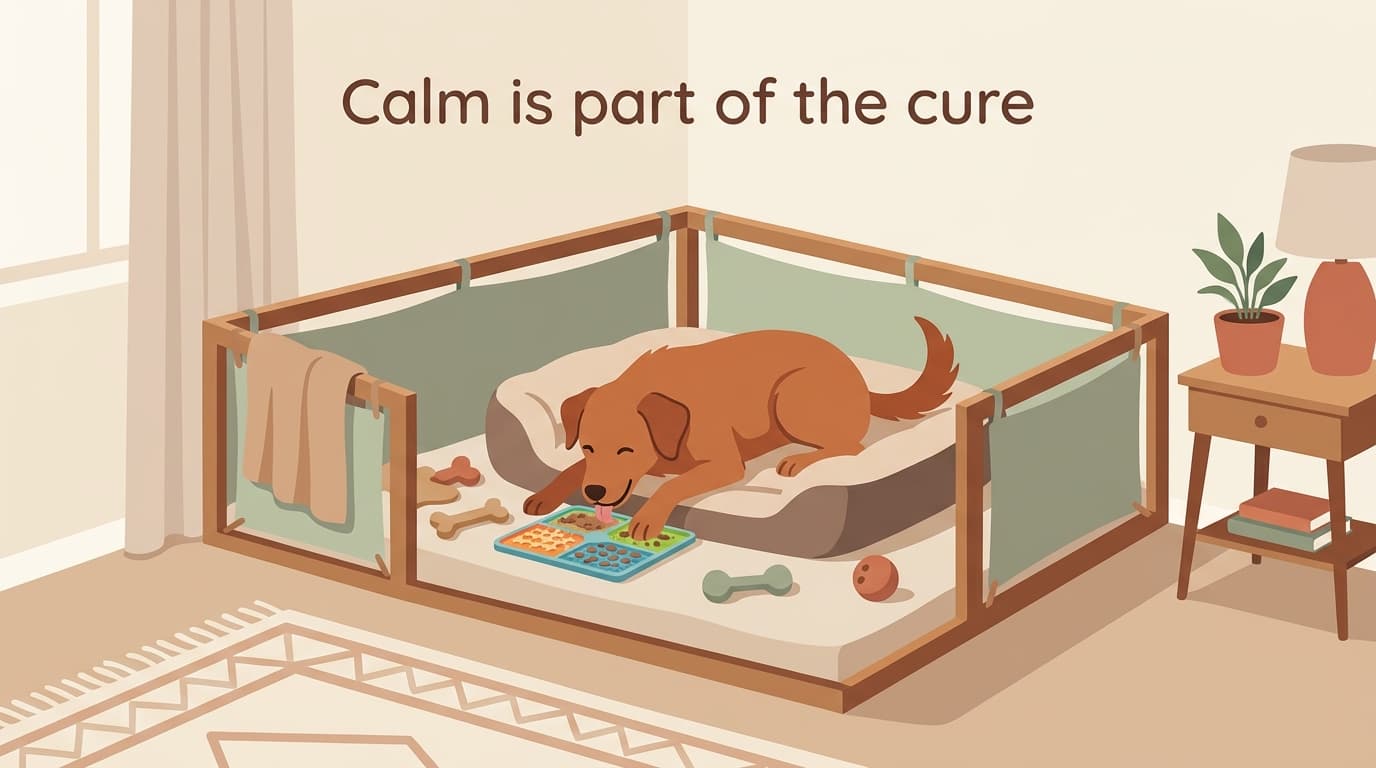
Calm is part of the cure
It is worth being clear why this matters medically, not just for kindness. The whole point of crate rest is to keep your dog still so the injured disc and spinal cord can heal undisturbed, and that depends on your dog actually staying calm and restricted. A dog that is bored, frustrated, and wound up is a dog straining against the confinement, whining, fidgeting, trying to jump or pace, which is exactly the movement the rest is meant to prevent. So keeping your dog mentally settled is not separate from the medical treatment; it is what makes the rest work. Enrichment that calms your dog is, in a real sense, part of the prescription, and approaching it that way, as treatment rather than indulgence, helps you take it as seriously as the medication and the turning.
Tiring the mind without the body
The trick with a confined dog is to tire out the mind without exercising the body, because mental effort is genuinely tiring and a mentally satisfied dog settles far more readily. The key principle is that every form of enrichment here must respect the rest rules, no jumping, no charging about, nothing that needs the dog to move much, all done from a settled, lying-or-sitting position within the pen.
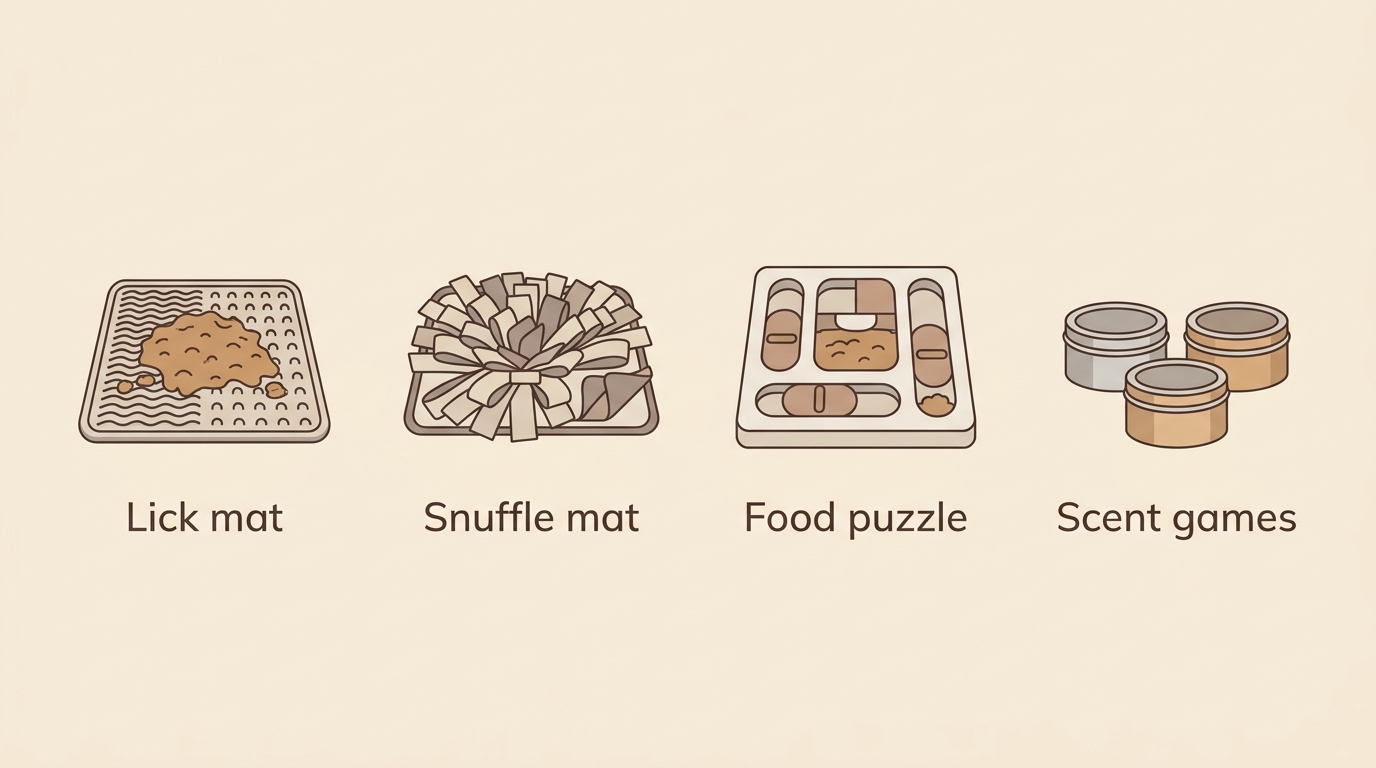
Your mainstays are licking and chewing activities, which are naturally calming for dogs and need no movement: a lick mat smeared with something tasty, a stuffed and frozen food toy to work at slowly, a long-lasting chew. Food puzzles and slow feeders that make the dog use its nose and brain to get at food, rather than its legs, turn a meal into an absorbing task. Scent-based enrichment works beautifully because it engages the nose, a dog's richest sense, while keeping the body still: a snuffle mat kept flat on the floor of the pen, or simply scattering a few treats in a towel to be sniffed out, gives real mental work from a stationary position. Gentle, settled training games, teaching a nose-target, a "watch me", or other quiet cues the dog can perform lying down, provide engagement and the satisfaction of working with you, without any movement at all. Rotate a few of these through the day and your dog has things to look forward to and to occupy its mind, which takes the edge off the boredom and the frustration that make confinement so hard.
A practical note: keep it all genuinely low-key and within the rules. A snuffle mat is for flat, stationary sniffing, not for a dog to dig and bounce at; a chew is for lying and gnawing, not for a tug game. If any activity is winding your dog up rather than settling it, or tempting it to move more than it should, set that one aside. The goal is calm absorption, not excitement.
Company and routine
Two simple things, beyond any specific activity, do a great deal to keep a confined dog content: company and predictability. Dogs are social, and a dog confined alone in a back room will fret far more than one whose pen is in the heart of the household, where it can see and hear its family going about the day. So position the recovery space where the life of the home happens, the kitchen or the lounge, so your dog feels included rather than banished, even though it cannot join in. This sense of still being part of things is genuinely settling.
Routine helps too, because predictability is calming for an anxious or bored dog. Keeping mealtimes, the enrichment activities, the toilet breaks, and your own comings and goings to a reasonably regular pattern gives the day a shape your dog can anticipate, which reduces the restless uncertainty of long confined hours. Brief, calm interaction throughout the day, a few minutes of gentle fuss, quiet words, simply sitting by the pen, reassures your dog without exciting it. None of this requires much, just presence, predictability, and the dog being kept in the warm centre of family life rather than shut away.
When to ask about medication
Sometimes, despite everything, a dog simply cannot settle, and the anxiety or frustration becomes so great that it is sabotaging the very rest the dog needs, pacing, panting, whining relentlessly, or repeatedly trying to move in ways that risk the recovery. If you reach that point, it is worth knowing that this is a problem your vet can help with, and asking is sensible, not a failure. Your vet can prescribe medication, mild sedation or anti-anxiety medication, to help a genuinely distressed dog stay calm enough to rest, which can be far better for the recovery than letting the dog work itself up and undo the healing. So if you genuinely sense that your dog's distress is winning the battle against the rest, do not just struggle on; ring your vet and ask whether something could help take the edge off. It is a recognised part of managing some recoveries, and a calm dog, however that calm is achieved, heals better than a frantic one.
Looking after you
Your own wellbeing through these weeks matters as much as anything above, and the strain is real. The constant vigilance, the broken sleep, the guilt every time your dog looks at you reproachfully from the pen, the sheer relentlessness of it, genuinely wear owners down, and studies of owners nursing dogs through serious spinal injury bear out that it is a heavy commitment. It is completely normal to find this hard, to feel frustrated, tearful, or exhausted, and to feel guilty for confining a dog who clearly wants to be free.
Please be kind to yourself in it. Remember that the confinement is an act of love, not cruelty, even when it does not feel that way, and that it is temporary. Share the load if there is more than one of you, accept help, and lower your expectations of everything else in life for a few weeks. It can also genuinely help to know that owners of the mildly affected dogs often find this hardest of all, precisely because a dog that feels well wants its normal life back and does not understand why it cannot have it, so if you are struggling with a bright, bouncy dog who hates the pen, you are not doing it wrong. This is a hard chapter with an end in sight, and getting your dog and yourself through it, a bit frayed but intact, is a real achievement.
Keeping a confined dog calm is part of the cure, not a luxury, so treat the enrichment as seriously as the medication. Tire the mind without the body, through licking, chewing, scent work, food puzzles, and gentle settled games, all kept low-key and within the rest rules. Keep your dog in the heart of the home, on a predictable routine, with calm company. Ask your vet about medication if distress is genuinely sabotaging the rest. And look after yourself too, because this is hard, it is temporary, and you are doing something loving. A calm dog rests better and heals better, and a kept-together owner gets you both to the finish line.
References
- Olby NJ, Moore SA, Brisson B, Fenn J, Flegel T, Kortz G, Lewis M, Tipold A. ACVIM consensus statement on diagnosis and management of acute canine thoracolumbar intervertebral disc extrusion. Journal of Veterinary Internal Medicine, 2022;36(5):1570-1596.
- Freeman PM, Holmes MA, Jeffery ND, Granger N. Time requirement and effect on owners of home-based management of dogs with severe chronic spinal cord injury. Journal of Veterinary Behavior, 2013;8(6):439-443.
Sister tool · Sightline
Track whether treatment is working
Sightline, a separate ConciergeVet tool, runs a short weekly check-in built on validated pain and mobility instruments, turns it into a single Sightline Score you can watch trend over weeks rather than judge on one bad day, and produces a report you can bring to your vet.
A written log, or our printable trackers, does much the same job.
See how Sightline tracks treatmentTrack the recovery, day by day
Recovery from a disc injury is all about the trend. Log the daily milestones through crate rest and rehab so you can see real progress, not just good and bad days.
Open the Recovery TrackerYou're not doing this alone
Compare treatment journeys and talk to owners managing IVDD. Free to join.
Join PetsLikeMine