

Life on Wheels: Choosing and Using a Dog Wheelchair
Alastair Greenway
BVM&S MRCVS
A dog that cannot use its back legs can still live a happy, active, genuinely full life. When a dog loses the use of its hind legs, a particular fear tends to circle: that a dog who cannot walk cannot have a good life, and that the kindest thing might be to let them go. Many dogs on wheels run, play, explore, and delight in their days every bit as much as they did before. Loss of mobility is not, in itself, the end of a good life, and it is very often not a reason to say goodbye.
I want to be straight as well as hopeful, and we will come to the genuine considerations and the harder questions later, because you deserve the truthful picture, not a rose-tinted one. But the starting point, the thing too many owners are never told, is that paralysis is not a death sentence, and a wheelchair can give a dog back a life of running and joy. Let us look at how.
What changes owners' minds
The alternative belief costs dogs their lives. Far too many dogs are put to sleep when they lose their mobility, not because their life could not be good, but simply because their owners were never told that a good life was possible, or did not know how to make it happen. That is a heartbreaking waste.
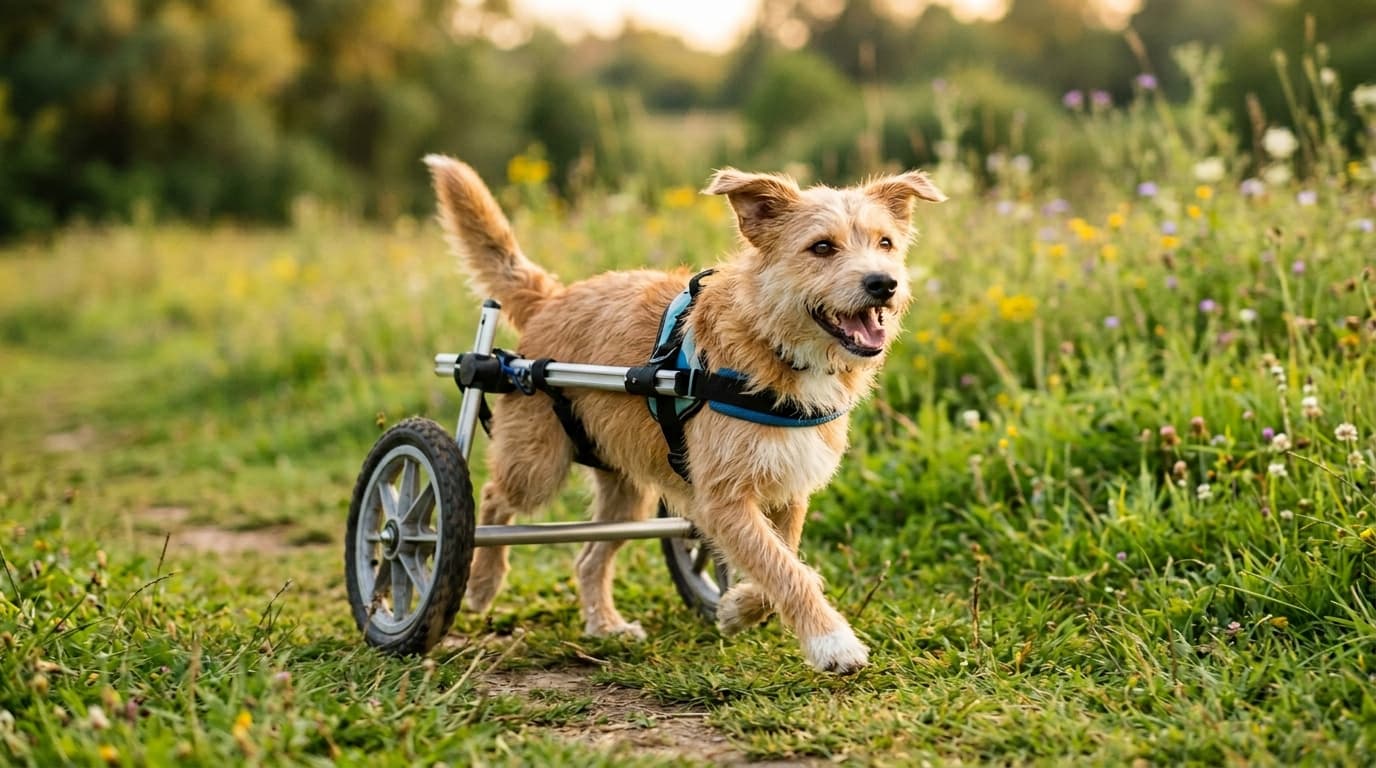
None of this is wishful thinking. It is borne out by the owners who have actually lived it. In a study of people caring for dogs with severe, permanent spinal cord injury for many months, the great majority found the experience genuinely worthwhile, a number felt it had actually strengthened the bond with their dog, and only a single owner felt it had reduced their own quality of life. Dogs, for their part, adapt to disability far better than we expect: they do not grieve a lost ability the way we imagine we would, do not feel self-conscious or sorry for themselves, and do not measure their lives against what they used to do. A dog in a well-fitted wheelchair, zooming across a field with its tongue out, is not a tragic figure; it is simply a dog enjoying being a dog, by slightly different means. This can have a good ending, and many, many dogs go on to thrive on wheels.
There is even hope for some dogs that never regain normal sensation. With dedicated physiotherapy, a proportion of paraplegic dogs develop what is called "spinal walking," a reflex-driven gait of their own that lets them walk again in a fashion, independent of a cart; in one study of paraplegic dogs that had lost deep pain, well over half went on to develop this after surgery for a disc extrusion. So a dog facing life on wheels is not necessarily facing it forever, and either way, a good life is genuinely achievable.
Is a wheelchair right for your dog?
With that hope established, let us be practical, because a wheelchair is not the only aid and not automatically the right one for every dog at every stage. A cart is most obviously suited to a dog with lasting weakness or paralysis of the back legs that is otherwise well and bright, giving them back independent movement.
But it sits within a wider toolkit, and sometimes another aid fits better, or fits better first. For a dog that is still recovering and may regain function, the priority is often continued rehabilitation rather than committing to a cart, and your vet or a rehab therapist can advise on the outlook. For getting around the house, or for a dog that needs occasional help, a support sling or a lifting harness under the belly can be all that is needed, and for some indoor situations a padded drag bag suits a dog better than wheels. Many dogs use a combination, a harness for the stairs, a cart for walks, floor time for pottering about. And throughout, ongoing physiotherapy and rehabilitation continue to matter, both to maintain the body and, in some dogs, to support that gradual return of spinal walking. So the question is not simply "wheelchair, yes or no," but "what combination of support gives this particular dog the best mobility and comfort right now," and that is a conversation to have with your vet or rehab therapist.
Choosing a cart
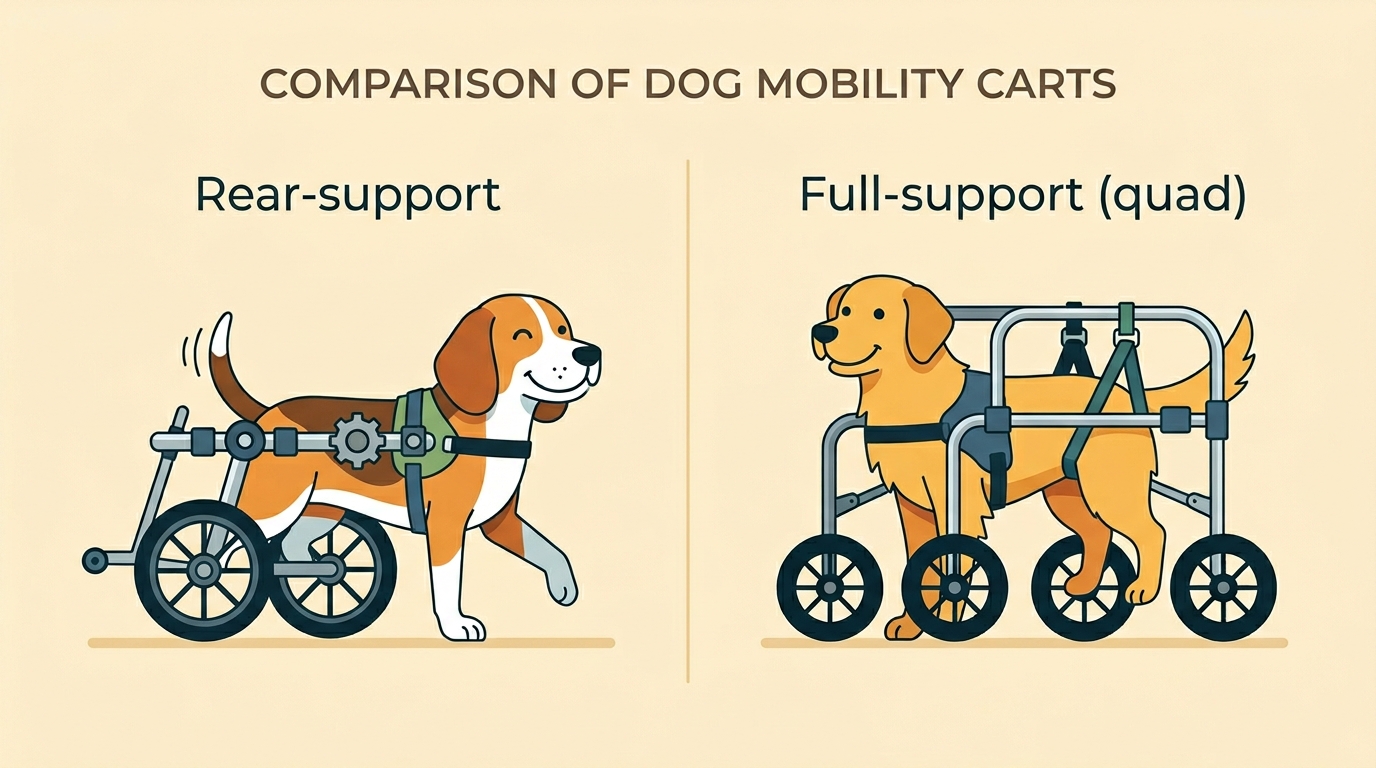
If a wheelchair is the right step, choosing well makes all the difference, and the main decisions are straightforward once you know what to look for. Start with the type of cart. A rear-support wheelchair, which supports the back end while the dog powers along with its front legs, suits the common situation of hind-limb weakness or paralysis. A full-support or "quad" wheelchair, which supports all four limbs, is for dogs affected in the front legs too, or with neck disease affecting all four limbs, provided the dog still has enough movement somewhere to propel itself. Your vet can help you judge which your dog needs.
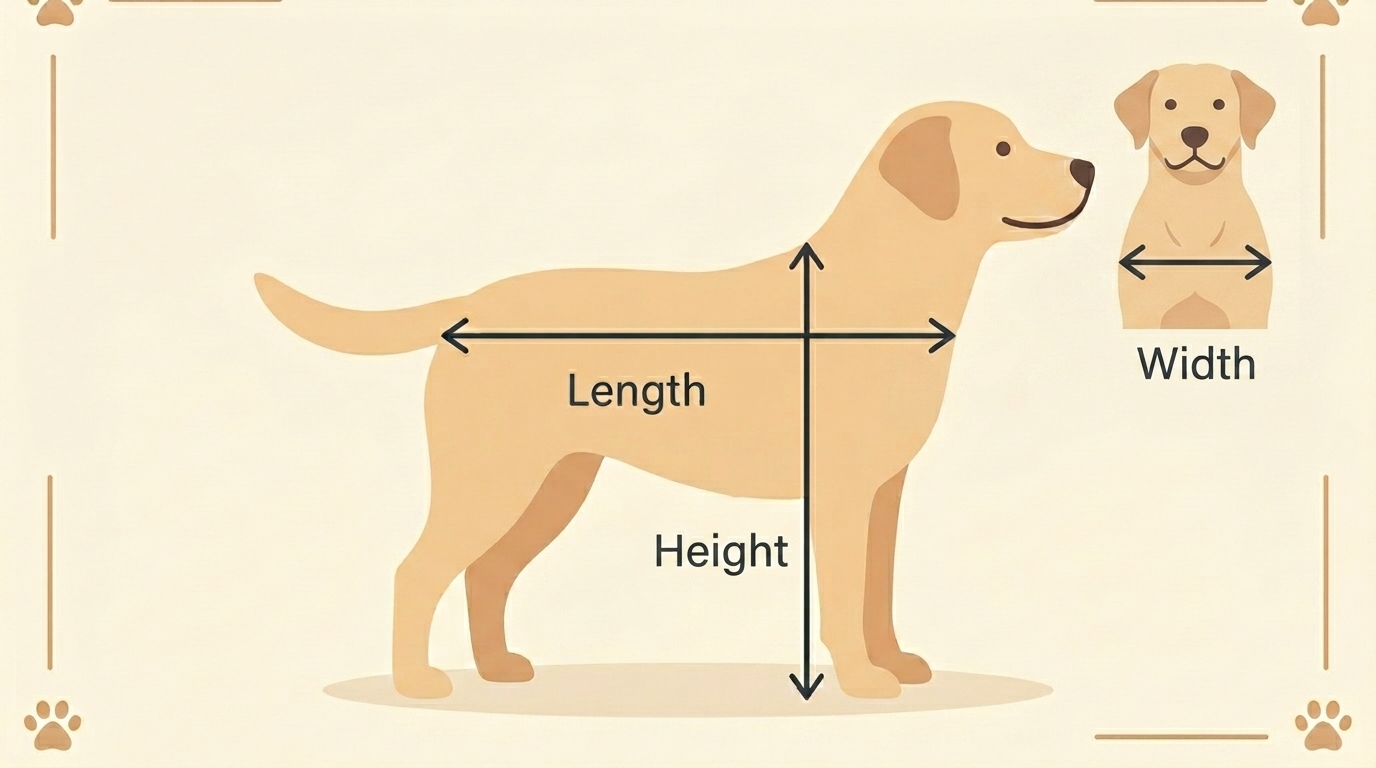
Next comes fit, and it genuinely matters: a cart must be correctly sized and measured to your individual dog, so that it supports them properly without rubbing or straining, much as a wheelchair for a person must be the right size. Look for adjustability, too, which is especially valuable for a dog that is still growing or that may recover some function, since an adjustable cart can be adapted as the dog changes rather than outgrown. As for where to get one, there are several reputable wheelchair suppliers in the UK offering both off-the-peg adjustable carts and custom-built options, and your vet or rehabilitation therapist can point you toward suitable ones and help with measuring. In the interests of full transparency, you should know that the founder of this platform has commercial interests in the pet health space; this article recommends no particular brand and earns nothing from your choice, and the only thing that matters is finding the cart that genuinely fits and suits your dog, on your vet's guidance. Buy on fit and function, not on marketing.
Introducing and using it
Getting a dog used to a wheelchair is usually easier than owners fear, though it takes a little patience and the right approach. Introduce it gradually and positively: short, happy first sessions, plenty of encouragement and treats, and letting your dog discover that the cart means freedom and fun rather than something strange and alarming. Some dogs, especially those who have been frustrated by their inability to move, take to a cart almost instantly and are off across the room within minutes; others find the contraption odd at first, with its noise and the way it follows them, and need a little more coaxing and a few sessions to gain confidence. Both are normal, so do not worry if your dog is hesitant at first.
A few practical points keep things safe and comfortable. Always supervise your dog in the cart, and be mindful of the terrain, since carts manage some surfaces and slopes better than others. Crucially, a wheelchair is not for twenty-four-hour use: your dog needs regular breaks out of it, both to rest and, importantly, to protect the skin from any pressure or rubbing, so think of the cart as a tool for active times rather than something the dog lives in. Balance cart time with comfortable floor time and with the ongoing physiotherapy that keeps the whole dog in good shape. A cart does take a little time to fit and remove each time, and becomes part of the daily routine, but owners quickly find this second nature. Used this way, the wheelchair becomes a natural, happy part of your dog's day.
Caring for the whole dog
A wheelchair restores movement, but a dog with lasting hind-limb disability usually needs a little broader care, and it is worth knowing the main pieces so nothing is missed. Many of these dogs need help managing their bladder and bowel, which our guide to long-term incontinence covers in full, since getting this routine right is central to both comfort and health. Because a less mobile dog spends more time lying down, protecting the skin from pressure sores and from urine scald matters, and our guide to preventing sores and scald explains how. Setting up your home to suit a wheelchair dog, with ramps, accessible bedding and bowls, and non-slip flooring, makes daily life easier, and our home-adaptation guide goes into it. And keeping your dog lean is especially important when mobility is limited, both to make moving easier and to protect the joints, as our weight-management guidance describes. Maintaining a less-mobile dog does take ongoing time and effort, the physiotherapy, the daily care, the routine, and there is no point pretending otherwise; but none of it is overwhelming once it becomes routine, and each piece has its own guide. Together they make up the comfortable, well-supported life that lets a dog on wheels truly thrive.
Quality of life, squarely
For the great majority of dogs, life on wheels is genuinely good, and the hopeful picture above is the real and common one, backed by the owners who have lived it. But it is right to acknowledge that it is not the answer for every single dog in every situation. A few dogs do not adapt well to a cart, some have other health problems that complicate things, and the daily care is a real commitment of time and energy that a minority of owners find genuinely hard. For certain dogs with certain conditions, when you weigh their genuine day-to-day quality of life squarely and from their point of view rather than ours, wheels may not be the right path, and harder decisions have to be faced.
One thing worth holding onto as you weigh this: in both people and dogs with spinal injury, what most erodes quality of life is not the loss of walking itself but uncontrolled pain. A comfortable, pain-free dog on wheels can have an excellent quality of life; a dog in unmanaged pain is a different and more urgent situation. So the key is to assess your dog's quality of life truthfully and with your vet, looking clearly at their comfort, their enjoyment, their dignity, and their day-to-day experience as a dog, not at our own feelings or fears. Our more sensitive guides, on assessing quality of life and on the hardest decisions, are there, gently, for anyone who needs to think this through, and there is no shame and no failure in any loving decision reached carefully with your vet. For most dogs facing life on wheels, though, the answer is the hopeful one, and the considerations here are about doing it thoughtfully, not reasons to lose heart.
So, if your dog is facing life on wheels, hold onto this truth: this can be a happy ending, and most dogs on wheels live full, joyful lives, as the owners who have walked this road will tell you. Talk to your vet or a rehabilitation therapist about whether a cart suits your dog and how to get the fit right, lean on our guides to incontinence care, home adaptation, and skin protection to round out the whole-dog picture, and, when you are ready, look up the many stories of dogs thriving on wheels, because seeing them run again is the best answer there is to the fear you may have started with.
References
- Olby NJ, Moore SA, Brisson B, Fenn J, Flegel T, Kortz G, Lewis M, Tipold A. ACVIM consensus statement on diagnosis and management of acute canine thoracolumbar intervertebral disc extrusion. Journal of Veterinary Internal Medicine, 2022;36(5):1570-1596.
- Freeman PM, Holmes MA, Jeffery ND, Granger N. Time requirement and effect on owners of home-based management of dogs with severe chronic spinal cord injury. Journal of Veterinary Behavior, 2013;8:439-443.
- Henea ME, Sindilar EV, Burtan LC, Mihai I, Grecu M, Anton A, Solcan G. Recovery of spinal walking in paraplegic dogs using physiotherapy and supportive devices to maintain the standing position. Animals, 2023;13(8):1398.
Sister tool · Sightline
Track whether treatment is working
Sightline, a separate ConciergeVet tool, runs a short weekly check-in built on validated pain and mobility instruments, turns it into a single Sightline Score you can watch trend over weeks rather than judge on one bad day, and produces a report you can bring to your vet.
A written log, or our printable trackers, does much the same job.
See how Sightline tracks treatmentTrack the recovery, day by day
Recovery from a disc injury is all about the trend. Log the daily milestones through crate rest and rehab so you can see real progress, not just good and bad days.
Open the Recovery TrackerYou're not doing this alone
Compare treatment journeys and talk to owners managing IVDD. Free to join.
Join PetsLikeMine