

How to Express Your Dog's Bladder, Step by Step
Alastair Greenway
BVM&S MRCVS
When a dog has lost the ability to wee on its own, perhaps after a spinal injury or during IVDD recovery, helping to empty its bladder by hand, what vets call expressing the bladder, becomes one of the most important parts of its daily care. I know this sounds daunting. Pressing on your dog's belly to make it wee can feel frightening and strange the first time you hear about it. But it is a gentle, learnable skill, and many owners do it every day to keep their dogs safe and comfortable. This guide, together with the demonstration video, walks you through how to do it kindly and correctly, and what manual expression can and cannot achieve, because that clarity matters for your dog's health.
Why it matters
Understanding why this matters so much makes the task feel less like a chore and more like the genuinely protective care it is. When a dog cannot empty its own bladder, the urine builds up, and that causes two real problems. The bladder can become over-distended, stretched too full for too long, and a bladder that is repeatedly over-stretched can lose its muscle tone, which can actually delay or reduce a dog's chances of regaining normal bladder control as it recovers. And a bladder that does not empty properly is far more prone to urinary tract infections, which in dogs can be stubborn to clear and, left unchecked, can travel up toward the kidneys. Expressing the bladder regularly keeps it from over-filling and helps keep infections at bay, keeping your dog comfortable and protecting its recovery until, in many cases, normal function returns.
Get shown by your vet or nurse first
Before anything else, one thing matters more than all the written steps put together, so I want to be completely clear about it: please have your vet or a veterinary nurse show you how to do this in person before you rely on doing it yourself. This guide and the video are here to reinforce and remind you of that hands-on teaching, to support you between appointments and refresh your memory, but they are not a substitute for being shown on your own dog by a professional who can guide your hands, confirm you have found the bladder, and check your technique. This matters all the more given a fact we will come to plainly below, that even trained professionals do not always empty the bladder completely by hand, so getting your technique checked, and knowing what an adequately emptied bladder feels like for your dog, is genuinely important. Never hesitate to ask your veterinary team to show you again if you are unsure.
How often to express
Your vet will tell you how often to express your individual dog, but as a general guide most dogs that cannot wee on their own need their bladder expressed around three to four times a day, spread through the day and last thing at night, to stop it over-filling between times. Alongside the schedule, it helps to recognise the signs of a full bladder, a firm, rounded swelling low in the belly, and sometimes dribbling of urine as an over-full bladder overflows, which is a sign it needs emptying rather than that your dog is managing on its own. Sticking to a regular routine, rather than waiting for signs, is the safest approach, because it keeps the bladder from ever getting dangerously full.
Step by step
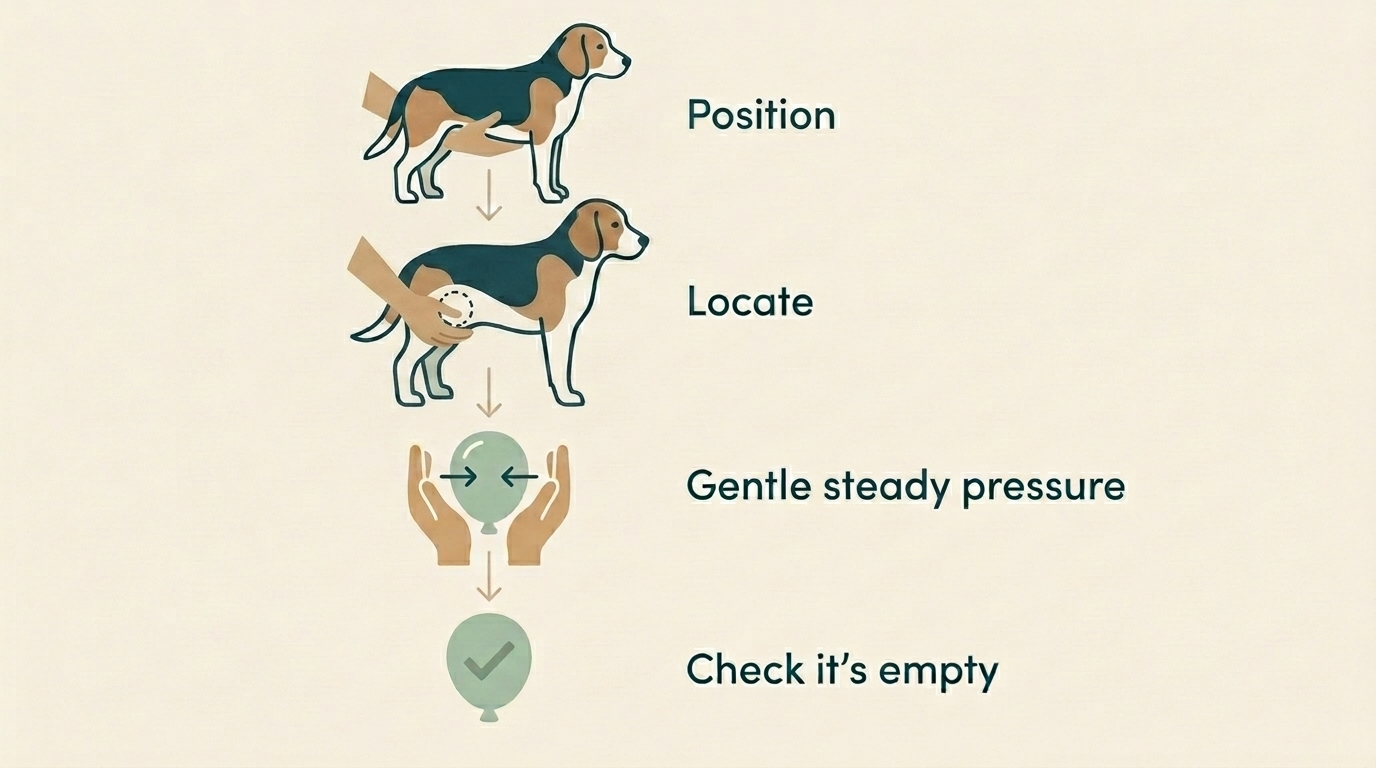
Here is the general technique, to support what your vet has shown you. Take it gently and calmly throughout, because a relaxed dog, and a relaxed you, makes the whole thing far easier. The whole process usually takes only ten to twenty seconds once you have the knack.
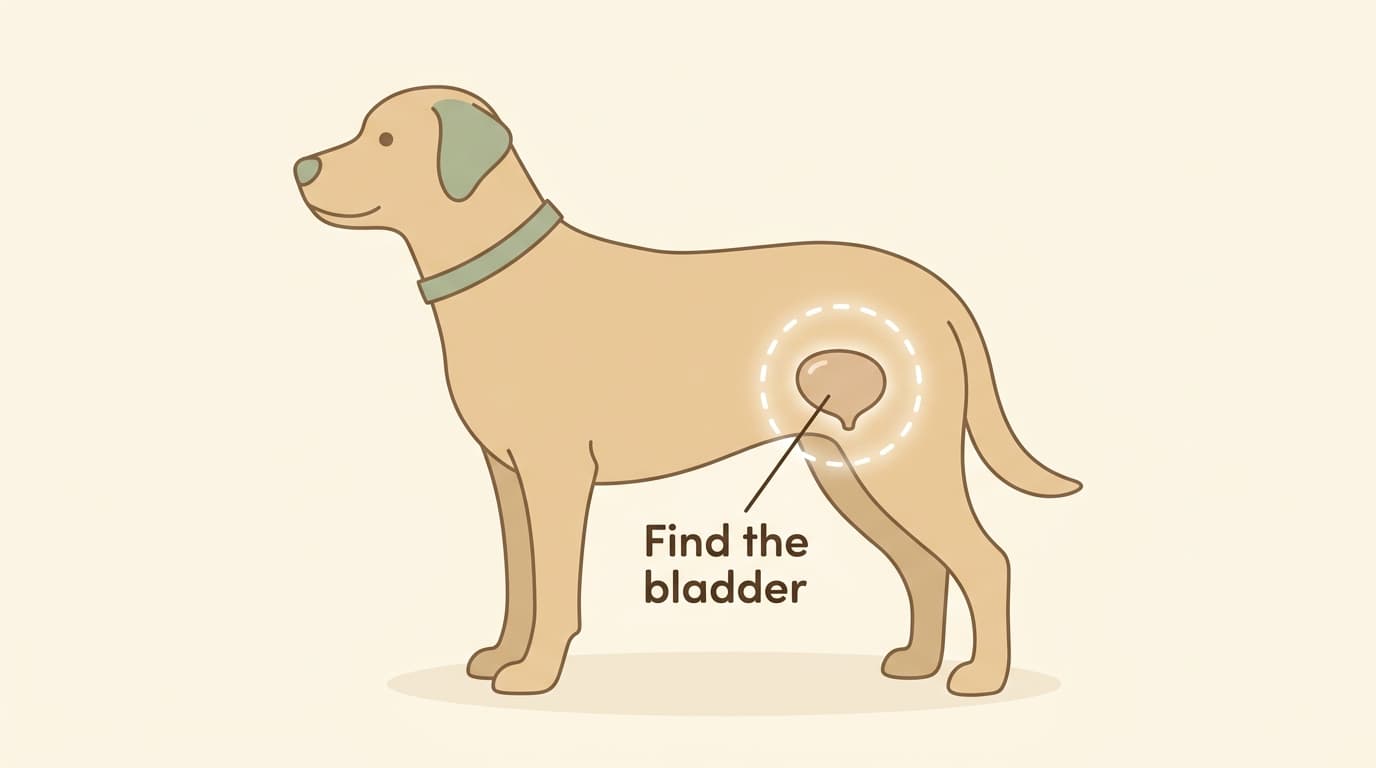
First, position your dog comfortably, whichever way suits you both: a dog that can stand may be supported in a standing position, perhaps with a sling or a towel under the belly to steady it, while a dog that cannot stand is often easiest to express lying on its side. Second, locate the bladder, which feels like a smooth, round, water-filled balloon in the lower part of the tummy, toward the back; when full it is firmer and easier to find, when empty it more or less disappears. In a male dog it sits roughly above the middle of the penis. Your vet will have shown you exactly where to feel for it on your dog. Third, apply gentle, steady, even pressure, cupping the bladder with one or both hands and pressing slowly and evenly, directing it toward the urethra, gradually increasing the pressure until urine begins to flow in a steady stream. Two rules matter most here. The pressure must be slow and constant, never a pulsing, jarring, or sudden punching action, which is both ineffective and could cause harm. And it should never hurt your dog or require real force: it is gentle, patient pressure, not squeezing or crushing. A short delay between pressing and the urine flowing is completely normal, so hold the steady pressure for a few seconds rather than expecting it instantly. Fourth, keep going until the stream slows to dribbles and the bladder feels small and soft, then, after a pause, gently press again, because emptying the bladder as fully as possible is what protects against infection. You will gradually learn the difference between a full bladder and a properly emptied one, which is exactly the kind of thing the video helps make clear.
If your dog has a tense abdomen that makes expressing difficult, a couple of tricks help: a warm compress on the belly, or a calm massage first, can relax the muscles, and if your dog is on a prescribed muscle relaxant, expressing twenty to thirty minutes after a dose can make it easier.
A frank word: expression often isn't complete
Many sources gloss over something you deserve to know, because it directly affects your dog's health. Manual expression frequently does not empty the bladder completely. In a study of paraplegic dogs, expression performed by trained vets and nurses removed, on average, only about half the urine in the bladder, and at-home expression by owners is likely to be less effective still. That does not mean expressing is pointless, far from it, regularly reducing the volume genuinely helps prevent over-distension and infection, but it does mean two important things. First, you should not assume that because you have expressed your dog, the bladder is now empty and all is well; a meaningful amount of urine often remains. Second, this is precisely why your vet stays involved, may check how well the bladder is emptying, and for some dogs recommends additional measures. So treat expression as a vital part of the routine, not a complete solution on its own, and keep your vet in the loop about how it is going.
The bladder that won't express, and when expression isn't enough
This leads to an important safety point and a practical one. Bladders behave differently depending on where the spinal injury sits, as our guide to long-term incontinence explains. Some bladders are floppy and easy to express with light pressure. Others, particularly after injuries higher up the spine, become firm and tense and genuinely difficult to express, because the muscle that should relax to let urine out stays clenched. The safety rule here is simple and important: if your dog's bladder feels hard and will not empty with gentle, steady pressure, do not force it. Forcing urine out against a tightly closed outlet is not safe, and a firm bladder that will not express is a reason to contact your vet rather than to push harder.
For these dogs, and indeed for many dogs in which expression alone does not empty the bladder well enough, your vet has other options. These include particular medications that help the bladder empty or relax the outlet, and intermittent catheterisation, passing a catheter to drain the bladder properly, which is sometimes necessary in addition to or instead of manual expression. So if you are finding expression difficult, or your vet has shown that the bladder is not emptying well, that is not a failure on your part, it is a known limitation of the technique and a reason to go back to your vet, who can reassess and add what is needed. The goal is a reliably and adequately emptied bladder, by whatever combination of means works for your particular dog.
Hygiene and skin
A dog that cannot wee normally, and that may dribble urine between expressions, is at real risk of urine scald, where urine left on the skin causes painful soreness. So keeping your dog clean and dry is an important partner to expressing the bladder: after each expression, and whenever your dog has leaked, gently clean the area with warm water and pat it properly dry, and check the skin regularly for redness. Our guide to preventing pressure sores and urine scald covers this care in full, and it is well worth reading alongside this one.
When to call the vet
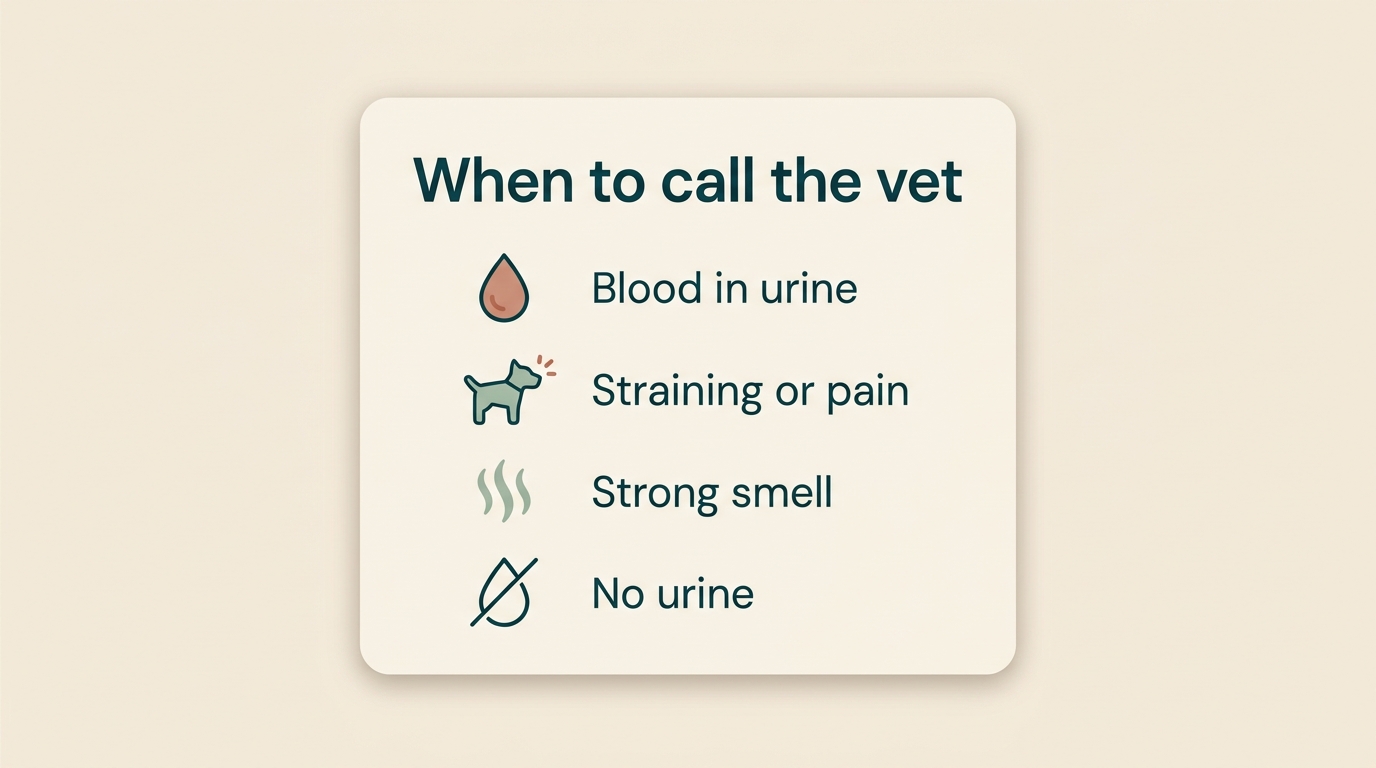
While expressing becomes routine, there are signs that mean you should contact your vet rather than carry on, so do get in touch promptly if any of these arise: you cannot express the bladder at all, or it feels hard and will not empty; you see blood in the urine; your dog strains or seems to be in pain or distress; there are signs of a urinary infection such as a strong or unpleasant smell, cloudy urine, or your dog seeming unwell or feverish; or your dog is producing no urine at all. Any of these warrants a conversation with your vet, because they can signal an infection, a bladder that needs catheterising, or another problem that needs proper attention. As ever, if something does not seem right, it is always worth a call.
So, to support you as you get the hang of this, do lean on our quick-reference expression card to keep the steps to hand, and watch the demonstration video, which shows the positioning, how to find the bladder, the gentle technique, and what a properly emptied bladder looks like, far more clearly than words alone can. Most importantly, remember three things: this genuinely does get easier with practice, expression reduces but does not always fully empty the bladder so your vet stays part of the picture, and for many dogs the need for it is temporary, with normal control returning as they recover.
References
- Olby NJ, Moore SA, Brisson B, Fenn J, Flegel T, Kortz G, Lewis M, Tipold A. ACVIM consensus statement on diagnosis and management of acute canine thoracolumbar intervertebral disc extrusion. Journal of Veterinary Internal Medicine, 2022;36(5):1570-1596.
- Carwardine DR, Rose JH, Harcourt-Brown TR, Granger N. Effectiveness of manual bladder expression in paraplegic dogs. American Journal of Veterinary Research, 2017;78(1):107-112.
Free downloads
Companion worksheets to put what you've read into practice. Free PDFs, print at home.
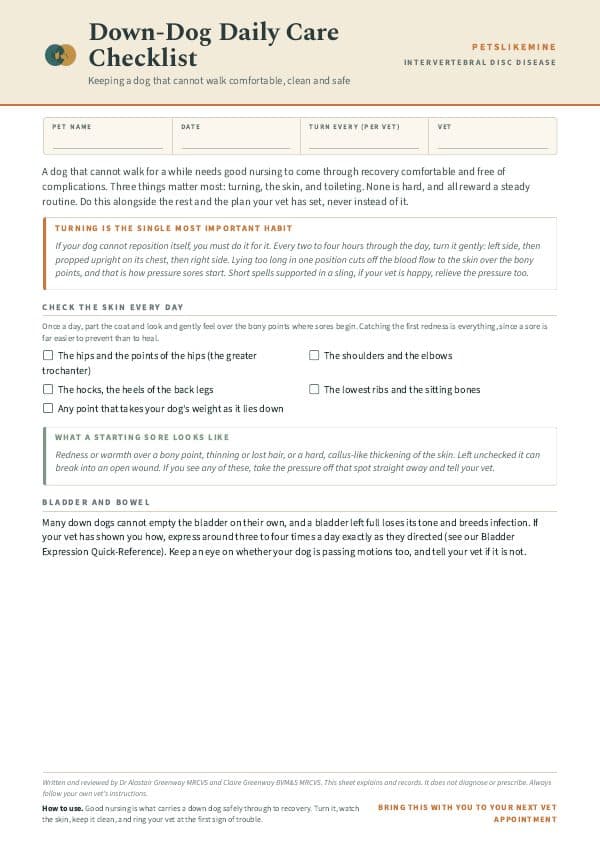
Down-Dog Daily Care Checklist
PDF · 230 KBCaring for a dog that cannot yet walk is a lot to hold in your head, so here it is on one page. Bladder emptying, turning, skin and bedding checks, meals and meds, each with its own tick box through the day. Nothing important slips when the days start to blur together.
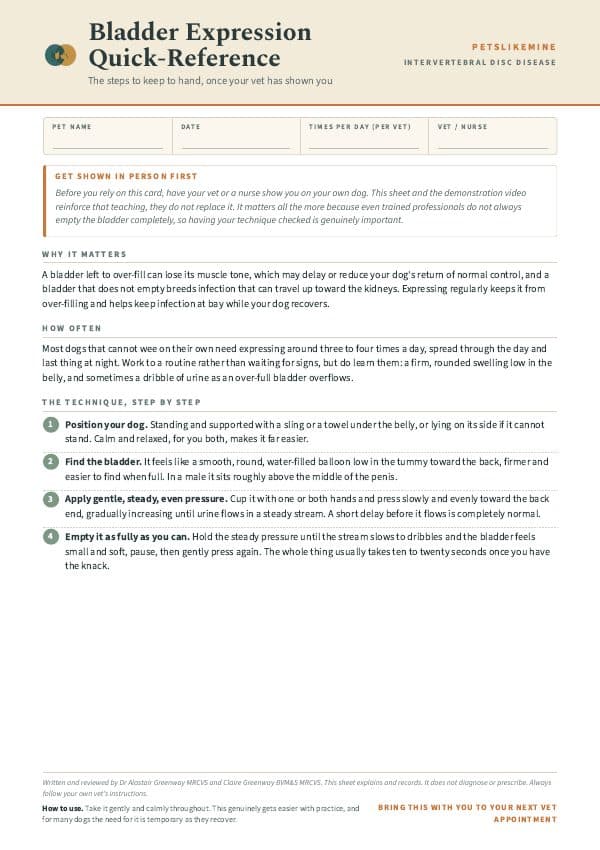
Bladder Expression Quick-Reference
PDF · 211 KBThe steps for emptying your dog's bladder, stripped back to a card you can prop up while your hands are busy. How to find the bladder, how much pressure, how often, and what should make you call the vet, with a QR code to the full how-to video. Frightening on day one, second nature by the end of the week.
Sister tool · Sightline
Track whether treatment is working
Sightline, a separate ConciergeVet tool, runs a short weekly check-in built on validated pain and mobility instruments, turns it into a single Sightline Score you can watch trend over weeks rather than judge on one bad day, and produces a report you can bring to your vet.
A written log, or our printable trackers, does much the same job.
See how Sightline tracks treatmentTrack the recovery, day by day
Recovery from a disc injury is all about the trend. Log the daily milestones through crate rest and rehab so you can see real progress, not just good and bad days.
Open the Recovery TrackerYou're not doing this alone
Compare treatment journeys and talk to owners managing IVDD. Free to join.
Join PetsLikeMine