

Is This an IVDD Emergency? The Red Flags That Mean Act Now
Alastair Greenway
BVM&S MRCVS
A dog that has suddenly gone wobbly, started dragging a back leg, or cried out in pain needs an answer fast, not a biology lesson. So here it is, straight away.
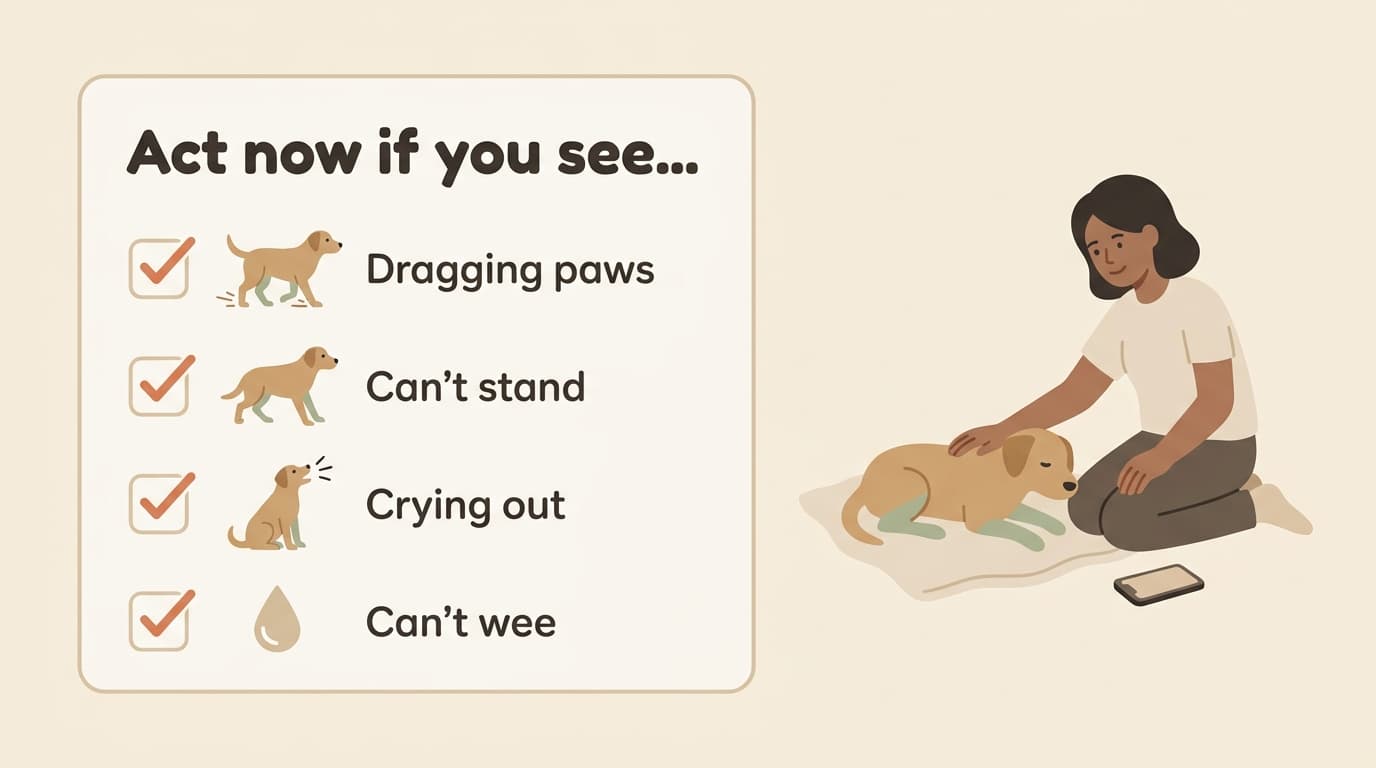
Act now if you see any of these
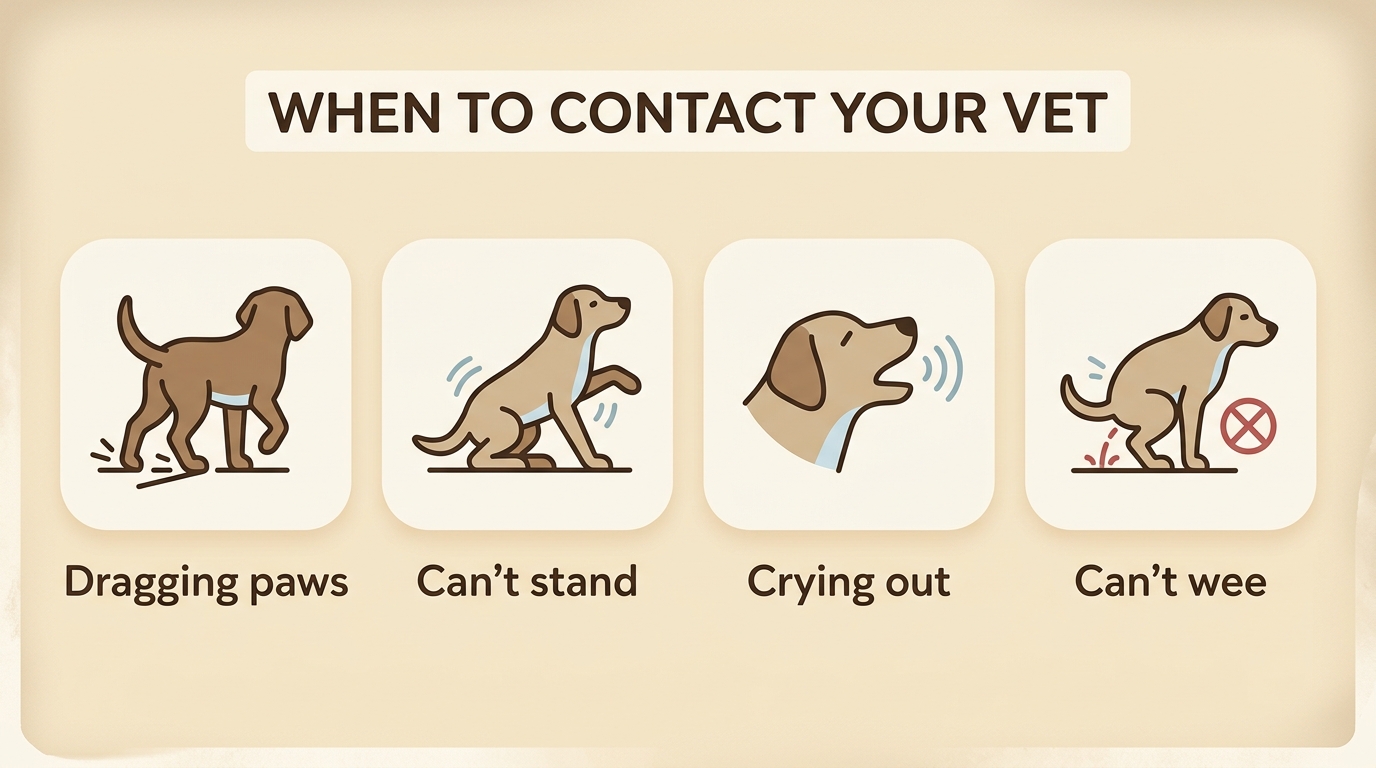
Treat it as an emergency and call a vet immediately if your dog shows any of the following:
- Sudden inability to walk, or back legs that have given way
- Dragging or knuckling the back paws, walking on the tops of them
- Crying out or screaming in pain
- Suddenly unable to wee
- Wobbliness that is getting worse in front of you
- A rigid, hunched back, or the head held low and stiff with a painful neck
If any of these is happening, ring your vet or your nearest out-of-hours service now and tell them you think your dog has a spinal emergency. If you are mid-crisis, make the call first and read on while you get ready to go.
Why there's a clock ticking
Here is why IVDD can be so time-critical, in plain terms. In this condition a disc in the spine presses on or strikes the spinal cord, and the longer and harder that pressure continues, the more the nerves are damaged, sometimes permanently. The cord is delicate and does not recover well once severely injured, so relieving the pressure sooner gives it the best chance.
For most dogs, those still walking or merely wobbly, this is urgent but not a race against the clock by the hour. For the most severely affected dogs, though, the ones that are paralysed and have lost the ability to feel a deep pinch in their back legs, time genuinely changes the odds. In these dogs, surgery within roughly the first forty-eight hours of the signs starting has carried around a sixty percent chance of walking again, whereas leaving it toward a week or more has seen that chance fall steeply, in some reports to under ten percent. That is why "wait and see" can be the wrong instinct with a paralysed dog.
I want to be precise, though, because there is a lot of frightening half-truth online. The modern veterinary position is not the old "operate within a few hours or it is hopeless" rule. Dogs that had lost deep pain for a week or more before surgery have still gone on to recover in the published literature, so there is no magic deadline after which the door slams shut. The message, then, is not "panic because you have minutes," it is "this is time-sensitive, so do not wait and see, get your dog assessed urgently." Treating it promptly gives your dog the best chance, and that is entirely within your power right now.
The deep-pain test, explained safely
You may read about checking for "deep pain," and it is worth understanding what that means, though the assessment that counts is the one your vet does. Deep pain perception is a conscious response to a firm pinch of a toe: the dog turns its head, cries out, or looks round at you, showing that the sensation is genuinely reaching the brain. It is not the reflex where the leg simply pulls back on its own. That withdrawal reflex can happen through the spinal cord alone, with no message getting through to the brain, so a leg that twitches or pulls away can give you false reassurance even in a dog that has lost deep pain.
This distinction matters enormously, because the presence or absence of deep pain is the biggest single factor in a dog's outlook, the difference between odds well above ninety percent and odds around half. But here is the practical rule for you at home, and it is the one to hold onto: if your dog cannot walk and you are trying to judge this yourself, it is very easy to misread a reflex twitch as a good sign. So if you cannot clearly tell whether your dog has deep pain, assume the worst and go now. Do not spend time at home pinching toes and second-guessing. When in doubt, treat it as an emergency, and let the vet make the assessment that matters.
Your first few minutes, step by step
If you think your dog is having a spinal emergency, here is exactly what to do, in order:
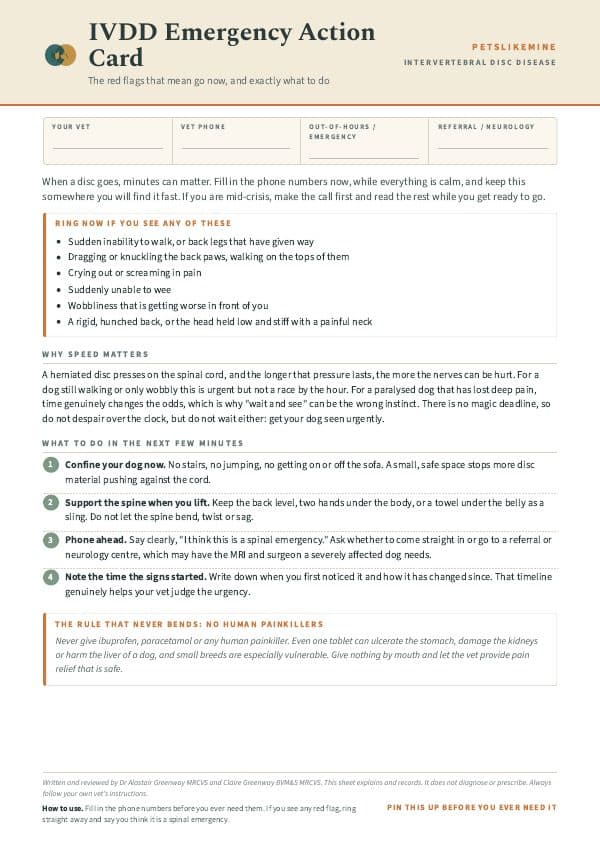
- Confine your dog immediately. No stairs, no jumping, no getting on or off the sofa, no running about. Restrict them to a small, safe space right now, because every extra movement risks pushing more disc material against the cord and worsening the damage.
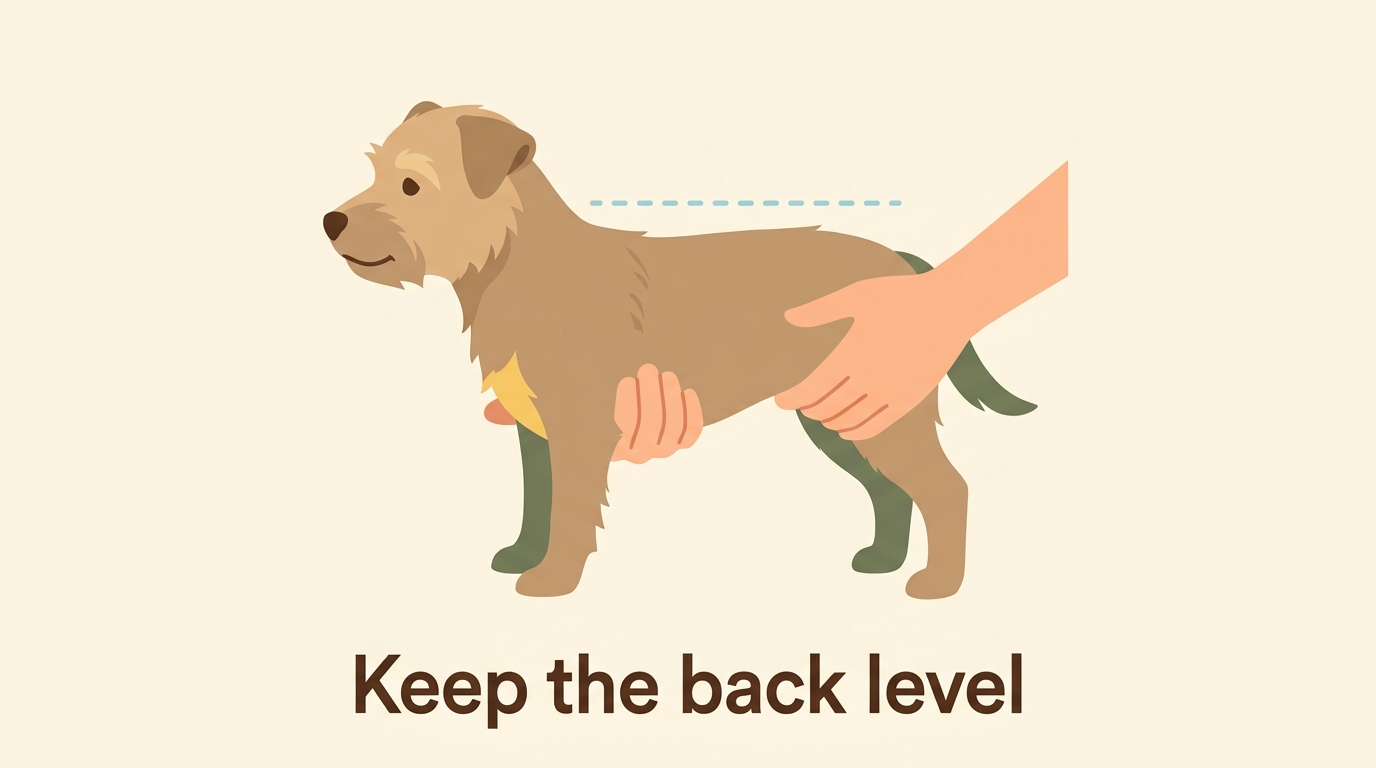
- Support the spine when you lift. When you move your dog, keep the back as level as possible, supporting the whole body with two hands, or use a towel under the belly as a sling, so the spine is not allowed to bend, twist, or sag.
- Ring your vet or the out-of-hours service. Phone ahead rather than just turning up, and say clearly, "I think this is a spinal emergency," so they can prepare for you. Ask whether you should come straight in or go directly to a referral or neurology centre, since a severely affected dog may need an MRI and a surgeon that not every practice has on site.
- Do not give human painkillers. This matters more than people realise. Ibuprofen is rapidly absorbed and lingers far longer in a dog than in a person, and even a single tablet can ulcerate the stomach and damage the kidneys of a small dog; paracetamol can cause serious liver and red-blood-cell damage, with toy breeds especially vulnerable. There is no safe home painkiller to reach for, so give nothing and let the vet provide appropriate pain relief, which they can do safely.
- Note the time the signs started. Write down when you first noticed the problem and how it has changed since, because, as the clock above shows, that timeline genuinely helps your vet judge the urgency and the options.
Those five steps, done calmly and quickly, are exactly the right first response, and they put your dog in the best possible position before you even reach the clinic.
Signs that need a vet soon, not tonight
Not every back twinge is a crisis, and it helps to know the difference so you neither panic unnecessarily nor miss something. Signs that are not immediate emergencies, but that still warrant a prompt, non-urgent vet appointment, include a mild reluctance to jump up or use stairs, the occasional yelp, or a stable, mild stiffness that is not getting worse.
For these milder signs, the sensible approach is to book a vet appointment promptly rather than rushing to the emergency service, to start strict rest in the meantime, restricting your dog's movement as a precaution, and, crucially, to watch closely for any escalation. Because IVDD can progress, a dog that is mildly stiff today could deteriorate, so if those mild signs start getting worse, especially if your dog becomes wobbly, weak, or unable to walk, then it has tipped into the emergency category and you should act on the red flags above. Pain alone, even without weakness, is still a genuine sign of disc trouble that deserves rest and a vet's attention, not pushing through. Mild signs mean "see a vet soon and watch carefully," not "ignore it."
When it's the neck, not the back
IVDD does not only affect the back; it can affect the neck too, and that looks a little different, so it is worth recognising. With neck, or cervical, disc disease, the dominant feature is usually pain, often severe, and you may see your dog holding its head low and stiff, extremely reluctant to lift or turn it, sometimes crying out, and occasionally wobbly or weak in all four legs rather than just the back ones. A dog in severe neck pain may stand hunched and miserable, unwilling to move its head down to its bowl. Neck IVDD is genuinely painful and is also urgent, so the same principle applies: if your dog shows severe neck pain or any wobbliness affecting all four limbs, treat it as something that needs prompt veterinary attention, just as you would for the back.
So, if you are still unsure how worried to be, our IVDD triage and grade checker will walk you through your dog's signs step by step and give you a clear read on the urgency and what to do next, and you can keep our Emergency Action Card to hand for exactly these moments.
References
- Olby NJ, Moore SA, Brisson B, Fenn J, Flegel T, Kortz G, Lewis M, Tipold A. ACVIM consensus statement on diagnosis and management of acute canine thoracolumbar intervertebral disc extrusion. Journal of Veterinary Internal Medicine, 2022;36(5):1570-1596.
- Jeffery ND, Barker AK, Hu HZ, Alcott CJ, Kraus KH, Scanlin EM, Granger N, Levine JM. Factors associated with recovery from paraplegia in dogs with loss of pain perception in the pelvic limbs following intervertebral disk herniation. Journal of the American Veterinary Medical Association, 2016;248(4):386-394.
- Pancotto T. Making the cut: surgical versus medical management of canine disk disease. dvm360, 2013.
- Toxicoses from human analgesics in animals. MSD Veterinary Manual.
Free downloads
Companion worksheets to put what you've read into practice. Free PDFs, print at home.
Sister tool · Sightline
Track whether treatment is working
Sightline, a separate ConciergeVet tool, runs a short weekly check-in built on validated pain and mobility instruments, turns it into a single Sightline Score you can watch trend over weeks rather than judge on one bad day, and produces a report you can bring to your vet.
A written log, or our printable trackers, does much the same job.
See how Sightline tracks treatmentTrack the recovery, day by day
Recovery from a disc injury is all about the trend. Log the daily milestones through crate rest and rehab so you can see real progress, not just good and bad days.
Open the Recovery TrackerYou're not doing this alone
Compare treatment journeys and talk to owners managing IVDD. Free to join.
Join PetsLikeMine