

Protecting an At-Risk Dog: Weight, Ramps, Harness, and the Evidence
Alastair Greenway
BVM&S MRCVS
Dachshunds, French bulldogs and a handful of other breeds carry a built-in tendency to disc problems, and if yours has not had an episode yet, the natural wish is to keep it that way. Trouble is, much of the prevention advice floating around mixes genuinely useful guidance with well-meaning dogma. The "never let a dachshund use stairs", "never let them jump", "keep them quiet" rules can harden into a kind of fearful over-restriction. This guide cuts through that with the evidence: what genuinely helps protect an at-risk dog, what is sensible precaution, and what is myth, so you can give your dog a healthy, active, well-protected life rather than a bubble-wrapped one. You cannot change your dog's genes, but several everyday choices genuinely do lower the risk, and a few popular rules deserve correcting.
Keep them lean
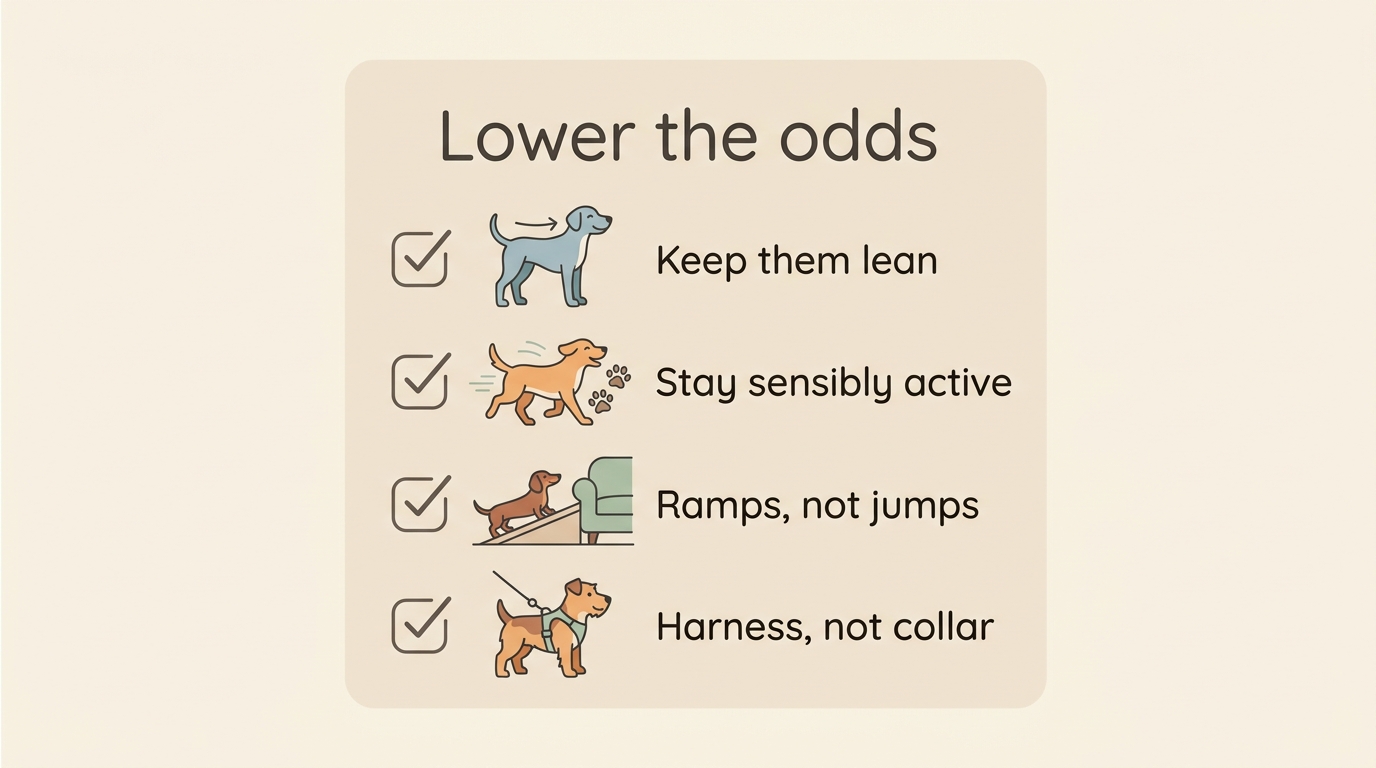
Keeping your dog at a healthy, lean body weight is the first piece of standard prevention advice, and it is worth doing, though it is worth being clear about why. Carrying excess weight is bad for any dog, straining the joints, taxing the heart, and shortening life, and a lean dog is a healthier dog across the board. For an at-risk breed, keeping lean is sensible general health care that you should absolutely follow.
Let me be straight about the IVDD-specific evidence, though: the proof that weight control specifically prevents disc disease is weaker than the confident advice suggests. The large DachsLife study did not find body condition to be a statistically significant predictor of which dogs got IVDD, and a study of recovery from IVDD surgery similarly found body condition did not significantly affect the outcome. So the truthful position is this: keep your dog lean because it is good for them in many important ways, but understand it as sound overall health advice rather than a proven IVDD-specific shield. That is a more truthful basis for the advice than implying that a lean dog is protected from disc disease, and it spares you the false guilt of thinking a single extra pound caused an episode.
How to keep your dog lean is straightforward in principle: feed an appropriate amount for your dog's size and activity, measure the food rather than guessing, go easy on treats, and learn to assess your dog's body condition by eye and feel, ribs easily felt but not seen, a visible waist, a tucked tummy, asking your vet to show you if you are unsure.
Sensible activity, not cotton wool
On activity, the evidence is genuinely reassuring, and it is also where the dogma most needs correcting. The instinct, on learning your dog is at risk, is often to restrict its activity, to keep it quiet and still to "protect its back". The evidence points the other way. The DachsLife study found that dogs getting more daily exercise had a lower risk of IVDD, with more than an hour a day associated with roughly half the odds compared with less active dogs.
So regular, sensible activity is not a risk to be minimised; it is associated with protection, and a fit, well-muscled, active dog appears to be at lower risk than a sedentary one, very possibly because good muscle supports the spine and keeps the dog at a healthy weight and fitness. The practical message, then, is to give your at-risk dog a normal, active, happy life with plenty of regular walks and play, not to wrap it in cotton wool. The one genuine caveat is to avoid the specific repetitive high-impact jarring of the spine, the constant leaping on and off high furniture dozens of times a day, repeated jumping for a ball from a standstill, that kind of thing, which is a different matter entirely from a good long walk or a run in the park. Sensible activity, yes, enthusiastically; pointless enforced inactivity, no. That distinction is the heart of protecting an at-risk dog well.
Settling the stairs question
No piece of IVDD dogma is more entrenched than "never let an at-risk dog use stairs", so it deserves a clear, evidence-based answer. The DachsLife study, which looked at exactly this, did not find that access to stairs was a significant risk factor for IVDD. In fact, where stair restriction appears linked to higher IVDD in such surveys, the most likely explanation is the reverse of what it seems: owners restrict stairs for dogs that are already showing back problems or known to be vulnerable, so the restriction follows the risk rather than causing it.
So the evidence does not support a blanket "no stairs ever" rule for a healthy at-risk dog, and there is no need for the paranoia that rule can create. That said, a little reasonable caution is fair: gentle, controlled stair use in normal daily life is not the demon it is made out to be, but you might sensibly discourage a young dog from charging up and down a long flight repeatedly at speed, in the same spirit as avoiding repetitive jumping. The sensible position is moderation and common sense, not prohibition: a healthy at-risk dog using the stairs gently as part of normal life is not doing something dangerous, and you do not need to carry your dog everywhere or block every staircase out of fear. (This is quite separate, of course, from a dog recovering from an episode, which genuinely must avoid stairs during its rest, as our crate-rest guide explains.)
Harness, ramps and home setup
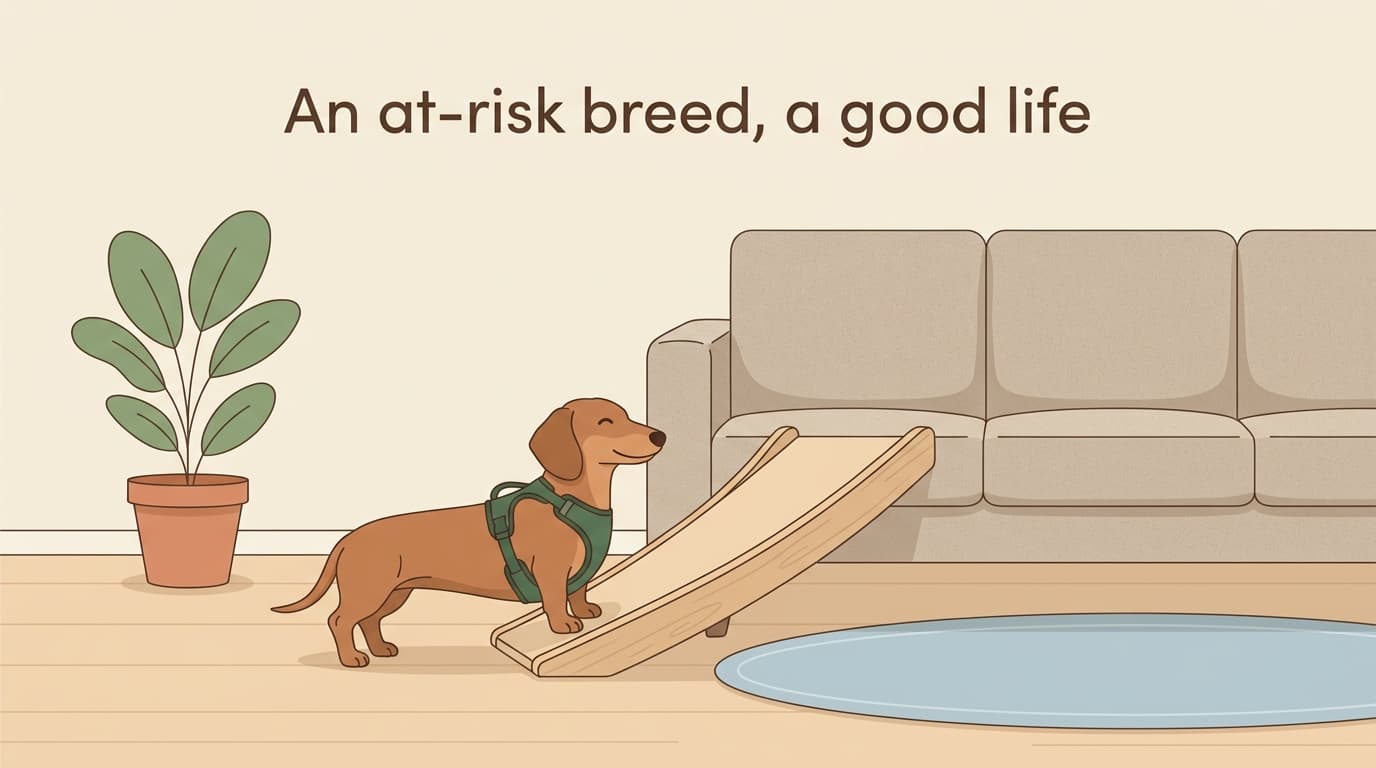
A few practical adjustments to everyday life are reasonable, low-cost precautions worth taking. A harness rather than a collar is sensible because it keeps pressure off the neck, though, in truth, it is a reasonable precaution rather than a proven preventive, as there is no good evidence a harness actually stops disc disease. Ramps or steps up to the sofa, the bed, or into the car spare your dog the repetitive jumping down from heights that is among the few activities genuinely worth avoiding, and they are an easy win. Non-slip flooring helps a dog move confidently without scrambling, as our home-adaptation guide covers. The theme across all of these is the same as the activity message: reduce the specific big, repetitive, jarring movements, not movement in general. You are smoothing out the few genuinely jarring moments of the day, not restricting your dog's life.
What you can't control
Finally, a clear word about the limits of prevention, because it matters for how you carry this. The biggest single factor in your dog's IVDD risk is its genetics, the inherited predisposition that comes with the breed, and that you cannot change, as our guides to the breed genetics and to breeding explain. This is worth knowing for two reasons. It means that if your dog does have an episode despite your doing everything sensible, it is not your fault, the predisposition was built in, and no amount of perfect management guarantees against it. And it means the single most valuable protective thing you can do is not actually any of the physical measures above but knowing the early warning signs, so that if a problem ever does begin, you recognise it and act fast, which our early-signs guide and emergency guide cover. Awareness is the real safety net, because it is the thing that most changes the outcome if the genetics do, one day, express themselves.
The evidence-based recipe, rather than the dogma: keep your at-risk dog lean, because it is good for them generally even if the IVDD-specific proof is thin; give them a sensibly active, happy life with plenty of regular exercise, because activity is associated with lower risk, not higher; do not impose a fearful "no stairs, no movement" regime that the evidence does not support; take the easy, reasonable precautions of a harness, ramps, and non-slip floors, and avoid the genuinely jarring repetitive jumps; accept that genetics is the part you cannot control; and, above all, learn the warning signs so you can act fast if needed. Lean, sensibly active, well-supported at home, and watched, that is how you protect an at-risk dog well, not by wrapping it in bubble-wrap.
References
- Packer RMA, Seath IJ, O'Neill DG, De Decker S, Volk HA. DachsLife 2015: an investigation of lifestyle associations with the risk of intervertebral disc disease in Dachshunds. Canine Genetics and Epidemiology, 2016;3:8.
- Gordon-Evans WJ, Johnson AL, Knap KE, Griffon DJ. The effect of body condition on postoperative recovery of dachshunds with intervertebral disc disease treated with postoperative physical rehabilitation. Veterinary Surgery, 2019;48(2):159-163.
- Blake S, Williams R, Ferro de Godoy R. A Systematic Review of the Biomechanical Effects of Harness and Head-Collar use in Dogs. bioRxiv [preprint], 2019.
Sister tool · Sightline
Track whether treatment is working
Sightline, a separate ConciergeVet tool, runs a short weekly check-in built on validated pain and mobility instruments, turns it into a single Sightline Score you can watch trend over weeks rather than judge on one bad day, and produces a report you can bring to your vet.
A written log, or our printable trackers, does much the same job.
See how Sightline tracks treatmentTrack the recovery, day by day
Recovery from a disc injury is all about the trend. Log the daily milestones through crate rest and rehab so you can see real progress, not just good and bad days.
Open the Recovery TrackerYou're not doing this alone
Compare treatment journeys and talk to owners managing IVDD. Free to join.
Join PetsLikeMine