

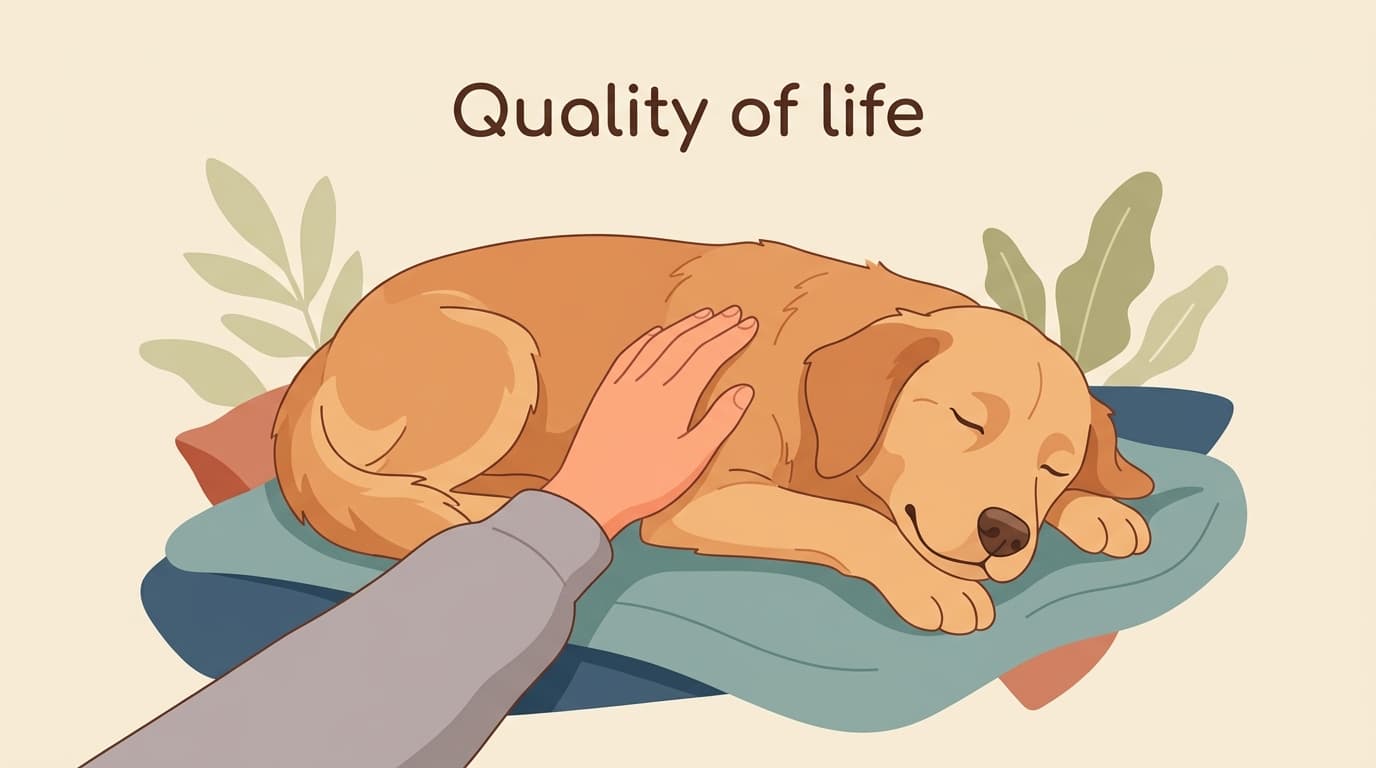
Quality of Life, and Saying Goodbye
Alastair Greenway
BVM&S MRCVS
Loving a dog through a serious illness includes, in the end, watching their quality of life clearly, and sometimes facing the hardest decision an owner ever makes. This is a gentle guide to that part of the journey: how to think clearly about your dog's quality of life, how to recognise when the balance has shifted, what the decision involves if it comes to it, and how to be kind to yourself in the grief that follows. Some owners come to a guide like this well in advance, with a dog who is doing well, and it can help you feel a little more prepared. Others come to it because the time may be near. Either way, facing this thoughtfully is a loving thing to do, and there is support, in your vet and beyond, every step of the way. There is no perfect way to do this, only a loving one.
A way to weigh your dog's quality of life
When a dog has a serious or permanent condition, it helps to have a way of thinking about their quality of life that is more than just a gut feeling on a hard day, and there are gentle frameworks for exactly this. The idea is to look clearly at the things that make up a dog's daily experience and weigh them up over time, rather than judging on a single good or bad moment.
The questions worth asking are simple and human. Is your dog comfortable, and free of pain that cannot be managed? Are they eating and drinking with some interest? Do they still show interest in the things around them, in you, in their world? Do they still take pleasure in the things they have always loved, in whatever form those now take? Are there more good days than hard ones? And is their dignity intact, or are they distressed by their own situation? Some owners find it helps to use a quality-of-life scale, scoring these kinds of factors regularly, and validated tools for assessing quality of life in dogs, including dogs with spinal cord injury, do exist and can be genuinely useful. But please treat any such scale as a tool to help you think, not a verdict that decides for you: it is there to bring clarity and structure to your reflection, to help you see a trend you might be too close to notice, not to replace your knowledge of your own dog or your conversation with your vet. Tracking these things gently over days and weeks is how you keep checking, with clear eyes and a loving heart, that the life you are supporting is still a good one for your dog.
When the balance shifts
The hardest thing to recognise is the point at which a dog's quality of life is no longer good, because we are so reluctant to see it, and because decline can be gradual. Watching closely for a sustained shift, more bad days than good, comfort that can no longer be maintained, a loss of the interest and pleasure that made your dog themselves, is how you give yourself the clarity to act with kindness rather than from crisis.
There is a piece of wisdom that many vets and owners hold onto: when it comes to a suffering animal, it is often kinder to be a week too early than a day too late. The instinct is almost always to wait, to hope for a little more time, to put off the unbearable, and that instinct comes from love. But the kindest gift we can sometimes give a dog whose quality of life has genuinely and lastingly gone is to spare them a final stretch of suffering or indignity, rather than holding on past the point that is good for them. You do not have to wait for a dramatic crisis or a terrible final day to act; recognising a sustained, irreversible decline is reason enough, and choosing peace a little early, out of love, is not something to feel guilty about. This is, perhaps, the truest expression of putting your dog's wellbeing above your own need to keep them with you.
If the time comes
If the time does come, the decision is not one you have to make alone or in the dark, and knowing roughly what it involves can take some of the fear out of it. It is a decision made together with your vet, who can give you their candid, experienced assessment of your dog's quality of life and prognosis, help you see the situation clearly, and support whatever you decide. Do talk to them openly; it is one of the most important things a vet does.
The procedure itself, putting a dog to sleep, is gentle and peaceful, designed to be painless and calm, usually a quiet injection after which your dog simply slips away as if falling asleep, and your vet will explain exactly what will happen and the choices around it, including where it takes place and whether you wish to be present. Many owners take comfort in being there, holding their dog; others find they cannot, and that is alright too, there is no right way to do this. Thinking a little in advance about what you would want can make a hard moment a little less overwhelming. What matters to hold onto is that this final act, when a dog's quality of life has genuinely gone, is not a failure or an abandonment but the last kindness you can offer, a release from suffering given out of love. It is the final act of care in a lifetime of caring.
Saying goodbye, and grief
Whatever the path and the timing, losing a dog hurts, and your grief is real and valid, however much anyone might, thoughtlessly, suggest it is "just a dog". The bond between a person and their dog is a profound one, and grieving its loss deeply is a measure of the love, not an overreaction. So please be gentle with yourself. Allow yourself to feel it, in whatever way it comes, the sadness, the emptiness, perhaps guilt or anger or relief tangled in with the sorrow, all of which are normal parts of grief. There is no correct timetable and no correct way to mourn.
It can help to do something to mark the loss and honour your dog, in whatever way feels right to you, and to lean on people who understand. Many people find real comfort in pet-bereavement support, and there are dedicated services and helplines for exactly this, which your vet can point you toward, so please do reach out if the grief feels heavy, because you do not have to carry it alone. And in time, gently, most people find that the sharp pain softens into something that can hold the love and the good memories alongside the loss. However your journey with your dog ends, the care you gave them, through their illness and at the end, mattered, and the love was real, and it remains.
Assessing your dog's quality of life clearly, using a scale as a tool and never a verdict, is how you keep faith with them through a serious illness; recognising a sustained decline, and remembering that a week early can be kinder than a day late, is how you act with love rather than from crisis; the decision, if it comes, is a gentle and shared one made with your vet, and is the last kindness rather than a failure; and the grief that follows is real, valid, and worthy of support and time. There is no perfect moment, only a loving one. Your vet will help you see clearly, support is there for you as well as your dog, and however this ends, the care you gave mattered more than you may, in the hardest moments, be able to feel.