

Arthritis in Dogs: Everything You Need to Know
Alastair Greenway
BVM&S MRCVS
Most owners arrive here for one of two reasons: a dog who's just been diagnosed with arthritis, or a nagging sense that something isn't quite right and a wish to work out what's going on. Either way, you've come to the right place.
I've been a vet for 25 years, and I've diagnosed and managed arthritis in thousands of dogs, from eight-month-old Labradors with elbow problems to fifteen-year-old terriers who'd been quietly struggling for longer than anyone realised. One thing I can tell you straight away: arthritis is manageable. It's not a death sentence, it's not the beginning of the end, and in most cases your dog can carry on living a good, full, happy life. But you need to understand what you're dealing with.
This article is long, so you never need to piece together fragments of information from five different websites again. Read it all, or skip to the sections you need. It's here whenever you need it.
What osteoarthritis actually is
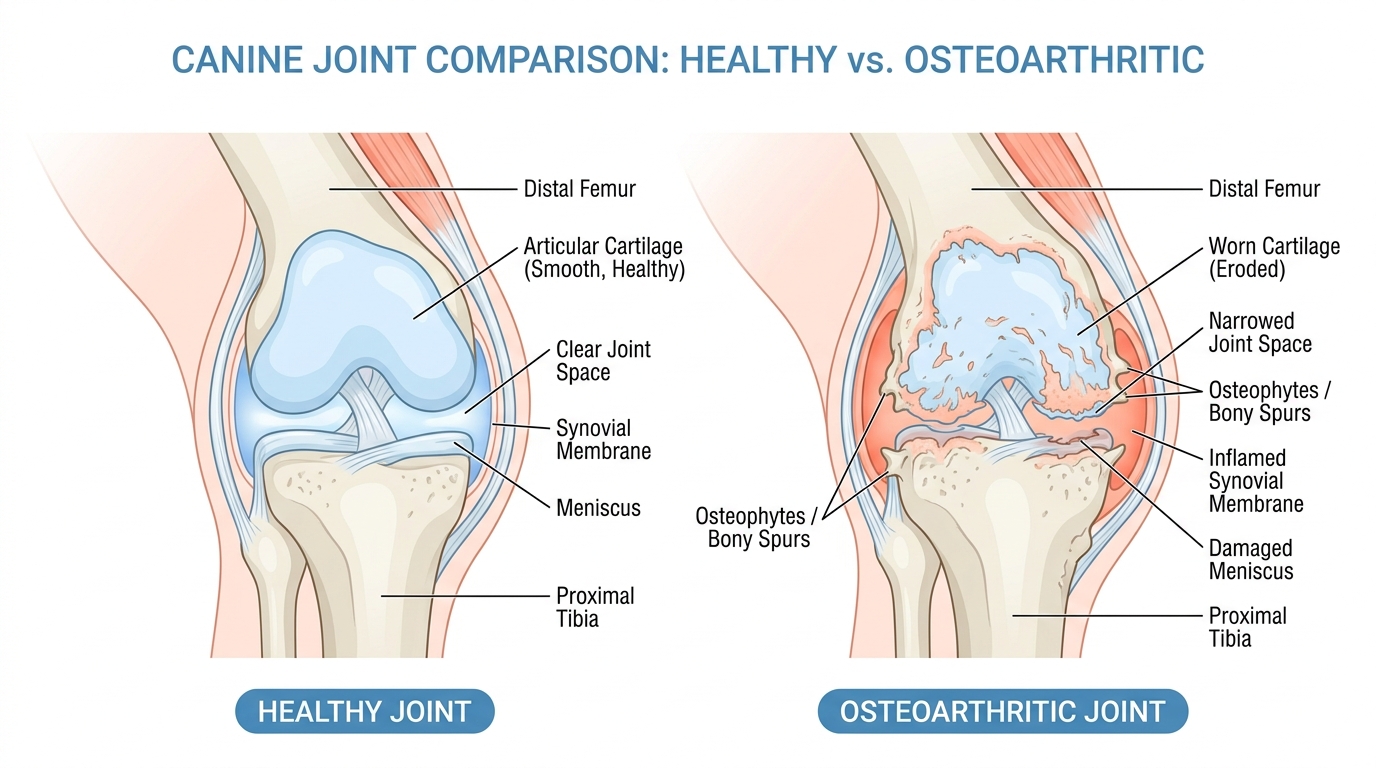
When most people hear "arthritis," they picture worn-out joints in elderly dogs. That's part of the story, but it misses something important. Osteoarthritis is not simply cartilage wearing thin, the way tyres wear on a car. It's a disease of the entire joint.
A healthy joint is a beautifully engineered structure. You have two bone surfaces covered in smooth, glassy cartilage. Between them sits synovial fluid, a viscous liquid that acts as both a lubricant and a shock absorber. Surrounding the whole thing is a joint capsule, a tough fibrous envelope lined with a thin membrane called the synovium. Ligaments hold the bones in the right relationship to each other. Muscles provide the power and stability to move it all.
In osteoarthritis, this entire system starts to fail. The cartilage degrades and cannot repair itself. The synovial membrane becomes inflamed. The joint fluid thins out and loses its protective viscosity. The outer capsule thickens and stiffens, restricting movement. New bone grows around the margins of the joint, those rough spurs and lumps you might see on an X-ray. The bone underneath the cartilage remodels and becomes less able to absorb impact. Ligaments weaken.
All of this happens gradually. And all of it causes pain.
Why it's more complicated than you might think
This is where it gets interesting, and where understanding really matters for how you manage the disease.
When a joint becomes arthritic, nerve receptors in the bone and joint capsule start sending pain signals to the brain. That part is straightforward. But something else happens over time. Those nerve receptors multiply. They become more sensitive. They start firing pain signals more easily, from stimuli that previously wouldn't have registered as painful.
And it doesn't stop at the joint. If the pain signals keep coming, the dog's entire nervous system can start to rewire itself. The spinal cord and brain become increasingly efficient at transmitting and amplifying pain. Eventually, the nervous system can generate pain signals on its own, regardless of what's happening in the joint itself.
Vets call this central sensitisation. You can think of it as the pain system getting stuck in the "on" position. It means that a dog who's had untreated or poorly treated arthritis for a long time may need different, more complex pain management than a dog whose arthritis was caught and treated early. The pain has essentially become its own disease, separate from the joint damage that started it.
This is why early diagnosis matters so much, and why "oh, he's just slowing down because he's getting old" is one of the most dangerous assumptions an owner can make. The longer pain goes unmanaged, the harder it becomes to manage.
How common is it?
More common than most people realise.
The often-quoted figure is that 80% of dogs over the age of eight have some degree of osteoarthritis. That number almost certainly overstates clinical disease and understates radiographic change, meaning plenty of dogs have visible joint changes on X-ray without obvious symptoms, and plenty of others have pain without dramatic X-ray findings. The relationship between what you see on a radiograph and how much pain a dog is experiencing is surprisingly unreliable.
Here's what we do know from the research. A 2024 study published in Scientific Reports found that nearly 40% of young dogs, aged between eight months and four years, already had radiographic evidence of osteoarthritis in at least one joint. Almost a quarter of those had clinical signs of pain. These were young dogs, many of whom their owners considered perfectly healthy.
UK primary care practice data suggests a diagnosed prevalence of somewhere between 2.5% and 6.6% of all dogs. But this almost certainly represents massive under-diagnosis. Most arthritic dogs are never formally diagnosed. Their owners assume the changes are just ageing. Their vets may not be specifically asked about stiffness or subtle behaviour changes during routine visits.
So the honest answer is that osteoarthritis is everywhere. It's the single most common cause of chronic pain in dogs. It affects every breed, every size, and every age, though some far more than others.
Not just an old dog's disease
This is one of the biggest misconceptions in veterinary medicine, and I still hear it from colleagues as well as owners.
The leading cause of osteoarthritis in dogs is developmental joint disease. Hip dysplasia, elbow dysplasia, osteochondritis dissecans (OCD), luxating patellas. These are conditions that begin in puppyhood and young adulthood, when bones and joints are still forming. They result in joints that don't fit together quite right. That imperfect fit means abnormal forces, abnormal wear, and the early onset of degenerative changes.
A Labrador with elbow dysplasia at two years old doesn't "suddenly get arthritis" at eight. They've had arthritis progressing quietly for six years before anyone noticed a limp. A German Shepherd with hip dysplasia was born with the genetic predisposition, developed the structural problem as a puppy, and has been accumulating joint damage since before their first birthday.
Two things follow from this. First, it means we need to be thinking about joint health from puppyhood, not just in senior dogs. How we exercise puppies, how we feed them, how we manage their growth, whether we screen for developmental conditions. All of this influences the trajectory of a lifetime of joint health.
Second, it means that if your young dog has been diagnosed with arthritis, you're not unlucky and you haven't done anything wrong. This is one of the most common diseases in dogs, and in most cases the seeds were sown before you had any say in the matter.
Which joints get hit hardest
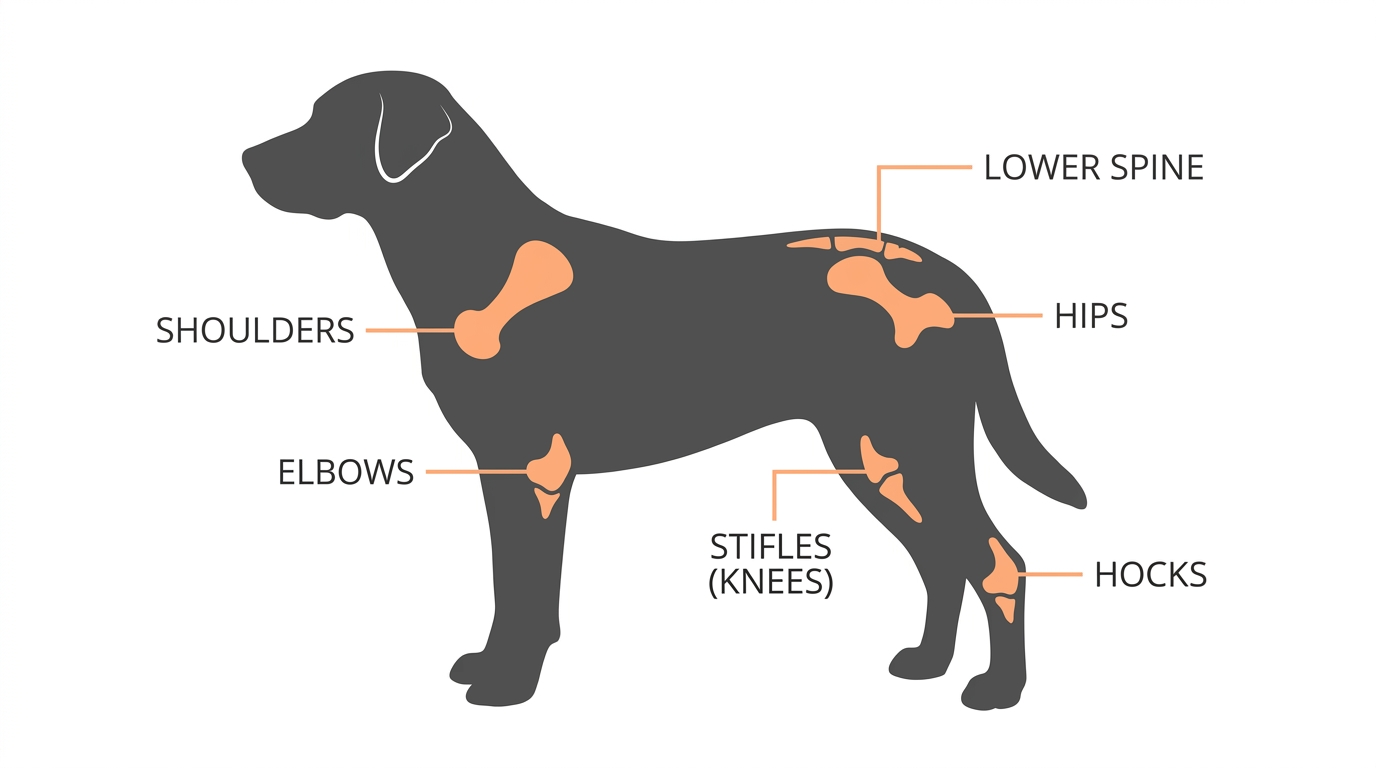
In dogs, the joints that bear the brunt of osteoarthritis are the elbows and hips. This is largely because the most common developmental conditions, elbow dysplasia and hip dysplasia, affect these joints. A 2024 study from Ludwig Maximilian University Munich found that in dogs over eight years old, 57% had radiographic evidence of osteoarthritis in the elbows, with the shoulders, hips, and stifles (knees) each affected in 35-40%.
But osteoarthritis can affect any joint with a synovial (movable) surface. The stifles are commonly affected, particularly after cruciate ligament injury. The spine is frequently involved, with spondylosis (bony bridging between vertebrae) being extremely common in older dogs. The hocks (ankles), wrists, and toes can all develop arthritis. And it rarely stops at one joint. Most arthritic dogs have multiple joints affected to varying degrees.
This is important to understand because it explains a lot of what you see at home. A dog with sore hips shifts weight forward onto the front legs. Over time, those overworked front legs, shoulders, and elbows develop their own problems. The spine compensates for the abnormal movement patterns. Secondary issues develop in areas that were originally healthy. The whole body adapts, and the whole body pays the price.
More than one kind of arthritis
Not all arthritis is the same. Osteoarthritis is overwhelmingly the most common form in dogs, but it's worth knowing the others exist, because they require different treatment.
Osteoarthritis (OA), also called degenerative joint disease, is what this article is primarily about. It's caused by developmental conditions, injury, instability, obesity, or accumulated wear. It's progressive, it's permanent, and it can't be cured, but it can be managed effectively.
Immune-mediated arthritis is a different beast entirely. Here, the dog's own immune system attacks the joints. It tends to cause a sudden onset of fever, lethargy, and painful swelling in multiple joints simultaneously, often symmetrically (both wrists, both hocks). It can sometimes be triggered by an underlying infection, gastrointestinal disease, or even cancer. If the trigger can be identified and treated, the joint inflammation may resolve, though the damage done may lead to osteoarthritis down the line.
Rheumatoid arthritis is a specific and destructive form of immune-mediated arthritis. It's rare in dogs but devastating when it occurs, causing severe erosion and deformity of the joints.
Septic arthritis is caused by infection, usually bacterial, within a joint. This typically affects a single joint, comes on suddenly with severe pain and swelling, and is a genuine emergency. It can follow surgery, a penetrating wound, or occasionally spread from an infection elsewhere in the body.
If your vet has diagnosed your dog with osteoarthritis, that's what we're dealing with. But if your dog has sudden-onset, multi-joint swelling with fever, or a single acutely painful joint, get them seen urgently. Those are different conditions requiring different treatment.
How arthritis affects the whole body
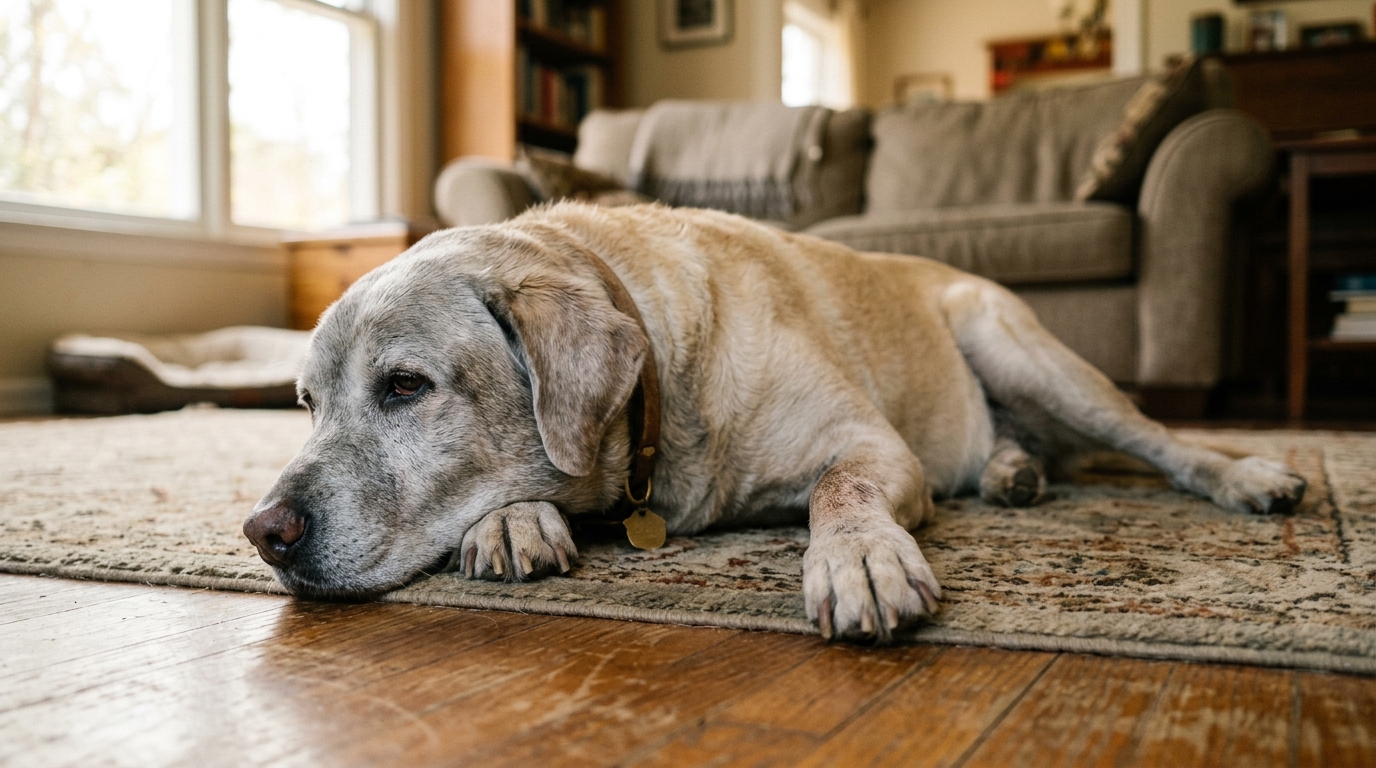
One of the things I wish more owners understood is that arthritis doesn't stay in the affected joint. Its effects ripple outward through the entire body.
Think about a dog with painful back legs. They shift weight forward. The front legs now carry more than their fair share. The neck extends to compensate for the altered centre of gravity. The back muscles work overtime to stabilise a body that's moving differently than it was designed to. The core weakens because the dog is moving less. The hind legs lose muscle mass from disuse.
Over months and years, this compensation creates secondary problems. Shoulders and elbows that were perfectly healthy start to ache from the extra load. Back muscles go into spasm. The dog develops a new pain in an area that has nothing structurally wrong with it, simply because it's been overworking to compensate for the original problem.
And then there's the behavioural impact. Dogs in chronic pain often become less social, less playful, more irritable. They may snap when touched in certain areas. They sleep more but may sleep less well, shifting frequently to find a comfortable position. They lose interest in things they used to enjoy. Some become anxious. Some become withdrawn.
None of this is "just getting old." It's pain, and it's treatable.
Can arthritis be cured?
No. And you should be very cautious of anyone who claims otherwise.
Osteoarthritis involves structural changes to the joint that are, with current medicine, irreversible. Cartilage that has been destroyed does not regrow. New bone that has formed around the joint margins does not disappear. The joint will never return to its original healthy state.
But this is the part that matters: the degree of structural damage often correlates poorly with the amount of pain a dog experiences. A joint that looks terrible on X-ray might cause only mild discomfort when well managed. A joint that looks relatively normal on X-ray might be extremely painful due to inflammation and central sensitisation.
Management is the word, not cure. And management can be extraordinarily effective. With the right combination of pain relief, weight management, exercise modification, environmental changes, and supportive therapies, many dogs with arthritis live comfortably and happily for years. Some owners tell me they barely notice the arthritis most days.
The goal isn't to reverse the disease. It's to control the pain, maintain mobility, preserve muscle mass, slow progression, and protect quality of life. Those are achievable goals for the vast majority of arthritic dogs.
What happens if you do nothing?
This is the question nobody wants to ask, but it's important.
Untreated osteoarthritis is progressive. The joint damage accumulates. The inflammation continues. The pain increases. Central sensitisation develops, making the pain harder to treat when you eventually do intervene.
The dog compensates for as long as it can. It moves less, plays less, engages less. It loses muscle mass. Secondary problems develop. The compensatory patterns become entrenched. Quality of life erodes gradually, often so gradually that owners don't notice the decline until they look back at photos from a year or two ago and realise how much has changed.
Eventually, immobility and chronic pain reach a point where the question of euthanasia arises. And this is the tragedy: osteoarthritis is one of the most commonly cited reasons for euthanasia in older dogs, yet it is also one of the most manageable conditions in veterinary medicine. Dogs are euthanised not because arthritis is untreatable, but because it went untreated for too long.
I don't say this to frighten you. I say it because acting early and acting consistently makes an enormous difference to the trajectory of this disease. If your dog has been diagnosed, you're already ahead of the many owners who never get that far.
Where to go from here
If you're newly diagnosed, start with our guide to the first 30 days after diagnosis. It'll walk you through what to prioritise now and what can wait.
If you want to understand pain better, read how dogs hide pain and why you're not failing as an owner, and then move on to the complete medication guide.
If you're ready to start making practical changes, the exercise guide and home modifications article are both immediately actionable.
And if you're feeling overwhelmed, know this: you don't have to do everything at once. The fact that you're here, reading this, learning about your dog's condition, puts you ahead of the vast majority of owners. Every small step you take, whether it's a better bed, a ramp for the car, or a conversation with your vet about pain relief, makes a real difference to your dog's life.
References
- Enomoto M, de Castro N, Hash J, et al. Prevalence of radiographic appendicular osteoarthritis and associated clinical signs in young dogs. Scientific Reports, 2024.
- Roitner M, Klever J, Reese S, Meyer-Lindenberg A. Prevalence of osteoarthritis in the shoulder, elbow, hip and stifle joints of dogs older than 8 years. The Veterinary Journal, 2024.
- Johnston SA. Osteoarthritis: joint anatomy, physiology, and pathobiology. Veterinary Clinics of North America: Small Animal Practice, 1997.
- Anderson KL, O'Neill DG, Brodbelt DC, et al. Prevalence, duration and risk factors for appendicular osteoarthritis in a UK dog population under primary veterinary care. Scientific Reports, 2018.
Sister tool · Sightline
Track whether treatment is working
Sightline, a separate ConciergeVet tool, runs a short weekly check-in built on validated pain and mobility instruments, turns it into a single Sightline Score you can watch trend over weeks rather than judge on one bad day, and produces a report you can bring to your vet.
A written log, or our printable trackers, does much the same job.
See how Sightline tracks treatmentSee where your pet stands today
Tracking is the other half of managing arthritis. Take the 2-minute Mobility Check to see your pet's stage, then watch it shift as treatment takes effect.
Take the Mobility CheckYou're not doing this alone
Compare treatment journeys and talk to owners managing arthritis. Free to join.
Join PetsLikeMine