


IVDD in French Bulldogs & Other At-Risk Breeds
Alastair Greenway
BVM&S MRCVS
Say "dog with a bad back" and most people picture a dachshund, and they're not wrong to. But dachshunds are far from the only breed at raised risk of intervertebral disc disease, and one breed in particular has come up fast on the inside: the French bulldog, whose soaring popularity means more affected dogs every year. If you share your life with a Frenchie, or a corgi, a beagle, a cocker spaniel, or one of several other breeds, this guide is for you. It explains which breeds carry a higher risk, why they share it, and what that means for you, so that the dachshund's reputation doesn't leave other at-risk owners in the dark.
Not just dachshunds: the French bulldog
Beyond the dachshund, the headline breed to know about is the French bulldog, because its risk is both high and rising. In a large study of IVDD across many breeds, the French bulldog carried the highest adjusted odds of any purebred dog, with around twenty-one times the odds of disc disease compared with a typical dog. To see how central this is to the breed, disc disease is the single most common neurological disorder seen in French bulldogs, accounting for something like forty-five percent of their neurological cases. French bulldogs also tend to be affected young, with one of the earliest average ages at diagnosis of any breed, often under five years old.
There's a further point Frenchie owners genuinely need to know, because it's both striking and under-publicised: recurrence is common. In a study of French bulldogs that had surgery for a first IVDD episode, more than half, around fifty-three percent, went on to have a recurrence, with about half of those recurrences happening within the first year, and young dogs particularly prone to a further episode in the neck. In other words, an IVDD episode in a Frenchie is quite often not a one-off, which is important to factor into both expectations and insurance.
What makes all this especially important is the breed's explosive rise in popularity. As French bulldogs have become one of the most popular breeds, the sheer number of them means disc disease in the breed is being seen more and more, and many new Frenchie owners have no idea their fashionable companion carries a back-problem risk rivalling, indeed exceeding, the dachshund's. So if you have a French bulldog, this is genuinely worth knowing: yours is, statistically, among the most IVDD-prone breeds there is, the disease is the commonest neurological problem in the breed, and recurrence is more likely than not. The awareness that a dachshund owner would have is just as important for you.
The wider at-risk line-up
The French bulldog and the dachshund lead the field, but a number of other breeds carry a clearly raised risk, and it's worth knowing the wider line-up so that owners of these dogs are alert too. Breeds repeatedly identified as chondrodystrophic and at increased IVDD risk include the beagle, the Pembroke Welsh corgi, the cocker spaniel, the basset hound, the shih tzu, the Cavalier King Charles spaniel, the pug, and the bichon frise, among others. You'll notice a pattern in that list, and it's not a coincidence: these are mostly the short-legged, long-bodied dogs, the breeds with that distinctive low-slung, dwarfed build. That shared shape is the visible clue to a shared underlying cause, which is the key to the whole picture.
Two more general risk factors are worth noting, because the research finds they apply across breeds: being a toy or small dog, and being overweight, are both linked to higher odds of IVDD, while more daily activity is linked to lower odds. So whatever your breed, keeping your dog lean and appropriately active is sensible, protective advice.
If your breed is on that list, the message is not alarm but awareness: a genuinely raised risk that's worth taking seriously, knowing the warning signs for, and factoring into how you care for your dog, exactly as a dachshund owner would. And if your breed is not on it, no list like this is ever complete, so a raised risk can exist in other breeds too, and the warning signs are worth knowing for any dog.
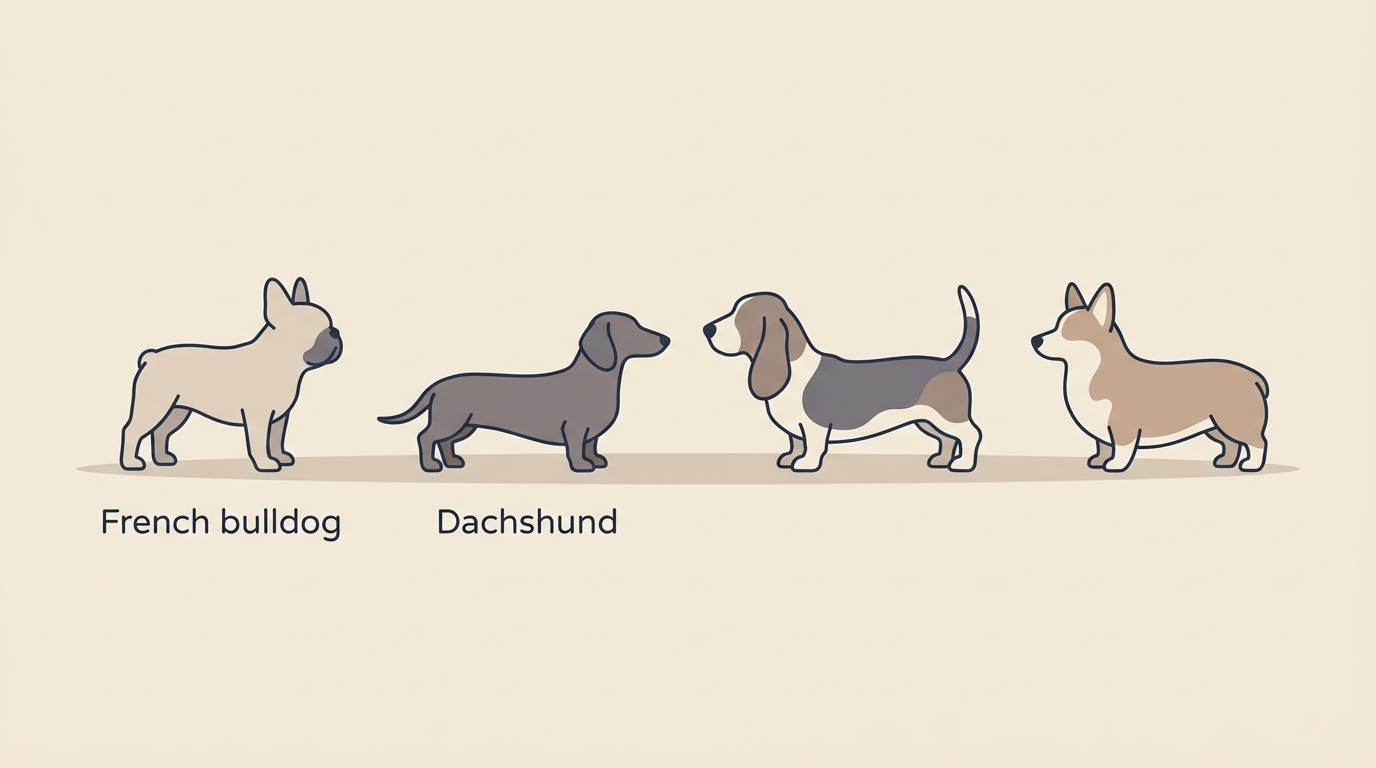
Why they share the risk: the same genetics
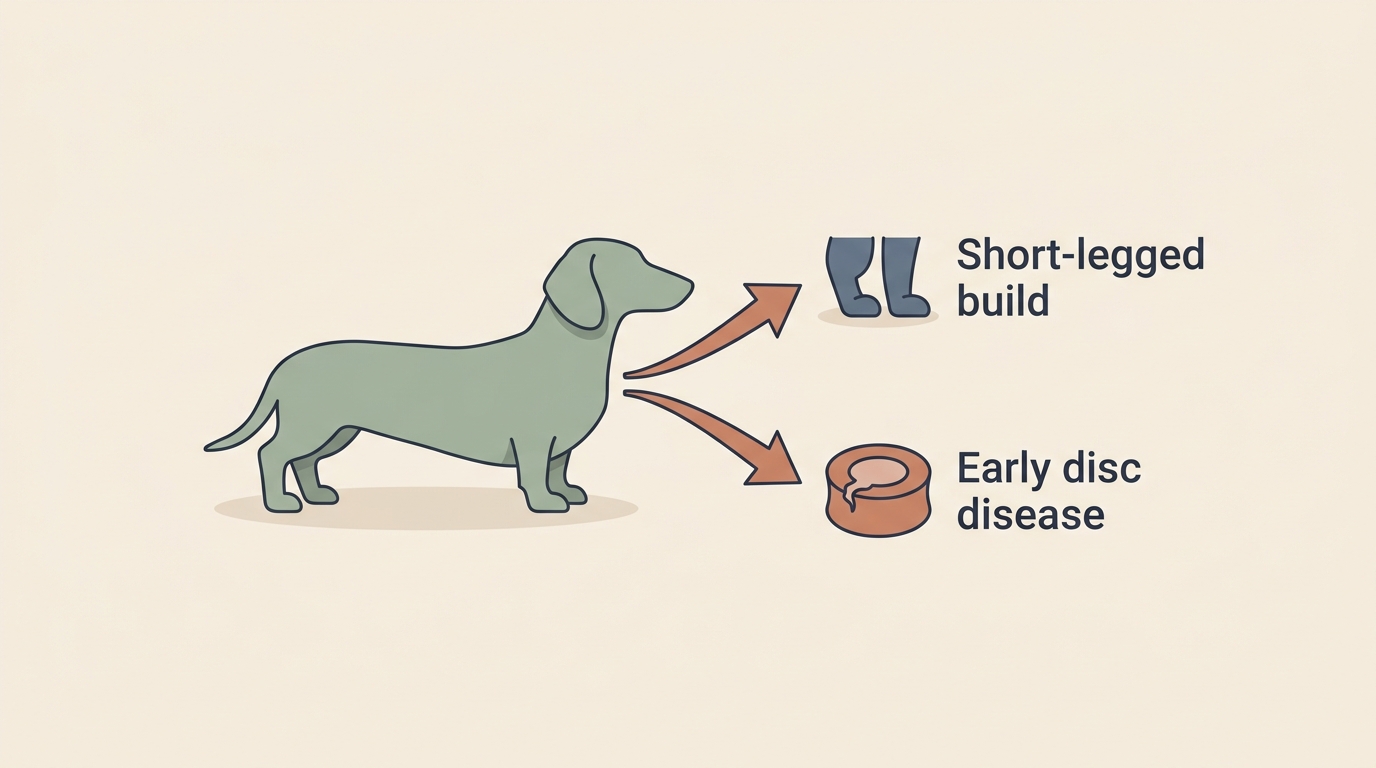
What ties all these breeds together is the same story we tell in full in our article on dachshunds, so I'll keep it brief here and point you there for the detail. The common thread is a genetic feature these breeds share, the same one responsible for their characteristic short legs. A particular gene variant, an FGF4 retrogene on chromosome 12, gives these breeds their dwarfed, short-legged build, and in the very same stroke causes their intervertebral discs to degenerate and calcify abnormally early in life.
This is why the at-risk breeds so often share that low-slung shape: the short legs and the disc disease come from the same genetic source, so the body shape is, in effect, a visible flag for the disc risk that travels with it. The proper term for this build is chondrodystrophic, meaning the short-legged, long-bodied conformation produced by that gene, and it's the chondrodystrophic breeds that dominate the IVDD risk list. The crucial point, which our dachshund guide explains more fully, is that it's the gene, not simply the long back, that drives the disc problem; the discs of these breeds are programmed to age early regardless. So when you look at a French bulldog or a corgi or a basset hound and see that distinctive shape, you're looking at the outward sign of the same genetic predisposition, and that is why these particular breeds cluster at the top of the risk list together.
A note on where it strikes
Disc disease doesn't always strike in the same place, and that's a useful nuance for owners of these breeds. In many dogs, dachshunds classically, the problem most often occurs in the middle of the back, the thoracolumbar spine. But some breeds are relatively more prone to disc disease in the neck, the cervical spine, and this includes French bulldogs and beagles. French bulldogs in particular can be predisposed to spinal problems linked to malformations in their vertebrae, a consequence of the same selective breeding that shapes the breed, and as we saw, their recurrences often strike in the neck.
Why does this matter to you? Because neck disc disease can look a little different from the classic back problem, often dominated by severe pain, a low, stiff head carriage, a reluctance to lift or turn the head, and sometimes wobbliness affecting all four legs rather than just the back ones. So if you have a Frenchie or a beagle, it's worth knowing that a disc problem might show up as neck pain and all-four-limb signs, not only as the back-leg weakness people associate with IVDD. Whatever form it takes, the urgency is the same, and our guide to the red flags covers the warning signs to act on across both the neck and the back.
The dachshund may be the famous face of IVDD, but the French bulldog now tops the risk list, is being seen more every year, has disc disease as its commonest neurological problem, and tends to suffer recurrences; and a whole group of short-legged breeds, beagles, corgis, cocker spaniels, basset hounds, and others, share a genuinely raised risk through the same genetics that gives them their distinctive shape. If you own one of these breeds, the practical takeaway is simple and empowering: know that your dog is at raised risk, learn the warning signs for both back and neck disease so you can act fast if they ever appear, and care for your dog with that awareness, much as our dachshund guide advises, keeping them lean, avoiding repetitive jarring jumps, walking on a harness rather than a collar, and being alert. And if you're thinking about the longer view, our guide to breeding and the genetics of IVDD looks at how the same science that explains this shared risk is beginning to offer ways to reduce it in future generations.
References
- Demographic and lifestyle characteristics impact lifetime prevalence of owner-reported intervertebral disc disease: 43,517 companion dogs in the United States. Journal of the American Veterinary Medical Association, 2025;263(5).
- Brown EA, Dickinson PJ, Mansour TA, et al. FGF4 retrogene on CFA12 is responsible for chondrodystrophy and intervertebral disc disease in dogs. Proceedings of the National Academy of Sciences, 2017;114(43):11476-11481.
- Mayousse V, Desquilbet L, Jeandel A, Blot S. Prevalence of neurological disorders in French bulldog: a retrospective study of 343 cases (2002-2016). BMC Veterinary Research, 2017;13:212.
- Leu D, Vidondo B, Stein V, Forterre F. Recurrence rate of intervertebral disc disease in surgically treated French Bulldogs: a retrospective study (2009-2019). Acta Veterinaria Scandinavica, 2023;65(1):3.
Sister tool · Sightline
Track whether treatment is working
Sightline, a separate ConciergeVet tool, runs a short weekly check-in built on validated pain and mobility instruments, turns it into a single Sightline Score you can watch trend over weeks rather than judge on one bad day, and produces a report you can bring to your vet.
A written log, or our printable trackers, does much the same job.
See how Sightline tracks treatmentTrack the recovery, day by day
Recovery from a disc injury is all about the trend. Log the daily milestones through crate rest and rehab so you can see real progress, not just good and bad days.
Open the Recovery TrackerYou're not doing this alone
Compare treatment journeys and talk to owners managing IVDD. Free to join.
Join PetsLikeMine