

Neck vs Back IVDD: How Cervical and Thoracolumbar Disc Disease Differ
Alastair Greenway
BVM&S MRCVS
Picture intervertebral disc disease and most people picture a dog dragging its back legs. That image is real, but it's only half the story. IVDD is not one disease that always happens in one place. A disc can herniate anywhere along the spine, and where it happens, in the neck or in the back, genuinely changes the picture: the signs look different, different breeds tend to be affected, the surgery is a different operation, and sometimes even the urgency differs. Plenty of sources blur the two together, which leaves owners confused when their dog's "disc problem" doesn't match the dragging-back-legs description they read about. This guide draws the distinction clearly: how neck (cervical) and back (thoracolumbar) disc disease differ, and why it matters for your dog.
Two places along the spine
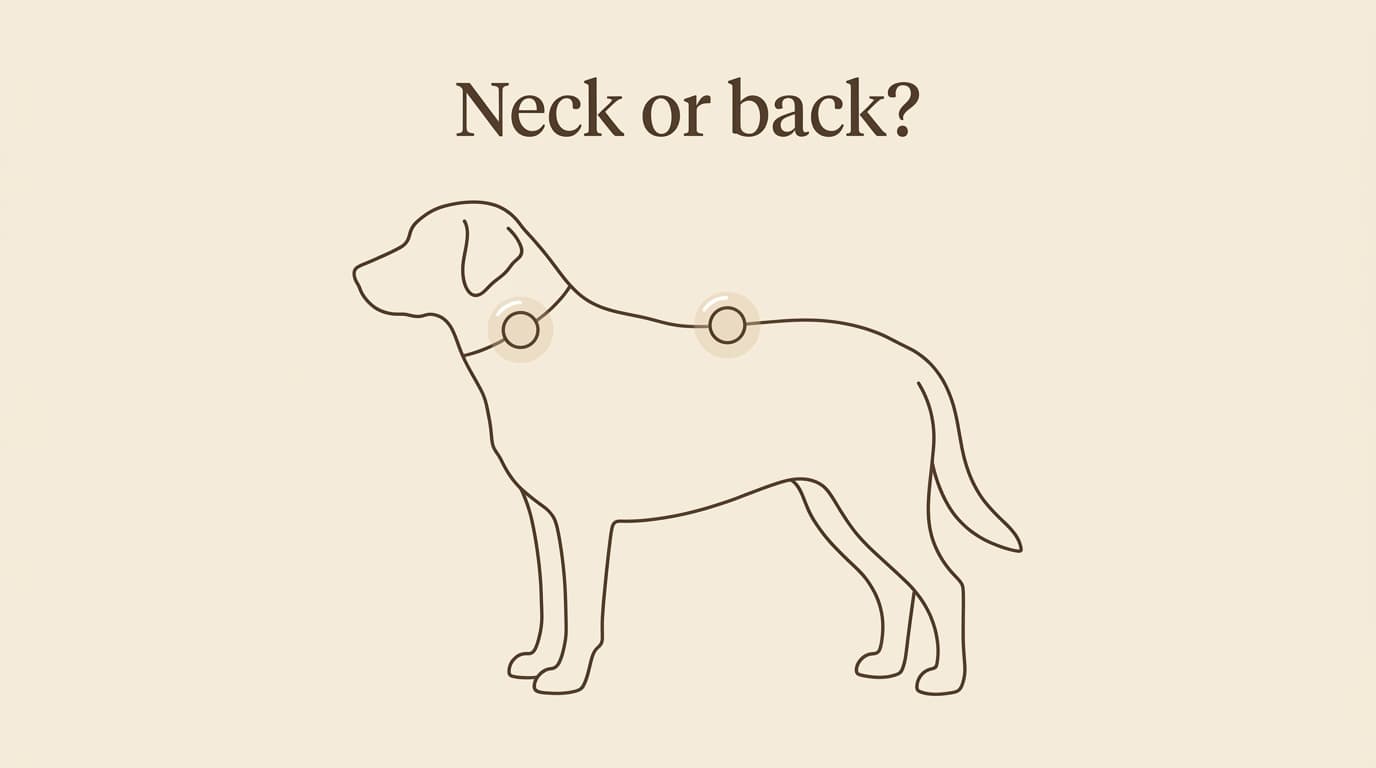
A quick orientation to the spine helps here. Running from the skull to the tail, the spine has regions, and disc disease in dogs clusters in two of them. The thoracolumbar spine, the mid-to-lower back, is where the classic, most familiar form of IVDD occurs, and it accounts for the majority of cases. The cervical spine, the neck, is the other main site. It's affected in a minority of cases by comparison, but an important minority, because neck disc disease behaves quite differently from the back form. So when a vet talks about a "neck" versus a "back" disc, they're describing genuinely different situations that happen to share the same underlying disease process, and the difference in location drives most of what follows.
How the signs differ
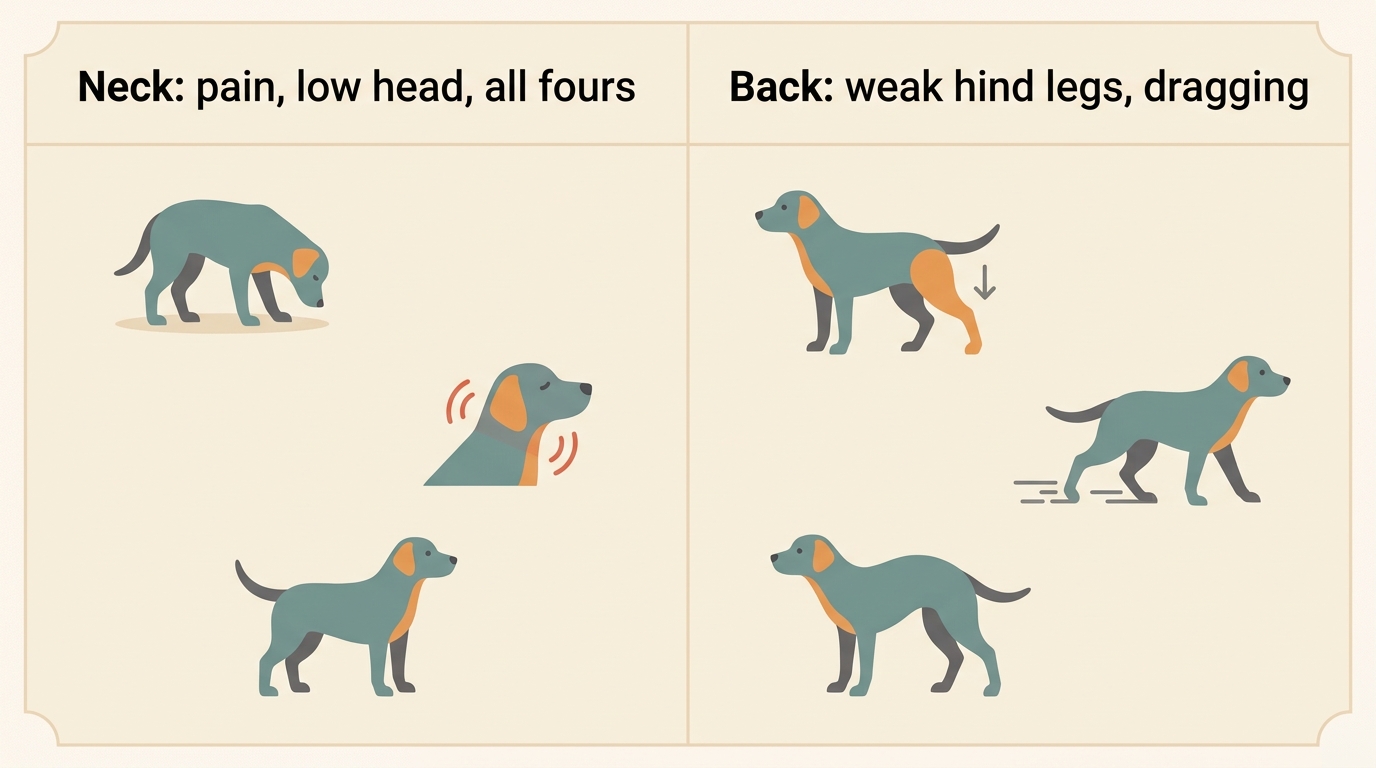
The most practically useful difference is in how the two present, because the signs an owner notices are quite distinct. Back, or thoracolumbar, disc disease produces the picture most people know: weakness or paralysis of the back legs, knuckling or dragging the hind paws, wobbliness in the hindquarters, an arched and painful back, and often effects on the bladder. The trouble is in the back half of the dog, while the front legs usually work normally.
Neck, or cervical, disc disease often looks quite different, and the dominant feature is frequently pain, sometimes severe. A dog with a neck disc problem may hold its head low and stiff, be very reluctant to lift or turn its head, cry out, and seem generally rigid and miserable with pain. Because the affected part of the spinal cord is higher up, neck disease can affect all four legs rather than just the back ones, causing wobbliness or weakness in the front as well as the back. Some dogs show a particular kind of foreleg lameness or hold a front leg up. Bladder effects are less common with neck disease than with back disease. So the contrast is roughly this: back disease tends to mean weak or paralysed hind legs with the front end fine, while neck disease tends to mean dominant pain, a low stiff head, and signs that can involve all four legs. If your dog's problem looks like "severe pain and all four legs a bit wrong" rather than "back legs not working", you're not imagining it, that points toward the neck.
Which dogs, and where
Which dogs tend to get disc disease where also varies a little, though there's plenty of overlap. The classic thoracolumbar burst disc is strongly associated with the short-legged chondrodystrophic breeds, the dachshund being the archetype, as our guides on at-risk breeds explain. Cervical disc disease occurs in these breeds too, but some breeds appear relatively more prone to neck problems, including French bulldogs and beagles. French bulldogs in particular feature here, partly because of the spinal conformation that comes with the breed. Larger, non-chondrodystrophic breeds, when they get disc disease, more often have the slower, chronic protrusion type, which can occur in the neck or the back. None of this is a hard rule, any breed can have a disc problem in either location, but it's useful background, and it's part of why knowing your dog's breed and the likely pattern helps your vet build the picture, as our at-risk-breeds guide covers.
Why location changes the treatment
Location doesn't just change the signs; it changes aspects of the treatment, which is the practical reason the distinction matters. Most importantly, the surgery is a different operation depending on where the disc is. For a back disc, decompression is typically done through a procedure called a hemilaminectomy; for a neck disc, the operation is usually a different one called a ventral slot, approached from underneath the neck. These are different procedures with their own techniques and considerations, which our guide to what surgery involves covers, and it's part of why a neck case and a back case aren't simply interchangeable.
Beyond the surgery, the management emphasis can differ. Pain-led cervical disease, where severe pain is the main problem without major loss of function, often responds well to conservative management with rest and pain relief, though severe or non-improving cases need imaging and may need surgery. Imaging matters here too: an MRI scan is the best way to see exactly where and what the problem is, wherever it sits, which is why it's central to working up a disc case in either location. Throughout, the same underlying logic of severity and urgency applies regardless of location. A dog losing function, whether in two legs or four, needs prompt assessment, and the deep-pain principle that governs prognosis in the back form applies to the neck form too. So location shapes the operation and some of the management, while the core principles of grading, deep pain, and urgency carry across both.
References
- Mayousse V, Desquilbet L, Jeandel A, Blot S. Prevalence of neurological disorders in French bulldog: a retrospective study of 343 cases (2002-2016). BMC Veterinary Research, 2017;13:212.
- Chang YP, Huang WH, Lua WZ, Wong W, Liu IH, Liu CH. Outcomes in Dogs with Multiple Sites of Cervical Intervertebral Disc Disease Treated with Single Ventral Slot Decompression. Veterinary Sciences, 2023;10(6):377.
- da Costa RC, De Decker S, Lewis MJ, Volk H, The Canine Spinal Cord Injury Consortium (CANSORT-SCI). Diagnostic Imaging in Intervertebral Disc Disease. Frontiers in Veterinary Science, 2020;7:588338.
Sister tool · Sightline
Track whether treatment is working
Sightline, a separate ConciergeVet tool, runs a short weekly check-in built on validated pain and mobility instruments, turns it into a single Sightline Score you can watch trend over weeks rather than judge on one bad day, and produces a report you can bring to your vet.
A written log, or our printable trackers, does much the same job.
See how Sightline tracks treatmentTrack the recovery, day by day
Recovery from a disc injury is all about the trend. Log the daily milestones through crate rest and rehab so you can see real progress, not just good and bad days.
Open the Recovery TrackerYou're not doing this alone
Compare treatment journeys and talk to owners managing IVDD. Free to join.
Join PetsLikeMine