

Rehabilitation After IVDD: The Roadmap
Alastair Greenway
BVM&S MRCVS
Once a dog has come through the frightening acute phase, the surgery or the first weeks of strict rest, the natural next question arrives: what now? How does a dog that cannot walk, or can barely walk, actually get back to moving? The answer is rehabilitation, and it is the part of the journey that the acute drama tends to overshadow. Getting the pressure off the spinal cord, whether by surgery or by giving a herniation time to settle, is really only half the story. Rehabilitation is how function comes back, how muscle is rebuilt, and how a recovering dog is given the best chance at the fullest life it can have. This guide is the map of that journey: what rehab is, why it matters, the phases it moves through, and who helps you along the way.
One realistic expectation belongs right at the start, because it matters and because we would rather be straight with you than oversell. Rehabilitation is genuinely worthwhile, but its job is to support recovery, prevent secondary problems, and rebuild strength and coordination safely, not to work magic. The evidence does not show that rehab speeds up the return of walking or changes the fundamental odds. What it does do is real and valuable, and worth doing well.
What rehabilitation is for
It helps to understand what rehab is actually for, because the goals are not quite what people assume. When a dog has had a spinal cord injury and a period of enforced rest, several things happen to the body beyond the disc problem itself. Muscle wastes away quickly when it is not used. Joints stiffen. A dog that has been compensating for weak back legs can develop secondary strains and imbalances. And the nervous system, recovering and relearning, benefits from being gently and appropriately challenged. Rehabilitation addresses all of this: it keeps muscle and joints in good condition, helps the body relearn coordinated movement, prevents the secondary problems that immobility causes, and supports the dog toward its best possible function.
There is one piece of framing that everything else hangs on, though. A good controlled study comparing structured rehabilitation against standard care after spinal surgery found that the rehab was entirely safe, but that it did not actually shorten the time it took dogs to walk again, recovery took a similar length of time either way. So the right way to think about rehab is not as something that will make your dog walk sooner or that improves the odds of walking at all, but as something that keeps your dog comfortable, prevents the body deteriorating during recovery, maintains strength and condition, and gives the recovery the best supported conditions to happen in. That is a genuinely worthwhile thing, and it is what good rehabilitation delivers. It is care that supports the process, not a treatment that accelerates it, and understanding that spares you both false hope and unnecessary disappointment if progress is gradual.
The phases of recovery
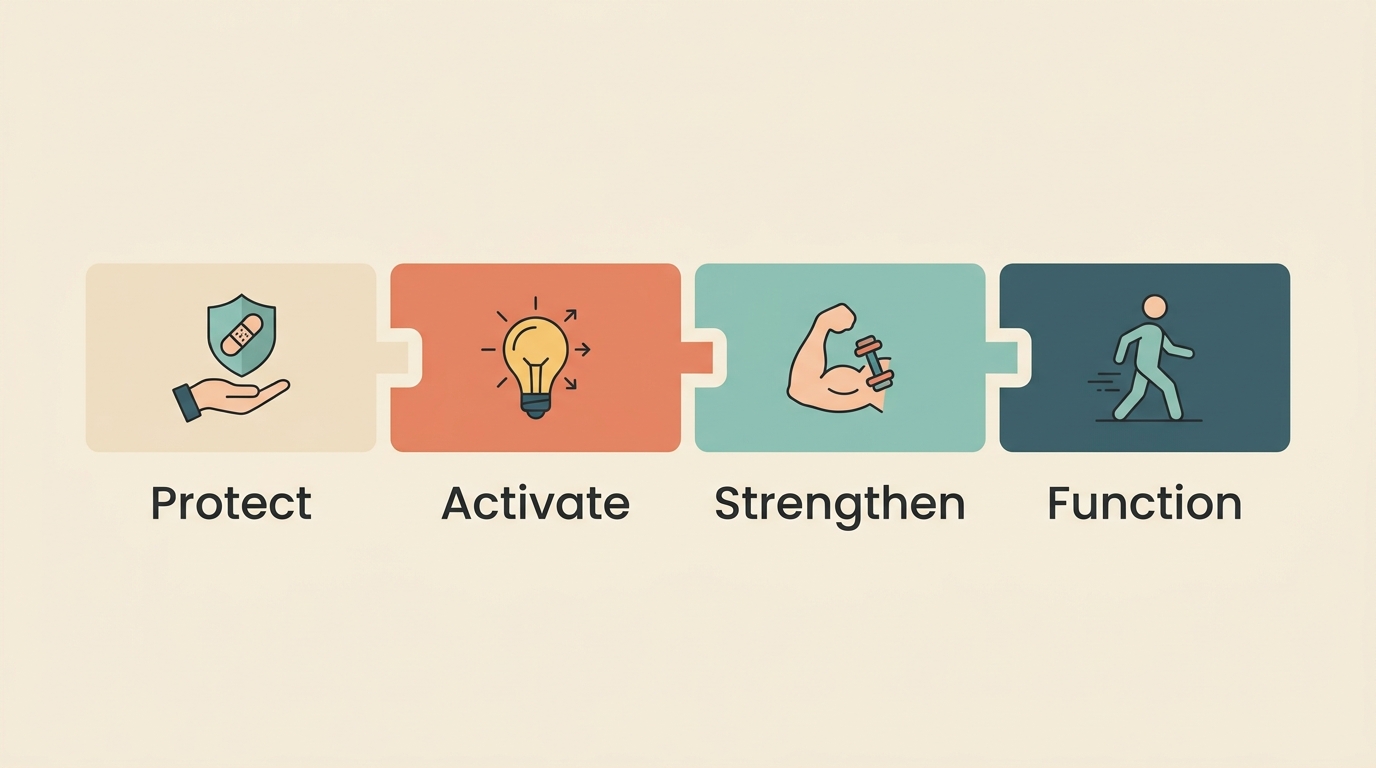
Rehabilitation is not a single activity but a journey through phases, and it helps to know the shape of it, while remembering that the pace is set by your dog's progress and your rehab team, not by a fixed calendar. Think of it loosely as moving through four overlapping stages.
The first is the protected phase, during and just after the period of strict rest, where the priority is still stability and healing, and any "rehab" is limited to very gentle, passive measures that do not disturb the recovering spine. The second is the early active phase, as your dog begins to bear weight and attempt movement, where the work is about supported standing, gentle weight-shifting, and helping the first attempts at stepping. The third is the strengthening phase, as function returns more solidly, where the focus moves to rebuilding muscle and coordination through controlled, progressively more demanding exercise. And the fourth is the return-to-function phase, working toward the best, most stable everyday movement your dog can achieve. Crucially, these phases are mapped to milestones rather than dates, the move from one to the next depends on your dog reaching things like standing, taking supported steps, and walking, not on a particular day arriving. Some dogs move through quickly, others slowly, and a few work toward function by a different route entirely, as we will see. Our recovery tracker helps you and your rehab team see where your dog is on this path and chart the progress.
Who's involved
Rehabilitation is a team effort, and knowing who does what helps you assemble the right support. At the centre is your vet, who oversees the recovery, decides when it is safe to progress, and refers you onward. Qualified veterinary physiotherapists and rehabilitation practitioners provide hands-on therapy and design the exercise programme, and increasingly there are practitioners who specialise in canine neurological rehabilitation specifically. Hydrotherapists, working on veterinary referral, provide the water-based work we cover separately. And then there is you, because a great deal of rehabilitation happens at home, in the gentle exercises and the daily handling that you carry out between professional sessions, always under guidance. This is genuinely a partnership: the professionals provide the expertise, the assessment, and the equipment, and you provide the consistent day-to-day work that makes it add up. You do not do this alone, and you do not do it by guesswork, but you are a central part of the team.
A look at the toolkit
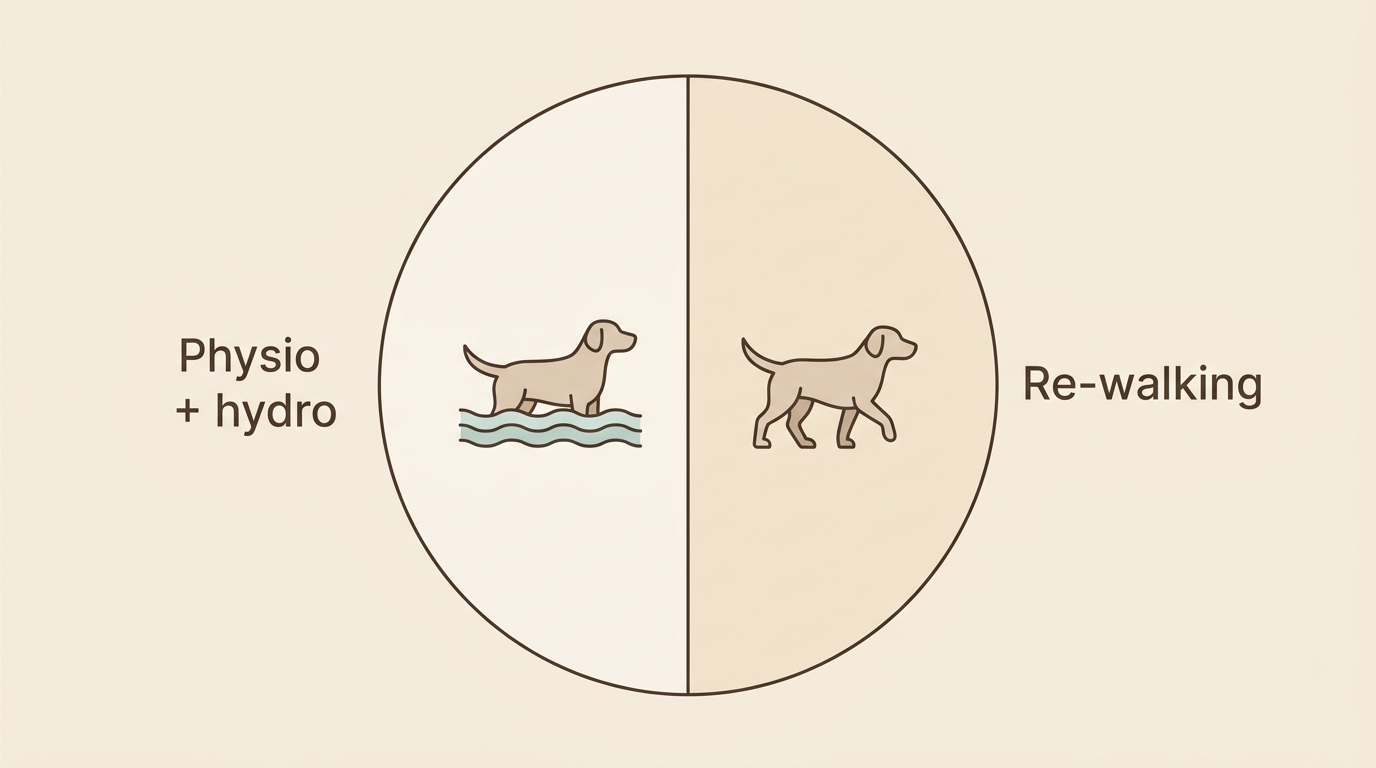
This stage of our guides covers each part of the rehabilitation toolkit in detail, so think of this article as the map and the others as the close-ups. Home physiotherapy, the gentle, phase-appropriate exercises you can safely do yourself with your team's guidance, has its own guide. Hydrotherapy, the valuable water-based work and the important question of when it is safe to start, has its own guide. The complementary therapies, acupuncture and laser, where we look squarely at what the evidence does and does not show, have their own guide. And re-teaching your dog to walk, supporting those first steps and, for some dogs, the development of a reflex-driven gait, has its own guide too. Each of these is a tool within the same overall journey, and your rehab team will draw on the ones that suit your individual dog, at the right stage. You do not need all of them, and you do not need to work out the combination yourself, that is exactly what your vet and physiotherapist are for.
Setting expectations squarely
A frank word about what recovery looks like belongs here, because realistic expectations are kinder than false hope. Recovery from a serious spinal injury is gradual, and it is not always complete. Many dogs make an excellent recovery and return to normal or near-normal function. Some recover partially, ending up with a degree of lasting wobbliness or weakness but a perfectly good life. And some dogs, particularly those most severely affected, work toward function by a different route, a reflex-driven "spinal walking", or a happy, active life on wheels, both of which our later guides cover and both of which can be genuinely good outcomes. The goal of rehabilitation is not a guaranteed return to exactly how things were, it is the best possible function and the best possible life for your individual dog, whatever form that takes.
So hold onto that as the realistic, hopeful frame: rehabilitation is a real journey with a clear map, its job is to support and protect the recovery and rebuild your dog as fully as possible, and while it is not a magic accelerator, it is genuinely worth doing well. This stage of guides walks each part of the path, your rehab team tailors it to your dog, and our recovery tracker helps you follow the progress. Whatever your dog's best outcome turns out to be, good rehabilitation gives them the best chance of reaching it.
References
Sister tool · Sightline
Track whether treatment is working
Sightline, a separate ConciergeVet tool, runs a short weekly check-in built on validated pain and mobility instruments, turns it into a single Sightline Score you can watch trend over weeks rather than judge on one bad day, and produces a report you can bring to your vet.
A written log, or our printable trackers, does much the same job.
See how Sightline tracks treatmentTrack the recovery, day by day
Recovery from a disc injury is all about the trend. Log the daily milestones through crate rest and rehab so you can see real progress, not just good and bad days.
Open the Recovery TrackerYou're not doing this alone
Compare treatment journeys and talk to owners managing IVDD. Free to join.
Join PetsLikeMine