

Managing Long-Term Incontinence with Dignity
Alastair Greenway
BVM&S MRCVS
Lasting bladder or bowel problems after a spinal injury are, for a lot of owners, the part of the road ahead that feels most daunting, practically and emotionally. The worry tends to take one of two shapes: that it means an undignified life for the dog, or that you simply will not be able to cope. Here is the honest reassurance at the outset. With a sensible routine, long-term incontinence is genuinely manageable, it becomes a normal part of daily life surprisingly quickly, and a dog with a well-managed bladder can live happily and with complete dignity. This guide explains what is actually going on with the bladder, how to build a daily routine around it, how to protect your dog's skin and comfort, and, most importantly, how to watch for the one health risk that matters most, urinary infections. It works alongside our step-by-step guide to expressing the bladder, which covers the hands-on technique in detail.
Two kinds of bladder problem
A spinal injury can affect the bladder in two broadly different ways, and knowing which one your dog has explains a great deal about how their bladder behaves day to day. The difference comes down to where along the spine the injury sits, and your vet will tell you which pattern applies to your dog.
One type follows an injury higher up the spine, in the back or chest region, which is where most disc disease occurs. Here, the bladder tends to become tense and overactive, holding onto urine too tightly: the muscle that should relax to let urine out instead stays clenched, so the bladder fills up, becomes firm, and is difficult to empty, often leaking only when it overflows because it has become too full. Vets call this an upper motor neuron bladder, and the key practical point is that it can be genuinely hard to express by hand and may need extra help to empty. The other type follows an injury lower down, at the very base of the spine near the tail, affecting the nerves to the bladder directly. Here the opposite happens: the bladder becomes floppy and slack, with little tone, so it fills up and then simply leaks, dribbling more or less constantly because the muscle that should hold urine in has lost its grip. This kind of bladder, vets' lower motor neuron type, is usually easy to express with gentle pressure.
Why does this matter to you? Because the two behave differently and are managed differently: a firm, tense, hard-to-empty bladder and a floppy, constantly-leaking one call for somewhat different routines, and the firm type in particular needs careful, regular emptying, and sometimes medication, to avoid becoming dangerously over-full. You do not need to diagnose this yourself, your vet will identify which pattern your dog has and guide the management accordingly, but understanding that there are two types helps the rest of the picture make sense, and helps you know what to expect from your own dog's bladder.
Building the daily routine
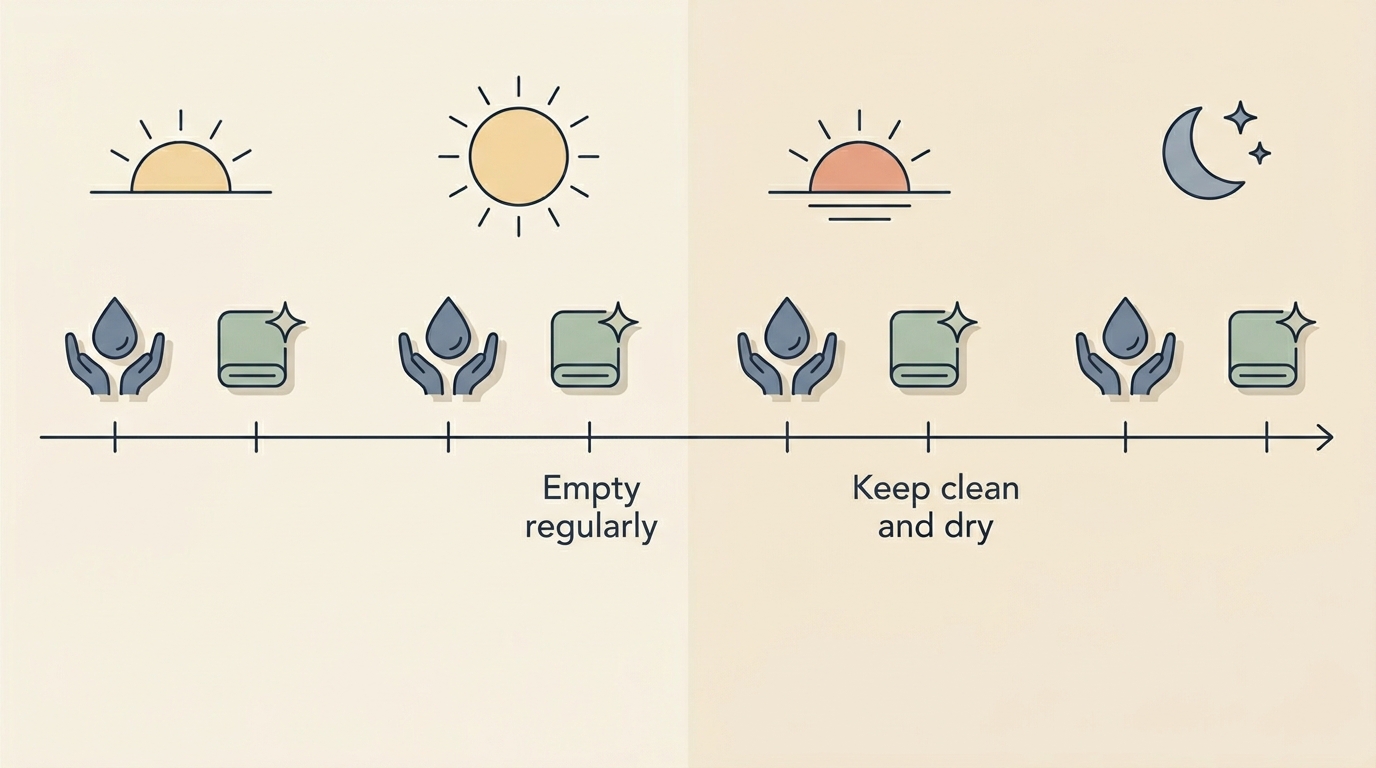
Whatever the type, the heart of managing incontinence is a consistent daily routine, and once it is established it runs almost on autopilot. The central task is regular bladder emptying, because a bladder that is reliably emptied several times a day leaks less between times, stays healthier, and keeps your dog more comfortable. For many dogs this means expressing the bladder by hand a few times a day, the technique our dedicated guide walks through step by step, ideally after you have been shown how by your vet or nurse. Build these emptying sessions into fixed points in the day, morning, midday, evening, last thing at night, and the bladder gets a rhythm that keeps it from ever getting too full.
One point deserves spelling out here, because it affects your dog's health and many guides skip it. Manual expression frequently does not empty the bladder completely. In a study of paraplegic dogs, expression by trained vets and nurses removed on average only about half the urine present, and expression at home by owners is likely less effective still. That does not make expressing pointless, regularly reducing the volume genuinely helps, but it does mean you should not assume the bladder is fully empty just because you have expressed it, and it is exactly why your vet stays involved and why, for some dogs, additional measures are needed. For dogs whose bladder does not empty well by hand, or the firm, tense type that is hard to express, your vet may recommend particular medications, or intermittent catheterisation, passing a catheter to drain the bladder properly, alongside or instead of manual expression. So this is very much a plan to set and review with your vet rather than a one-size-fits-all routine. The principle to hold onto is simply this: a reliable, regular, and adequate emptying routine is the foundation of good incontinence management, it protects your dog's health, and it quickly becomes second nature.
Keeping clean, dry and comfortable
Alongside the emptying routine comes keeping your dog clean, dry, and comfortable, which protects both their skin and their dignity. A dog that leaks urine needs prompt, gentle cleaning of any soiled skin and coat, patted properly dry, because, as our guide to preventing pressure sores and urine scald explains, urine left on the skin causes painful scalding. Keeping the back end and lower belly clean, and clipping the hair there to make cleaning easier, goes a long way, and a barrier cream on the skin helps protect against scald, on your vet's recommendation.
A few practical pieces of kit make daily life much easier, and they are worth getting right. Washable, absorbent bedding, with a moisture-wicking top layer such as veterinary sheepskin, keeps your dog dry and is easily laundered, so having several sets to rotate is invaluable. Incontinence pads placed under the dog catch leaks and keep the surface dry. And belly bands for male dogs, or absorbent wraps, can be used to manage dribbling, particularly useful at certain times or in certain parts of the house, provided, crucially, that they are changed frequently and never left wet against the skin, since a soggy wrap left on causes the very scald you are trying to avoid. None of this kit is complicated or expensive, and the right combination for your dog, washable bedding, pads, and perhaps a wrap, turns the practical side of incontinence into a manageable laundry-and-cleaning routine rather than a constant battle. Plenty of dogs live comfortably and cleanly this way for years.
Urinary infections: the risk to watch
A dog with long-term bladder problems is at genuinely raised risk of urinary tract infections, and these are the complication to stay vigilant for. The reason is straightforward and connects directly to the point above, a bladder that does not empty fully leaves residual urine sitting inside, and that stagnant urine is a breeding ground for bacteria, so infections take hold far more easily than in a normal dog. This is precisely why emptying the bladder as fully and regularly as possible matters so much, and why incomplete expression is a health issue rather than just an inconvenience. Recurrent or untreated infections matter, because they cause discomfort and can, over time, travel up toward the kidneys and cause more serious problems.
So you need to know the signs of a urinary infection, and contact your vet promptly if you spot them. The things to watch for are urine that smells strong or unpleasant, urine that looks cloudy or bloody, signs of discomfort or straining around urination, and, importantly, any sign that your dog seems generally off-colour, unwell, or feverish, since a urinary infection can make a dog systemically poorly. If you notice any of these, a prompt call to your vet is the right move, because urinary infections are very treatable when caught early, usually needing a course of antibiotics guided by testing the urine, but are better not left to worsen. Good daily management helps prevent infections in the first place, by keeping the bladder regularly and properly emptied, which is one more reason the emptying routine matters so much. Think of yourself as your dog's early-warning system for infection: a quick check of how the urine looks and smells, and how your dog seems in themselves, lets you catch trouble while it is still easy to treat.
Long-term incontinence in a spinal-injured dog is a practical challenge, not a barrier to a good life. Build a reliable daily routine of regular and adequate bladder emptying, working with your vet on whether expression alone is enough for your dog, keep your dog clean, dry, and protected with washable bedding and the right kit, and stay alert for the signs of a urinary infection so you can catch one early. Do that, and your dog can live comfortably, cleanly, and with full dignity. It looks overwhelming from the outside, in those first daunting days, but ask almost any owner who has been doing it for a while and they will tell you the same thing: it becomes routine, it stops being a big deal, and it takes nothing away from the love and the life you share. Our guides to expressing the bladder, to protecting the skin, and to adapting your home fill in the practical details, and your vet is your partner throughout, especially in setting the routine and in dealing promptly with any infection.
References
- Hu HZ, Granger N, Jeffery ND. Pathophysiology, clinical importance, and management of neurogenic lower urinary tract dysfunction caused by suprasacral spinal cord injury. Journal of Veterinary Internal Medicine, 2016;30(5):1575-1588.
- Carwardine DR, Rose JH, Harcourt-Brown TR, Granger N. Effectiveness of manual bladder expression in paraplegic dogs. American Journal of Veterinary Research, 2017;78(1):107-112.
Sister tool · Sightline
Track whether treatment is working
Sightline, a separate ConciergeVet tool, runs a short weekly check-in built on validated pain and mobility instruments, turns it into a single Sightline Score you can watch trend over weeks rather than judge on one bad day, and produces a report you can bring to your vet.
A written log, or our printable trackers, does much the same job.
See how Sightline tracks treatmentTrack the recovery, day by day
Recovery from a disc injury is all about the trend. Log the daily milestones through crate rest and rehab so you can see real progress, not just good and bad days.
Open the Recovery TrackerYou're not doing this alone
Compare treatment journeys and talk to owners managing IVDD. Free to join.
Join PetsLikeMine