

Will It Happen Again? Reducing the Risk of Recurrence
Alastair Greenway
BVM&S MRCVS
After one IVDD episode, with all the fear and effort it involved, one question tends to loom over the whole recovery: will it happen again? It is a natural worry, and you deserve a straight answer rather than false comfort. So here it is, with the real figures and, just as importantly, what genuinely lowers the risk and what is sensible-sounding but not actually proven. You cannot guarantee against a recurrence, but there are real things that stack the odds in your favour, and knowing the warning signs again means you can act fast if it ever does come back.
The real odds
Plainly, then: recurrence is a genuine possibility after IVDD, and the chance varies with how the first episode was managed and with your dog's breed. After conservative (non-surgical) management, another episode at some point is reasonably common, reported across a wide range depending on the dog and the study. After surgery, recurrence at the operated site is uncommon, especially where the disc has been fenestrated, but a different disc can still herniate in future. Breed matters too: some breeds are notably prone to repeat episodes, French bulldogs in particular, in whom recurrence after surgery has been reported in over half of dogs, as our at-risk-breeds guide discusses.
Two things follow from all that. A recurrence is possible, sometimes likely, and it would be wrong to promise you otherwise, even after a textbook recovery, because another disc can always go. But it is also far from inevitable, many dogs never have a second episode, and the things we turn to now genuinely tilt the balance toward that better outcome. So the right frame is realistic vigilance, not dread.
What lowers the risk
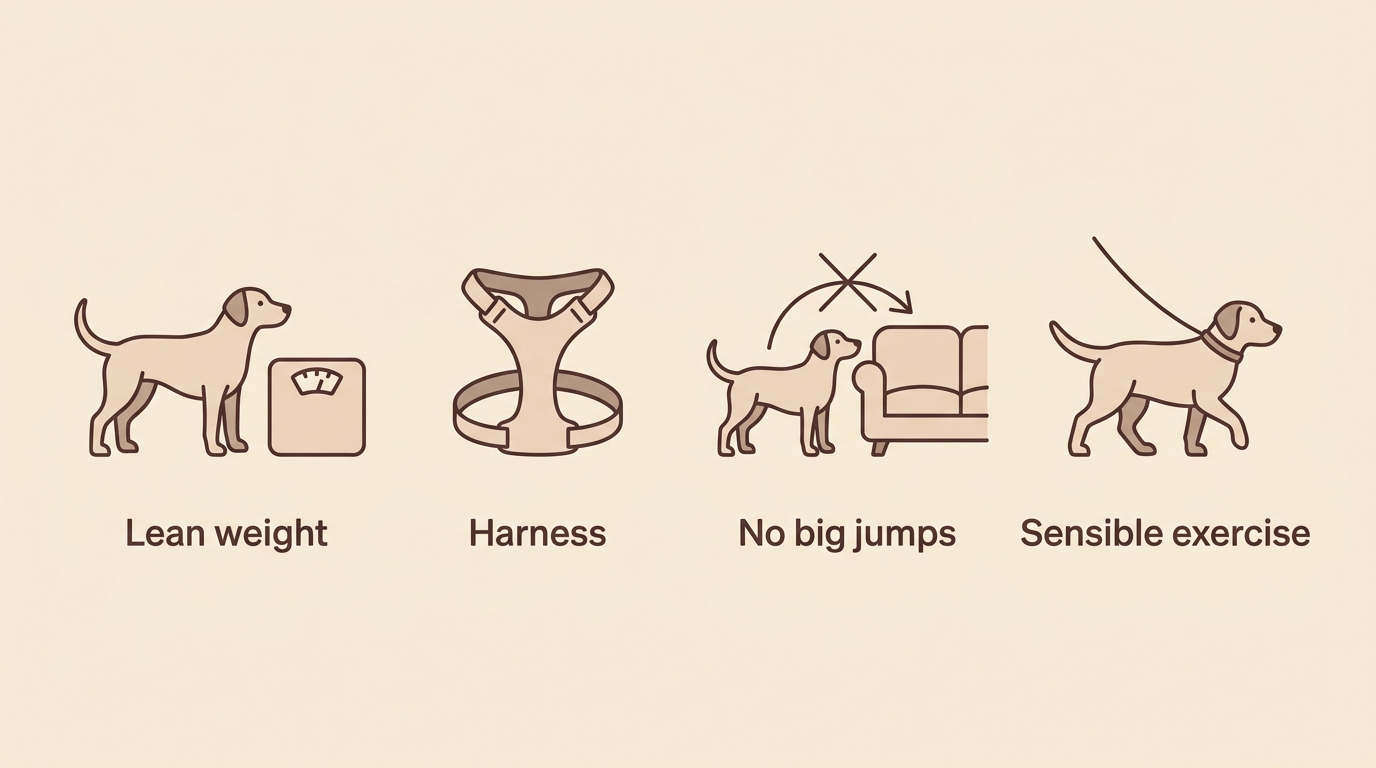
Several measures are sensibly recommended to reduce the risk of recurrence, and it is worth being clear about which have solid backing and which are reasonable precautions. The practical recommendations are: keeping your dog at a healthy, lean weight; giving sensible, regular exercise rather than either sedentary inactivity or repetitive high-impact bursts; using a harness rather than a collar; using ramps and discouraging big jumps on and off furniture; and avoiding the repetitive jarring of the spine that comes from, say, leaping off the sofa dozens of times a day. For surgically treated dogs, fenestration of the disc at the time of surgery is the one measure with good evidence specifically against recurrence, since a fenestrated disc rarely re-herniates, as our surgery guide explains.
Let me be straight about the harness point, because it is easy to overstate. A harness is sensible because it keeps pressure off the neck rather than loading it through a collar, but there is no good evidence that a harness actually prevents disc disease, so treat it as a reasonable precaution, not a proven shield. The genuinely well-founded measures here are fenestration for surgical dogs and, as we will see, the sensible-activity picture; the rest are reasonable, low-cost precautions worth taking even where the specific proof is thin.
Two pieces of advice worth a closer look
Two of the most commonly given pieces of advice deserve a clear, evidence-based look, because the popular versions overstate what the research actually shows, and a definitive guide should not pass on dogma as fact.
Start with weight. Keeping your dog lean is sound general health advice, and being overweight is bad for a dog's joints and wellbeing in many ways, so it is well worth doing. It is also worth acknowledging that the specific evidence that weight control prevents IVDD or its recurrence is weaker than you might expect: the large DachsLife study did not find body condition to be a statistically significant predictor of IVDD, and a study of recovery from IVDD surgery found body condition did not significantly affect the outcome. So keep your dog lean, by all means, it is good for them generally, but understand it as sound overall health advice rather than a proven IVDD-specific shield, which is the truthful position.
Now activity, and here the nuance is genuinely reassuring. The same DachsLife study found that dogs getting more daily exercise had a lower risk of IVDD, with more than an hour a day associated with roughly half the odds, which directly contradicts the instinct to wrap an at-risk or recovered dog in cotton wool. So the evidence supports sensible, regular activity as part of a healthy life, not enforced inactivity. What to avoid is not movement in general but the specific repetitive high-impact jarring of constant jumping on and off furniture, which is a different matter from a good daily walk. Our guide to protecting an at-risk dog goes into this nuance in full; the short version is that a lean, sensibly active dog is doing better than a heavy, under-exercised one, and that "rest forever" is not the lesson of a single episode.
Catching a recurrence early
The most practically useful thing of all comes last: because a recurrence is possible, your best protection is knowing the warning signs so you can act fast if it ever returns, just as you now know them from the first time. The signs of a recurrence are the same signs as a first episode, the early warning signs of disc pain, an arched back, reluctance to move or jump, yelping, a stiff neck, covered in our early-signs guide, and the emergency red flags of wobbliness, knuckling, dragging, or an inability to walk or wee, covered in our emergency guide and triage checker.
Second time around, the advantage you have is experience: you already know what this looks like, you know not to "wait and see" if neurological signs appear, and you know to get your dog seen fast. So if you ever spot those signs returning, act on them promptly exactly as you learned to, because early action is just as valuable for a recurrence as it was the first time. Keeping that knowledge fresh is itself a form of protection.
Recurrence after IVDD is a real possibility, more so in breeds like the French bulldog, and it would be wrong to promise it cannot happen, but it is far from inevitable and there is much you can sensibly do. Fenestration genuinely lowers the risk in surgical dogs; sensible regular activity is supported by the evidence and beats enforced inactivity; keeping your dog lean is good general advice even if its IVDD-specific proof is thinner; a harness, ramps, and avoiding big repetitive jumps are reasonable precautions; and knowing the warning signs so you can act fast is your best safety net. Lean, sensibly active, well-supported, and watched, that is the evidence-based recipe, and our guide to protecting an at-risk dog takes the prevention picture further.
References
- Mann FA, Wagner-Mann CC, Dunphy ED, et al. Recurrence rate of presumed thoracolumbar intervertebral disc disease in ambulatory dogs with spinal hyperpathia treated with anti-inflammatory drugs: 78 cases (1997-2000). Journal of Veterinary Emergency and Critical Care, 2007;17(1):53-60.
- Leu D, Vidondo B, Stein V, Forterre F. Recurrence rate of intervertebral disc disease in surgically treated French Bulldogs: a retrospective study (2009-2019). Acta Veterinaria Scandinavica, 2023;65(1):3.
- Aikawa T, Fujita H, Shibata M, Takahashi T. Recurrent Thoracolumbar Intervertebral Disc Extrusion after Hemilaminectomy and Concomitant Prophylactic Fenestration in 662 Chondrodystrophic Dogs. Veterinary Surgery, 2012;41(3):381-390.
- Brisson BA, Moffatt SL, Swayne SL, Parent JM. Recurrence of thoracolumbar intervertebral disk extrusion in chondrodystrophic dogs after surgical decompression with or without prophylactic fenestration: 265 cases (1995-1999). Journal of the American Veterinary Medical Association, 2004;224(11):1808-1814.
- Blake S, Williams R, Ferro de Godoy R. A Systematic Review of the Biomechanical Effects of Harness and Head-Collar use in Dogs. bioRxiv [preprint], 2019.
- Packer RMA, Seath IJ, O'Neill DG, De Decker S, Volk HA. DachsLife 2015: an investigation of lifestyle associations with the risk of intervertebral disc disease in Dachshunds. Canine Genetics and Epidemiology, 2016;3:8.
- Gordon-Evans WJ, Johnson AL, Knap KE, Griffon DJ. The effect of body condition on postoperative recovery of dachshunds with intervertebral disc disease treated with postoperative physical rehabilitation. Veterinary Surgery, 2019;48(2):159-163.
Sister tool · Sightline
Track whether treatment is working
Sightline, a separate ConciergeVet tool, runs a short weekly check-in built on validated pain and mobility instruments, turns it into a single Sightline Score you can watch trend over weeks rather than judge on one bad day, and produces a report you can bring to your vet.
A written log, or our printable trackers, does much the same job.
See how Sightline tracks treatmentTrack the recovery, day by day
Recovery from a disc injury is all about the trend. Log the daily milestones through crate rest and rehab so you can see real progress, not just good and bad days.
Open the Recovery TrackerYou're not doing this alone
Compare treatment journeys and talk to owners managing IVDD. Free to join.
Join PetsLikeMine