

Adapting Your Home for a Mobility-Impaired Dog
Claire Greenway
BVM&S MRCVS
A dog left with lasting mobility problems, whether using a wheelchair, dragging the back legs, or simply weak and wobbly, suddenly finds the home it knows full of small obstacles: the slippery kitchen floor, the step up to the garden, the sofa it used to leap onto. Adapting your home to suit them is far easier and cheaper than most owners fear. This is not about building work or expensive special equipment; it is about a handful of sensible, low-cost changes that make your home safe and navigable for a dog whose legs no longer work as they did. This guide walks through those changes, room by room and need by need, with the wheelchair dog and the wobbly dog both in mind, so your dog can move about safely and live comfortably in the home you share.
Think adaptation, not renovation. Most of what follows costs little, can be done in an afternoon, and uses things you can buy easily or may already own. You are removing hazards and adding a few aids, not rebuilding the house.
Flooring: the first and biggest fix
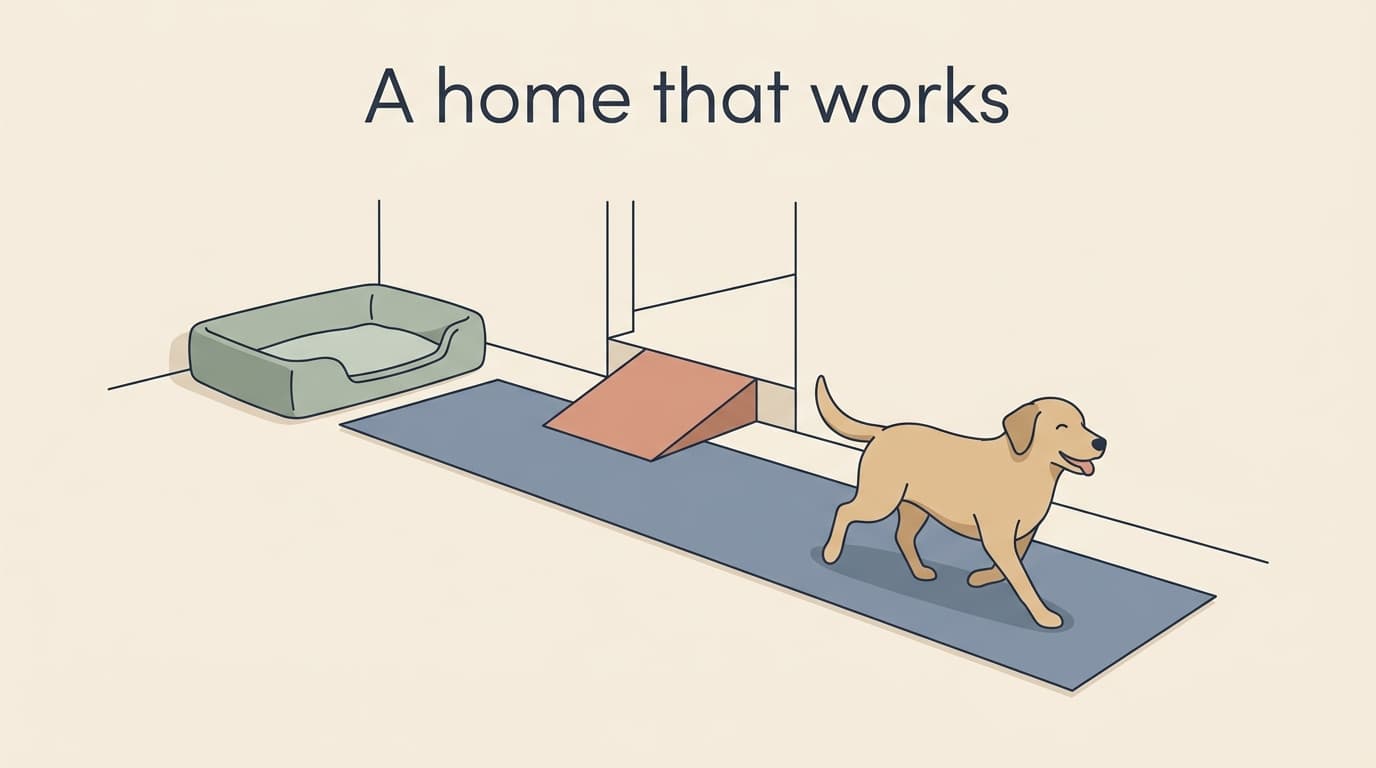
If you do only one thing, sort out the flooring, because slippery floors are the single biggest hazard for a dog with weak or unsteady legs, and the easiest to fix. Specialists in canine mobility rate non-slip flooring as one of the most effective changes you can make for an unsteady dog. Hard, smooth surfaces, laminate, tile, polished wood, vinyl, give no grip, and a dog that cannot rely on its back legs will slip, scramble, and struggle to get up, which is both distressing and a real risk to a healing or vulnerable spine.
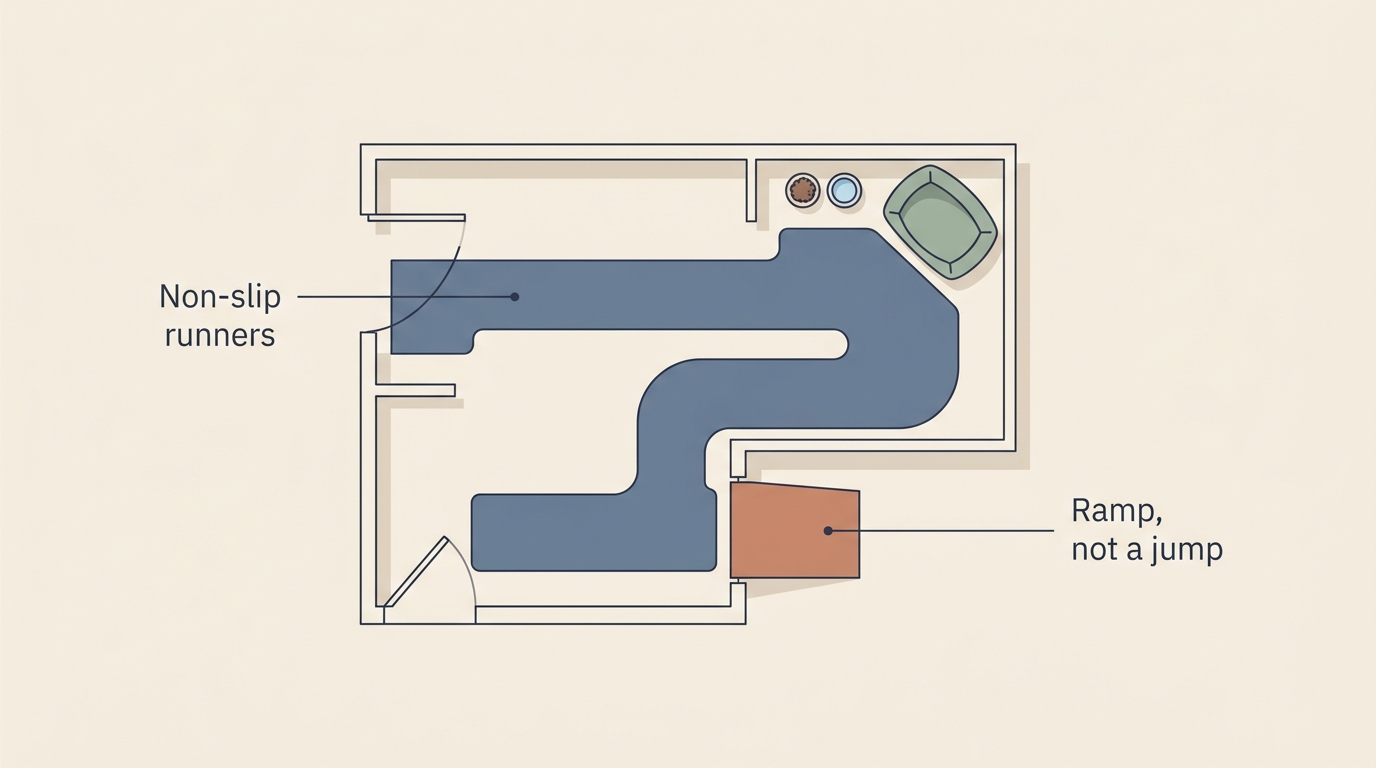
The fix is to add traction wherever your dog walks, and a few specifics make it work much better. Lay down non-slip rugs, carpet runners, yoga mats, or gym-style foam floor tiles along the routes your dog uses most, from the bed to the door, around the food bowls, across open stretches of hard floor, so they always have something to grip. Two details matter: put a non-slip pad underneath any rug or runner so it cannot slide out from under your dog, and make sure there is grippy flooring everywhere your dog needs to be, including directly under the dog bed, since standing up from the bed is a common slipping point. You do not need to carpet the whole house, just create grippy pathways through it. Two small extras help your dog's own grip too: keeping the nails short, since long nails stop the pads making proper contact, and trimming the tufts of hair that grow between the pads, both of which improve traction on smooth floors. This combination, more than any other change, transforms a hard-floored home from a skating rink into somewhere a wobbly or wheelchair-using dog can move with confidence.
Slopes instead of steps
Next come changes in level, the steps and heights that a four-legged dog takes for granted but a mobility-impaired one cannot. The principle here is to replace climbing and jumping with gentle slopes wherever you can. A ramp over a step, up to a favourite resting spot, or, importantly, into the car, lets a dog walk up a gentle incline instead of facing a jump or a climb it can no longer manage, sparing the strain that transitions like these place on the back and limbs. When choosing a ramp, the single most important thing is that it is long enough to reach comfortably from the floor right up to the destination, because a ramp that is too short for the height becomes too steep to be useful, and a non-slip surface on the ramp is essential so your dog does not slide. Ramps can be bought ready-made, some designed to look like furniture, or improvised from a sturdy board with a grippy surface, and for a wheelchair-using dog the ramp needs to be wide and shallow enough for the cart.
Just as important as adding ramps is blocking off the climbs and jumps your dog should no longer attempt. Stairs are the main one: a dog recovering from or prone to a spinal problem should not be navigating a full flight, so use a baby gate or barrier to block the stairs and prevent your dog attempting them unsupervised, carrying them up and down instead where needed. A brief note is worth making here, because you may read conflicting advice: for some dogs with other conditions, such as arthritis, gentle stair use can actually be a useful, muscle-maintaining exercise, but that does not apply to a dog with a disc problem recovering from or at risk of an episode, for whom the jarring and twisting of stairs is exactly what to avoid, as our crate-rest guide explains. So for the spinal dog this article is about, block the stairs. And discourage the old habit of leaping onto sofas, beds, and chairs, which puts exactly the kind of jarring force on the spine you want to avoid, by providing a ramp up to permitted spots or, more simply, by giving your dog a comfortable place of its own at ground level so it no longer needs to. The combination, ramps where you want access and barriers where you do not, keeps your dog moving safely between the levels of your home without the risky jumps and climbs.
Accessible essentials: bed, bowls, space
Beyond floors and levels, a few adjustments to your dog's essentials make daily life much easier for them. The bed should be easy to get into and out of: a low, supportive bed with low or no sides, placed on a non-slip surface, lets a dog that cannot climb or step up still get comfortable without a struggle. A thick orthopaedic or memory-foam bed is ideal, because it both makes getting in and out easier and protects the skin of a dog spending more time lying down, as our guide to preventing pressure sores explains, and memory foam in particular moulds to the body and distributes weight well. Position it somewhere warm, draught-free, and in the heart of the household, so your dog rests easily and stays part of family life rather than isolated, with non-slip flooring right up to and under it.
Food and water bowls deserve a thought too, and there is a right height worth knowing. Raising the bowls so they sit at roughly the dog's shoulder height, or just below the lower chest, lets your dog eat and drink with a neutral spine and only slight neck bend, rather than stooping awkwardly down to the floor. For a dog with hind-limb weakness this has a neat bonus: eating from a floor-level bowl throws extra weight onto the front legs, whereas a raised bowl shifts some of it back onto the rear, which is gentle, useful work for those limbs. Stand the bowls on a non-slip surface so they stay put and your dog stays steady. And more generally, keep the spaces your dog uses clear and uncluttered, with clear routes between the key points, the bed, the bowls, the door, so a wobbly or wheeled dog has an easy, obstacle-free path around its home, and make sure those areas are well lit so your dog can see where it is going. None of these tweaks is expensive, and together they let your dog manage the basics of eating, drinking, and resting with independence and dignity.
The wheelchair dog, specifically
Does your dog use a wheelchair? A few extra points are worth keeping in mind, because a cart changes the space your dog needs, and our guide to life on wheels covers the cart itself in detail. The main practical consideration is clearance: a dog in a cart is wider and longer than the dog alone, so check that it can get through your doorways and along your hallways without snagging, widening a doorway if you realistically can, and clear a little extra room around the routes it travels and the spaces it turns in. Rearranging furniture to create clear, straight paths, adding ramps at the thresholds and small steps the cart cannot roll over, and laying non-slip flooring so the wheels get good traction all help a cart-using dog move freely.
Remember too that a wheelchair is not for constant use, as our wheels guide explains, so your dog will spend plenty of time out of the cart, resting and pottering about on the floor. For these times, comfortable floor space matters, and a padded drag bag, a soft protective cover for the lower body, is genuinely useful: when a paralysed dog drags its hind end across the floor, it can scrape and develop rug burns on the belly, legs, and feet, and a drag bag protects those sensitive areas while still letting the dog move about. So think of the home as serving your dog both in and out of the wheels: clear, ramped routes wide enough for the cart when it is on, and comfortable, safe, protected floor space for when it is off. With both in mind, a wheelchair dog moves through its home as freely as any other.
A simple plan you can act on this week: start with the floors, laying non-slip runners with non-skid pads along your dog's main routes and under the bed, because that single change does the most, and keep the nails short and paw hair trimmed for extra grip. Add ramps, long enough not to be steep and with a grippy surface, where your dog needs to manage a step or get to the car, and block the stairs and discourage the jumps it should no longer attempt. Give it a low, supportive bed and steady, raised bowls at shoulder height, and keep clear, well-lit paths between them. And if your dog is on wheels, check the cart fits through the gaps it needs to and keep comfortable, protected floor space for its time out of the cart. None of this is a renovation, it is an afternoon's sensible tweaking,. Our guides to life on wheels and to keeping a disabled dog thriving fill in the rest of the picture.
References
- Canine Arthritis Resources and Education (CARE). Home Environment Modifications for Dogs with OA.
- Canine Arthritis Resources and Education (CARE). Assistive Devices for Dogs with Arthritis.
- Packer RMA, Seath IJ, O'Neill DG, De Decker S, Volk HA. DachsLife 2015: an investigation of lifestyle associations with the risk of intervertebral disc disease in Dachshunds. Canine Genetics and Epidemiology, 2016;3:8.
Free downloads
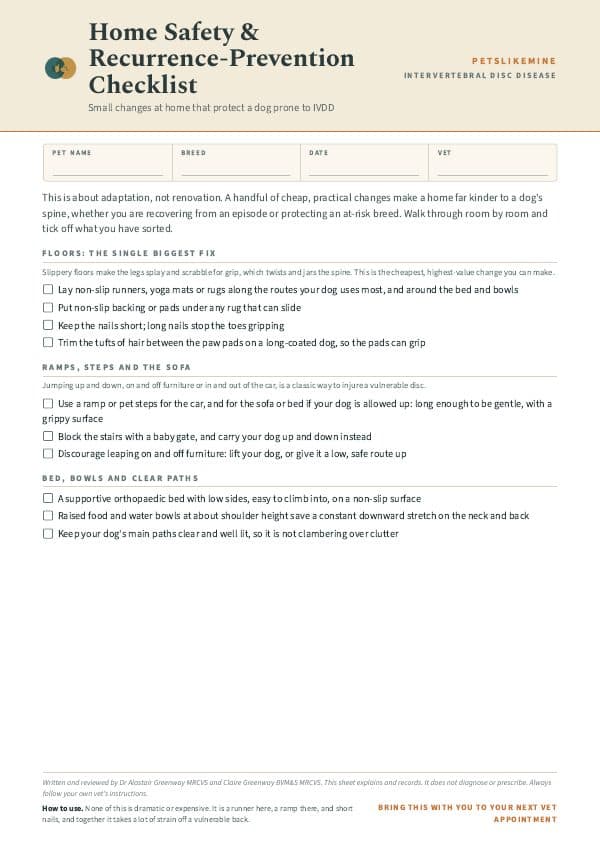
Companion worksheets to put what you've read into practice. Free PDFs, print at home.
Sister tool · Sightline
Track whether treatment is working
Sightline, a separate ConciergeVet tool, runs a short weekly check-in built on validated pain and mobility instruments, turns it into a single Sightline Score you can watch trend over weeks rather than judge on one bad day, and produces a report you can bring to your vet.
A written log, or our printable trackers, does much the same job.
See how Sightline tracks treatmentTrack the recovery, day by day
Recovery from a disc injury is all about the trend. Log the daily milestones through crate rest and rehab so you can see real progress, not just good and bad days.
Open the Recovery TrackerYou're not doing this alone
Compare treatment journeys and talk to owners managing IVDD. Free to join.
Join PetsLikeMine