

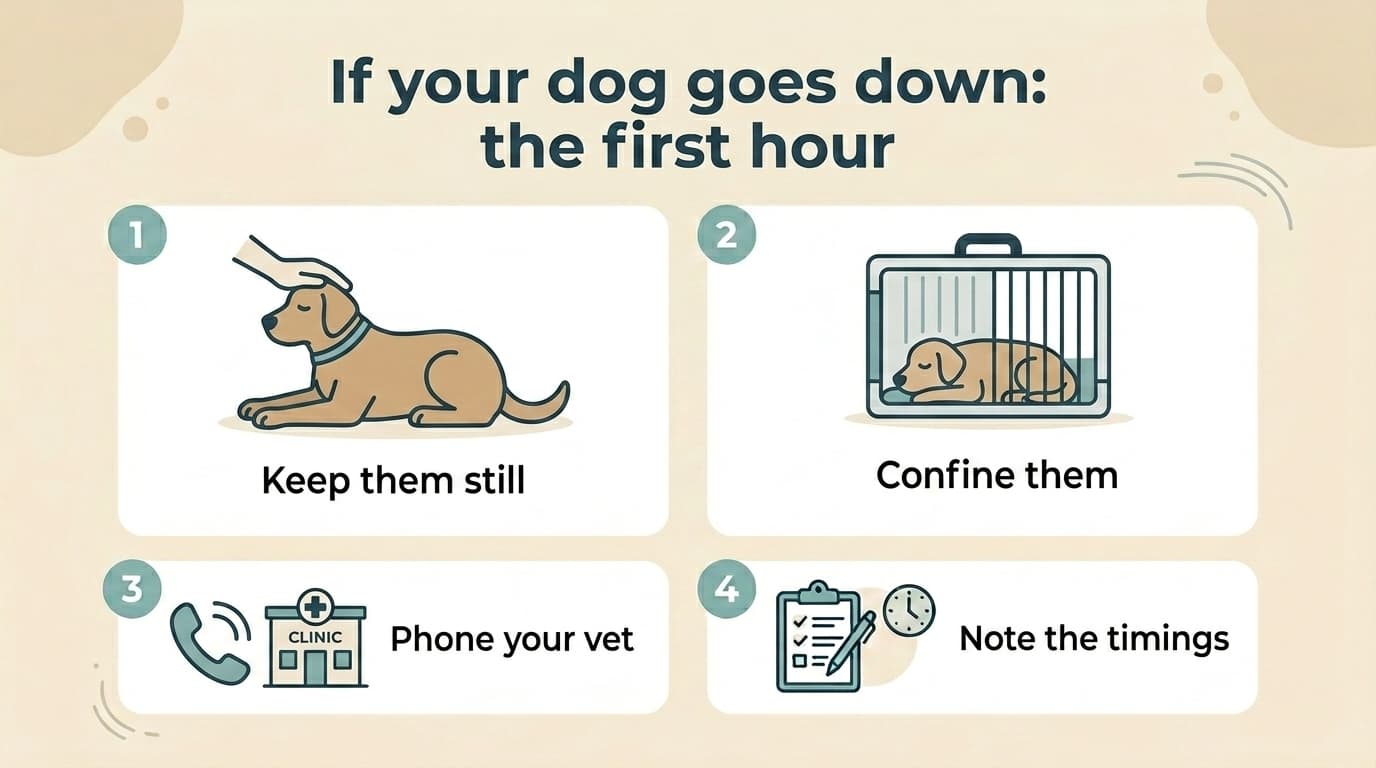
The First Few Hours: A Calm, Step-by-Step Action Plan
Alastair Greenway
BVM&S MRCVS
When a dog suddenly goes weak or off its legs, the last thing that helps is an essay. What helps is knowing exactly what to do, in order, calmly. So here it is, step by step. Work through it one step at a time; you can read the detail later. The most important thing has already happened, which is that you took it seriously and acted.
1. Keep your dog still
Right now, before anything else, stop your dog moving. Confine it to a small space, a crate, a pen, a small room, or simply hold it gently still, and stop all walking, jumping, and moving about.
Here is why that matters so much. With a suspected disc problem, movement can push more disc material against the spinal cord and make the injury worse, so keeping your dog still from this moment is the single most protective thing you can do while you organise help. Do not let your dog walk around "to see how bad it is", and do not let it attempt stairs or jump onto or off furniture. Still and confined, straight away.
2. Lift and carry safely
When you need to move your dog, to get it to the car, support its spine and keep its back level and straight. Support the whole body, both ends at once, so the back does not bend, twist, or sag, rather like carrying a tray you must not tip.
Do not lift your dog by the scruff, and do not let its back end dangle. For a bigger dog, get a second person so one of you supports the front and one the back. A towel slipped under the belly can serve as a sling to help. Our guide to safe lifting has the full technique, but the rule for right now is simple: keep the back level, support both ends, move gently.
3. Phone the vet now
Call your vet, or if it is out of hours, your nearest emergency vet, straight away. Phone ahead rather than just setting off, so they can be ready for you.
Tell them clearly what has happened: that it came on suddenly, whether your dog can walk, whether it can feel and move its legs, and whether it can wee. If you can, mention whether your dog reacts when you gently pinch a back toe, the conscious "deep pain" response your vet will want to know about, though do not spend long testing this at home, as our deep-pain guide explains. Ask whether you should come straight in or go directly to a specialist or out-of-hours centre, because a severely affected dog may need an MRI scan and a surgeon that not every practice has on site, and knowing where to go saves precious time.
4. Note what you see
Quickly note a few things, because they genuinely help your vet judge how urgent this is and what the options are. Write down, or just fix in your mind: the time the signs started, what exactly changed and in what order, whether your dog can move and feel its back legs, and when it last weed.
That short timeline matters more than you might think. How long the signs have been present, and whether things are getting rapidly worse, feed directly into how urgently your dog needs to be seen and treated, so having the facts straight helps everyone act quickly and correctly.
5. What not to do
A few things to avoid, because they can do harm. Do not give any human painkillers, ibuprofen, paracetamol, or anything from your own cabinet, as these can be highly toxic, even fatal, to dogs, and your vet will provide safe pain relief; our medications guide explains why. Do not give food if there is any chance your dog may need surgery and anaesthesia soon, since a recently fed dog can complicate an anaesthetic, so hold off on feeding until your vet has advised. And do not "wait until morning" if your dog cannot walk, a dog that has lost the ability to walk needs to be seen urgently, not slept on, even if it means an out-of-hours trip.
How urgent is this?
To orient you quickly: a dog that is in pain but still walking needs prompt veterinary attention, today, but is usually not a by-the-minute emergency. A dog that has suddenly become unable to walk, is dragging its back legs, or cannot wee, is an urgent emergency and needs to be seen as fast as possible. And a dog whose signs are rapidly getting worse in front of you is the most urgent of all. If you are unsure where your dog falls, our IVDD triage and grade checker will walk you through the signs and give you a clear read, and our emergency guide covers the red flags in more detail. The overarching rule, as always with this condition: if in any doubt, treat it as an emergency.
So, hold onto this: you have kept your dog still, you are moving it safely, you have called the vet and told them what matters, you have the timeline straight, and you have avoided the things that could do harm. That calm, quick response is exactly what gives your dog its best chance, and you have already done the most important part by acting now rather than waiting. Keep our printable action card to hand for next time, follow your vet's instructions from here, and take a breath, because the decisive first steps are behind you.
References
- Olby NJ, Moore SA, Brisson B, Fenn J, Flegel T, Kortz G, Lewis M, Tipold A. ACVIM consensus statement on diagnosis and management of acute canine thoracolumbar intervertebral disc extrusion. Journal of Veterinary Internal Medicine, 2022;36(5):1570-1596.
- Toxicoses from human analgesics in animals. MSD Veterinary Manual.
Sister tool · Sightline
Track whether treatment is working
Sightline, a separate ConciergeVet tool, runs a short weekly check-in built on validated pain and mobility instruments, turns it into a single Sightline Score you can watch trend over weeks rather than judge on one bad day, and produces a report you can bring to your vet.
A written log, or our printable trackers, does much the same job.
See how Sightline tracks treatmentTrack the recovery, day by day
Recovery from a disc injury is all about the trend. Log the daily milestones through crate rest and rehab so you can see real progress, not just good and bad days.
Open the Recovery TrackerYou're not doing this alone
Compare treatment journeys and talk to owners managing IVDD. Free to join.
Join PetsLikeMine