

Hydrotherapy for IVDD: Does It Help, and When to Start?
Alastair Greenway
BVM&S MRCVS
Hydrotherapy comes up a lot when a dog is recovering from a spinal injury, and you can see why. The idea of a dog that can barely walk on land moving freely in water is an appealing one, and it is genuinely a useful rehabilitation tool. Owners tend to arrive with two questions, and both deserve straight answers. Does it actually help? And, just as importantly, when is it safe to start, because the timing matters most and gets glossed over too often. This guide explains what hydrotherapy does, why the underwater treadmill is usually preferred for spinal cases, and the timing rule that protects your dog, all within the principle that hydrotherapy is arranged through your vet, not booked off your own bat.
What the water actually does
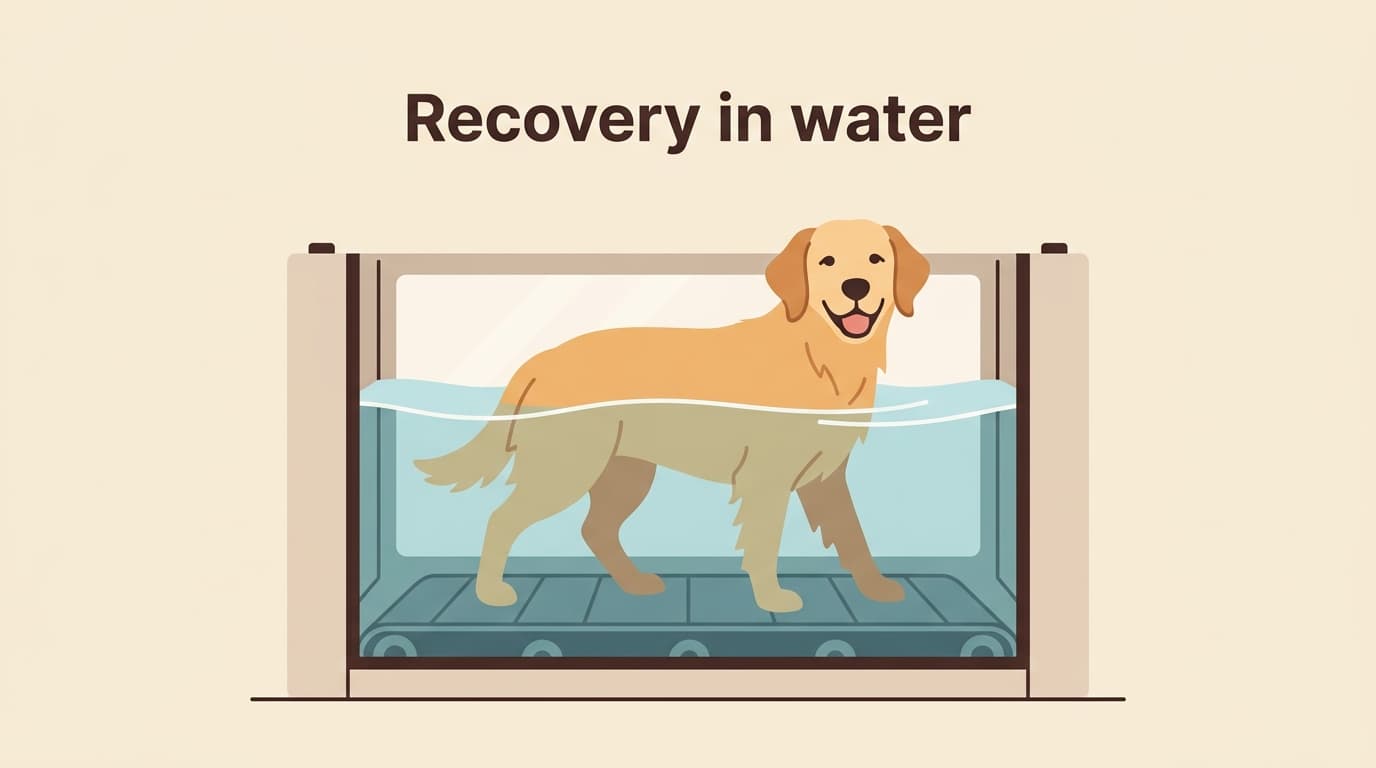
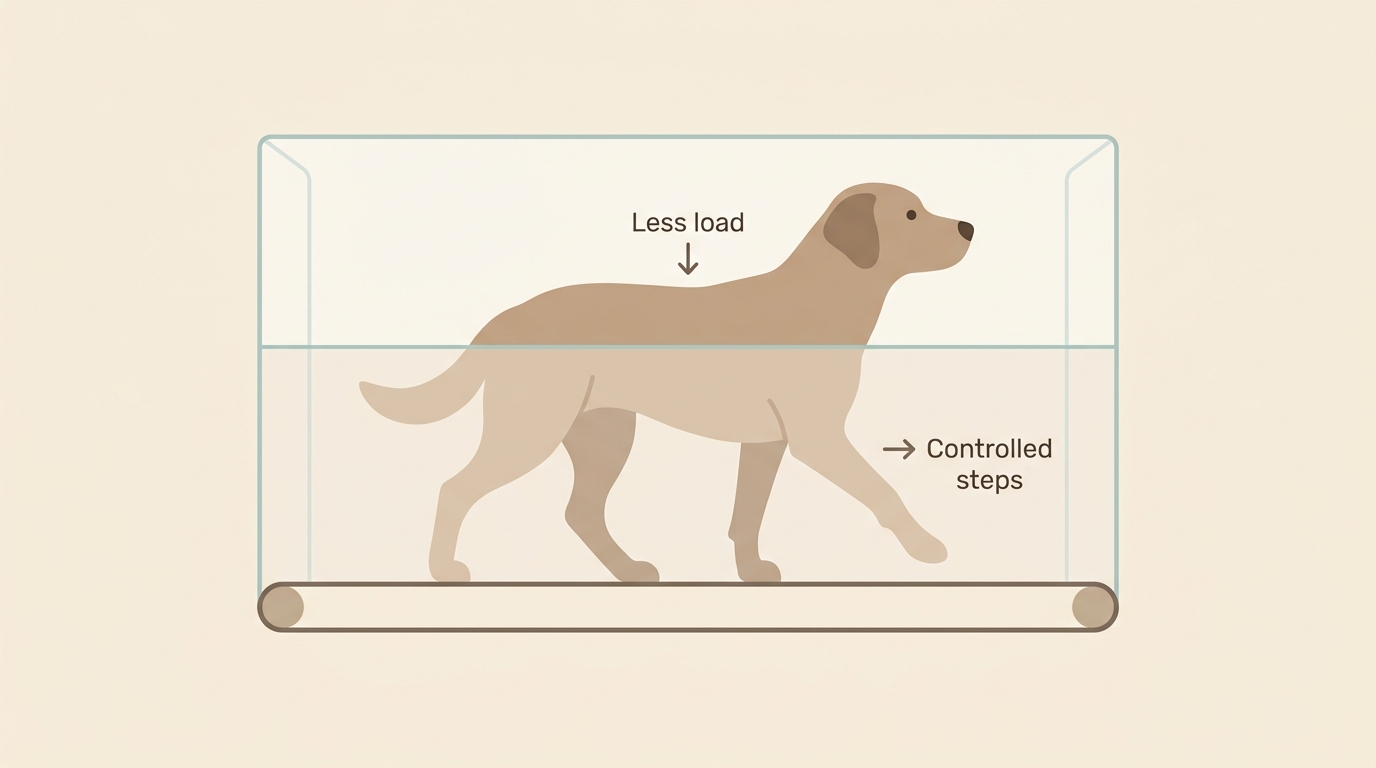
The appeal of water is real and based on simple physics. When a dog stands in water, buoyancy supports much of its body weight, so a dog that is too weak to hold itself up and move properly on land can stand and step in water with far less load to carry. Warm water also eases movement and comfort, relaxing muscles and making the whole effort less of a struggle. And moving in water provides gentle resistance that helps rebuild muscle. Put together, this means hydrotherapy lets a recovering dog practise standing, weight-bearing, and stepping, and rebuild wasted muscle, in conditions that take much of the strain off the healing spine and legs.
The limits matter just as much, though, because this is where hydrotherapy is often oversold. Hydrotherapy is a tool for the rebuilding phase of recovery, helping a dog regain muscle and practise movement; it is not a cure, and there is no good evidence that it speeds up the fundamental recovery or changes whether a dog will walk again. Its value is mechanical and practical, letting a weak dog move and rebuild in a supported way, rather than being a treatment that heals the injury. So think of it as a valuable rebuild aid at the right stage, used as part of a wider rehabilitation plan, rather than the thing that will make your dog better.
Treadmill versus pool
If hydrotherapy is recommended, you may come across two forms, and for spinal rehabilitation they are not equal. The underwater treadmill, a treadmill housed in a tank that is then filled with warm water to a chosen depth, is usually the preferred option for neurological cases. The reason is control: on an underwater treadmill the water level can be set to give exactly the right amount of weight support, and the dog walks a proper, controlled, weight-bearing gait on the moving belt, which is precisely the pattern of movement a recovering dog needs to relearn. Free swimming in a pool, by contrast, is good exercise and builds fitness, but it is a different action from walking and gives less of the controlled, weight-bearing stepping that spinal rehabilitation is aiming for. So while both have their uses, do not be surprised if your rehab team favours the underwater treadmill for an IVDD dog, as it more directly rehearses the walking your dog is working back toward.
Timing: the rule that matters
Getting the timing wrong can cause real harm: hydrotherapy must not be started too early. For a dog that has had spinal surgery, the surgical wound needs to be fully healed before the dog goes in the water, because submerging a wound that has not yet healed risks infection and wound complications. In practice this usually means waiting until around two weeks after surgery, once the wound has healed and on your vet's specific say-so.
Two further timing principles matter just as much. Hydrotherapy should only ever be done on veterinary referral, never arranged independently while your dog is still recovering, because your vet must judge that your dog is ready and that it is safe. And it is never a substitute for the prescribed rest: during the strict-rest phase, your dog should be resting, not at hydrotherapy, and the water work belongs to the later rebuilding phase once your vet has moved your dog on from strict confinement. So the rule, in short, is that hydrotherapy comes later in the recovery, after wound healing and after the strict-rest phase, and always on your vet's instruction. A good hydrotherapy centre will in any case require a veterinary referral before they will treat your dog, precisely because the timing and the suitability need a vet's judgement.
Inside a typical session
If your dog does start hydrotherapy, it helps to know what to expect, because it is a calm and controlled process rather than anything dramatic. A session typically begins with an assessment by the qualified hydrotherapist, who will check your dog and plan appropriately. Your dog is supported with a buoyancy aid or harness and helped into the water, and the sessions are short and controlled to begin with, building up gradually as your dog gains strength and confidence. The hydrotherapist controls the water depth, the pace, and the duration, and progresses these carefully over successive sessions. It is gentle, supervised, and tailored, and most dogs come to take it in their stride. The hydrotherapist will also talk to you about how the sessions fit with the rest of your dog's rehabilitation.
Is it right for every dog?
No, in truth, and it is worth saying so. Hydrotherapy is genuinely helpful for many dogs in the rebuilding phase of recovery, supporting movement and muscle, but it is not a cure, it is not appropriate during the acute phase or before a wound has healed, and it is not the right choice for every dog or every situation. There is also a practical reality: hydrotherapy means finding a suitable centre, often travelling to it, paying for sessions, and fitting it into the recovery, which is not always easy or affordable. So it is one valuable option among several in the rehabilitation toolkit, suited to the right dog at the right stage, rather than something every recovering dog must have. Your vet will advise whether, and when, it is right for your dog.
Hydrotherapy, then, is a genuinely useful rebuild tool that lets a weak dog move and build muscle with much of the strain taken off, with the underwater treadmill usually preferred for spinal cases, but its great rule is timing, after the wound has healed, after the strict-rest phase, and always on veterinary referral. Arranged properly, through your vet and a qualified hydrotherapist at the right point in recovery, it can be a valuable part of your dog's rehabilitation, and our rehabilitation roadmap shows where it fits in the wider journey.
References
Sister tool · Sightline
Track whether treatment is working
Sightline, a separate ConciergeVet tool, runs a short weekly check-in built on validated pain and mobility instruments, turns it into a single Sightline Score you can watch trend over weeks rather than judge on one bad day, and produces a report you can bring to your vet.
A written log, or our printable trackers, does much the same job.
See how Sightline tracks treatmentTrack the recovery, day by day
Recovery from a disc injury is all about the trend. Log the daily milestones through crate rest and rehab so you can see real progress, not just good and bad days.
Open the Recovery TrackerYou're not doing this alone
Compare treatment journeys and talk to owners managing IVDD. Free to join.
Join PetsLikeMine