

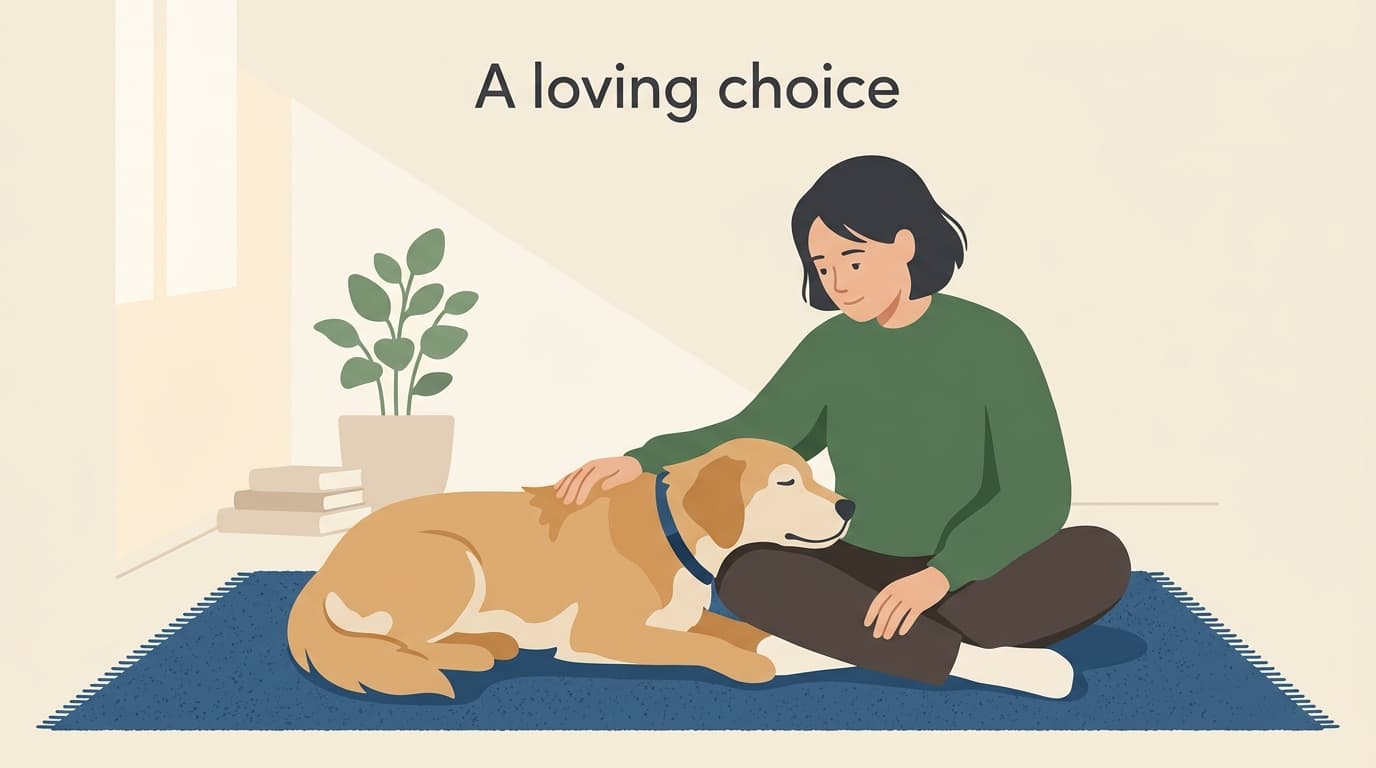
When Surgery Isn't the Right Choice
Alastair Greenway
BVM&S MRCVS
For some dogs with a serious disc injury, surgery is not the right answer. That sentence is hard to read if you are facing it, because so much of what is written about IVDD treats surgery as the thing a good owner does, and anything else as giving up. That framing is unkind and untrue. Choosing not to pursue surgery can be an act of love and good sense rather than a failure, and there are real, legitimate reasons it is sometimes the right decision. What follows is a candid look at when surgery may not be advised, when it comes down to a personal or financial reality, what the alternatives are, and how to carry the difficult feelings that come with it. Whatever you are weighing, please know there is no shame in it.
Times surgery has little to offer
There are situations where surgery itself may offer little, or where a vet may gently advise that it is not the kindest path, and understanding them can help a decision feel less like a failure and more like a clear-eyed kindness. The clearest is the most severely affected dog: a dog that has lost deep pain perception and has had that loss for some time faces a guarded outlook even with surgery, with recovery of walking reported in around sixty percent of these dogs at best and lower the longer deep pain has been absent, as our guides to deep pain and surgery explain. For some of these dogs, particularly with a long delay, the realistic chance surgery offers may be small.
A rarer but graver complication weighs here too: progressive myelomalacia, in which the spinal cord tissue itself breaks down. It affects a meaningful proportion of deep-pain-negative dogs, and where it is occurring or feared, surgery cannot help. Beyond the spinal injury itself, a dog's age, or other significant health problems that make anaesthesia and major surgery genuinely risky, can mean the burden and danger of surgery outweigh what it could realistically achieve. In all of these, a vet advising against surgery, or being straight that its odds are poor, is not abandoning your dog. They are giving you the truthful picture so that you can make a kind decision, and choosing not to put a dog through major surgery that offers little is itself a form of care.
When the deciding factor is personal or financial
Sometimes surgery might offer a reasonable chance, and yet it is still not the path you can take, and the commonest reason is cost. IVDD surgery, with its MRI, the operation, and the hospital stay, can run to many thousands of pounds, as our guide to what it costs sets out, and not every family can find that sum, particularly without insurance. Let me say something clearly here, because owners in this position often carry a heavy and undeserved guilt: cost is a legitimate factor, and deciding within your real means is not abandoning your dog.
There is no shame in not being able to spend thousands of pounds you do not have. An owner who cannot fund surgery, and who therefore chooses committed conservative care, or who makes a harder decision still, is not a bad owner. They are a person making a loving choice within real constraints, which is something almost every owner faces in some form. Money is a real part of these decisions for most ordinary families, and a good vet understands that completely and will discuss it with you openly and without judgement, including any options that might bring the cost down, as our cost guide and our guide to seeing a neurologist cover. Please do not let guilt about money convince you that you have failed your dog; deciding sensibly within your means is exactly what a responsible, loving owner does.
The alternatives to an operation
Choosing against surgery is not the same as choosing to do nothing, and it helps to know that there are real alternatives, because that knowledge can lift some of the fear from the decision. For many dogs, committed conservative management, strict rest, good pain relief, and dedicated nursing and rehabilitation, is a genuine and worthwhile treatment in its own right, not merely a consolation, as our guides to crate rest and rehabilitation describe, and for the less severely affected dogs it carries genuinely good odds. Even for some severely affected dogs, dedicated care and rehabilitation, and time, can lead to meaningful recovery, including the reflex-driven "spinal walking" some paralysed dogs develop over months, as our guide to re-teaching walking explains.
For a dog left with a permanent disability, a good life on wheels is a real and often happy option, as our guides to life on wheels and to the permanently affected dog set out, with the evidence showing that many such dogs have a genuinely good quality of life. Alongside these, good palliative care, keeping a dog comfortable and content without pursuing a cure, is a legitimate and compassionate path for some dogs and some situations. The point is that "not surgery" opens onto a range of caring options rather than a void, and your vet can help you find the one that fits your dog and your circumstances. Whichever it is, it can be a path walked with love and good care.
Carrying the guilt
Whatever you decide, if surgery is not the path you take, you may carry guilt, the nagging "should I have found a way?", the fear that you let your dog down, the grief tangled up with self-doubt. These feelings are completely normal and deeply human, and they say more about your love for your dog than about any failing. So let me offer what I hope is some release from them.
The "right" choice in these situations is not defined by whether you pursued the most aggressive option regardless of the odds, the cost, or your dog's wider wellbeing. The right choice is the one made thoughtfully, with love, with clear information, and with your dog's genuine best interests at heart, within the real circumstances of your life. By that measure, a decision made carefully and kindly, even a decision against surgery, even a decision that costs you dearly to make, is a good one, and you should not let guilt tell you otherwise. Your vet will not judge you, truly, vets see these decisions constantly and understand the weight of them, and the kindest thing you can do is to make your choice thoughtfully and then be gentle with yourself about it. You are not failing your dog by facing a hard reality with love; you are doing one of the hardest things an owner ever does.
There are real, legitimate reasons that surgery is sometimes not the right choice, whether because its realistic odds are poor, because of your dog's age or other health, or because of a financial reality that is no one's fault, and choosing against it can be an act of love rather than a failure. There are caring alternatives, committed conservative care, a good life on wheels, or compassionate palliative support, and there is a vet who will help you, not judge you. Whatever you decide, deciding it thoughtfully and kindly is what a good owner does. Our next guide gently covers quality of life and, if it should come to it, saying goodbye, for whenever you may need it.
References
- Langerhuus L, Miles J. Proportion recovery and times to ambulation for non-ambulatory dogs with thoracolumbar disc extrusions treated with hemilaminectomy or conservative treatment: A systematic review and meta-analysis of case-series studies. The Veterinary Journal, 2017;220:7-16.
- Jeffery ND, Barker AK, Hu HZ, Alcott CJ, Kraus KH, Scanlin EM, Granger N, Levine JM. Factors associated with recovery from paraplegia in dogs with loss of pain perception in the pelvic limbs following intervertebral disk herniation. Journal of the American Veterinary Medical Association, 2016;248(4):386-394.
- Balducci F, Canal S, Contiero B, Bernardini M. Prevalence and Risk Factors for Presumptive Ascending/Descending Myelomalacia in Dogs after Thoracolumbar Intervertebral Disk Herniation. Journal of Veterinary Internal Medicine, 2017;31(2):498-504.
- Castel A, Olby NJ, Ru H, Mariani CL, Munana KR, Early PJ. Risk factors associated with progressive myelomalacia in dogs with complete sensorimotor loss following intervertebral disc extrusion: a retrospective case-control study. BMC Veterinary Research, 2019;15(1).
- Gallucci A, Dragone L, Menchetti M, Gagliardo T, Pietra M, Cardinali M, Gandini G. Acquisition of Involuntary Spinal Locomotion (Spinal Walking) in Dogs with Irreversible Thoracolumbar Spinal Cord Lesion: 81 Dogs. Journal of Veterinary Internal Medicine, 2017;31(2):492-497.
Sister tool · Sightline
Track whether treatment is working
Sightline, a separate ConciergeVet tool, runs a short weekly check-in built on validated pain and mobility instruments, turns it into a single Sightline Score you can watch trend over weeks rather than judge on one bad day, and produces a report you can bring to your vet.
A written log, or our printable trackers, does much the same job.
See how Sightline tracks treatmentTrack the recovery, day by day
Recovery from a disc injury is all about the trend. Log the daily milestones through crate rest and rehab so you can see real progress, not just good and bad days.
Open the Recovery TrackerYou're not doing this alone
Compare treatment journeys and talk to owners managing IVDD. Free to join.
Join PetsLikeMine