

Home Physiotherapy: Safe Exercises by Recovery Phase
Alastair Greenway
BVM&S MRCVS
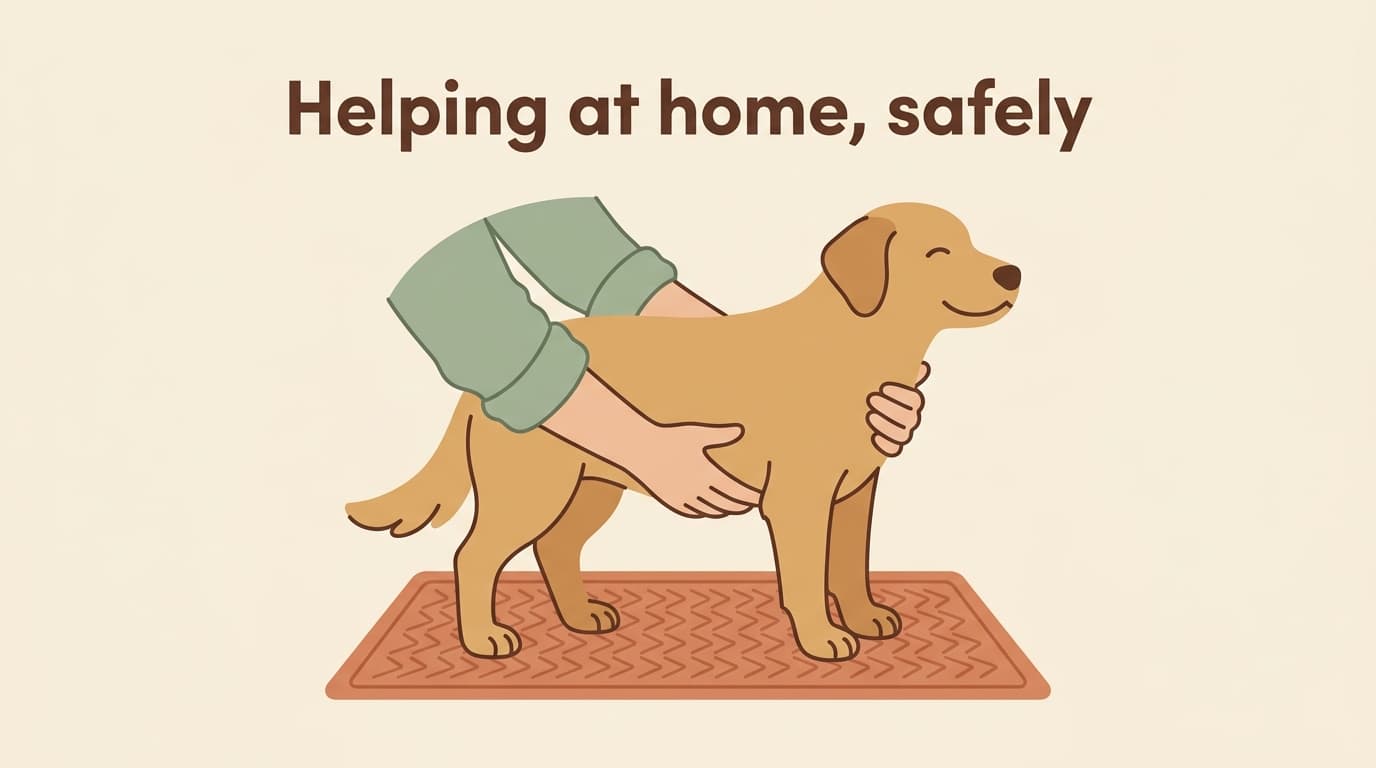
There is a great deal you can safely do at home to help a dog recover from a spinal injury, and most of it takes the form of gentle, guided physiotherapy that supports recovery and keeps the body in good condition. The crucial words are "safely" and "guided", because the wrong exercise at the wrong time, or a movement done carelessly, can genuinely set a recovery back. So this guide walks through the kinds of home physiotherapy used at each phase, always within a framework of doing it correctly and only with your vet's and physiotherapist's blessing. Used well, little-and-often home work is one of the most rewarding parts of helping your dog back to its best.
Approval first, always
Before a single exercise, here is the rule that governs everything in this article: every exercise described here is only safe with the specific approval of your vet or qualified veterinary physiotherapist, for your individual dog, at the right point in its recovery. This is not a box-ticking caution, it genuinely matters. What is helpful for one dog at one stage can be harmful for another, or for the same dog a fortnight earlier, and a recovering spine is not something to experiment on. So please treat what follows as an explanation of the kinds of thing that home physiotherapy involves, so you understand the programme your professionals design, and not as a menu to start working through on your own. The right exercises, in the right order, at the right intensity, come from your rehab team, who have assessed your dog. When in doubt, do less, or nothing, and ask. With that firmly established, here is what home physio looks like as it progresses.
It is worth being realistic about what this achieves, so expectations stay grounded: guided home physiotherapy supports your dog's recovery, keeps muscle and joints in condition, prevents secondary problems, and helps coordination return, and it is genuinely worthwhile for those reasons. The evidence does not show that it speeds the return of walking or changes the underlying odds, so we will not claim that, but maintaining the body and supporting the process well is a real and valuable thing.
Phase 1: passive work
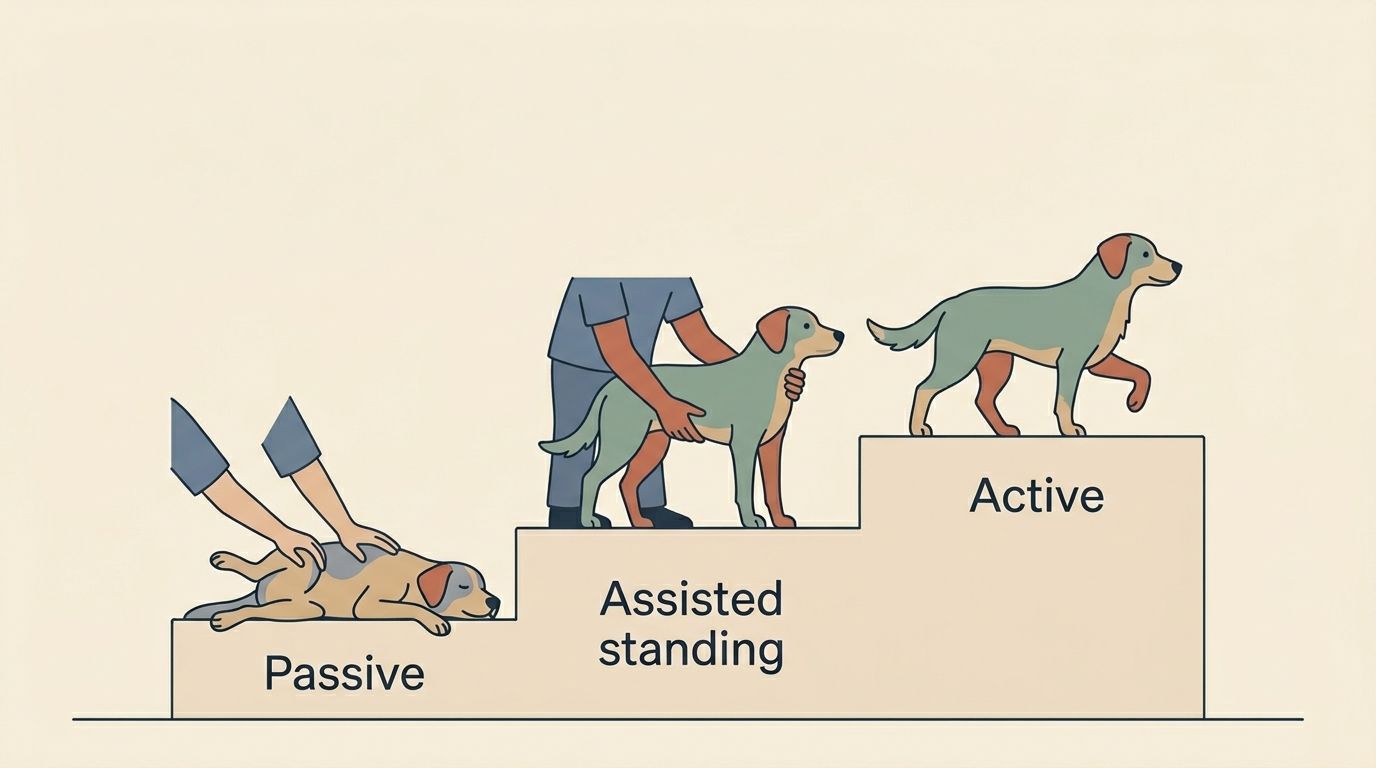
In the earliest phase, while your dog is still largely rested and may not be able to move much itself, home physiotherapy is limited to gentle, passive measures, things done to the dog rather than movements the dog makes, that keep the body ticking over without disturbing the healing spine.
The mainstays here are passive range-of-motion exercises, in which you gently and slowly flex and extend the joints of the legs through their comfortable range, without forcing, to keep the joints mobile and discourage stiffness while the dog cannot exercise them itself. Alongside this, gentle massage can help maintain circulation, ease muscle tension, and provide comfort and human contact. And supported, careful position changes, the turning and repositioning that are part of nursing a down dog, double as gentle physical care. The point of this phase is maintenance, not progress: keeping joints supple and muscles from seizing while the real healing happens through rest. Your physiotherapist will show you exactly how to perform passive range-of-motion correctly, because the technique, the gentleness, and the limits matter, and it should never cause pain.
Phase 2: assisted weight-bearing
As your dog begins to recover and your team judges it ready, the work moves to helping the dog bear its own weight again, with support. This is where you start to help the dog do things rather than simply moving its limbs for it.
The exercises here centre on supported standing, holding your dog up, often with a sling under the belly, so that it can bear some weight through its legs without having to balance or hold itself up entirely. From supported standing come gentle weight shifts, encouraging the dog to feel and take weight through different legs, and sling-assisted balance work, all of which begin to wake up the muscles and the coordination needed for standing and, eventually, walking. The common theme is support: the dog is doing some of the work, but you and the equipment are taking enough of the load that it is safe and not a struggle. This phase rebuilds the basic ability to stand and bear weight, which is the foundation everything else is built on, and again your physiotherapist will show you how to support your dog correctly so that you help without hindering, and without hurting your own back.
Phase 3: active strengthening
Once your dog can bear weight and is moving more, and only when your team confirms it is ready, the work becomes about actively rebuilding strength and coordination through controlled exercise. This is the most active phase, and also the one where it is easiest to overdo things, so the guidance becomes especially important.
Exercises at this stage are about challenging the dog's strength and balance in controlled ways: proprioceptive and stepping work that helps the dog relearn where its feet are and how to place them, short and controlled slow lead walks rather than free running, gentle inclines to build strength, stepping slowly over a series of low poles laid on the ground (often called cavaletti work) to encourage deliberate foot placement, and sit-to-stand repetitions to build the back-leg and core strength used in rising and walking. The key word throughout is controlled: these are deliberate, measured exercises done in short sessions, not a return to normal activity, and they progress gradually as your dog gets stronger, with your physiotherapist guiding when and how to step things up. Done well, this phase turns the basic ability to stand into real, functional strength and coordination.
Doing it safely
Across all the phases, a handful of safety principles keep home physiotherapy genuinely helpful rather than risky, and they are worth holding in mind every single session. Keep sessions short and frequent rather than long and tiring, because little and often is both safer and more effective than occasional marathon efforts. Stop at the first sign of fatigue or any sign of pain, never pushing a tired or sore dog to do more. Work on non-slip surfaces always, so your dog cannot slip and wrench itself, as our home-adaptation guide describes. Never force a limb or a movement, everything is gentle and within the comfortable range. And stay within the phase your team has set, resisting the temptation to skip ahead because your dog seems to be doing well. If anything worries you, a movement that causes a yelp, a setback, a reluctance that wasn't there before, stop and check with your vet, and our guide to recovery red flags covers the signs that warrant a call.
So the shape of it is simple even if the detail is guided: home physiotherapy progresses from gentle passive movement, through assisted weight-bearing, to active strengthening, always little and often, always within the rest rules, and always, always on the say-so of your vet or physiotherapist, who design the programme for your individual dog. Use our home-physio cards to keep the approved exercises and their technique to hand, but let your rehab team lead, because the safety and the timing are everything.
References
- Zidan N, Sims C, Fenn J, Williams K, Griffith E, Early PJ, Mariani CL, Munana KR, Guevar J, Olby NJ. A randomized, blinded, prospective clinical trial of postoperative rehabilitation in dogs after surgical decompression of acute thoracolumbar intervertebral disc herniation. Journal of Veterinary Internal Medicine, 2018;32(3):1133-1144.
- Lewis MJ, Granger N, Jeffery ND, The Canine Spinal Cord Injury Consortium (CANSORT-SCI). Emerging and Adjunctive Therapies for Spinal Cord Injury Following Acute Canine Intervertebral Disc Herniation. Frontiers in Veterinary Science, 2020;7:579933.
Sister tool · Sightline
Track whether treatment is working
Sightline, a separate ConciergeVet tool, runs a short weekly check-in built on validated pain and mobility instruments, turns it into a single Sightline Score you can watch trend over weeks rather than judge on one bad day, and produces a report you can bring to your vet.
A written log, or our printable trackers, does much the same job.
See how Sightline tracks treatmentTrack the recovery, day by day
Recovery from a disc injury is all about the trend. Log the daily milestones through crate rest and rehab so you can see real progress, not just good and bad days.
Open the Recovery TrackerYou're not doing this alone
Compare treatment journeys and talk to owners managing IVDD. Free to join.
Join PetsLikeMine