

Re-teaching Your Dog to Walk
Alastair Greenway
BVM&S MRCVS
Few moments in a spinal recovery move owners the way the first wobbly, lurching step does after weeks of a dog not walking. Your dog may be beginning to recover genuine movement, or it may be working, in a different way, towards the reflex-driven gait some paralysed dogs develop. Either way, supporting those first steps is both a practical task and an emotional one. This guide is about helping your dog re-learn to walk: how to support the early attempts, the aids that help, a clear explanation of "spinal walking" for dogs that have lost deep pain, and the patience that the whole process asks of you. It is a hopeful subject, and rightly so, but a truthful one too.
From standing to stepping
Re-learning to walk builds directly on the standing and weight-bearing work covered in our home-physiotherapy guide, and follows naturally from it once your dog can support some of its own weight. The progression, always guided by your rehab team, moves from supported standing, to weight-shifting, to assisted stepping, to those first independent steps.
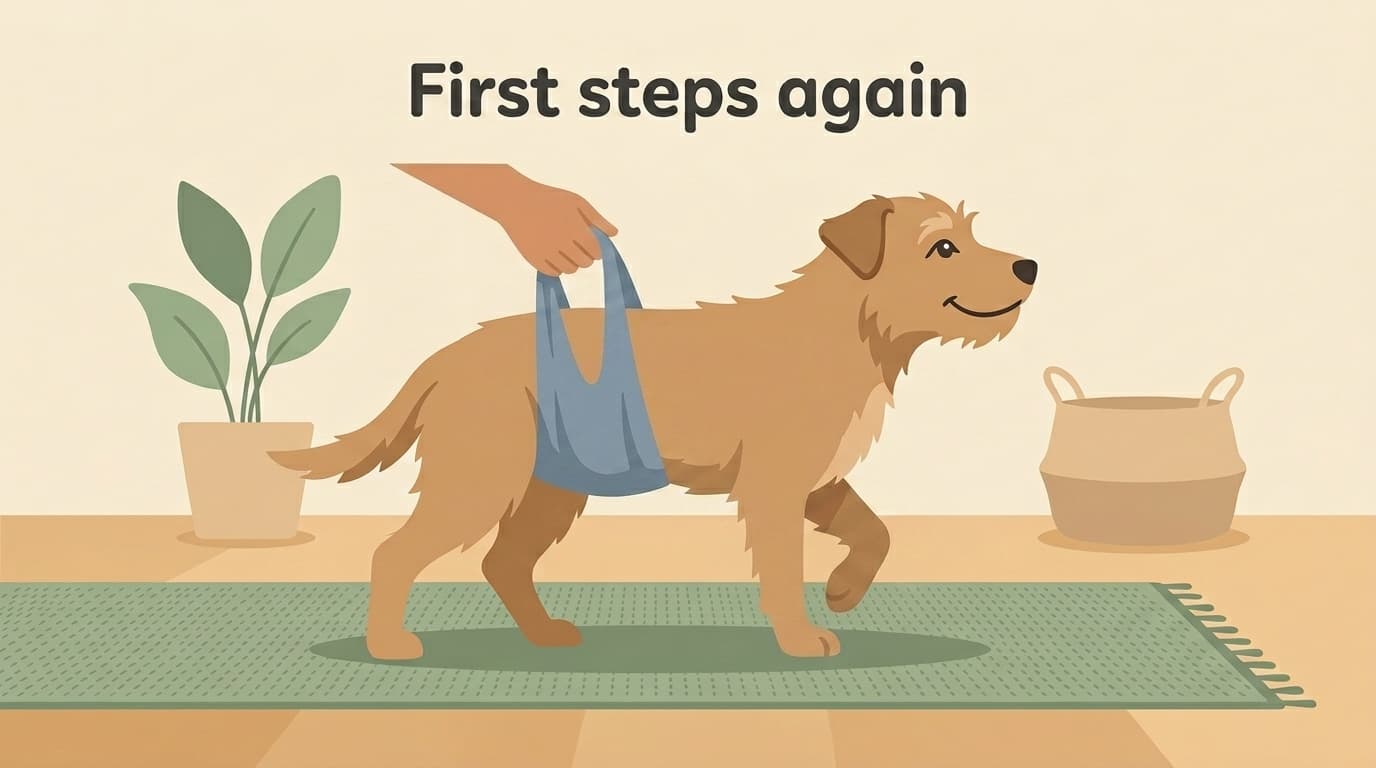
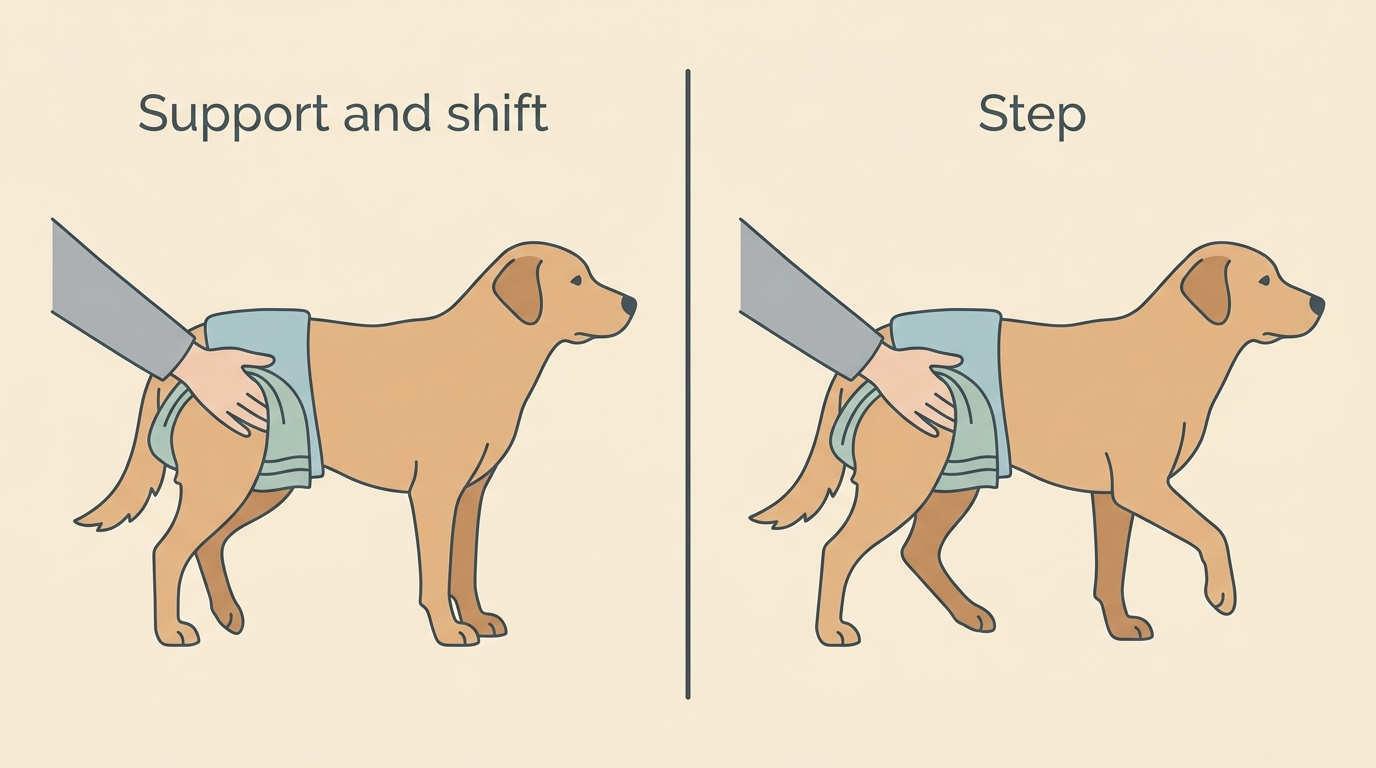
In practice, helping a dog step again means supporting its weight, often with a sling under the belly, so that it can concentrate on moving its legs rather than on holding itself up, and then encouraging and assisting the stepping motion. Gentle weight-shifting helps the dog feel and trust its legs, and proprioceptive cues, helping the dog become aware of where its feet are and how to place them, are a big part of relearning coordinated movement. The work is supported, patient, and built up gradually, the dog doing a little more of it itself as strength and coordination return. Your physiotherapist will guide exactly how much to support and how to encourage the stepping, because the balance of help, enough to make it possible, not so much that the dog does nothing, is something they judge for your individual dog. These supported steps are how the basic machinery of walking is coaxed back into action.
Aids that help
Several practical aids make re-teaching walking safer and more effective, and they are worth knowing about. Slings and support harnesses, as above, let you take some of your dog's weight so it can practise stepping, and there are well-designed versions for exactly this purpose. Non-slip flooring is genuinely important, as our home-adaptation guide explains, because a dog relearning to walk needs grip and the confidence that its feet will not skid out from under it; practising on a runner or mat rather than a slick floor makes a real difference. Toe-grips and similar aids can help some dogs gain traction.
And then there is the wheelchair, which deserves a word here because owners often see it as a sign of defeat, the opposite of learning to walk. It is not. For many dogs a wheelchair is actually an aid to rehabilitation, not a replacement for it: getting a dog upright, mobile, and exercising in a cart maintains its muscle, keeps it active and engaged, and can support the very recovery that might, in time, reduce its need for the cart. So a wheelchair can be part of re-teaching movement rather than an admission that walking will not return, and our guide to life on wheels covers it fully. Used alongside the supported stepping work, these aids let your dog practise and stay mobile while its strength and coordination rebuild.
What "spinal walking" really means
For dogs that have lost deep pain perception, the most severely affected, there is a particular and genuinely hopeful possibility that deserves a clear explanation: spinal walking. This is a reflex-driven way of walking that some paralysed dogs develop over time, in which the spinal cord below the injury, working on its own local reflexes without a restored connection to the brain, generates enough of a stepping pattern that the dog can move itself about. It is not the same as a normal recovery, the dog has not regained conscious control or sensation, but it can give a dog a real, functional, independent way of getting around.
Two candid points about it matter. First, it is not quick and it is not guaranteed: in one study of paraplegic dogs that had lost deep pain, around fifty-nine percent developed spinal walking, but it took a median of around two and a half months, and sometimes considerably longer, of dedicated rehabilitation work, with smaller and younger dogs more likely to achieve it. So it asks for months of patient effort with no certainty of the outcome. Second, it is a genuine good, not a consolation prize: a dog walking by reflex, in its own fashion, can have a thoroughly happy and mobile life. Understanding that spinal walking exists, and is a real possibility for a proportion of even the most affected dogs, can transform how a deep-pain-negative diagnosis feels, from the end of mobility to a long but hopeful road. Your rehab team will guide the dedicated work it takes, and our guides on deep pain and on the permanently affected dog give the wider picture.
Why progress comes in fits and starts
Whatever route your dog is on, towards normal walking, towards spinal walking, or towards a good life on wheels, the single most important thing to know is that progress is not a straight line. Recovery comes in fits and starts: a sudden good day, then a plateau where nothing seems to change for a fortnight, then another small leap forward. Those plateaus are normal and are not a sign that recovery has stopped, so try not to be disheartened by them. The work is to keep going steadily, to celebrate the small wins, the first time a paw is placed deliberately, the first unaided second of standing, the first shaky step, because those small milestones are the real markers of progress, and to take the long view. Your rehab team can help you read where your dog is and what to expect next, and our recovery tracker lets you log the small gains so you can see, over weeks, the progress that is easy to miss day to day.
So, whether your dog's goal is a full return to walking, a reflex-driven spinal walk, or a happy active life in a cart, the path is the same in spirit: steady, supported, patient practice, guided by your rehab team, that coaxes your dog toward the best possible function it can reach. Those first steps, in whatever form they come, are worth every bit of the patience they take, and many dogs travel further than their owners dared hope at the start.
References
Sister tool · Sightline
Track whether treatment is working
Sightline, a separate ConciergeVet tool, runs a short weekly check-in built on validated pain and mobility instruments, turns it into a single Sightline Score you can watch trend over weeks rather than judge on one bad day, and produces a report you can bring to your vet.
A written log, or our printable trackers, does much the same job.
See how Sightline tracks treatmentTrack the recovery, day by day
Recovery from a disc injury is all about the trend. Log the daily milestones through crate rest and rehab so you can see real progress, not just good and bad days.
Open the Recovery TrackerYou're not doing this alone
Compare treatment journeys and talk to owners managing IVDD. Free to join.
Join PetsLikeMine