

IVDD Grades 1 to 5: What Your Dog's Grade Actually Means
Alastair Greenway
BVM&S MRCVS
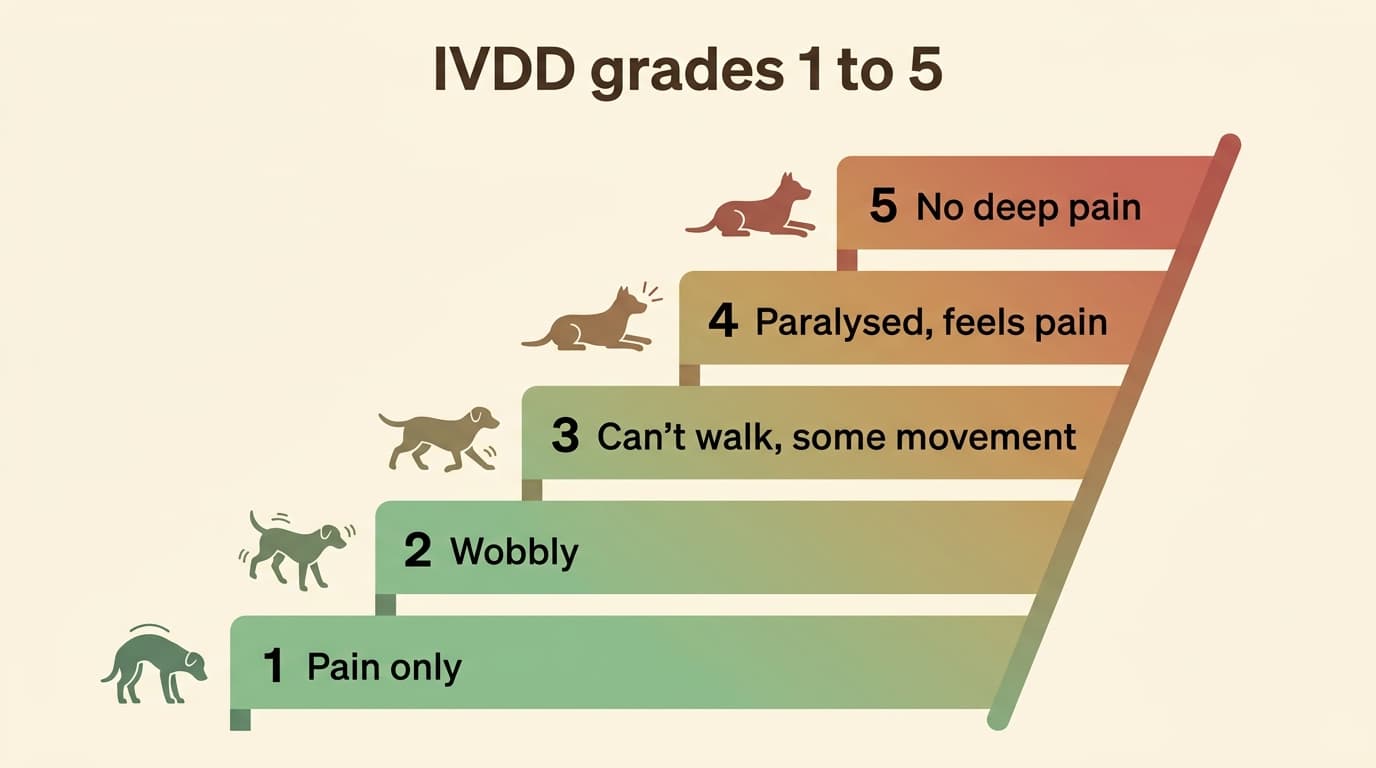
The grade is the single most important number in this whole condition, and your vet or a neurologist has just handed you one. If "grade 5" was the word in the room, that lands hard, because it sounds like the worst end of a scale. What you actually want to know is plainer than that: can your dog walk, will they wee normally again, do they need surgery, and what are the odds. This guide translates the IVDD grades into plain English, with the real recovery figures attached. The grade is the strongest predictor vets have of whether your dog will walk again, and it drives the choice between rest and surgery, so understanding it is the foundation for every decision that follows.
One reassurance before we begin: a grade is a snapshot of how your dog is right now, not a fixed sentence. Grades can improve with treatment, the early grades in particular do very well, and even the worst grade is not automatically hopeless. So let us go through them calmly, one at a time, with the numbers, and see where your dog sits.
Why the grade carries so much weight
In intervertebral disc disease, a herniated disc presses on or strikes the spinal cord, and the grade describes how severely that has affected the nerves, judged by what your dog can and cannot do. That makes it far more than a label. Of all the things a vet can assess, the grade, and within it one specific feature called deep pain, is the most important prognostic indicator there is, the factor that best predicts recovery. It is also the number your vet uses to decide whether rest or surgery is the wiser path. Almost everything else in the IVDD story hangs off it, which is why your vet reaches for it first, and why it is worth your understanding it properly rather than just fearing the high end.
It helps to know where the scale comes from. The system most vets use is a version of what is called the modified Frankel scale, adapted for dogs from a human spinal-injury scale, and it runs from the mildest cases at grade 1 to the most severe at grade 5. You may occasionally meet a clinic that numbers things slightly differently, or even reverses the scale, which we come back to, but the five-grade version below is the common one, and the principle behind it never changes: the more, and the more severe, the signs, the more serious the situation.
The five grades, one at a time
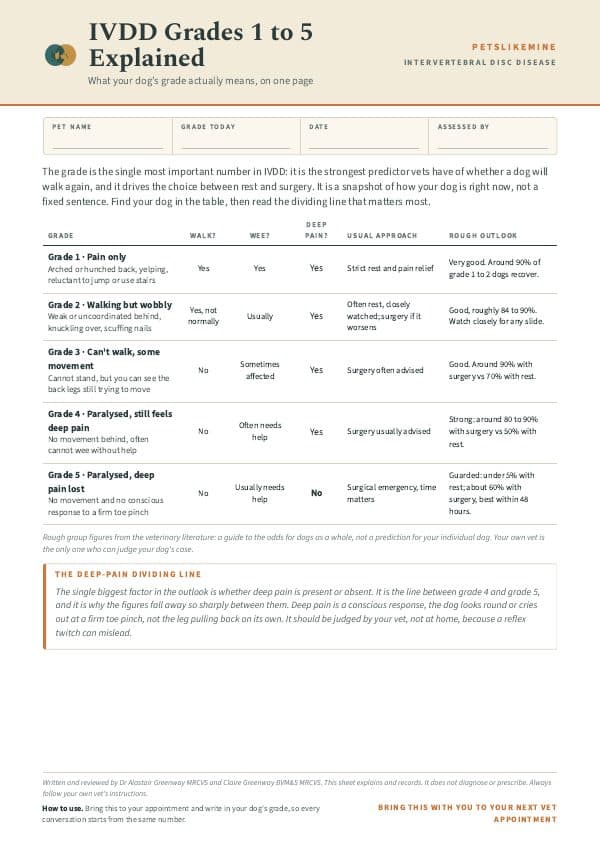
For each grade below I have set out the same things in the same order, so you can find your dog and compare: what you would typically see, whether they can walk, whether they can wee, whether deep pain is present, the usual approach, and the rough recovery figures. Those figures are drawn from the veterinary literature and describe groups of dogs, so they are a guide to the odds, not a prediction for your individual dog, whose own vet is the only one who can judge their particular case.
Grade 1: pain only
What you would see: a dog in pain but otherwise moving normally, often with an arched or hunched back, yelping or crying out, reluctant to jump or use stairs, perhaps tense and unwilling to be touched along the back. Can they walk? Yes, normally. Can they wee? Yes. Is deep pain present? Yes. Usual approach: usually managed conservatively, with strict rest and pain relief. Rough outlook: very good. Around ninety percent of grade 1 and 2 dogs recover, with either medical or surgical management, and studies of conservatively managed grade 1 dogs have reported essentially all of them recovering. The one caveat, which matters for what you do next, is that recovery does not mean immunity: among ambulatory dogs treated with rest and anti-inflammatories, roughly half went on to have a recurrence at some point. So grade 1 is the mildest grade and the outlook is excellent, but the pain is a genuine warning that needs proper rest, not pushing through, and not a one-off to forget once it settles.
Grade 2: walking but wobbly
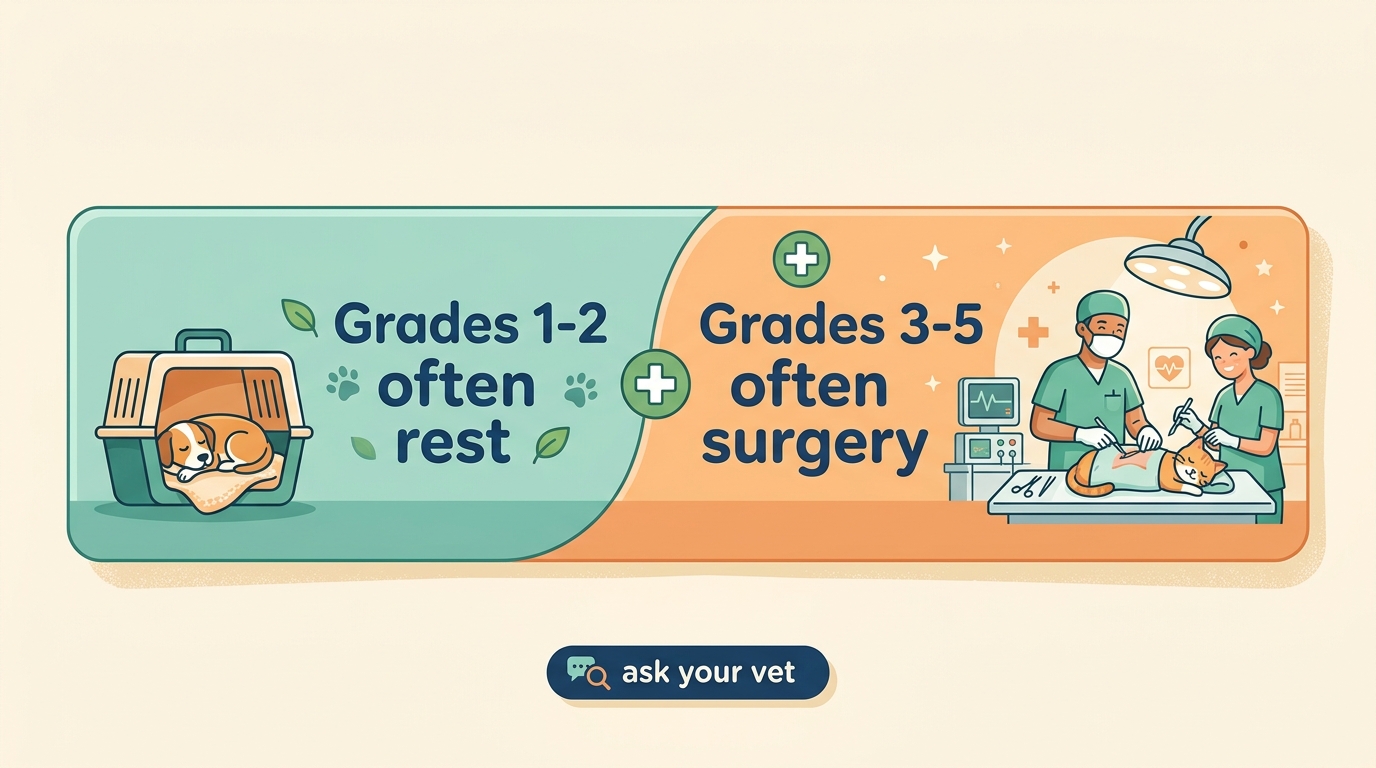
What you would see: a dog still on its feet but visibly affected, walking but weak, wobbly or uncoordinated in the back legs, knuckling over onto the tops of the paws, or scuffing the nails. Can they walk? Yes, but not normally. Can they wee? Usually yes. Is deep pain present? Yes. Usual approach: often conservative, with strict rest and pain relief, closely monitored, though more severe or non-improving cases may be considered for surgery. Rough outlook: generally good, in the same roughly ninety percent range as grade 1 with appropriate treatment, although conservatively managed series have reported figures a little lower, around eighty-four percent in one study of grade 2 dogs. The key thing at grade 2 is vigilance, because a wobbly dog can deteriorate, so it needs watching closely for any worsening, which is itself a reason to seek surgical advice promptly.
Grade 3: can't walk, but some movement remains
What you would see: a dog that can no longer walk properly, non-ambulatory, but that still has some voluntary movement in the back legs, you can see them trying to move the legs even though they cannot stand or bear weight. Can they walk? No. Can they wee? Sometimes affected. Is deep pain present? Yes. Usual approach: surgery is often advised, though conservative management is sometimes chosen depending on circumstances. Rough outlook: good, and this is the grade where surgery starts to pull clearly ahead of rest. Reported recovery is around ninety percent with surgery versus around seventy percent with medical management. Grade 3 is the point at which the conversation often turns toward surgery, and given that gap it is worth having that conversation quickly.
Grade 4: paralysed, but still feels deep pain
What you would see: paraplegia, no voluntary movement in the back legs at all, and the dog is frequently unable to wee on its own and may need its bladder managed. Can they walk? No. Can they wee? Often not without help. Is deep pain present? Yes, and this is the crucial feature of grade 4. Usual approach: surgery is usually advised. Rough outlook: strong, because the preserved deep pain is a very good sign. With surgery, around eighty to ninety percent of these dogs recover, against roughly fifty percent with medical management, so the gap between the two paths is now wide. Putting grades 3 and 4 together, studies of non-ambulatory but deep-pain-positive dogs treated surgically have found very high recovery, in the region of eighty-six to ninety-six percent walking again, typically within about two weeks, although a minority, around seventeen percent in one series, were left with some lasting wobbliness or pain. Grade 4 looks frightening because the legs are not moving, but the deep pain tells a genuinely hopeful story, especially with surgery.
Grade 5: paralysed, with loss of deep pain
What you would see: paraplegia as in grade 4, but with the additional, critical feature that deep pain perception is absent. Can they walk? No. Can they wee? Usually not without help. Is deep pain present? No, and this is what defines grade 5. Usual approach: a surgical emergency in which time matters enormously. Rough outlook: this is the most serious grade and the figures are more guarded, so I will give them straight. With medical management alone, fewer than five percent of grade 5 dogs recover. With surgery the outlook is far better but time-dependent: operating within roughly forty-eight hours of the signs starting has carried around a sixty percent chance of recovery in the reported series, and overall, across all timings, recovery after surgery for deep-pain-negative dogs averages around sixty percent, with published figures ranging from about thirty to seventy-five percent.
Two further things about grade 5 deserve a straight word, one hopeful and one hard. The hopeful one is "spinal walking": even some dogs that never regain deep pain can, over months and with dedicated physiotherapy, develop a reflex-driven gait that lets them walk in a fashion of their own, so a grade 5 dog that does not recover normal sensation is still not necessarily a dog that will never walk. Indeed, rehabilitation makes a striking difference to these dogs as a group: with dedicated physiotherapy a markedly higher proportion reach a walking status and far fewer are put to sleep for their neurological state. The hard one is a rare but serious complication called progressive myelomalacia, in which the spinal cord tissue begins to break down and the damage spreads along the cord; it affects roughly one in ten dogs that are paralysed with loss of deep pain, usually comes on within the first few days, and is sadly almost always fatal. Your vet will watch for it. I mention it not to frighten you but because a complete picture of grade 5 includes both the real hope and the real risk, and your vet will talk you through both for your own dog. The headline remains: grade 5 is grave and urgent, it deserves the fastest possible action, but it is not a foregone conclusion.
The deep-pain dividing line
The single biggest factor in your dog's outlook is whether deep pain perception is present or absent. It is the line that separates grade 4 from grade 5, and it explains why the recovery figures fall away so sharply between them.
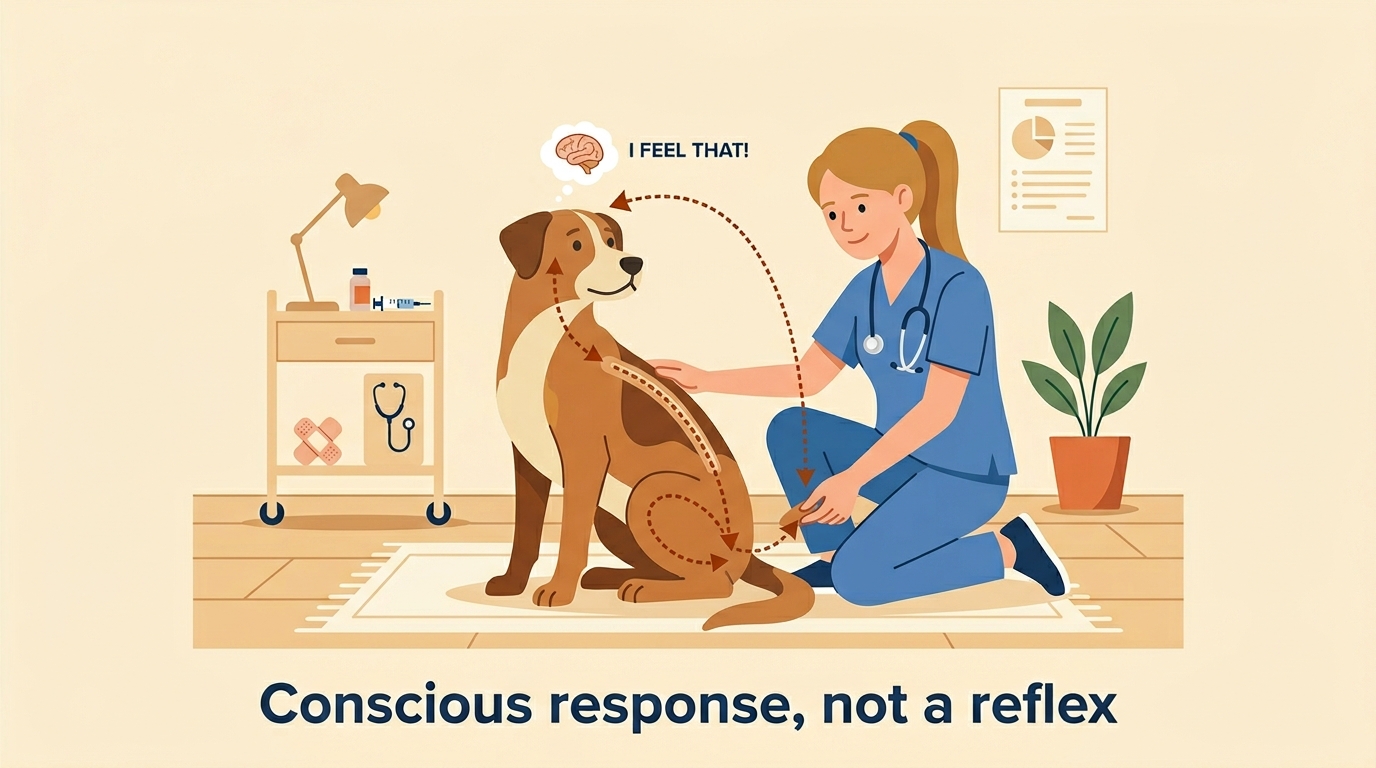
Deep pain perception needs explaining carefully, because it is easy to misunderstand and the distinction is genuinely important. Deep pain is a conscious response to a firm pinch of a toe, the dog turns its head, cries out, or looks round at you, showing that the sensation is reaching the brain. It is emphatically not the reflex twitch where the leg pulls back on its own, because that withdrawal can happen through the spinal cord alone, with no message getting through to the brain, even in a dog that has completely lost deep pain. This is exactly why deep pain should be assessed by your vet, not judged at home from a leg that flinches, since a pulling-back leg can give false reassurance. We cover this test in full in our dedicated article on deep pain, because getting it right is so important. The reason it matters so much is the very thing the grade figures show: a dog that still feels deep pain has a far better outlook than one that does not, which is why your vet checks it so carefully and why it sits at the heart of the grading.
A note on scheme variation
You may come across slightly different versions of the grading scale, and that is nothing to worry about. Veterinary modified-Frankel systems have been published with anywhere between three and six grades, some split the assessment of sensation into superficial and deep, some place bladder involvement at a different point, and a few clinics abroad even number the scale in reverse. So the exact phrasing your vet uses might not match another source to the letter. None of that changes the substance. Whichever version is used, the same principle runs through all of them: more signs, and more severe ones, mean a more serious situation, with pain-only at the mild end and loss of deep pain at the severe end. If the numbers seem to differ slightly between what your vet says and what you read elsewhere, trust your vet's assessment of your individual dog, and hold onto the principle rather than the precise wording.
Neck disease reads a little differently
Most IVDD affects the middle of the back, the thoracolumbar spine, and the grades above describe that picture. Disc disease in the neck, the cervical spine, reads somewhat differently. Neck IVDD tends to be dominated by pain, often severe, and because the affected part of the spinal cord is higher up, it can affect all four limbs rather than just the back legs, sometimes causing wobbliness or weakness in front and back alike. A dog with neck disease often holds its head low and stiff and is very reluctant to lift or turn it. It is also worth knowing that, perhaps counter-intuitively, neck disease as a whole tends to respond less well to conservative management than thoracolumbar disease does, which is one reason a neck problem warrants prompt veterinary advice. The same broad logic of severity still applies, but the signs map onto the body differently, so do not be thrown if a neck problem does not look like the back-leg picture above.
Grades change, and ascending signs are a red flag
A grade is a snapshot of a moving situation, not a permanent verdict, and dogs move between grades in both directions. Many improve with the right treatment, climbing back toward normal, which is the hopeful side. But dogs can also deteriorate, slipping to a more severe grade as the disc problem progresses, and this is why your vet wants to recheck and monitor rather than assess once and walk away.
There is one pattern that is a genuine red flag and that you must act on without delay: ascending signs, where the problems seem to be creeping forward up the body, for example weakness that started in the back legs beginning to affect the trunk or the front, or a dog that is rapidly getting worse rather than holding steady. This can be a sign of a serious, rapidly progressing problem, including the myelomalacia mentioned earlier, so if you ever see signs spreading or a fast deterioration, treat it as an emergency and get straight back to your vet. Our guide to the IVDD red flags that mean act now sets out exactly what to watch for and when a same-day or out-of-hours call is warranted. As a general rule throughout IVDD: if in any doubt, treat it as an emergency.
So, where does your dog sit? If you are trying to gauge their likely grade and what to do next, our IVDD triage and grade checker walks you through it step by step and points you to the right action. Once you have a sense of the grade, our article on deciding between surgery and conservative treatment weighs the path ahead in detail, with these same figures laid out side by side, and our guide to strict crate rest covers how to do the resting properly if that is your route. The grade is the foundation, but it is the start of a plan, not the whole story, and as the numbers above show, even the frightening grades carry more hope than that first scary figure suggests, especially when you act quickly and follow through on the care.
References
- Olby NJ, Moore SA, Brisson B, Fenn J, Flegel T, Kortz G, Lewis M, Tipold A. ACVIM consensus statement on diagnosis and management of acute canine thoracolumbar intervertebral disc extrusion. Journal of Veterinary Internal Medicine, 2022;36(5):1570-1596.
- Jeffery ND, Barker AK, Hu HZ, Alcott CJ, Kraus KH, Scanlin EM, Granger N, Levine JM. Factors associated with recovery from paraplegia in dogs with loss of pain perception in the pelvic limbs following intervertebral disk herniation. Journal of the American Veterinary Medical Association, 2016;248(4):386-394.
- Pancotto T. Saved from the sidelines: conservative management of intervertebral disk disease. dvm360, 2013.
- Pancotto T. Making the cut: surgical versus medical management of canine disk disease. dvm360, 2013.
- Ferreira AJ, Correia JH, Jaggy A. Thoracolumbar disc disease in 71 paraplegic dogs: influence of rate of onset and duration of clinical signs on treatment results. Journal of Small Animal Practice, 2002;43(4):158-163.
- Henea ME, Sindilar EV, Burtan LC, Mihai I, Grecu M, Anton A, Solcan G. Recovery of spinal walking in paraplegic dogs using physiotherapy and supportive devices to maintain the standing position. Animals, 2023;13(8):1398.
Free downloads
Companion worksheets to put what you've read into practice. Free PDFs, print at home.
Sister tool · Sightline
Track whether treatment is working
Sightline, a separate ConciergeVet tool, runs a short weekly check-in built on validated pain and mobility instruments, turns it into a single Sightline Score you can watch trend over weeks rather than judge on one bad day, and produces a report you can bring to your vet.
A written log, or our printable trackers, does much the same job.
See how Sightline tracks treatmentTrack the recovery, day by day
Recovery from a disc injury is all about the trend. Log the daily milestones through crate rest and rehab so you can see real progress, not just good and bad days.
Open the Recovery TrackerYou're not doing this alone
Compare treatment journeys and talk to owners managing IVDD. Free to join.
Join PetsLikeMine