

Epilepsy
Recurrent seizures with no identifiable underlying cause.
2
Pets tracked
37
Expert guides
12
Members
Expert guides
What a Seizure Actually Looks Like
Something happened to your dog or cat. It lasted seconds, or a couple of minutes, and it frightened the life out of you. Maybe they collapsed and went rigid. Maybe they just stared through you, or their face twitched, or they snapped at something that was not there. And now you are trying to answer...
What Seizures Look Like in Cats
Cats rarely seize the way we expect them to. Most of us picture the dramatic version: collapse, stiff legs, paddling, the whole body taken over. That happens in cats too, but a great many feline seizures are quieter and stranger, so easily mistaken for odd behaviour that owners often don't realise they've witnessed one. A...
How (and Why) to Film a Seizure for Your Vet
The single most useful thing you can bring your vet about your dog's seizures is a video you took on your phone. Not a careful description, not a researched symptom list, not even the timeline you pieced together at three in the morning. A clear recording of the event itself.
The Hours Afterwards: Understanding the Post-Ictal Phase
The seizure is over. The jerking has stopped and your dog is breathing again, and then comes the part nobody warned you about. They stagger into the furniture, stare through you as if they have never met you, pace the same loop of the kitchen or bump into walls as though the lights have gone...
Is This an Emergency? Status Epilepticus and Cluster Seizures
You need an answer now, not a lecture, so here it is.
Seizure First Aid: What to Do and What Not to Do
Phone in one hand, dog or cat seizing on the floor in front of you: start here and read the rest later. Stay calm. Don't touch their mouth. Move hard objects out of the way. Note the time. Don't hold them still. Most single seizures stop on their own within a couple of minutes, and...
What Causes Seizures in Cats
When a cat has a seizure, the first question an owner asks is why, and in cats the answer matters more than most people realise. In dogs, the most likely explanation by a wide margin is idiopathic epilepsy, a seizure disorder with no findable cause. Cats are different. A feline seizure is more often the...
When Your Vet Refers You to a Neurologist
The word "referral" lands hard. A voice at the back of your mind says it must be serious, or your own vet wouldn't be passing you up the chain. In epilepsy, that voice is usually wrong.
Idiopathic Epilepsy: Breeds, Genetics and Age of Onset
Two questions come up again and again once a dog is diagnosed with idiopathic epilepsy. "Did we cause this?" And, with the breeder's paperwork in hand, "Will the rest of the litter get it too?" Both are fair, and both deserve straight answers rather than reassuring fog, whether your own dog has just been diagnosed...
The Diagnostic Workup: Bloods, MRI, CSF and What It Costs
A seizure, or a handful of them, tends to be followed by a list of tests. Bloods, maybe blood pressure, possibly an MRI under anaesthetic with a price tag that makes your stomach drop. You want to do right by your dog, but you also want to know what's genuinely necessary, what each test actually...
Reactive, Structural and Idiopathic Seizures Explained
A seizure sends most owners home with one word ringing in their head: why. Why my pet, why now, and is this something that can be fixed or something we have to live with?
Why Epilepsy Is a "Diagnosis of Exclusion"
Your dog has had a seizure, maybe more than one. You've been to the vet, perhaps had blood taken, perhaps been quoted for an MRI. Then the verdict comes back: "the tests are all normal, it's most likely epilepsy." And the obvious question lands: how can anyone know what's wrong if nothing showed up? It's...
Realistic Goals: Control, Not Cure
A few months into treatment, a particular kind of disappointment turns up in the consulting room, and it almost always comes from the same place. The owner started their dog on medication expecting the seizures to stop. Just stop. So when one breaks through, even after months of calm, it lands like a failure: the...
The First Weeks on Medication: What to Expect
The tablets have started, and so has the question almost every owner asks in the first few days: is this working, or have we got it wrong? Your dog may be sleepy and a bit wobbly. They may have had another seizure since you began. Either way, doing something at last brings relief and worry...
Imepitoin (Pexion) Explained
Pexion is the brand name your vet has either just started your dog on or laid on the table as an option, and it tends to raise the same handful of questions. How is it different from phenobarbital, the drug everyone seems to mention first? Is it as good? Why no blood tests? And what...
Phenobarbital: What to Expect (and the Liver Question)
Type "phenobarbital" into a search bar the night your dog starts it, and within a few clicks you'll hit a forum thread insisting, in capital letters, that the drug "destroys the liver". It's worth knowing how little that headline reflects the real picture.
The Anti-Seizure Drugs Compared
Four drug names do most of the work in canine and feline epilepsy: phenobarbital, Pexion, bromide and Keppra. Once you and your vet agree it's time to treat, the question becomes which of them, and why that one rather than another. There's a lot of strong opinion attached to each name, so what this page...
When Should Treatment Start?
Your dog has had a seizure, maybe two. The bloods and the examination point towards epilepsy, and now the question on the table is whether to put a young, otherwise healthy animal on a tablet every twelve hours for life. It is one of the hardest conversations I have, and it usually lands at the...
Giving Medication Reliably (and Never Stopping Abruptly)
When a pet is diagnosed with epilepsy, the part nobody warns you about isn't the decision to medicate or the seizures themselves. It is the ordinary, relentless business of getting a tablet into an animal twice a day, every day, on roughly the same schedule, for the rest of their life, without missing so many...
When the First Drug Isn't Enough: Adding On vs Switching
A meaningful minority of dogs keep seizing after the first anti-seizure drug is started and given faithfully, and that is a normal point on this journey rather than a dead end. If you've done it all by the book, given the medicine religiously and sat through the blood tests, and the seizures haven't stopped, it's...
Managing Anti-Seizure Medication Side Effects
The seizures are settling, and yet the dog seems different. Sleepier. Wobblier. Suddenly ravenous, and draining the water bowl. A few weeks into treatment this is when a lot of owners come back to me quietly worried, and the question underneath is almost always the same: have we traded one problem for another?
Therapeutic Drug Monitoring: Why Your Vet Checks Blood Levels
A dog who has just started phenobarbital or potassium bromide usually goes home with a little timetable of blood tests attached. The dog seems perfectly fine, so the obvious question is what all those needles in the vein are actually for.
How Dose Titration Works
A medication has been started, and now your vet keeps talking about "adjusting the dose." You go back for a blood test, the dose changes, you go back again. Meanwhile your dog has had another seizure, and the question that nearly everyone asks at this point is a fair one: is this actually working, or...
Can a Dog With Epilepsy Live a Normal Life?
Of all the questions a new diagnosis raises, this is usually the one owners reach for first, sometimes the same night, with the dog asleep and looking utterly normal. Can he still have a good life? Will this take years off her? It sits underneath all the others, and you deserve a straight answer rather...
Routine, Exercise and Quality of Life
A new epilepsy diagnosis often brings a quiet fear in alongside it: that ordinary life is over, that the walks have to shrink, that you can never leave the house again. I understand where that comes from, but it isn't true, and living as though it were can cost your pet the very thing all...
The Cost of Epilepsy and How Insurance Works
Once the diagnosis lands and the panic of the first seizure fades, a more practical worry tends to follow: what is this going to cost us, for the rest of his life? It's a fair question, and an awkward one to ask out loud when your dog is the one who's unwell. So let me...
The Emotional Toll of Caring for a Pet With Epilepsy
When UK researchers sat down with owners living alongside canine epilepsy, the phrase they chose for the study came straight from those owners' own mouths: "We have a ticking time bomb" (Pergande et al., 2020). It captures the whole thing. The seizure itself is only part of what wears people down. The rest is the...
CBD for Dogs With Epilepsy: What the Evidence Actually Says
Spend any time in epilepsy forums and you'll meet the same two voices. One owner whose dog "hasn't seized since we started CBD." Someone underneath insisting "the drugs are poison, get him off them." Between those poles sits a real question that deserves a real answer, and that's what this page is for.
Diet and Epilepsy: The Evidence for MCT and Ketogenic Diets
Spend ten minutes online after a diagnosis and the diet claims find you: switch to grain-free and the seizures stop, a ketogenic diet cured someone's spaniel, some oil is "nature's anticonvulsant". It is a seductive idea, partly because it feels like something you can do today without a prescription, and partly because the human epilepsy...
Identifying and Managing Seizure Triggers
In the days after a seizure, most owners arrive at the same question, and they usually ask it quietly, half-afraid the answer points back at them. Was it the walk? The fireworks? The new food? Underneath sits a very human hope: find the thing that set it off, and you can stop it happening again.
Keeping a Seizure Diary (and Why It Changes Your Vet Visits)
Your vet will almost never see your dog have a seizure. By the time you reach the surgery the event is over, and what is left to go on is your account of it. So the single most important piece of evidence in your dog's diagnosis and treatment plan is not a blood test or...
New and Emerging Treatments, Realistically
Two appropriate medications in, the seizures are still coming, and the midnight search begins. That is the usual route to a page like this one, and the internet has plenty waiting at the other end: a device that stops seizures, a breakthrough drug, an oil that cured someone's dog completely. When you're frightened and watching...
Quality of Life and Difficult Decisions
There's a particular tiredness that comes with epilepsy, and it's hard to explain to anyone who hasn't lived it. Perhaps the gaps between seizures are getting shorter. Perhaps the drugs meant to help have left your dog flat and wobbly and not quite himself. Perhaps a question you can't say out loud has started to...
Your Status Epilepticus Emergency Plan
I've watched this play out more times than I'd like. A dog who has had seizures for a while has a bad one, a long one, and the owner who asked all the right questions at the calm consultations freezes. The out-of-hours number is somewhere in an email. The rescue medicine is in a drawer,...
Advanced and Add-On Treatment Options
By the time an owner reaches this point, the harder parts are usually behind them. Your dog has been on treatment for a while, the first add-on has been tried, and the seizures still keep coming. So let me be straight from the first paragraph: yes, there are more options, and many of them help....
Managing Cluster Seizures at Home: Rescue Medication
Cluster seizures have a cruelty of their own. The seizure in front of you is only half of it; the other half is knowing another may follow within hours, and waiting for it. If your vet has handed you a rescue kit, or has started talking about one, this article turns that waiting into a...
Drug-Resistant (Refractory) Epilepsy Explained
You give the tablets on time. You've sat through the blood tests, watched the dose creep up, and still, every few weeks, your dog goes down again. Then a vet uses a word that sounds like a door closing: refractory. Drug-resistant. And underneath every other worry sits the frightening one: have we run out of...
Breeds prone to Epilepsy
Epilepsy is seen more often in some breeds than others. If you have one of these, its breed guide covers what to watch for and where to get help.
Free epilepsy downloads
Vet-built worksheets and trackers. Print at home, no signup required.
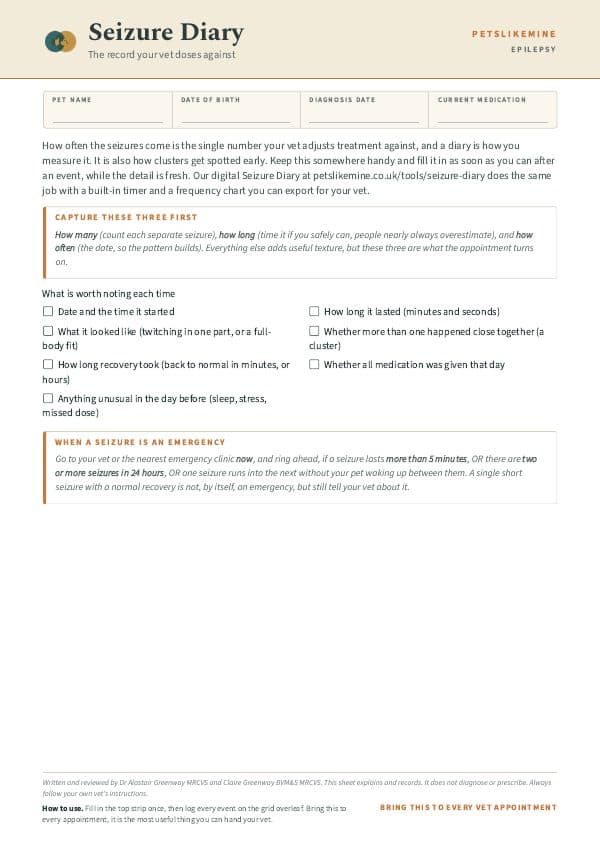
Seizure Diary
PDF · 236 KBThe record your vet doses against. Log every seizure: when it happened, how long it lasted, whether it came in a cluster, and how recovery went. Frequency is the number treatment is adjusted against, so a good diary is the single most useful thing you can bring to an appointment.

Seizure First-Aid Card
PDF · 179 KBWhat to do, and what not to do, during a seizure, on one fridge-ready card. The calm steps that keep your pet safe, the things to avoid (hands away from the mouth), and the clear line for when a seizure becomes an emergency.
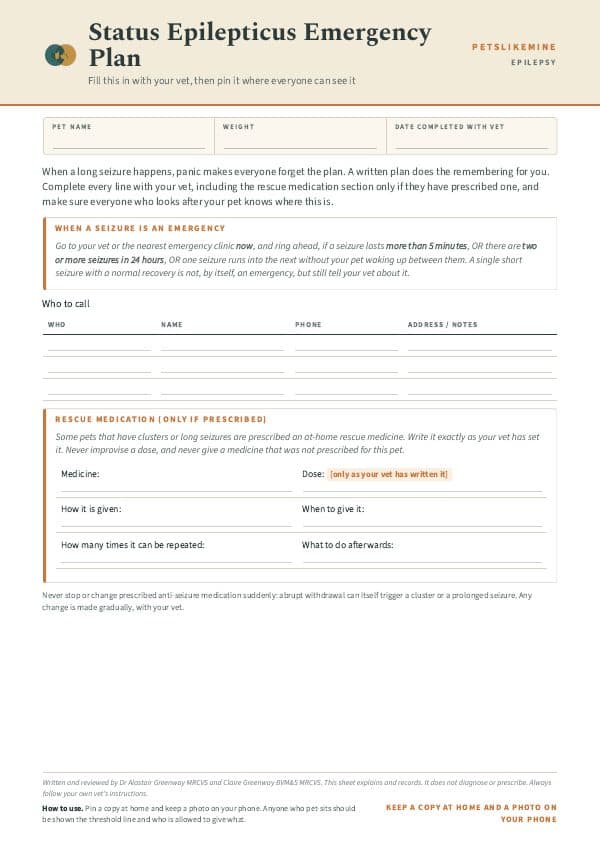
Status Epilepticus Emergency Plan
PDF · 224 KBA one-page plan to complete with your vet and pin up at home. The emergency thresholds, who to call, and a place to record any prescribed rescue medication exactly as your vet has set it, so panic never erases the plan when a long seizure happens.
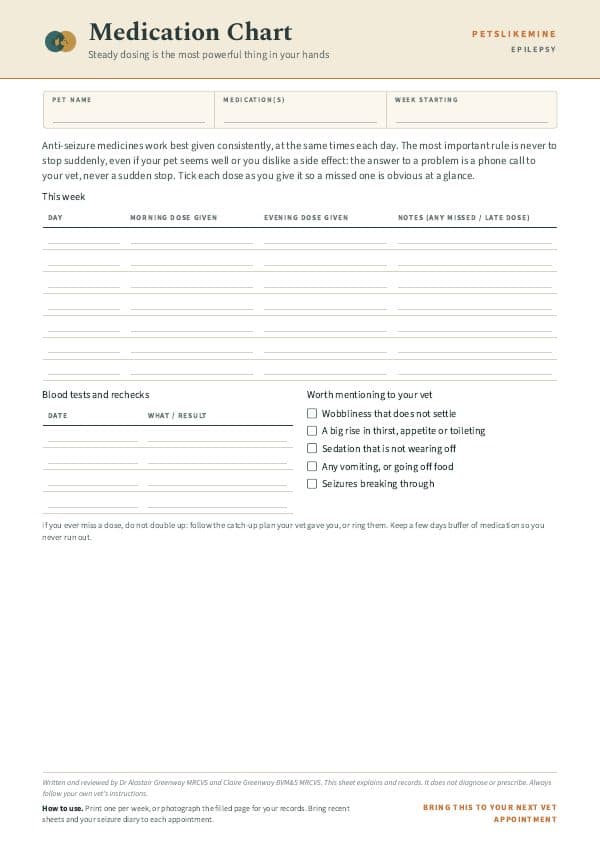
Medication Chart
PDF · 175 KBA weekly tick-sheet for anti-seizure medication, with space for blood-test dates and the side effects worth mentioning. Consistent dosing is the most powerful thing in your hands, never stop suddenly, and a missed dose shows at a glance.
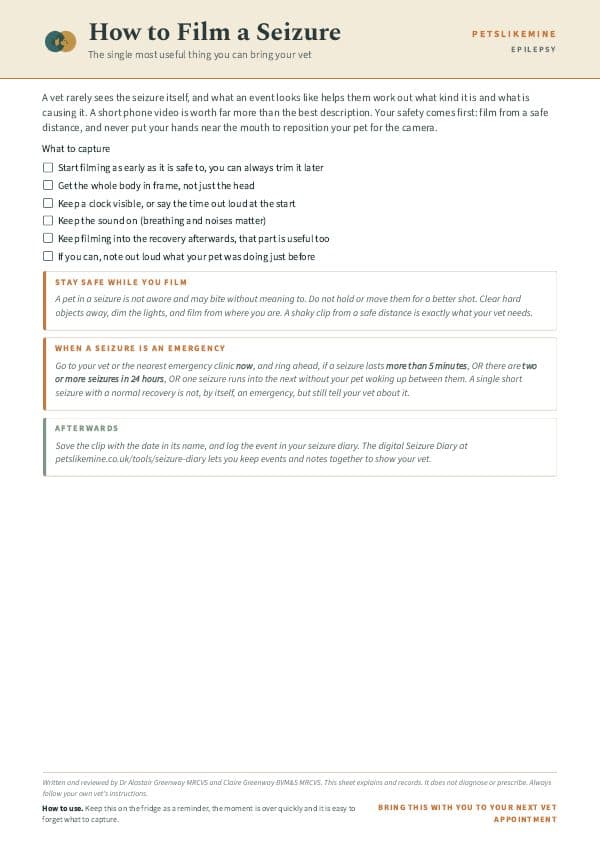
How to Film a Seizure
PDF · 175 KBA short video tells your vet more than any description. What to capture, how to stay safe while you film (never put your hands near the mouth), and why the recovery afterwards matters too.

Trigger Log
PDF · 132 KBA daily log to spot the patterns that set seizures off. Track sleep, stress, missed doses and more alongside seizure days, then look for what keeps turning up in the day or two before. The best-supported triggers are stress, disrupted sleep, hormonal cycles and missed medication.
Connect with others managing Epilepsy
- 🐾
Find pets with the same condition and similar treatments
- 📊
Track symptoms, medications, and health trends over time
- 💬
Share experiences and learn from other pet owners
- 🩺
Get expert veterinary insights on community posts
Your community
Join the Epilepsy community
Connect with other owners managing Epilepsy. Share what is working, ask questions, and follow along day to day.
Visit the communityFind real-world care
When you're ready to take the next step in person, the PetCare Atlas lists neurology specialists across the UK. Search by your postcode to find someone near you.
Find a vet or specialist near youFree includes 1 pet, up to 2 condition spaces, daily tracking, and your top 2 matches