

Quality of Life and Difficult Decisions
Alastair Greenway
BVM&S MRCVS
There's a particular tiredness that comes with epilepsy, and it's hard to explain to anyone who hasn't lived it. Perhaps the gaps between seizures are getting shorter. Perhaps the drugs meant to help have left your dog flat and wobbly and not quite himself. Perhaps a question you can't say out loud has started to form anyway, and you feel guilty even for thinking it. So before we go near any numbers, let me take some weight off you: you are not failing your dog by asking how good his life actually is. That question is one of the most loving things you can do for him. This article is about how to ask it clearly, talk it through with your vet, and face the hardest decision if it comes to that. I'll be straight throughout, because gentleness and candour aren't opposites here.
One rule comes before everything else if you're mid-crisis as you read. A seizure lasting more than five minutes, or two or more in 24 hours, or fits running into each other without recovery, is an emergency. Ring your vet or the nearest emergency clinic now.
The real measure was never the seizure count
It's easy to start believing the goal is zero seizures. It isn't, and never was. The international veterinary consensus says so in plain words: "The ideal goal of AED therapy is to balance the ability to eliminate epileptic seizures with the quality of life of the patient," with realistic success being to reduce how often, how long and how severe the seizures are "with no or limited and acceptable AED adverse effects to maximize the dog's and owner's quality of life" (Bhatti et al., 2015).
That gives you permission to think about the whole dog. Quality of life here is squeezed from two directions: the seizures, with the fear and disruption around them, and the burden of the treatment, the sedation and wobbliness, the ravenous hunger and weight gain, the thirst. In a dog on several drugs at once, those side effects can quietly become the bigger daily problem. The consensus is explicit that treatment is a balance of benefits and harms, and that success includes the absence of intolerable side effects, not simply fewer fits (Bhatti et al., 2015). This isn't only a clinician's framing. Asked what mattered most, owners of dogs with epilepsy rated their dog's quality of life above seizure frequency itself (Packer & Volk, 2015). So if you've felt that everyone keeps talking about numbers while you watch your dog stop being your dog, you're not wrong, and you're not alone.
Before any talk of endings, there's a hopeful point worth making. If it's the drugs dragging your dog's life down rather than the disease, that's often something you can change. A dose adjustment, removing a medicine, or trading slightly more frequent but milder seizures for a brighter dog are all legitimate conversations to have with your vet (Bhatti et al., 2015). The mechanics live in managing medication side effects; the point here is that "his quality of life is poor" and "there is nothing left to try" are not the same sentence.
Two reminders, gently. The goal was always reduction, not cure: a dog is a "responder" when seizures drop by at least half, and complete freedom is uncommon (Bhatti et al., 2015), so don't read "he's still having seizures" as "the treatment has failed." And never stop or reduce anti-seizure medication abruptly, even when quality of life is the worry, because it can trigger cluster seizures or status epilepticus. Any change is made with your vet and tapered slowly (Bhatti et al., 2015).
Putting a real method to the assessment
Fear and habit make it hard to see clearly. When you're frightened, the last terrible night fills the whole screen, and when you're used to something you stop noticing how far it has crept, so it helps to have a method.
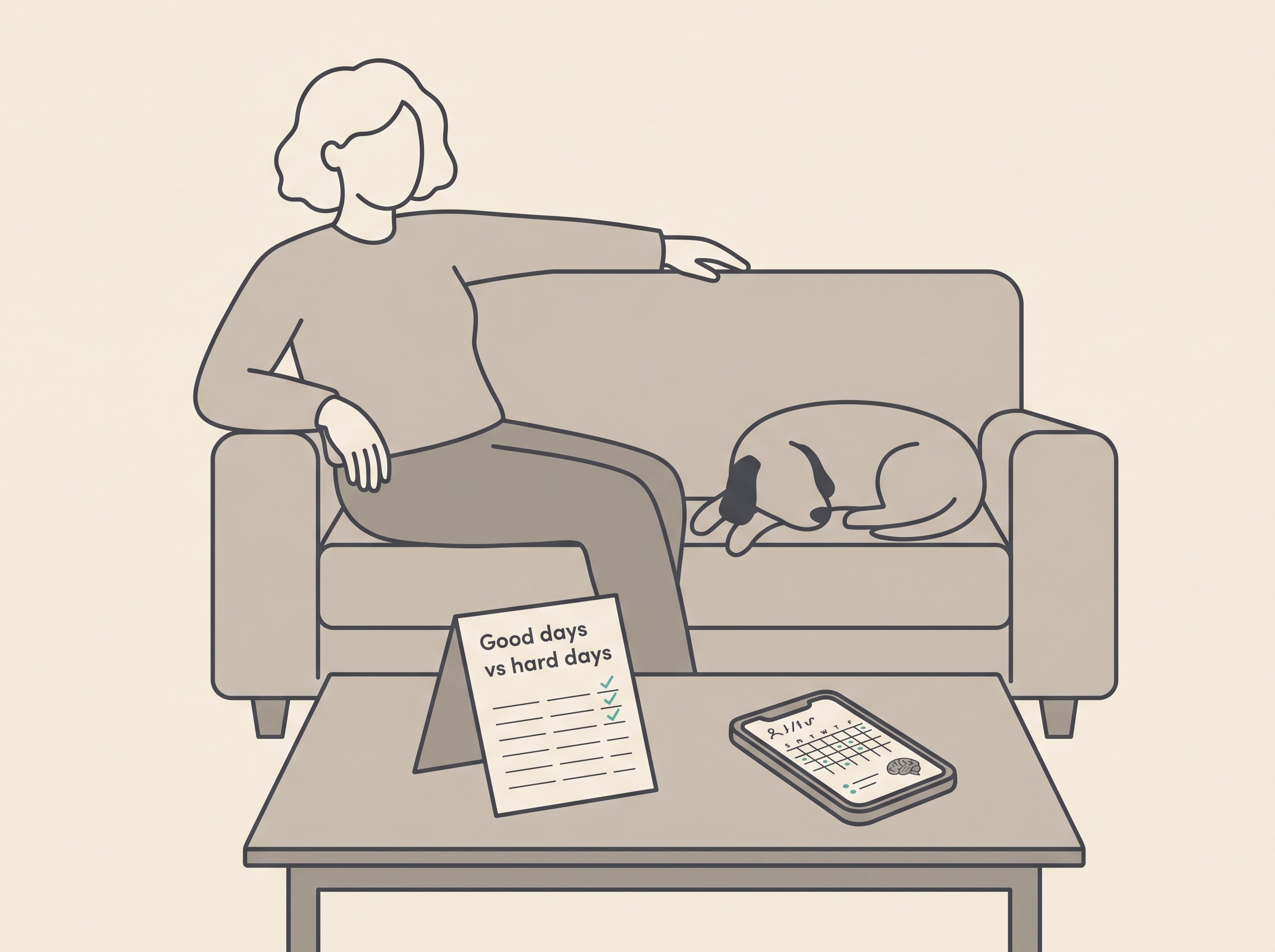
Start with a general quality-of-life scorecard. One of the most widely used is the HHHHHMM scale, developed by Dr Alice Villalobos: Hurt, Hunger, Hydration, Hygiene, Happiness, Mobility, and More good days than bad, each scored from one to ten. The published guidance is that "a score above 5 in each category, or an overall score greater than 35 [out of 70], suggests that the dog's quality of life is acceptable and that it is reasonable to continue end-of-life care and support" (Villalobos). Use it not as a verdict on one bad day but as a trend-tracker, scored every week or two.
Alongside it, reach for an epilepsy-specific lens. Researchers have built and validated a quality-of-life questionnaire just for dogs with idiopathic epilepsy, the EpiQoL, and it deliberately measures both the dog and the human, from seizure severity to the carer's own anxiety. Its authors recommend using it year on year, because epilepsy and quality of life shift over time (Wessmann et al., 2014). The lesson holds even without the questionnaire: assessing quality of life over time is real, structured clinical practice, not something you've invented to torment yourself.
So score regularly, watch the trend rather than any single day, and let your diary carry the seizure side so the assessment rests on a real record. That is what the Seizure Diary is for, and a good-days-versus-bad-days count, which sits inside the HHHHHMM scale, is one of the most telling measures alongside it (Villalobos).
The prognosis behind the hard cases
I've held the numbers back on purpose. They are not a forecast for your individual dog and not a verdict; I'm sharing them only so you know the difficulty you're feeling is proportionate to a genuinely hard situation. Start with the reassuring half. Many dogs with idiopathic epilepsy live a near-normal lifespan. In one hospital population, their median lifespan was about 9.2 years, close to dogs in general, against about 5.8 years for dogs whose seizures came from structural brain disease (Fredsø et al., 2014). If your dog is well controlled, that's the picture that applies; the fuller, hopeful version lives in can a dog with epilepsy live a normal life.
The hardest cases, though, are real. In that same population, epilepsy was the direct reason for death or euthanasia in 52% of the dogs with idiopathic epilepsy, and cluster seizures and status epilepticus had a strong, significant effect on shortening survival (Fredsø et al., 2014). Severity drives this: in a separate study of 407 dogs, cluster seizures occurred in 41%, and significantly more of the dogs with frequent clusters were put to sleep because of them (Monteiro et al., 2012). An older long-term study likewise found a shortened life in dogs euthanised because of their epilepsy, complete remission in only around 15%, and a median of about 2.3 years living with the disease (Berendt et al., 2007).
So take only this from it. Most dogs with epilepsy are not in this group, but if yours is, the weight you're carrying is that of a genuinely serious illness, not a failure of effort or love. Thinking carefully about your dog's quality of life, and where the limits lie, is responsible, devoted care, the opposite of giving up (Fredsø et al., 2014; Bhatti et al., 2015).
Talking to your vet, and the hardest question
The best time to have this conversation is before a crisis, not in the middle of one. Ask your vet, and the neurologist if one is involved, for a frank read on your dog specifically: the realistic outlook, what options genuinely remain, and where the limits lie. Your own vet can interpret your dog's particular seizure pattern, drug burden and quality-of-life trend in a way no general statistic ever can (Bhatti et al., 2015; Fredsø et al., 2014), and this is where the diary and your quality-of-life scores earn their keep (Wessmann et al., 2014). Feel free to ask the plain questions too: "What would you do if this were your dog?" and "Are we still helping him, or just keeping him going?"
Let's say the question you couldn't say out loud, together. It is not "have we tried everything?" That one has no bottom, and it can keep a frightened, loving owner reaching for one more drug long after the dog has stopped benefiting. The kinder, truer question puts your dog's experience first: is this still a life he would choose, comfortable, engaged, more good days than bad (Villalobos; Bhatti et al., 2015)? That's why the trend you've been tracking matters more than any single day.
Let me say the next part as plainly and as gently as I can. For a dog whose seizures cannot be controlled, whose recovery after each one is severe and frequent, or whose quality of life stays poor despite everything you and your vet have tried, choosing euthanasia can be a kindness and a loving, legitimate decision. It is not a failure, and it is not giving up. The guiding principle, that the goal is your dog's quality of life and not seizure numbers at any cost (Bhatti et al., 2015), points exactly here: when quality of life is gone and cannot be restored, letting go can be the most loving use of everything you've learned.
I want to be just as clear about the other side. There's no single right answer and no deadline imposed by this page: many owners reasonably keep going, adjust the treatment, find more good time, and are glad they did. Both paths can be acts of love. The decision is yours and your vet's, made for your dog, in your own time.
Whatever you're weighing, know that the exhaustion, guilt and grief that arrive before anything has even happened are normal and common in epilepsy caregivers. Owners describe living with chronic fear and broken sleep, restricted lives, and the sense of carrying a "ticking time bomb" (Pergande et al., 2020). The deeper work of looking after yourself, and the community who understand it, belongs in the emotional toll of caring for a pet with epilepsy, and I'd send you there when you're ready, because you matter in this too.
A brief word for cat owners
Everything above applies just as much to cats: the same quality-of-life-first principle, the same scorecards, the same candid framing around the hardest decision. I've kept the article dog-led because that's where most of the evidence sits, but the heart of it doesn't change for a feline patient. One difference is worth flagging: structural causes are relatively more common in cats, and where a cat's seizures are structural the outlook can be different (Fredsø et al., 2014), a detail that belongs with what causes seizures in cats.
Where this leaves you
There's no neat ending to a subject like this, and I won't pretend otherwise. If you hold onto one thing, let it be that quality of life, not the seizure count, is the measure that matters, and that if the drugs are the problem, that's often fixable. Loving an animal through epilepsy is hard in ways most people will never see. Whatever you decide, whether that's staying the course or, in time, letting go, you are not doing it wrong. You're doing it with love, and that has always been the thing that counts.
References
- - Berendt, M., Gredal, H., Ersbøll, A. K., & Alving, J. (2007). Premature death, risk factors, and life patterns in dogs with epilepsy. Journal of Veterinary Internal Medicine, 21(4), 754-759.
- - Bhatti, S. F. M., De Risio, L., Muñana, K., Penderis, J., Stein, V. M., Tipold, A., Berendt, M., Farquhar, R. G., Fischer, A., Long, S., Mandigers, P. J. M., Matiasek, K., Packer, R. M. A., Pakozdy, A., Patterson, E. E., Platt, S., Podell, M., Potschka, H., Rusbridge, C., & Volk, H. A. (2015). International Veterinary Epilepsy Task Force consensus proposal: medical treatment of canine epilepsy in Europe. BMC Veterinary Research, 11, 176.
- - Fredsø, N., Koch, B. C., Toft, N., & Berendt, M. (2014). Risk factors for survival in a university hospital population of dogs with epilepsy. Journal of Veterinary Internal Medicine, 28(6), 1782-1788.
- - Monteiro, R., Adams, V., Keys, D., & Platt, S. R. (2012). Canine idiopathic epilepsy: prevalence, risk factors and outcome associated with cluster seizures and status epilepticus. Journal of Small Animal Practice, 53(9), 526-530.
- - Packer, R. M. A., & Volk, H. A. (2015). Epilepsy beyond seizures: a review of the impact of epilepsy and its comorbidities on health-related quality of life in dogs. Veterinary Record, 177(12), 306-315.
- - Pergande, A. E., Belshaw, Z., Volk, H. A., & Packer, R. M. A. (2020). "We have a ticking time bomb": a qualitative exploration of the impact of canine epilepsy on dog owners living in England. BMC Veterinary Research, 16, 443.
- - Villalobos, A. E. Quality of Life Scale ("HHHHHMM" Scale). Quality of life assessment tool for companion animals in palliative/hospice care (Pawspice).
- - Wessmann, A., Volk, H. A., Parkin, T., Ortega, M., & Anderson, T. J. (2014). Evaluation of quality of life in dogs with idiopathic epilepsy. Journal of Veterinary Internal Medicine, 28(2), 510-514.