

Managing Anti-Seizure Medication Side Effects
Alastair Greenway
BVM&S MRCVS
The seizures are settling, and yet the dog seems different. Sleepier. Wobblier. Suddenly ravenous, and draining the water bowl. A few weeks into treatment this is when a lot of owners come back to me quietly worried, and the question underneath is almost always the same: have we traded one problem for another?
Side effects from anti-seizure drugs are common, mostly mild, and the great majority ease off over the first few weeks as your pet's body adjusts (Bhatti et al., 2015). But a small number are genuinely serious and need a phone call, not a wait-and-see. The job of this article is to help you tell those two groups apart. It does not cover the liver question in depth (see phenobarbital explained), blood-level testing (see therapeutic drug monitoring), or the how-to of giving medication (see giving medication reliably).
Start here: the rule that overrides everything
Before any detail, the most important thing about side effects is what not to do. Never stop an anti-seizure drug, and never cut the dose, to escape a side effect on your own. The body has adapted to a steady level of the drug, and pulling it away abruptly can trigger cluster seizures or even status epilepticus, the long, continuous seizure that is a genuine emergency (Bhatti et al., 2015). It catches people out, because easing off looks like the kindness when a dog seems drugged and miserable. If a side effect is bothering you, ring your vet, who can taper slowly and safely, by 20% or less per month, never in one go (Bhatti et al., 2015). The full reasoning is in giving medication reliably. Side effects are a reason to call, never a reason to stop.
What's normal, drug by drug
Most common side effects are dose-dependent, so they appear soon after starting or after a dose increase and then fade over the following days to weeks as the body develops tolerance (Bhatti et al., 2015). The wobbly, dopey, hungry dog of week one is very often a steadier, more like-themselves dog by week three or four, on exactly the same dose, which is why patience matters in the early window covered by the first weeks on medication. What counts as expected depends on which medicine your pet is on.
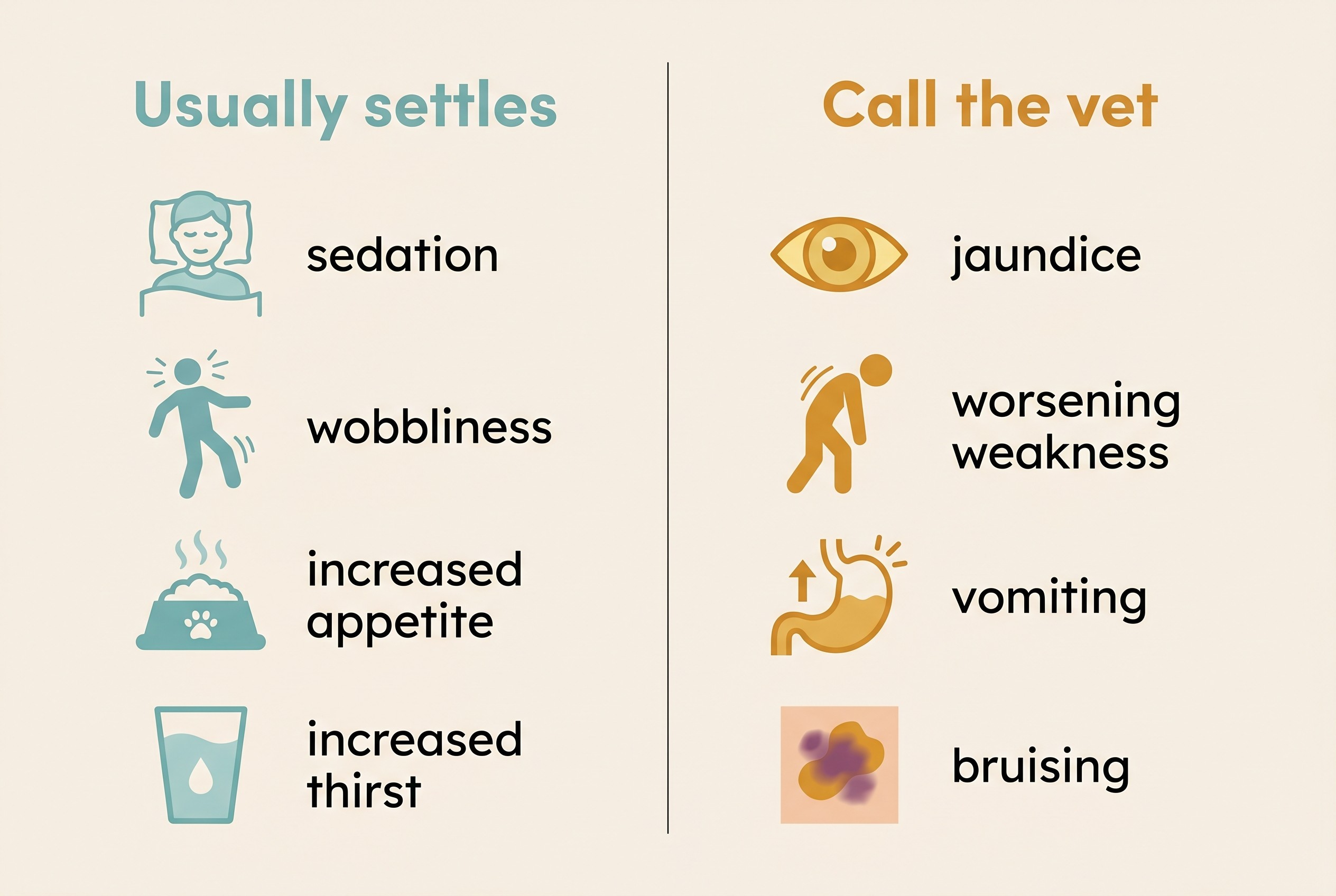
Phenobarbital (phenobarbitone). This is the one most owners are on, and its early effects are the classic picture: sedation and lethargy, ataxia (a drunken wobbliness, especially in the back end), polyphagia (a ravenous appetite, often with weight gain), and polydipsia and polyuria (drinking and urinating noticeably more). All four are dose-dependent, show up soon after starting or after a dose goes up, and generally lessen over the following weeks as tolerance develops (Bhatti et al., 2015). The sleepy, hungry, thirsty dog of the first fortnight is usually just a body that has not caught up yet.
Potassium bromide (KBr, used in dogs). Bromide brings a similar cluster: sedation, ataxia and weakness in the back legs, increased drinking and urinating, and a bigger appetite with weight gain. One effect is more its own: gastrointestinal irritation (nausea and vomiting), which is common but largely preventable by giving the dose with food (Bhatti et al., 2015). There is also a quirk that can catch out a dog who was doing fine. Dogs on bromide need a constant diet with steady chloride intake, because changes in dietary chloride alter the level of bromide in the blood, and a sudden diet change can tip a stable dog into toxicity or into losing seizure control (Bhatti et al., 2015). So treat "do not change the food without asking" as a real instruction.
Imepitoin (Pexion, dogs only). Imepitoin is generally well tolerated. The effects that do occur are usually mild and transient, most concentrated at the start: increased appetite, hyperactivity, a bit more drinking and urinating, drowsiness, drooling, the occasional vomit, wobbliness, lethargy, diarrhoea, the third eyelids showing, and sensitivity to sound (Bhatti et al., 2015). Two reassuring points stand out: no idiosyncratic reactions have been demonstrated with imepitoin, and it does not appear to induce the routine liver enzymes the way phenobarbital does (Bhatti et al., 2015). How the drug works sits in imepitoin (Pexion) explained.
Levetiracetam (Keppra). This is the easy-going one. Mild sedation, ataxia, a dip in appetite or the odd vomit are only rarely described (Bhatti et al., 2015). One point confuses owners: some dogs do brilliantly for months and then start seizing more again. That loss of effect over time, sometimes called the honeymoon effect, is a tolerance phenomenon and a control issue, not a side effect, and it does not mean the drug is hurting your dog (Volk et al., 2008). It means the plan may need revisiting, which is the business of when the first drug isn't enough.
Settles on its own, or needs a call?
If your pet had a dose increase a week or two ago and is a bit dopey and ravenous but otherwise themselves, that is the expected path: give it time, while keeping your vet in the loop.
What should prompt a call has a different texture: wobbliness or weakness that is marked, or getting worse rather than better; sedation so deep your pet is hard to rouse; effects that do not settle over the weeks they should; anything that has worsened after a recent dose change and is not easing; and, always, any of the serious signs below. The lever you are pulling is "tell the vet so they can adjust", not "adjust it yourself". Dose timing, splitting doses and any change to the amount are veterinary decisions, guided for phenobarbital and bromide by blood levels, covered in therapeutic drug monitoring.
Practical things that genuinely help
While you wait for tolerance to do its work, the biggest thing within your control is weight. That ravenous appetite, combined with the sedation that makes a dog less active, is a recipe for steady weight gain (Bhatti et al., 2015), so get ahead of it from day one. Measure the food rather than eyeing it, hold your nerve against the begging (the hunger is the drug talking, not genuine starvation), and keep your pet lean, because preventing weight gain is far easier than shifting it later. Pair that with the medicine-specific habits already noted, giving bromide and imepitoin with food and keeping a bromide dog's diet constant (Bhatti et al., 2015), and the most useful thing of all: keep a record, which I will come back to.
Rare but serious: the signs worth knowing
Most owners will never see these, but knowing the signs means you will act fast if you do.
Phenobarbital's idiosyncratic reactions. Separate from the everyday dose-dependent effects, phenobarbital can occasionally cause reactions that are not about dose at all: hepatotoxicity (liver injury), blood dyscrasias such as anaemia, a low platelet count or a low white-cell count from bone-marrow suppression, a skin condition called superficial necrolytic dermatitis, a possible risk of pancreatitis, and less commonly dyskinesia, anxiety and a low blood albumin (Bhatti et al., 2015). Reassuringly, most are potentially reversible if phenobarbital is discontinued under veterinary direction (Bhatti et al., 2015). The signs that should put you on the phone are unusual bruising or pale gums, which point to a blood problem, and the liver signs below.
The liver, kept in proportion. This is the one owners panic about most, usually after reading that phenobarbital "destroys the liver", so let me be precise. A rise in the liver enzyme ALP, and to a lesser extent ALT, on routine bloodwork is an expected enzyme-induction effect of phenobarbital and does not by itself mean liver damage: in clinically well dogs on phenobarbital with raised enzymes, liver biopsies showed no structural damage at all, and the ALP rise was largely a cortisol-related form of the enzyme rather than of liver origin (Gaskill et al., 2005). Genuine hepatotoxicity is a real but separate concern that becomes more likely at high, long-term exposure: the risk climbs with serum concentrations above roughly 35 micrograms per millilitre, and in one case series of dogs with phenobarbital liver toxicity, 12 of 17 had concentrations of 40 micrograms per millilitre or higher (Dayrell-Hart et al., 1991; Bhatti et al., 2015). The warning signs that warrant a prompt call are jaundice (yellow gums or eyes), loss of appetite, vomiting, a swollen belly, or marked lethargy (Dayrell-Hart et al., 1991). The deeper narrative belongs to phenobarbital explained and the monitoring to therapeutic drug monitoring. A raised enzyme on a routine test is not the same as a damaged liver, and your vet reads those numbers in context.
Bromism, the bromide overshoot. When bromide levels climb too high, dogs develop an exaggerated version of the everyday neurological effects, a state called bromism: heavy sedation, profound wobbliness, weakness or partial paralysis of the limbs, and altered, dull mentation (Baird-Heinz et al., 2009; Bhatti et al., 2015). Toxicity becomes a concern as levels rise above the therapeutic range, with signs suggested above roughly 3000 micrograms per millilitre, and it can be set off by a drop in dietary chloride, which is why the constant-diet rule matters. Reassuringly, bromism is reversible, managed by lowering the dose and clearing the bromide faster with intravenous saline (Baird-Heinz et al., 2009; Bhatti et al., 2015). New or worsening wobbliness, weakness or dullness in a dog on bromide is a reason to ring the vet, not to wait it out.

Cats: get the drug names right
Feline epilepsy is its own world, and a couple of points here are non-negotiable because getting them wrong is dangerous.
Potassium bromide must not be used in cats. It is contraindicated. A large proportion of cats on bromide develop serious lower-airway disease: coughing, laboured breathing, and an inflammatory bronchitis that can progress to bronchiolitis, pulmonary fibrosis and death (Bertolani et al., 2012). One synthesis reports that nearly 40% of cats develop serious respiratory complications (Hazenfratz & Taylor, 2018). Signs often improve after stopping the drug, sometimes with steroids, but not always fully, and some cats do not recover (Bertolani et al., 2012). Imepitoin (Pexion) is not licensed for cats either.
For cats, phenobarbital is the first-line drug, and levetiracetam is the established second-line choice or add-on (Hazenfratz & Taylor, 2018). Phenobarbital's everyday side effects in cats mirror those in dogs, the sedation and the increased appetite and thirst, and levetiracetam is generally very well tolerated (Hazenfratz & Taylor, 2018). So if you have a cat, the picture you are watching is the phenobarbital and levetiracetam one above, not bromide or imepitoin.
One last feline point. If a cat has a seizure, one preventable cause to rule out is permethrin or pyrethroid toxicity, which happens when a flea spot-on meant for dogs is applied to a cat. That is a toxic emergency, not a medication side effect, and it needs an emergency vet straight away.
Putting it to work
Side effects are usually manageable and only rarely a reason to abandon a treatment that is controlling your pet's seizures. The early sleepiness, wobble, hunger and thirst are, far more often than not, the expected price of the first few weeks, and they tend to ease (Bhatti et al., 2015). The serious signs are uncommon, and now you know what they look like. In every case the right move is the same: tell your vet, who can adjust the dose gradually and safely, never stop or cut the drug yourself.
The most useful habit you can build is to write things down. Logging the side effects you see, alongside any dose changes and the seizures themselves, gives your vet the whole picture rather than a half-remembered account at a rushed appointment. The Seizure Diary is built for exactly this: note the wobble that appeared after Tuesday's dose increase, the appetite that is calming down, the morning the gums looked pale. Walk into the next consult with that record, and deciding whether to adjust anything becomes a real conversation rather than guesswork.
References
- Baird-Heinz, H. E., Van Schoick, A. L., Pelsor, F. R., Ranivand, L., & Hungerford, L. L. (2009). A systematic review of the safety of potassium bromide in dogs. Journal of the American Veterinary Medical Association, 234(11), 1425-1431.
- Bertolani, C., Hernandez, J., Gomes, E., Cauzinille, L., Poujade, A., & Gabriel, A. (2012). Bromide-associated lower airway disease: a retrospective study of seven cats. Journal of Feline Medicine and Surgery, 14(8), 591-597.
- Bhatti, S. F. M., De Risio, L., Muñana, K., Penderis, J., Stein, V. M., Tipold, A., Berendt, M., Farquhar, R. G., Fischer, A., Long, S., Löscher, W., Mandigers, P. J. J., Matiasek, K., Pakozdy, A., Patterson, E. E., Platt, S., Podell, M., Potschka, H., Rusbridge, C., & Volk, H. A. (2015). International Veterinary Epilepsy Task Force consensus proposal: medical treatment of canine epilepsy in Europe. BMC Veterinary Research, 11, 176.
- Dayrell-Hart, B., Steinberg, S. A., VanWinkle, T. J., & Farnbach, G. C. (1991). Hepatotoxicity of phenobarbital in dogs: 18 cases (1985-1989). Journal of the American Veterinary Medical Association, 199(8), 1060-1066.
- Gaskill, C. L., Miller, L. M., Mattoon, J. S., Hoffmann, W. E., Burton, S. A., Gelens, H. C. J., Ihle, S. L., Miller, J. B., Shaw, D. H., & Cribb, A. E. (2005). Liver histopathology and liver and serum alanine aminotransferase and alkaline phosphatase activities in epileptic dogs receiving phenobarbital. Veterinary Pathology, 42(2), 147-160.
- Hazenfratz, M., & Taylor, S. M. (2018). Recurrent seizures in cats: treatment - which antiepileptic drugs are recommended? Journal of Feline Medicine and Surgery, 20(9), 825-834.
- Volk, H. A., Matiasek, L. A., Luján Feliu-Pascual, A., Platt, S. R., & Chandler, K. E. (2008). The efficacy and tolerability of levetiracetam in pharmacoresistant epileptic dogs. The Veterinary Journal, 176(3), 310-319.
Keep track of how your pet is doing
The owners who cope best are the ones who notice changes early. A simple health log shows you what is working, and what is not, before the next vet visit.
Start tracking, freeYou're not doing this alone
Compare treatment journeys and talk to owners managing epilepsy. Free to join.
Join PetsLikeMine