

Imepitoin (Pexion) Explained
Alastair Greenway
BVM&S MRCVS
Pexion is the brand name your vet has either just started your dog on or laid on the table as an option, and it tends to raise the same handful of questions. How is it different from phenobarbital, the drug everyone seems to mention first? Is it as good? Why no blood tests? And what should the next few weeks feel like?
This piece is about imepitoin specifically, sold in the UK as Pexion, and it's a dog-only article (I'll explain why near the end). I won't line all the anti-seizure drugs up against each other here, because that head-to-head, and the way the choice differs between dogs and cats, lives in the anti-seizure drugs compared. My job is narrower: the one drug in front of you, where it genuinely shines and where it falls short.
What it actually is, and how it works
Imepitoin reached the European market in 2013 under the brand name Pexion, made by Boehringer Ingelheim (Bhatti et al., 2015). The way it works explains much of what follows. Your dog's brain has a natural braking system, a calming chemical signal called GABA that quietens overexcited neurons. Imepitoin gently boosts that brake. Technically it's a low-affinity partial agonist at the benzodiazepine binding site of the GABA-A receptor, but the important word is partial (Rundfeldt & Löscher, 2014). Where a drug like diazepam (Valium) presses that pedal to the floor, imepitoin presses it part of the way, raising the threshold at which neurons start firing abnormally while producing less sedation and a low potential for tolerance, dependence or abuse (Rundfeldt & Löscher, 2014; Bhatti et al., 2015).
Its licensed job is specific. The UK datasheet authorises it "for the reduction of the frequency of generalised seizures due to idiopathic epilepsy in dogs for use after careful evaluation of alternative treatment options" (Pexion UK SPC). Two phrases there matter: it's licensed for generalised seizures in idiopathic epilepsy, and it's framed as a considered choice, not an automatic one. In the European veterinary consensus it's a recognised first-line option in dogs alongside phenobarbital, and your vet weighs up which of the two suits your individual dog (Bhatti et al., 2015).
Where it genuinely shines
Pexion is a good drug, and its advantages deserve proportion. The headline is the side-effect profile. In the pivotal blinded trial comparing imepitoin directly with phenobarbital in 226 dogs, the effects owners most dread, drowsiness and sedation, excessive drinking and a ravenous appetite, were all significantly more frequent in the phenobarbital group than the imepitoin group (Tipold et al., 2015). Dogs on imepitoin tend to be more themselves, more of the time.
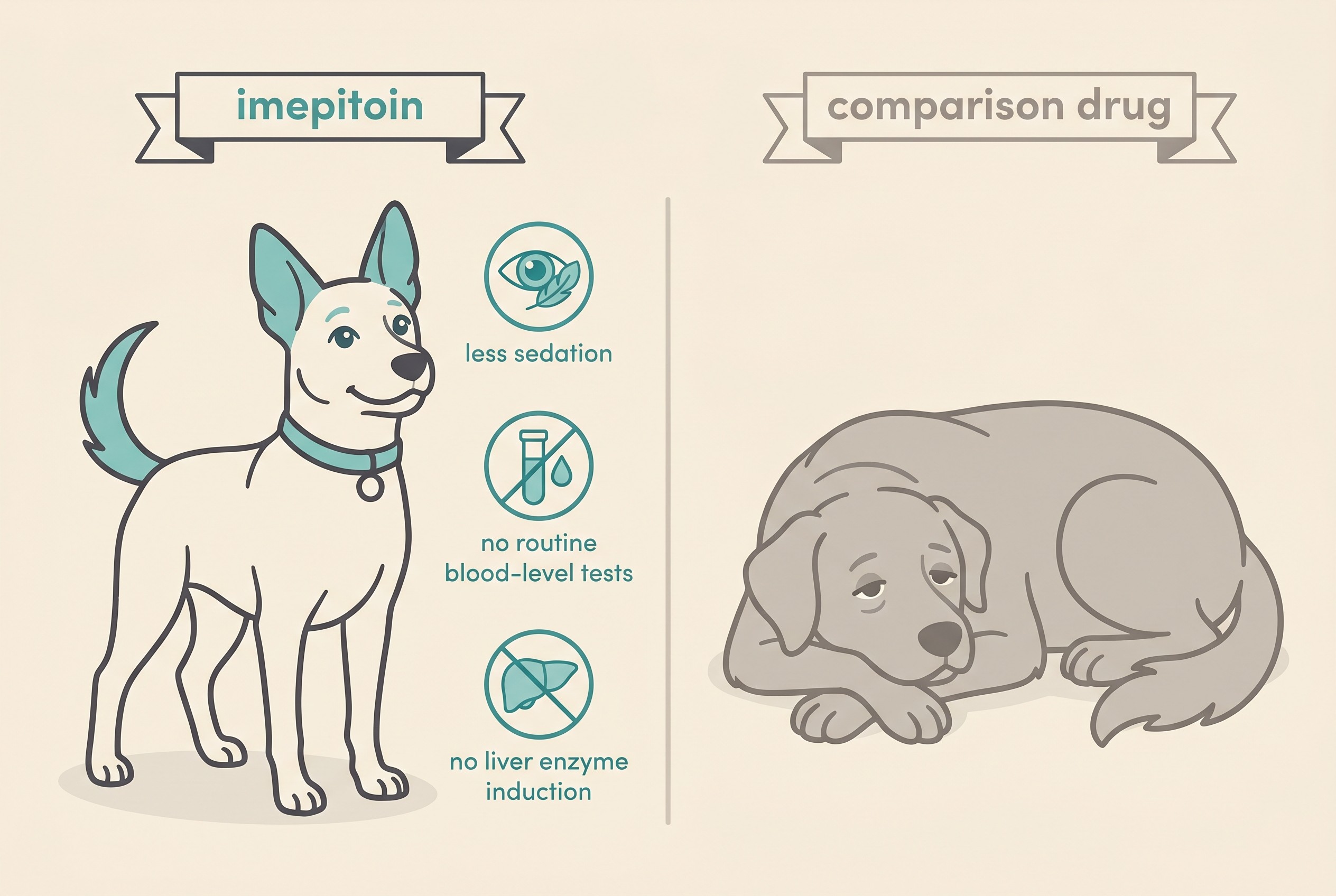
Then there's the liver, a conversation that belongs in full to the phenobarbital guide. The contrast is the point: in that same trial, phenobarbital-treated dogs developed significantly raised liver enzymes such as ALP and GGT, while no such effect occurred with imepitoin (Tipold et al., 2015), which doesn't meaningfully switch on the liver's drug-processing enzymes the way phenobarbital does (Rundfeldt & Löscher, 2014). For a drug your dog may take for years, that counts as a real point in its favour.
Your vet also doesn't need to chase a target blood level with repeated tests. Plasma levels don't track neatly with seizure control, and imepitoin has a wide safety margin (a Beagle study found no adverse effects even at 90 mg/kg twice daily, three times the maximum dose), so routine blood-level monitoring isn't required, unlike phenobarbital and bromide (Bhatti et al., 2015; Tipold et al., 2015). Your vet may still run occasional general bloods, but you're spared the regular level-checking other drugs need (see therapeutic drug monitoring). It also isn't a controlled drug, so it avoids the prescribing paperwork phenobarbital carries (Rundfeldt & Löscher, 2014).
The limits, told straight
Now the other half. The single most important limit: imepitoin is not for cluster seizures or for status epilepticus. The datasheet is blunt, stating that efficacy in these situations "has not been investigated" and that imepitoin "should not be used as primary treatment in dogs with cluster seizures and status epilepticus" (Pexion UK SPC; Bhatti et al., 2015). This ties into the emergency rule that runs through everything we write about epilepsy. A seizure lasting more than five minutes, or two or more seizures in 24 hours, or fits running into one another without your dog recovering in between, is an emergency: ring your vet or the nearest emergency clinic and go now. A single short seizure with a recovery afterwards is frightening, but isn't, by itself, an emergency. Imepitoin is a daily preventer for the right kind of epilepsy, not a treatment for a crisis, and that crisis is covered in status epilepticus and cluster seizures.
A second limit is that it doesn't work fully for every dog, and no anti-seizure drug does. The datasheet puts it plainly: "On treatment, some dogs will be free of seizures, in other dogs a reduction of the number of seizures will be observed, whilst others will be non-responders" (Pexion UK SPC). That's the heart of a truth covered in realistic goals: control, not cure: the aim is to reduce seizures, not abolish them, and a dog is usually counted a responder when their seizure frequency falls by at least half (Bhatti et al., 2015). To put a number on it, the newly-diagnosed trial found that on the full 30 mg/kg twice-daily dose, roughly a third to a half of dogs became free of generalised tonic-clonic seizures during follow-up (Rundfeldt et al., 2015): good odds for many, but not a guarantee, so don't read a continuing seizure as the drug "failing".
Then the efficacy debate, told square. On paper imepitoin and phenobarbital are close: the pivotal trial found their efficacy comparable, and a systematic review rated both as monotherapy "good", the same tier (Tipold et al., 2015; Charalambous et al., 2014). But that trial enrolled dogs with relatively mild to moderate epilepsy and excluded the clusterers, and some clinicians still regard phenobarbital as the more potent option for frequent or severe seizures. Imepitoin is also not well supported as an add-on bolted onto a first drug: the datasheet says "no definitive conclusions can be drawn" on that use, and the review found the add-on evidence "insufficient" (Pexion UK SPC; Charalambous et al., 2014). In short, it's a genuine first-line monotherapy with a friendlier profile, which may be the less powerful choice for the most difficult epilepsy and isn't the drug you reach for as a second agent. That's why your vet individualises the decision, and the full comparison sits in the anti-seizure drugs compared.
One more set of cautions, the safety small print. Imepitoin shouldn't be used in dogs who've reacted to it before, or in dogs with severely impaired liver function or severe kidney or heart disease, its safety hasn't been established in dogs under 5 kg, and it isn't recommended for breeding, pregnant or nursing dogs (Pexion UK SPC).
What the early days look like
Imepitoin is given twice a day, roughly twelve hours apart, every day, with a licensed dose range of 10 to 30 mg/kg twice daily and a recommended start of 10 mg/kg twice daily (Pexion UK SPC; Bhatti et al., 2015). If that doesn't control the seizures and your dog is tolerating it well, your vet can step it up towards the 30 mg/kg ceiling, the finer mechanics of which belong to how dose titration works (Pexion UK SPC). The tablets are scored so they can be halved, with a leftover half used for the next dose (Pexion UK SPC). Be consistent about food, too. Imepitoin is absorbed a little better on an empty stomach, so the rule isn't "always with food" or "always without", it's "always the same" relative to feeding (Pexion UK SPC; Rundfeldt & Löscher, 2014).
It also gets going relatively quickly: with a short half-life, peaking a few hours after a dose, it doesn't need the long climb to steady state that phenobarbital and bromide require (Rundfeldt & Löscher, 2014). One UK neurology referral centre describes it as starting to work within about three days (NDSR, n.d.), so you shouldn't wait weeks to see whether it's doing anything.

Most early side effects are mild and tend to ease after the first few weeks. By far the most common is a noticeably bigger appetite right at the start, with the datasheet also listing, less often, hyperactivity, increased drinking and urinating, mild drowsiness, drooling, the odd bout of vomiting or diarrhoea and wobbliness (Pexion UK SPC). Aggression has uncommonly been reported and may be drug-related, though it can also be part of the post-ictal period or the disease itself (Pexion UK SPC). In the newly-diagnosed trial, around 86% of dogs on the high dose had at least one side effect, which sounds alarming until you read the detail: most were mild to moderate, mostly nervous-system effects like wobbliness, disorientation and restlessness, and settled after those weeks (Rundfeldt et al., 2015). That's why I'd nudge you towards the Seizure Diary from day one, logging each seizure, every dose given or missed, and any side effects. It turns the fog of the first month into something your vet can use.
One rule sits above all the practical detail: never stop or suddenly change an anti-seizure drug on your own. Imepitoin's withdrawal picture is gentler than phenobarbital's, with the datasheet noting only "mild behavioural or muscular signs" on abrupt stopping (Pexion UK SPC), but the rule still holds. Stopping suddenly can provoke seizures, so any change of dose or switch between drugs should be gradual and guided by your vet (Pexion UK SPC; Bhatti et al., 2015). If the side effects ever feel too much, that's a conversation to have, not a decision to make alone.
A quick word on cats
You may have a cat too, so to be clear: imepitoin is not licensed for cats and isn't a feline first-line treatment (Pexion UK SPC). No anti-seizure drugs are licensed specifically for feline idiopathic epilepsy in Europe, and the practical first choices in cats are phenobarbital, then levetiracetam (Charalambous et al., 2018). The detail and the cat-specific safety points sit in the anti-seizure drugs compared.
Pulling it together
So where does it leave you? With a modern first-line drug whose gentler everyday feel and lighter monitoring are weighed against the fact that it's not for clusters or emergencies and may be less potent for severe epilepsy. That trade-off is real, and your vet makes it with your dog in front of them.
The most useful thing you can do now is gather evidence. Start the Seizure Diary today and log every seizure, every dose given or missed, and anything that looks like a side effect. That record is what tells you and your vet whether the dose is right or needs the careful step-up described in how dose titration works. And if you're still weighing imepitoin against the alternatives, the anti-seizure drugs compared is the page to read next.
References
- Bhatti, S. F. M., De Risio, L., Muñana, K., Penderis, J., Stein, V. M., Tipold, A., Berendt, M., Farquhar, R. G., Fischer, A., Long, S., Löscher, W., Mandigers, P. J. J., Matiasek, K., Pakozdy, A., Patterson, E. E., Platt, S., Podell, M., Potschka, H., Rusbridge, C., & Volk, H. A. (2015). International Veterinary Epilepsy Task Force consensus proposal: medical treatment of canine epilepsy in Europe. BMC Veterinary Research, 11, 176.
- Charalambous, M., Brodbelt, D., & Volk, H. A. (2014). Treatment in canine epilepsy: a systematic review. BMC Veterinary Research, 10, 257.
- Charalambous, M., Pakozdy, A., Bhatti, S. F. M., & Volk, H. A. (2018). Systematic review of antiepileptic drugs' safety and effectiveness in feline epilepsy. BMC Veterinary Research, 14, 64.
- North Downs Specialist Referrals (NDSR). (n.d.). What is imepitoin (Pexion)? Owner information sheet.
- Pexion (imepitoin). Summary of Product Characteristics, UK (NOAH Compendium datasheet), Boehringer Ingelheim; corroborated by the European Medicines Agency Pexion EPAR (EMEA/V/C/002543, authorised 2013).
- Rundfeldt, C., & Löscher, W. (2014). The pharmacology of imepitoin: the first partial benzodiazepine receptor agonist developed for the treatment of epilepsy. CNS Drugs, 28(1), 29-43.
- Rundfeldt, C., Tipold, A., & Löscher, W. (2015). Efficacy, safety, and tolerability of imepitoin in dogs with newly diagnosed epilepsy in a randomized controlled clinical study with long-term follow up. BMC Veterinary Research, 11, 228.
- Tipold, A., Keefe, T. J., Löscher, W., Rundfeldt, C., & de Vries, F. (2015). Clinical efficacy and safety of imepitoin in comparison with phenobarbital for the control of idiopathic epilepsy in dogs. Journal of Veterinary Pharmacology and Therapeutics, 38(2), 160-168.
Keep track of how your pet is doing
The owners who cope best are the ones who notice changes early. A simple health log shows you what is working, and what is not, before the next vet visit.
Start tracking, freeYou're not doing this alone
Compare treatment journeys and talk to owners managing epilepsy. Free to join.
Join PetsLikeMine