

Therapeutic Drug Monitoring: Why Your Vet Checks Blood Levels
Alastair Greenway
BVM&S MRCVS
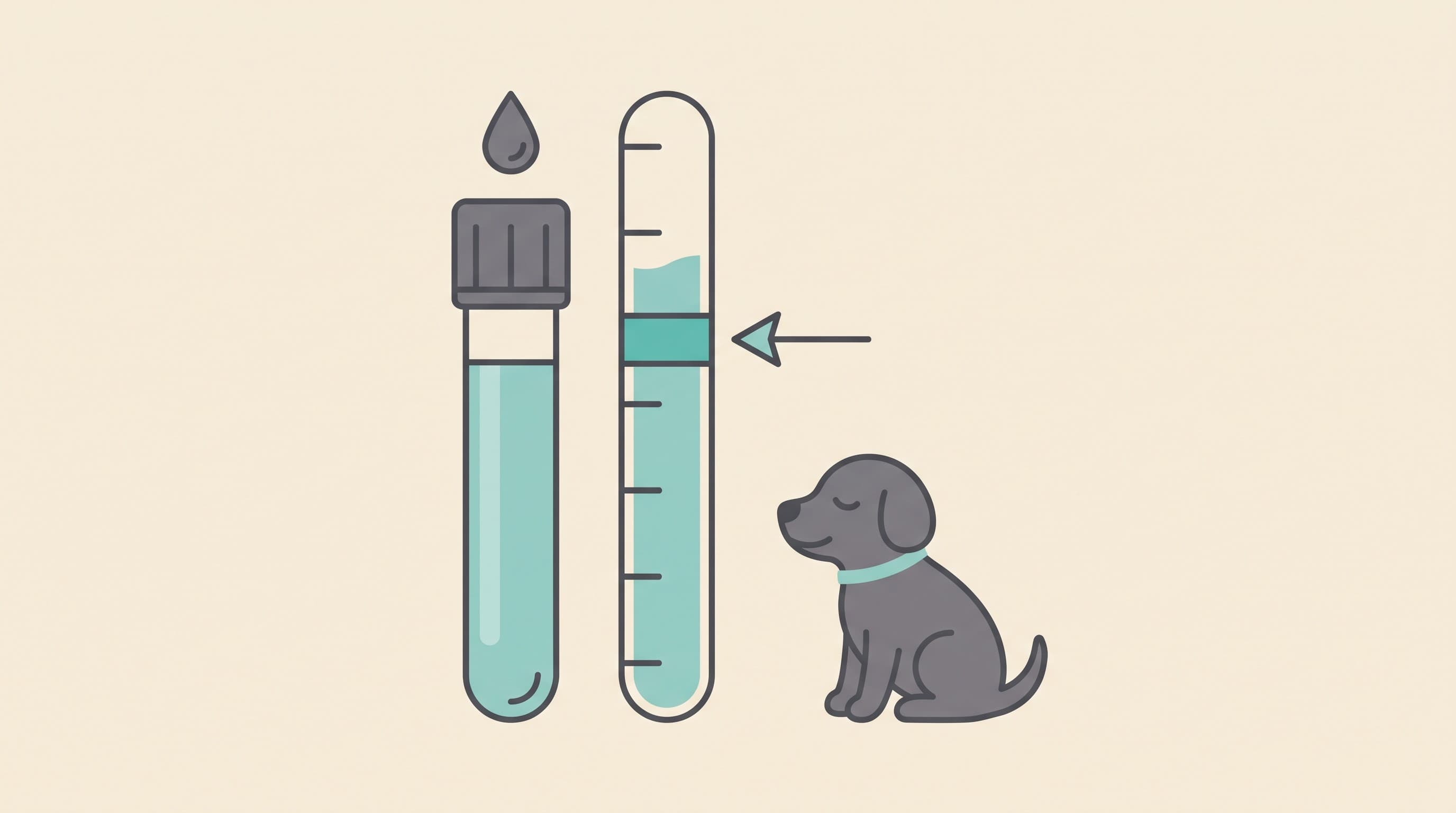
A dog who has just started phenobarbital or potassium bromide usually goes home with a little timetable of blood tests attached. The dog seems perfectly fine, so the obvious question is what all those needles in the vein are actually for.
The short answer is that with these drugs, the dose your dog swallows and the amount that ends up in their bloodstream are two very different things, and it's the second that matters. Measuring that amount is called therapeutic drug monitoring, usually shortened to TDM. This article explains what it is, which drugs need it, what the numbers mean, and the single most important rule for reading them. It's the companion to how dose titration works, which covers changing the dose; here we explain the levels those changes are built on.
What TDM is, and which drugs need it
Therapeutic drug monitoring means measuring how much of an anti-seizure drug is in your dog's blood, usually the serum, and using that number to guide the dose. Two drugs are strongly recommended for it: phenobarbital and potassium bromide. Both show wide variation between individual animals in how the drug is absorbed, processed and cleared, and both have a narrow margin between "enough to work" and "starting to cause problems" (Bhatti et al., 2015). When a drug behaves that unpredictably, you cannot safely steer by the dose alone.
Some drugs don't need it. Imepitoin (Pexion) is the clearest example: there's no useful relationship between the level of imepitoin in the blood and how well it controls seizures, so the manufacturer makes no recommendation to monitor it (Bhatti et al., 2015). Levetiracetam (Keppra) is similar, with no established veterinary therapeutic range, so routine level-checking isn't standard care (Bhatti et al., 2015). So if your dog is on Pexion or Keppra and nobody's checking levels, that's not an oversight. It's exactly right.
Why the dose isn't the level
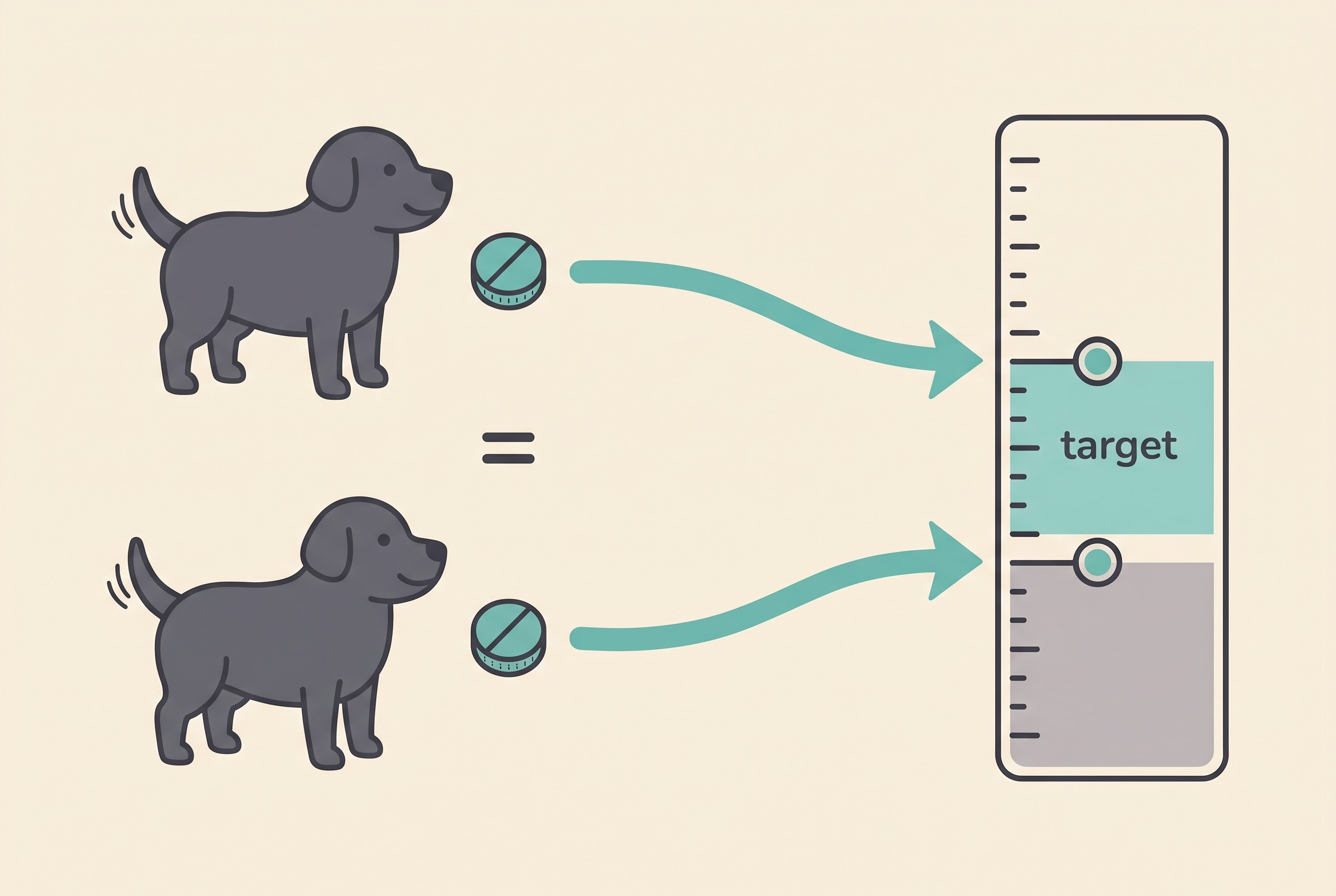
Everything else follows from this one idea. Two dogs of the same weight, given the same milligrams of phenobarbital, very often end up with quite different amounts in their blood. There's considerable individual variation in how dogs absorb the drug, how quickly the liver breaks it down and how long it lingers, so an identical dose per kilogram can leave one dog comfortably in range while another barely registers (Bhatti et al., 2015). This is why your vet titrates against the measured level, not the dose.
A second twist is worth knowing, because it explains another test on your timetable. Phenobarbital speeds up its own breakdown over the first few weeks: the liver clears it faster and its half-life shortens, a process called metabolic tolerance that typically settles after roughly 30 to 45 days (Bhatti et al., 2015). So a dose that gave a good level in week two can give a lower one a month later, not because anything has gone wrong, but because the body has got more efficient at clearing it. That's the whole reason a second blood test is scheduled at around six weeks: to catch the shift before seizures break through.
Phenobarbital: the numbers and the timing
For phenobarbital in dogs, the recognised therapeutic range is 15 to 40 mg/L in serum (sometimes written µg/mL, the identical unit). Within that range the consensus suggests aiming for around 25 to 30 mg/L, while deliberately avoiding levels above 35 mg/L because higher concentrations carry a greater risk of liver injury (Bhatti et al., 2015).
None of the timing is accidental. The first sample is usually taken around 14 days after starting or any dose change, because by then the level has settled enough to give a meaningful baseline (one lab guidance phrases this as "after two to three weeks", the same window). A second follows at about six weeks to check for metabolic tolerance (Bhatti et al., 2015; TVMDL). Once things are stable the tests space out: every six months while control is good, every twelve months if your dog is seizure-free (Bhatti et al., 2015).
When the blood is drawn matters less than you'd think. For most dogs you can sample at almost any point in the cycle, but at higher doses (around 5 mg/kg twice daily or more) the gap between a peak and a trough starts to matter, so sample at the same point each visit, ideally at the trough just before the next tablet (Bhatti et al., 2015).
Running alongside the level tests is a separate set of organ checks, because phenobarbital is processed by the liver: a baseline blood count, biochemistry and bile acid stimulation test, then repeat blood work at three months and every six months (Bhatti et al., 2015). The big question those checks answer, "is this drug damaging my dog's liver?", deserves a proper discussion, and it has one in phenobarbital explained.

Potassium bromide: a slower drug, a different schedule
Bromide plays by its own rules, and a note for cat owners first: bromide isn't a feline option at all, for reasons we'll come to, so this section is about dogs.
The therapeutic range is usually given as roughly 1000 to 2000 mg/L when bromide is used alongside phenobarbital, and higher, around 2000 to 3000 mg/L, when it's the only drug, so the figure your vet aims for depends on whether it's working alone or sharing the load (Bhatti et al., 2015). A 2024 review reports the underlying study ranges very similarly, at 810 to 2400 mg/L combined and 880 to 3000 mg/L as monotherapy (Charalambous et al., 2024).
The big difference is time. Bromide hangs around for a remarkably long while, with a half-life of roughly 25 to 46 days in dogs, so it takes about three months to reach a steady state where the level stops climbing (Bhatti et al., 2015; Charalambous et al., 2024). The first bromide level therefore isn't checked at two weeks like phenobarbital, but at around three months once the drug has settled, whether after starting or after a dose change (Bhatti et al., 2015; TVMDL). The flip side of that long half-life is that the time of day you draw blood barely matters, because the level changes so slowly that a peak and a trough are almost the same number (Bhatti et al., 2015; Charalambous et al., 2024).
One thing does genuinely move a dog's bromide level, and it surprises people: diet. Bromide and chloride (the salt in your dog's food) compete to be reabsorbed by the kidneys, so the chloride in the diet directly affects how much bromide stays in the blood. In one study, raising dietary chloride from 0.2% to 1.3% cut the apparent half-life of bromide from 69 days to 24 days (Trepanier & Babish, 1995). So keep the diet consistent while your dog is on bromide, and if you do change their food, tell your vet and expect to re-check the level. A switch to a saltier food can quietly drag a well-controlled dog into the seizure zone.
Treat the dog, not the number
A blood level is a guide, not a verdict. The published range describes where most dogs do well, but your dog is one dog, not a population. The international consensus is explicit: a dog whose seizures are well controlled, but whose level sits below the published range, does not need a dose increase, because that lower level may simply be all that dog needs (Bhatti et al., 2015). Laboratories make the same point, that these values "are simply guidelines and are not intended to replace clinical assessment and professional judgment" (MSU VDL, 2018). The goal isn't a textbook number. It's the lowest concentration that gives at least a 50% reduction in seizures, ideally freedom from them, without side effects your dog can't live with (Bhatti et al., 2015).
So your vet reads a result against two other things: how your dog is doing, and how your dog is feeling. The seizure diary you keep is the seizure-control half of that picture, the hard evidence of whether seizures are genuinely fewer, shorter or milder. A lab number only means something next to your real-world count.
The other half is side effects, and bromide shows clearest why levels are watched at all. When bromide climbs too high, dogs develop a picture called bromism: neurological signs such as a dazed consciousness, wobbliness and limb weakness, although it's dose-dependent and largely reversible once the bromide is lowered (Rossmeisl & Inzana, 2009). Tolerance also varies between individuals, so one dog can show bromism at a level another handles comfortably, which is exactly why a result must be read alongside how your dog looks and behaves, never in isolation (Rossmeisl & Inzana, 2009; Bhatti et al., 2015). If your dog becomes wobbly or unusually flat, that's a conversation for managing anti-seizure medication side effects.
One thing to be blunt about: TDM is about your vet adjusting the dose, never about you stopping or skipping doses to "get a clean reading". Anti-seizure medication is never stopped abruptly, because sudden withdrawal can trigger a cluster of seizures or a dangerous prolonged one (Bhatti et al., 2015). And while we're on emergencies: a single short seizure your dog recovers from is not, in itself, one. A seizure lasting more than five minutes, two or more in 24 hours, or fits arriving back to back, means ringing your vet or an emergency clinic now. If a result worries you, though, the answer is a phone call, not a missed tablet.
A quick word for cat owners
Most of this applies to cats too, with one major difference in the drug list. Phenobarbital is the feline first-line treatment and the same monitoring thinking holds: a serum target of around 15 to 45 µg/mL is commonly used, and in one series of 30 cats, 28 (93%) achieved seizure control within that range, although the feline therapeutic range hasn't been formally established the way the canine one has (Finnerty et al., 2014). What's different is bromide. Potassium bromide is not recommended in cats and is effectively off the table, because a significant proportion develop a potentially fatal lower-airway disease (Bertolani et al., 2012). So feline drug monitoring means phenobarbital, and if a second drug is needed, levetiracetam, not bromide.
What this means for your next appointment
Next time you're booking your dog in for "just another blood test", remember what that small sample is doing: it tells your vet where your individual dog has actually landed, something that can't be read off the dose on the box. So bring the diary, keep the diet steady if your dog's on bromide, and follow the sampling-time instructions exactly. How that level becomes an actual dose change is the subject of how dose titration works, the natural next read.
References
- - Bertolani, C., Hernandez, J., Gomes, E., Cauzinille, L., Poujade, A., & Gabriel, A. (2012). Bromide-associated lower airway disease: a retrospective study of seven cats. Journal of Feline Medicine and Surgery, 14(8), 591-597.
- - Bhatti, S. F. M., De Risio, L., Muñana, K., Penderis, J., Stein, V. M., Tipold, A., et al. (2015). International Veterinary Epilepsy Task Force consensus proposal: medical treatment of canine epilepsy in Europe. BMC Veterinary Research, 11, 176.
- - Charalambous, M., Shivapour, S. K., Brodbelt, D. C., & Volk, H. A. (2024). Bromide: the good, the bad, and the ugly of the oldest antiseizure medication. Frontiers in Veterinary Science, 11, 1433191.
- - Finnerty, K. E., Barnes Heller, H. L., Mercier, M. N., Giovanella, C. J., Lau, V. W., & Rylander, H. (2014). Evaluation of therapeutic phenobarbital concentrations and application of a classification system for seizures in cats: 30 cases (2004-2013). Journal of the American Veterinary Medical Association, 244(2), 195-200.
- - Michigan State University Veterinary Diagnostic Laboratory. (2018). Therapeutic drug monitoring for antiepileptic drugs in dogs and cats. MSU VDL Newsletter, Winter 2018.
- - Rossmeisl, J. H., & Inzana, K. D. (2009). Clinical signs, risk factors, and outcomes associated with bromide toxicosis (bromism) in dogs with idiopathic epilepsy. Journal of the American Veterinary Medical Association, 234(11), 1425-1431.
- - Texas A&M Veterinary Medical Diagnostic Laboratory (TVMDL). Therapeutic drug monitoring in dogs and cats. Retrieved from
- - Trepanier, L. A., & Babish, J. G. (1995). Effect of dietary chloride content on the elimination of bromide by dogs. Research in Veterinary Science, 58(3), 252-255.
Free downloads
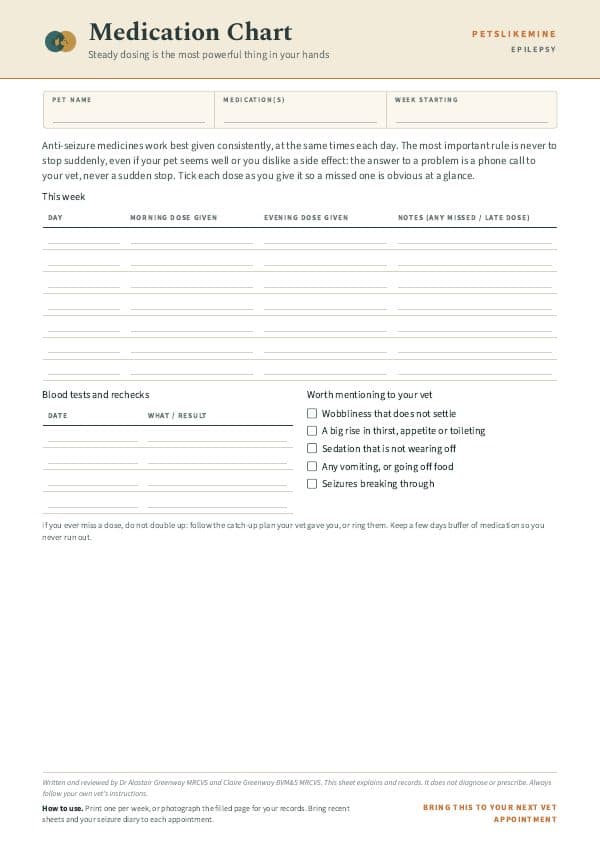
Companion worksheets to put what you've read into practice. Free PDFs, print at home.
Keep track of how your pet is doing
The owners who cope best are the ones who notice changes early. A simple health log shows you what is working, and what is not, before the next vet visit.
Start tracking, freeYou're not doing this alone
Compare treatment journeys and talk to owners managing epilepsy. Free to join.
Join PetsLikeMine