

Phenobarbital: What to Expect (and the Liver Question)
Alastair Greenway
BVM&S MRCVS
Type "phenobarbital" into a search bar the night your dog starts it, and within a few clicks you'll hit a forum thread insisting, in capital letters, that the drug "destroys the liver". It's worth knowing how little that headline reflects the real picture.
Phenobarbital is, on balance, one of the most reassuring drugs in veterinary medicine: effective, well understood, and monitorable. The liver risk is real but rare, and the routine blood tests your vet has planned exist to catch a problem long before it becomes dangerous. That doesn't mean the risk is zero, and you deserve more than a pat on the head. This piece is about phenobarbital itself: it doesn't compare the drugs (that's the drugs compared) or read out the blood numbers (that's therapeutic drug monitoring).
Why it's the old reliable
Phenobarbital has been used to control seizures for longer than any other drug in veterinary medicine, and it's still a first-line treatment for idiopathic epilepsy in dogs (Bhatti et al., 2015). That isn't inertia. It's because the drug works, and we understand it, and its risks, better than anything else we could reach for. It does its job by boosting GABA, the brain's main calming signal, which raises the threshold a seizure has to cross (Bhatti et al., 2015).
One practical aside, so the admin doesn't surprise you. In the UK it's sold as two licensed veterinary products, Epiphen and Phenoleptil, both prescription-only and, as Schedule 3 Controlled Drugs, needing original signed scripts at each repeat (Epiphen and Phenoleptil UK product information, 2026). That's normal regulation, not a sign it's dangerous to have at home.
Give it time: the first few weeks
Phenobarbital doesn't work properly on day one, and a seizure in the first couple of weeks is not the drug failing. The reason is steady state. The drug has to build up before its full effect and true blood level can be judged. Its half-life starts long, around 37 to 73 hours, then shortens over the first month as your dog's liver adapts, settling around 30 to 45 days in (Bhatti et al., 2015). In practice it takes roughly two weeks to reach an initial steady state, which is why a first blood level is usually checked then, with a second around six weeks (Bhatti et al., 2015). So a seizure in week one simply means the drug hasn't reached its working level yet, and logging those early events in the Seizure Diary gives you and your vet a clear picture rather than a panicked memory.
What "good control" really looks like
It helps to know what you're aiming at, because the target isn't what most owners assume. Phenobarbital reduces seizure frequency in roughly 60 to 93% of dogs with idiopathic epilepsy, and in one comparative study cited by the international consensus, 85% of dogs on phenobarbital were seizure-free for six months against 52% on bromide (Bhatti et al., 2015). But notice the word "reduction": the goal is control, not cure. A "responder" is usually a dog whose seizures drop by at least half, and complete freedom is uncommon (Bhatti et al., 2015). The fuller version of that yardstick lives in realistic goals: control, not cure.
Early side effects, and why they usually settle
The first week or two can look alarming, and I'd rather you knew in advance. A dog newly on phenobarbital is often sedated and drowsy, a bit wobbly (vets call it ataxia), suddenly ravenous, and drinking and weeing more, so you can end up with a slightly drunk, sleepy, bottomless-stomached version of your dog (Bhatti et al., 2015). The reassuring part: most of these effects are dose-dependent, appear soon after starting or a dose increase, and generally fade over the following weeks as the body develops tolerance (Bhatti et al., 2015). The wobble and heavy eyelids that frightened you in week one are usually much improved by week three or four. Managing them long term belongs in managing medication side effects.
The liver question, in three layers
The fear that phenobarbital "wrecks the liver" comes from a real observation: dogs on this drug very often show raised liver enzymes on blood tests. What the forums miss is what that rise usually means, and it splits into three layers.
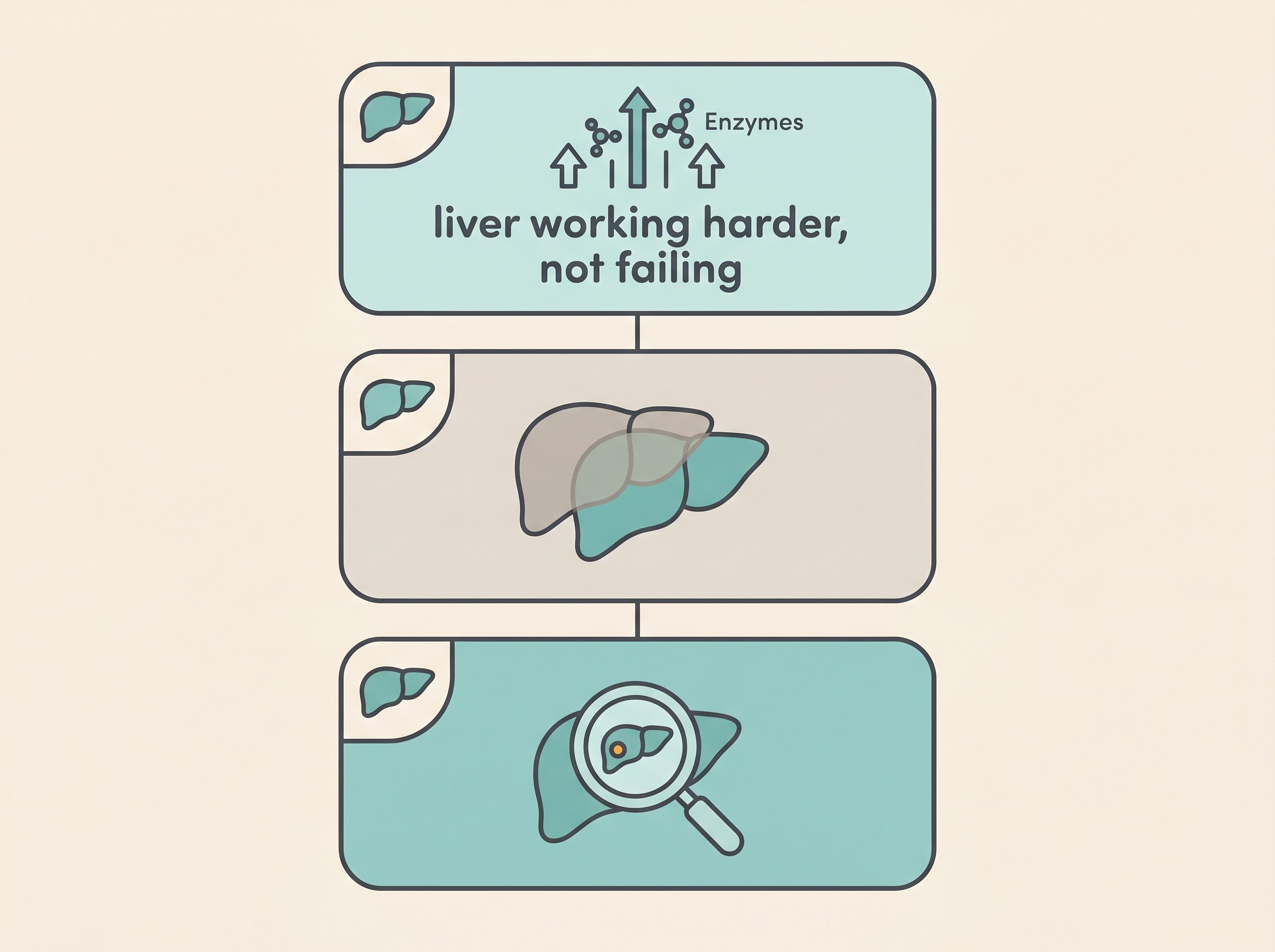
Layer one: most enzyme rises are induction, not damage. Phenobarbital is a microsomal enzyme inducer, which means it revs up the liver's enzyme-producing machinery, so the enzymes on a routine blood form, ALP and ALT, commonly rise in dogs whose livers have no injury at all. This isn't guesswork. In a controlled study, twelve healthy dogs were given phenobarbital for 29 weeks at therapeutic levels, and although their ALP and ALT rose significantly, there was no histological evidence of liver damage when the tissue was examined, and the markers that reflect genuine injury, AST, fasting bile acids and bilirubin, did not change (Müller et al., 2000). So a number going up is usually the liver working harder, not failing, which is why bile acids, bilirubin, albumin and AST are better windows onto true injury than ALP or ALT alone (Müller et al., 2000; Bhatti et al., 2015).
Layer two: induction and injury can't always be cleanly separated, and the level matters. Here's the counterweight. A liver-biopsy study comparing epileptic dogs on phenobarbital, all with raised enzymes, against untreated controls found that serum ALP and ALT could not reliably tell harmless induction apart from early liver injury, and some treated dogs did show changes in the tissue itself (Gaskill et al., 2005). So a raised enzyme is usually benign induction, but it can't simply be waved away, and that ambiguity is why monitoring exists. The single most useful number to carry: serum phenobarbital concentrations above 35 µg/mL (the same as 35 mg/L) carry a higher risk of liver toxicity and are deliberately avoided (Bhatti et al., 2015; Müller et al., 2000). Staying inside the target range is how the liver is kept safe.
Layer three: serious liver toxicity is real, but rare, and monitoring is designed to catch it. Genuinely dangerous, idiosyncratic liver toxicity does happen, but it's uncommon, sitting alongside other rare but serious effects: blood-cell abnormalities (anaemia, low platelets, low white cells), a skin condition called superficial necrolytic dermatitis, a possible pancreatitis risk, and a movement disorder called dyskinesia. All are uncommon and potentially reversible if the drug is withdrawn under veterinary guidance (Bhatti et al., 2015). The signs of true chronic liver trouble you'd act on are new or worsening sedation, poor appetite, weight loss, weakness, jaundice (yellow gums or eyes), a swollen belly, or a behaviour change, and any of those warrants a prompt vet call (Bhatti et al., 2015). As a UK veterinary neurology service puts it, phenobarbital is generally well tolerated and effective, serious liver toxicity is rare, and routine blood monitoring exists specifically to catch a problem before it becomes dangerous (Movement Referrals UK neurology, 2026; Bhatti et al., 2015). That's a world away from "it destroys the liver".
That monitoring is meant to be light-touch and predictable. Before starting, your vet takes a baseline: a full blood count, biochemistry (with cholesterol and triglycerides) and a bile acid stimulation test (Bhatti et al., 2015). After the early levels at two and six weeks, bloods and levels are repeated at three months and thereafter roughly every six months in a well-controlled dog, yearly in remission (Bhatti et al., 2015). What the numbers actually mean is handed to therapeutic drug monitoring.
Never stop suddenly, and the missed-dose question
This one is non-negotiable: never stop phenobarbital abruptly. Pulling it away suddenly can trigger cluster seizures or status epilepticus, a genuine emergency (Bhatti et al., 2015). If your dog ever does need to come off it, it's done slowly, with the consensus advising a reduction of 20% or less per month, always under your vet's direction (Bhatti et al., 2015). This holds even on the bad days when the side effects have you tempted to just stop. Don't. Ring your vet instead.
A missed dose is far less dramatic. The general rule: give it when you remember, unless it's nearly time for the next dose, in which case skip it and carry on, and never double up to "catch up" (PetMD and VCA missed-dose guidance, 2026). Because the right move can depend on how late the dose is, agree a plan with your vet in advance. The habit side, the pill organisers and reminders, lives in giving medication reliably.
If you have a cat
Most of this article is dog-led, but phenobarbital matters just as much for cats, where it's the first-line anti-seizure drug ahead of levetiracetam, though the feline evidence is thinner and rests on smaller studies (Charalambous et al., 2018). And here's a cheering piece of news on the very question that frightens dog owners: cats show very little of that liver-enzyme induction. A study of 33 epileptic cats found no significant change in any serum liver enzyme or biochemical value during phenobarbital treatment, and the authors concluded that phenobarbital "appeared to be a serum hepatic enzyme inducer in only a minority of cats, contrary to what is reported in dogs", strengthening its safety profile in cats (Hermans et al., 2022). Doses and targets in cats run a touch lower, and in that study three of the nine cats whose level rose above 30 µg/mL showed an ALT rise (Hermans et al., 2022; Charalambous et al., 2018). That's a concept, not a dosing instruction, which remains your vet's job.
One feline safety point belongs here, because getting drug names wrong in cats is dangerous. Potassium bromide is contraindicated in cats, as it carries a risk of fatal lower-airway disease, and imepitoin isn't licensed for cats, which is part of why phenobarbital is the feline mainstay (Charalambous et al., 2018; Bhatti et al., 2015). If you've read about either as a cat option, don't act on it. The full cat-versus-dog picture lives in the drugs compared.
Where this leaves you
The forum thread had it backwards. Phenobarbital isn't a liver-destroying gamble. Its commonest "liver" finding is the liver working harder, its rare serious risks are real but uncommon, and its monitoring exists to keep your dog safe (Bhatti et al., 2015; Müller et al., 2000). Your job is gentler than you feared: give it time to reach steady state, give every dose on time, and never stop suddenly.
And keep logging. Record every seizure, side effect and dose in the Seizure Diary, because that record turns your next vet visit from a guessing game into a clear-eyed conversation about whether the dose is right. You and your vet want the same thing: a dog who's still very much themselves.
References
- - Bhatti SFM, De Risio L, Muñana K, Penderis J, Stein VM, Tipold A, Berendt M, Farquhar RG, Fischer A, Long S, Löscher W, Mandigers PJJ, Matiasek K, Pakozdy A, Patterson EE, Platt S, Podell M, Potschka H, Rusbridge C, Volk HA. International Veterinary Epilepsy Task Force consensus proposal: medical treatment of canine epilepsy in Europe. BMC Veterinary Research. 2015;11:176.
- - Charalambous M, Pakozdy A, Bhatti SFM, Volk HA. Systematic review of antiepileptic drugs' safety and effectiveness in feline epilepsy. BMC Veterinary Research. 2018;14:64.
- - Epiphen and Phenoleptil. UK veterinary product information (VMD Product Information Database / NOAH; retailer datasheets). Accessed 2026.
- - Gaskill CL, Miller LM, Mattoon JS, Hoffmann WE, Burton SA, Gelens HCJ, Ihle SL, Miller JB, Shaw DH, Cribb AE. Liver histopathology and liver and serum alanine aminotransferase and alkaline phosphatase activities in epileptic dogs receiving phenobarbital. Veterinary Pathology. 2005;42(2):147-160.
- - Hermans M, Charalambous M, Pakozdy A, Eisl-Glantschnigg U, Neßler J, Van Meervenne SAE, Serrano G, Cornelis I, Van Ham L, Paepe D, Broeckx BJG, Bhatti SFM. Evaluation of the effect of phenobarbital administration on the biochemistry profile, with a focus on serum liver values, in epileptic cats. Journal of Feline Medicine and Surgery. 2022;24(8):e137-e145.
- - Movement Referrals (UK veterinary neurology service). Owner information: "Phenobarbital and the liver." Accessed 2026.
- - Müller PB, Taboada J, Hosgood G, Partington BP, VanSteenhouse JL, Taylor HW, Wolfsheimer KJ. Effects of long-term phenobarbital treatment on the liver in dogs. Journal of Veterinary Internal Medicine. 2000;14(2):165-171.
- - PetMD; VCA Animal Hospitals. Phenobarbital client-medication information (missed-dose handling). Accessed 2026.
Keep track of how your pet is doing
The owners who cope best are the ones who notice changes early. A simple health log shows you what is working, and what is not, before the next vet visit.
Start tracking, freeYou're not doing this alone
Compare treatment journeys and talk to owners managing epilepsy. Free to join.
Join PetsLikeMine