

Giving Medication Reliably (and Never Stopping Abruptly)
Alastair Greenway
BVM&S MRCVS
When a pet is diagnosed with epilepsy, the part nobody warns you about isn't the decision to medicate or the seizures themselves. It is the ordinary, relentless business of getting a tablet into an animal twice a day, every day, on roughly the same schedule, for the rest of their life, without missing so many that the protection slips. That is a real job, and most owners are quietly winging it.
So this article is the practical one. Not the science of which drug, but the daily system that keeps the medication going, plus the one rule that matters more than all the others put together: you never stop anti-seizure medication suddenly. For most pets with idiopathic epilepsy this is a lifelong daily commitment rather than a course you finish (Bhatti et al., 2015), and a good routine takes a huge amount of stress out of living with the condition, for your pet and for you.
Why the timing actually matters
Your vet is particular about "twice a day, roughly twelve hours apart" not out of fussiness but out of pharmacology. Anti-seizure drugs work by holding a steady level in the blood, high enough to keep the brain's electrical activity calm, and that level depends on you topping it up before the previous dose wears off.
How forgiving a given drug is comes down to how fast it clears. Phenobarbital, the most common first-line drug, is given twice daily at a typical starting dose of 2.5 to 3 mg/kg, and it takes around 30 to 45 days for the blood level to fully stabilise after you start it or change the dose (Bhatti et al., 2015). The twelve-hour rhythm exists to hold that level steady once it is there. Imepitoin (Pexion), licensed for dogs, is likewise twice daily (Bhatti et al., 2015). Levetiracetam (Keppra) is the one that really tests a household: its half-life is only 3 to 6 hours, which "necessitates frequent administration", usually three or four times a day for the standard formulation, and that frequency is its practical adherence challenge (Bhatti et al., 2015). If your pet is on it, you will need a system built around midday, not just breakfast and dinner. (Imepitoin isn't licensed for cats, and bromide must never be used in cats at all, so a feline drug list is shorter, usually phenobarbital first and levetiracetam second.)
At the other end sits potassium bromide, for dogs only, which has a very long half-life of 25 to 46 days and takes around three months to reach steady state (Bhatti et al., 2015). For a drug like that, one missed dose barely registers against the reservoir already in the body. For phenobarbital and especially levetiracetam, though, a missed or mistimed dose lets the blood level dip, and a dip is a window a seizure can slip through. As the standard owner-facing guidance puts it, giving the drug on a regular schedule is very important, and missing even one dose can sometimes allow a seizure (VCA Animal Hospitals). So how much a single slip matters depends on the drug, which brings us to the question every owner asks sooner or later.
What to do when you miss a dose
You will miss a dose eventually. Everyone does. What matters is what you do next, and there are two halves to it: a practical rule, and some perspective so you don't spiral.
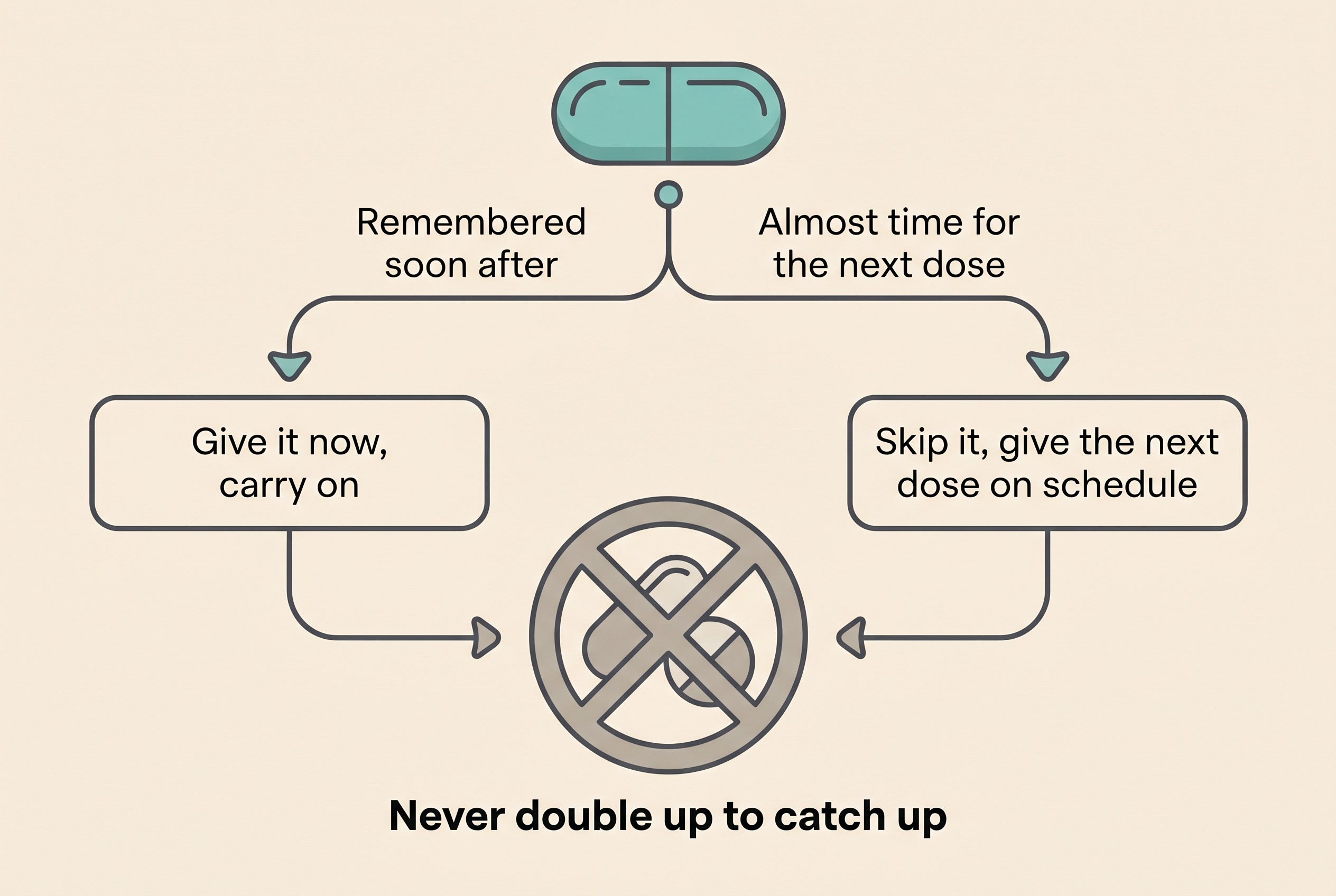
The rule, which is the standard owner-facing guidance for phenobarbital and a sensible default for the short-acting drugs, goes like this. If you miss a dose, give it when you remember. If it is already close to the time for the next dose, skip the missed one, give the next dose at the normal time, and carry on. Never give two doses at once and never give extra doses to "catch up" (VCA Animal Hospitals). That last part is what people get wrong out of guilt, and it is the dangerous bit. Doubling up doesn't restore yesterday's protection. It just risks toxic over-sedation today.
Now the perspective, because I have watched owners lie awake convinced that one forgotten tablet has endangered their dog. It almost certainly hasn't. A recent prospective study in people with epilepsy found no evidence that occasionally missing a dose significantly increased short-term seizure risk (a missed dose the day before had no meaningful relationship to whether a seizure happened, p = 0.68), while still recommending consistent adherence and noting that prolonged non-adherence stays concerning (Goldenholz et al., 2025). That is human data and a preliminary preprint, so hold it lightly, but the message is kind: one occasional slip is not a catastrophe, and a reliable system over the long run is what protects your pet.
There is an important caveat, and it is why I keep saying "a sensible default" rather than "the rule". It genuinely varies by drug: a missed bromide dose matters far less than a missed levetiracetam dose, because of those wildly different half-lives. So ask your vet what to do if you miss a dose of your pet's particular drug, write it down somewhere you will find it at 7am, and don't generalise from a forum post about a different medication.
Above everything else: never stop suddenly
You do not stop an anti-seizure drug abruptly. It must be reduced slowly, under your vet's direction (VCA Animal Hospitals).
The reason is serious enough to spell out. Stopping suddenly, or letting the level crash, can trigger withdrawal seizures or even status epilepticus, the prolonged seizing that is a genuine emergency. To avoid that, veterinary consensus is that when a drug is being withdrawn or switched, the dose should be reduced by no more than 20% per month (Bhatti et al., 2015). That is a slow, vet-supervised taper, never an owner decision made at the kitchen table.
This rule holds no matter why the thought has crossed your mind. "It has been working so well, surely we can stop now?" No, not without your vet, and not quickly. "I want to try CBD or a diet instead." That is a conversation for your vet, who can guide any change safely, and those options both point back to the never-stop rule here. "The side effects are getting to me." Understandable, and the answer is to ring your vet, not to stop, because there are often ways to ease them, covered in managing medication side effects. Whatever the plan, you taper, you don't quit.
The same logic is why running out of tablets is more dangerous than it sounds, and the best argument there is for the practical systems we are coming to.
Adherence is harder than anyone admits
A word of reassurance first, because owners are often quietly ashamed of how often they slip. You are not unusually disorganised. Adherence in canine epilepsy is subpar across the board, and a recognised management problem rather than a personal failing. The numbers are sobering: in a survey of owners of dogs on anti-seizure medication, overall median compliance was just 56%, only 33% of owners were more than 80% compliant, and only 21% managed 100%, with dogs missing a median of 6 days of treatment during the spells when owners fell off the wagon (Booth et al., 2021). So if you have been beating yourself up over the odd missed dose, breathe out. The goal isn't a perfection almost nobody achieves. It is a system good enough to keep you well inside the protective range.
Two findings from that work are quietly useful. Counter-intuitively, dogs on more than one drug had better compliance than dogs on a single drug, and lower daily dosing was associated with better compliance (Booth et al., 2021), so it is worth asking your vet whether your pet's schedule could be simplified if you are struggling. And in people with epilepsy, forgetting medication is associated with poorer seizure control, and the single most commonly forgotten dose is the evening one (Suzuki et al., 2020). That rings true for pets too. Mornings have a natural anchor in breakfast; evenings are when life gets messy, so build your system around protecting that evening dose in particular.
Building a system that actually holds
Here is the practical scaffolding. None of it is clever; it just needs to be consistent.
Anchor every dose to something that already happens. Tie tablets to meals, to your morning coffee, to the moment you lock the door at night. The aim is to ride the twelve-hour rhythm on the back of habits you never skip, so the medication stops being a separate thing to remember.
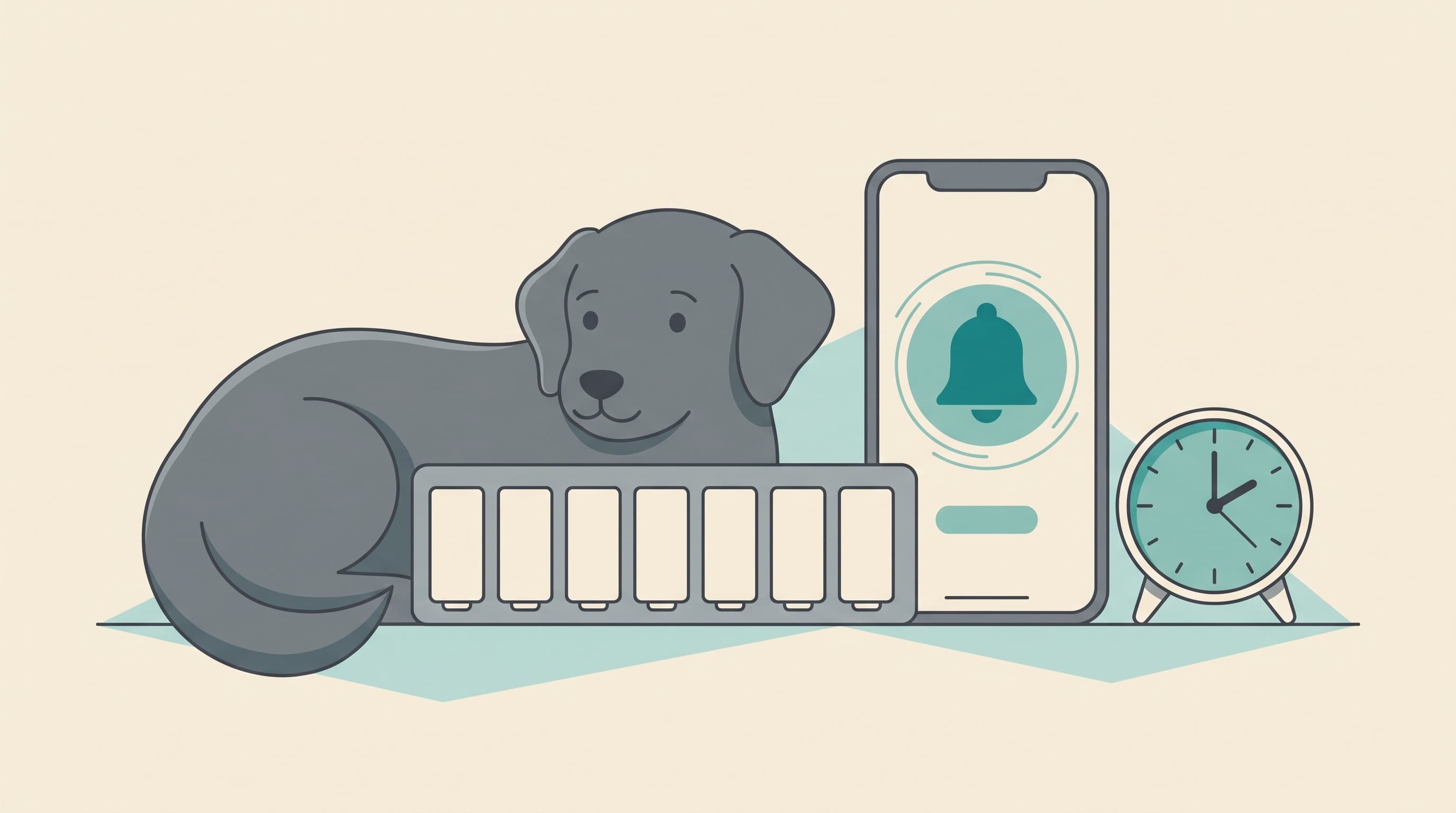
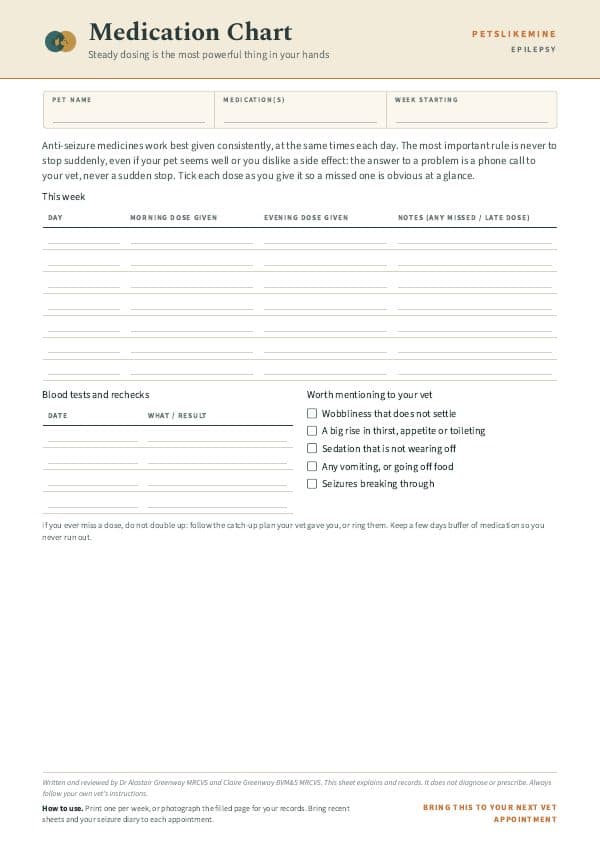
Stack your reminders. A daily phone alarm for each dose is the single easiest win, and a weekly pill organiser lets you see at a glance whether a compartment is still full. Best of all, log every dose, and every missed one, in the Seizure Diary, whose adherence tracking means slips get captured rather than forgotten and any link between a missed dose and a seizure becomes visible to you and your vet.
Get the pilling technique sorted. For many dogs, a small amount of high-value food or a commercial pill pocket does the job, and you can give most of these drugs with food where the label allows. Cats are genuinely harder: gentle restraint, a pill-giver and, above all, asking your vet or nurse to demonstrate the technique on your cat will save you weeks of struggle. Flavoured or compounded formulations exist too, though not every drug can be reformulated, so check with your vet first.
In a multi-pet household, slow down and separate. Dose each animal individually and confirm the right pet got the right tablet, because dosing in busy homes is messier than anyone admits and a pill in the wrong dog is two problems at once.
Plan for time away before it arrives. For travel or boarding, take enough in-date medication plus a buffer, keep it in its original labelled packaging, and brief whoever is caring for your pet in writing: the exact schedule, and the never-stop rule.
Treat repeat prescriptions as a standing task. Order refills well before you run out, not on the last tablet. An empty bottle is an accidental abrupt withdrawal, and you now know exactly why to avoid that.
None of these on their own is impressive, but together they turn a daunting lifelong responsibility into something that runs quietly in the background of an ordinary life. Most owners find that after a month or two the routine becomes as automatic as feeding, and the anxiety fades alongside it. Start logging in the Seizure Diary today and bring it to your next appointment. It is the difference between guessing and knowing, for both of you.
References
- Bhatti, S. F. M., De Risio, L., Muñana, K., Penderis, J., Stein, V. M., Tipold, A., Berendt, M., Farquhar, R. G., Fischer, A., Long, S., Löscher, W., Mandigers, P. J. J., Matiasek, K., Pakozdy, A., Patterson, E. E., Platt, S., Podell, M., Potschka, H., Rusbridge, C., & Volk, H. A. (2015). International Veterinary Epilepsy Task Force consensus proposal: medical treatment of canine epilepsy in Europe. BMC Veterinary Research, 11, 176.
- Booth, S., Meller, S., Packer, R. M. A., Farquhar, R., Maddison, J. E., & Volk, H. A. (2021). Owner compliance in canine epilepsy. Veterinary Record, 188(4), e16.
- Goldenholz, D. M., Cheng, J. C., Chang, C.-Y., et al. (2025). Does missing medication acutely change seizure risk? A prospective study. medRxiv (preprint), 2025.06.06.25329144.
- Suzuki, H., Mikuni, N., Ohnishi, H., Yokoyama, R., Enatsu, R., & Ochi, S. (2020). Forgetting to take antiseizure medications is associated with focal to bilateral tonic-clonic seizures, as revealed by a cross-sectional study. PLoS ONE, 15(10), e0240082.
- VCA Animal Hospitals. Phenobarbital (client medication handout). vcahospitals.com. Retrieved from
Free downloads
Companion worksheets to put what you've read into practice. Free PDFs, print at home.
Keep track of how your pet is doing
The owners who cope best are the ones who notice changes early. A simple health log shows you what is working, and what is not, before the next vet visit.
Start tracking, freeYou're not doing this alone
Compare treatment journeys and talk to owners managing epilepsy. Free to join.
Join PetsLikeMine