

The First Weeks on Medication: What to Expect
Alastair Greenway
BVM&S MRCVS
The tablets have started, and so has the question almost every owner asks in the first few days: is this working, or have we got it wrong? Your dog may be sleepy and a bit wobbly. They may have had another seizure since you began. Either way, doing something at last brings relief and worry in roughly equal measure, and the worry tends to win at 2am.
Here's what settles that question. The first few weeks on an anti-seizure drug are an adjustment period for both of you, and almost everything that frightens owners in this window is normal and temporary. Take the two things people fret about most: early wobble and sleepiness, and a seizure that still happens after starting. Both usually mean the opposite of what they seem to. Not that the drug has failed, but that you're in the early phase, before the medicine has had time to do its job. The deeper detail of each drug, the dose changes and the blood-test numbers have their own homes, and I'll point you to them as we go.
Why the drug needs time: steady state
Almost no owner is told this clearly. When you start a daily medicine, the level in the bloodstream doesn't jump to its working concentration overnight. It climbs, dose by dose, until the amount going in each day balances the amount the body clears. That plateau is called steady state, and until your dog reaches it, the drug hasn't got to the level it needs to work at (Bhatti et al., 2015). So a seizure in the first days or weeks does not mean the medicine has failed. It may not have arrived yet. How long that takes differs enormously by drug, which is the part that catches people out.
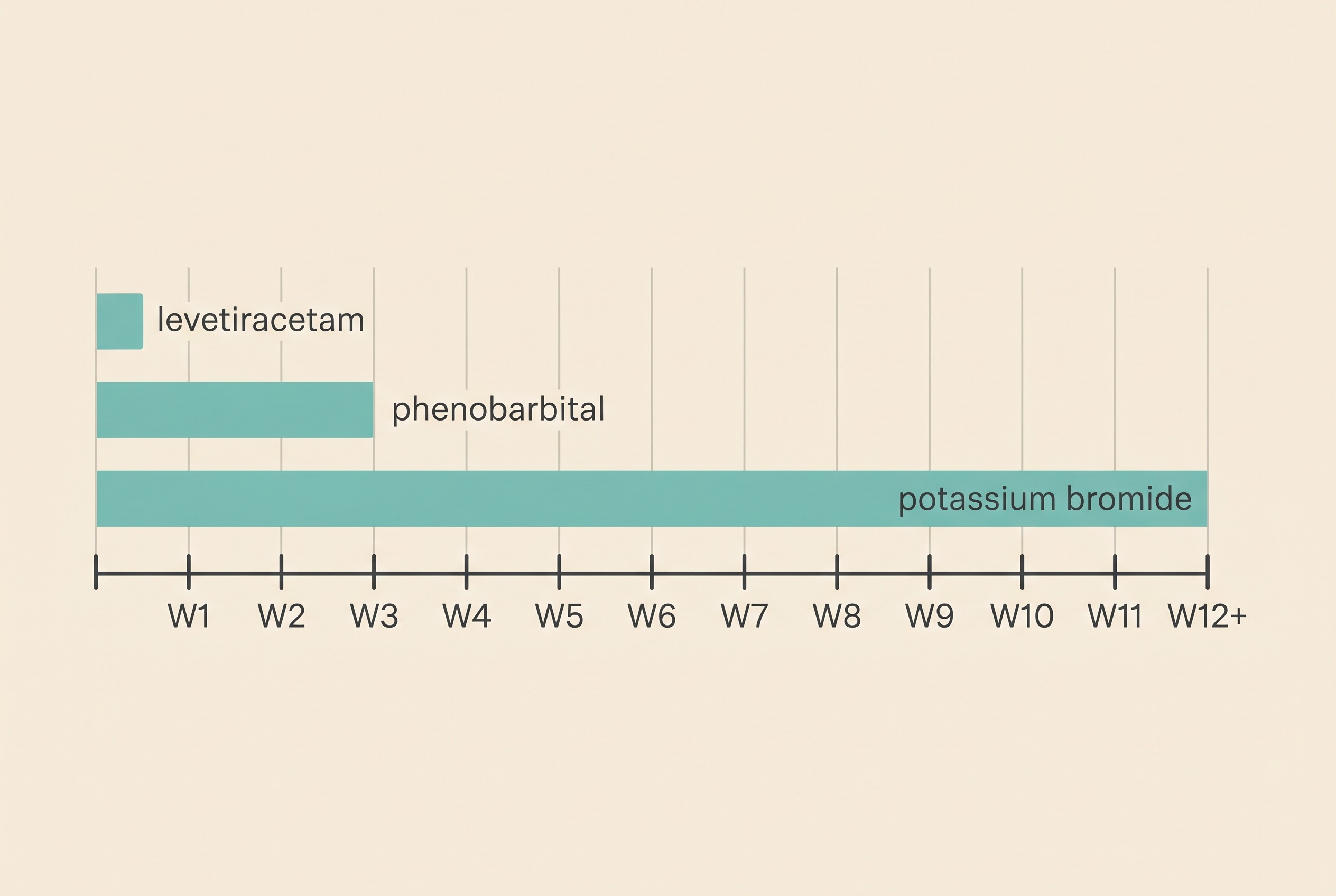
Phenobarbital, the most common first-line drug in dogs and the first choice in cats, takes roughly two to three weeks to reach steady state (MSD Veterinary Manual, 2026). Its half-life is long, around 37 to 73 hours after repeated dosing, which is why it climbs slowly (Bhatti et al., 2015). So you genuinely cannot judge how well it's working in the first few days. The real assessment comes a couple of weeks in, which is why your vet books that first blood test at the fortnight mark.
Potassium bromide is the slow one, so if your dog has been started on it, brace for a longer wait. It takes approximately three months to reach steady state, with a half-life of 25 to 46 days (Bhatti et al., 2015; MSD Veterinary Manual, 2026). Seizures continuing for weeks on bromide are expected, not failure. A loading-dose protocol can speed this up when faster control is needed, at the cost of more early sedation, but that detail belongs in the drug comparison guide. For now, bromide is simply the worked example of "slow to take effect, be patient." (It isn't used in cats, by the way. More on that below.)
Imepitoin (Pexion) and levetiracetam (Keppra), both used in dogs, behave quite differently. Imepitoin works fast, typically improving things within the first week, and given twice daily it doesn't need routine blood-level monitoring (Bhatti et al., 2015; NDSR, 2026). Levetiracetam is quicker still, reaching steady state within a few days on its short half-life (Bhatti et al., 2015). So the "wait weeks then check a level" story is really a phenobarbital and bromide one, and the anxious early window is much shorter on these two.
Early side effects, and why most settle
The other thing that frightens owners is the change in the dog in front of them. On phenobarbital especially, the common early effects are sedation, ataxia (a wobbly, slightly "drunk" gait, often worst in the back legs), and a noticeable jump in hunger, thirst and weeing (MSD Veterinary Manual, 2026). It's unnerving to watch your normally bright dog go quiet and unsteady.
The reassurance here is well documented. The neurological effects, the sedation and the wobble, typically ease over the first ten to fourteen days as your dog develops tolerance, even though the increased appetite, thirst and urination can hang around longer (MSD Veterinary Manual, 2026). So the sleepy, swaying dog of the first few days is usually not your new normal. It tends to lift within a week or two.
That same early-and-transient pattern shows up with imepitoin. In the field trial that compared it against phenobarbital in 226 dogs, the adverse effects occurred mostly at the start of treatment, and sedation, increased thirst and increased appetite were all significantly less common with imepitoin than with phenobarbital (Tipold et al., 2015). Its licensing information lists the common reactions, including increased appetite, drowsiness and wobbliness, as mostly mild and transient (EMA, 2026). Whichever drug your dog is on, early sleepiness or unsteadiness is usually the body adjusting.
Telling normal-and-settling apart from what-needs-action, plus weight gain and the rarer red flags, is a subject of its own. That lives in managing medication side effects.
What to track, and the first blood test
These early weeks are when good record-keeping earns its keep, because the evidence your vet uses at the recheck is whatever you've written down. Track every seizure (date, time, duration, what it looked like, how the recovery went), every dose given or missed, and the side effects you're seeing. Seizure frequency before treatment versus after is the single metric the medicine is judged against once steady state is reached (Bhatti et al., 2015; Potschka et al., 2015). This is exactly what the Seizure Diary is built to capture: it times the event, charts the frequency so you see the trend, and gives you a record to take straight to the consult. Filming a seizure and keeping the diary are the two most useful things any owner can do, and never more so than in these first uncertain weeks.
A word on that first blood test, because it surprises people. For phenobarbital, the first blood level is recommended around 14 days after starting, to confirm the drug has climbed to a sensible working level and to give your vet a baseline for any dose change (Bhatti et al., 2015). Bromide is also monitored by blood level, usually checked around four weeks in (when it's only roughly half of its eventual level) and again later. Imepitoin and levetiracetam aren't routinely monitored this way (Bhatti et al., 2015; NDSR, 2026). What those numbers mean, and the schedule over time, is owned by therapeutic drug monitoring. For now, a blood test a fortnight in is the plan working, not a warning sign.
Hold one nuance lightly here: seizures naturally bunch up and space out on their own, and in a review of placebo-controlled canine epilepsy trials, 22 of 28 dogs (79%) on a dummy treatment still showed a drop in seizure frequency (Muñana et al., 2010). That's not a reason to doubt your dog's medicine. It's why a quiet first fortnight is encouraging rather than proof, and why vets judge a drug over weeks to months.
When to call the vet during the adjustment window
Most of what happens in these first weeks is normal. A few things aren't, and knowing the difference lets you relax about the rest.
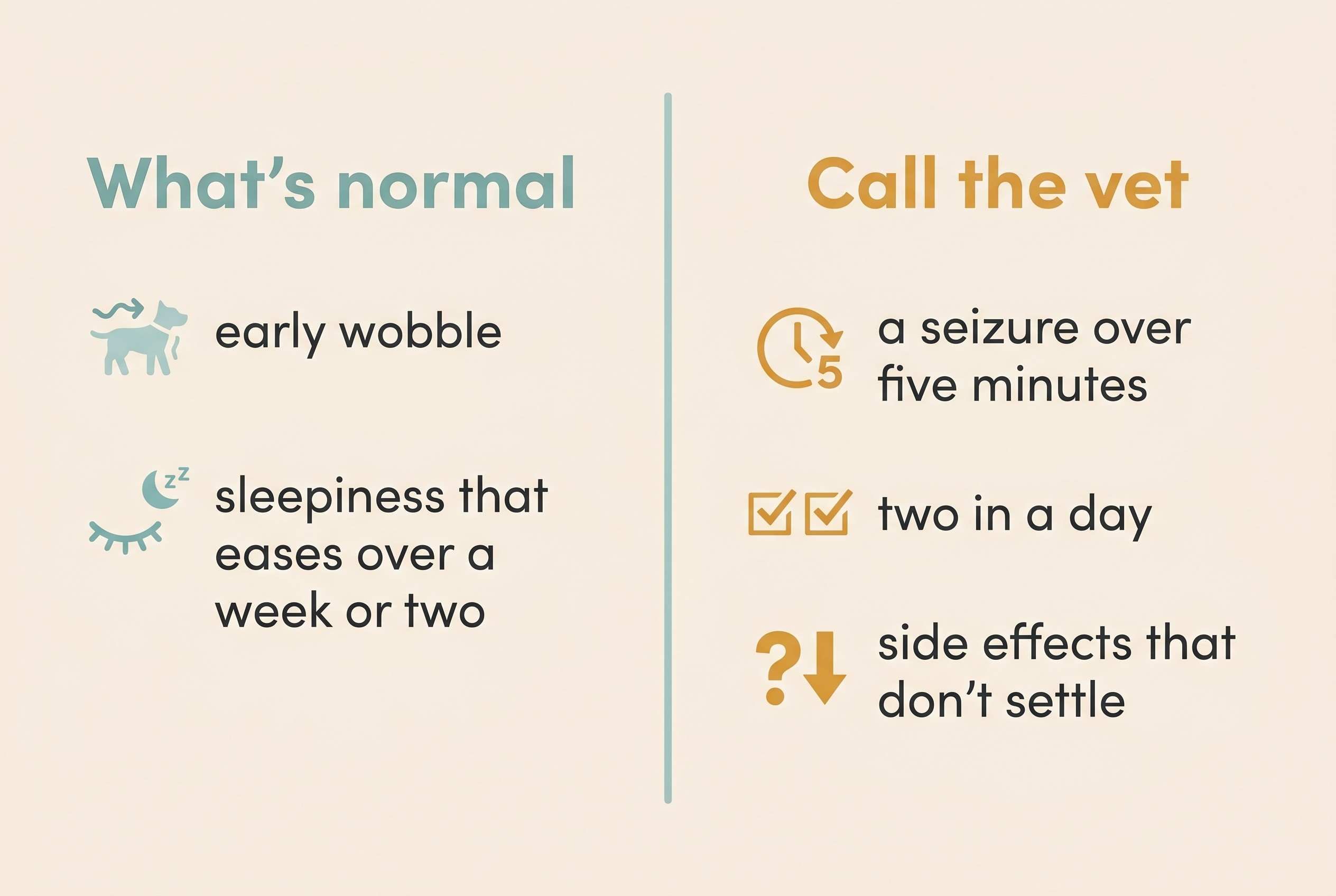
The emergency line still applies in full while starting medication. Starting a drug changes nothing here. A seizure lasting more than five minutes, two or more seizures in 24 hours, or seizures running into each other without your dog recovering in between is an emergency: get to a vet or emergency clinic now (Bhatti et al., 2015). A single short seizure with a normal recovery is frightening but not, by itself, an emergency. If your dog is prone to the worrying patterns, status epilepticus and cluster seizures covers the thresholds and what to do.
Side effects that are severe, frightening, or simply not improving after about two weeks warrant a call rather than a wait. A dog so sedated it won't eat or drink, a marked wobble that isn't easing, vomiting, yellow gums, or any collapse are all reasons to ring your vet (MSD Veterinary Manual, 2026). The early sleepiness should be lifting by the end of the second week. If it isn't, that's worth a conversation.
And the one rule that matters more than any other: never stop or cut the dose on your own to escape the side effects. Abruptly withdrawing an anti-seizure drug can trigger cluster seizures or even status epilepticus (Bhatti et al., 2015). If the side effects are hard to live with, ring your vet, because dose changes are made gradually and on advice, never on impulse. The deeper how-to of consistent dosing and the never-stop-abruptly rule lives in giving medication reliably.
Looking after yourself, too
It would be a half-told story to write about these first weeks and only talk about the dog. This period is often the hardest part of the whole journey for the human at the other end of the lead, and that's not weakness. It's well recognised: owners of dogs with epilepsy commonly live with fear, stress, uncertainty and a kind of hypervigilance, always braced for the next seizure. One study captured it in its title, taken from an owner's own words, "We have a ticking time bomb" (Pergande et al., 2020). New diagnosis, new drug, side effects to read, seizures that may still happen: it's a lot at once.
So name it, then lean on the practical anchors. A predictable dosing routine gives the days a shape. The Seizure Diary is a genuine way to feel in control and watch the trend bend rather than living event to event. And the questions that feel silly at 2am are the ones your vet would rather you asked. The deeper emotional side lives in the emotional toll of epilepsy.
A note for cat owners
Caring for a cat? The same principles hold: give the medicine time, track everything, and never stop a drug abruptly. The feline first-line drug is phenobarbital, which follows the same pattern as in dogs, the same early-and-settling side effects and the same roughly two-to-three-week climb to a blood-level check (Bhatti et al., 2015; MSD Veterinary Manual, 2026). Levetiracetam is the usual second choice. Two cautions are not negotiable, though. Potassium bromide is not used in cats, because it carries a risk of severe and sometimes fatal lung disease, and imepitoin isn't licensed for cats (MSD Veterinary Manual, 2026). So don't apply the bromide or imepitoin parts above to your cat. The drug-by-drug detail for cats is covered in the drug comparison guide.
Where this leaves you
The first few weeks are an adjustment period, for the medicine and for both of you. Early wobble and sleepiness usually settle within a week or two. The drug needs time, sometimes days, sometimes months, to reach the level where it works, so a seizure in this window is not the drug failing. A steady routine and a reliable diary are how you and your vet steer the dose from here.
It helps to hold the right goal in view, too. The aim was never to cure epilepsy, because medicine can't do that. The aim is fewer, milder seizures, and a "responder" usually means at least halving how often they happen. Most dogs come out the other side of this window doing genuinely well, and what that realistic success looks like is the natural next read: realistic goals, control not cure. For now, keep giving the tablets, keep the diary, and give it the time it needs. You're doing the right thing.
References
- Bhatti, S. F. M., De Risio, L., Muñana, K., Penderis, J., Stein, V. M., Tipold, A., Berendt, M., Farquhar, R. G., Fischer, A., Long, S., Löscher, W., Mandigers, P. J. J., Matiasek, K., Pakozdy, A., Patterson, E. E., Platt, S., Podell, M., Potschka, H., Rusbridge, C., & Volk, H. A. (2015). International Veterinary Epilepsy Task Force consensus proposal: medical treatment of canine epilepsy in Europe. BMC Veterinary Research, 11, 176.
- European Medicines Agency. (2026). Pexion (imepitoin): Summary of Product Characteristics / EPAR product information. Boehringer Ingelheim Vetmedica GmbH. Retrieved 10 June 2026, from
- MSD Veterinary Manual. (2026). Epilepsy in small animals. Merck & Co., Inc., Rahway, NJ, USA. Retrieved 10 June 2026, from
- Muñana, K. R., Zhang, D., & Patterson, E. E. (2010). Placebo effect in canine epilepsy trials. Journal of Veterinary Internal Medicine, 24(1), 166-170.
- North Downs Specialist Referrals. (2026). What is imepitoin (Pexion)? Client information sheet. Retrieved 10 June 2026, from
- Pergande, A. E., Belshaw, Z., Volk, H. A., & Packer, R. M. A. (2020). "We have a ticking time bomb": a qualitative exploration of the impact of canine epilepsy on dog owners living in England. BMC Veterinary Research, 16, 443.
- Potschka, H., Fischer, A., Löscher, W., Patterson, N., Bhatti, S., Berendt, M., De Risio, L., Farquhar, R., Long, S., Mandigers, P., Matiasek, K., Muñana, K., Pakozdy, A., Penderis, J., Platt, S., Podell, M., Rusbridge, C., Stein, V., Tipold, A., & Volk, H. A. (2015). International Veterinary Epilepsy Task Force consensus proposal: outcome of therapeutic interventions in canine and feline epilepsy. BMC Veterinary Research, 11, 177.
- Tipold, A., Keefe, T. J., Löscher, W., Rundfeldt, C., & de Vries, F. (2015). Clinical efficacy and safety of imepitoin in comparison with phenobarbital for the control of idiopathic epilepsy in dogs. Journal of Veterinary Pharmacology and Therapeutics, 38(2), 160-168.
Keep track of how your pet is doing
The owners who cope best are the ones who notice changes early. A simple health log shows you what is working, and what is not, before the next vet visit.
Start tracking, freeYou're not doing this alone
Compare treatment journeys and talk to owners managing epilepsy. Free to join.
Join PetsLikeMine