

What Causes Seizures in Cats
Alastair Greenway
BVM&S MRCVS
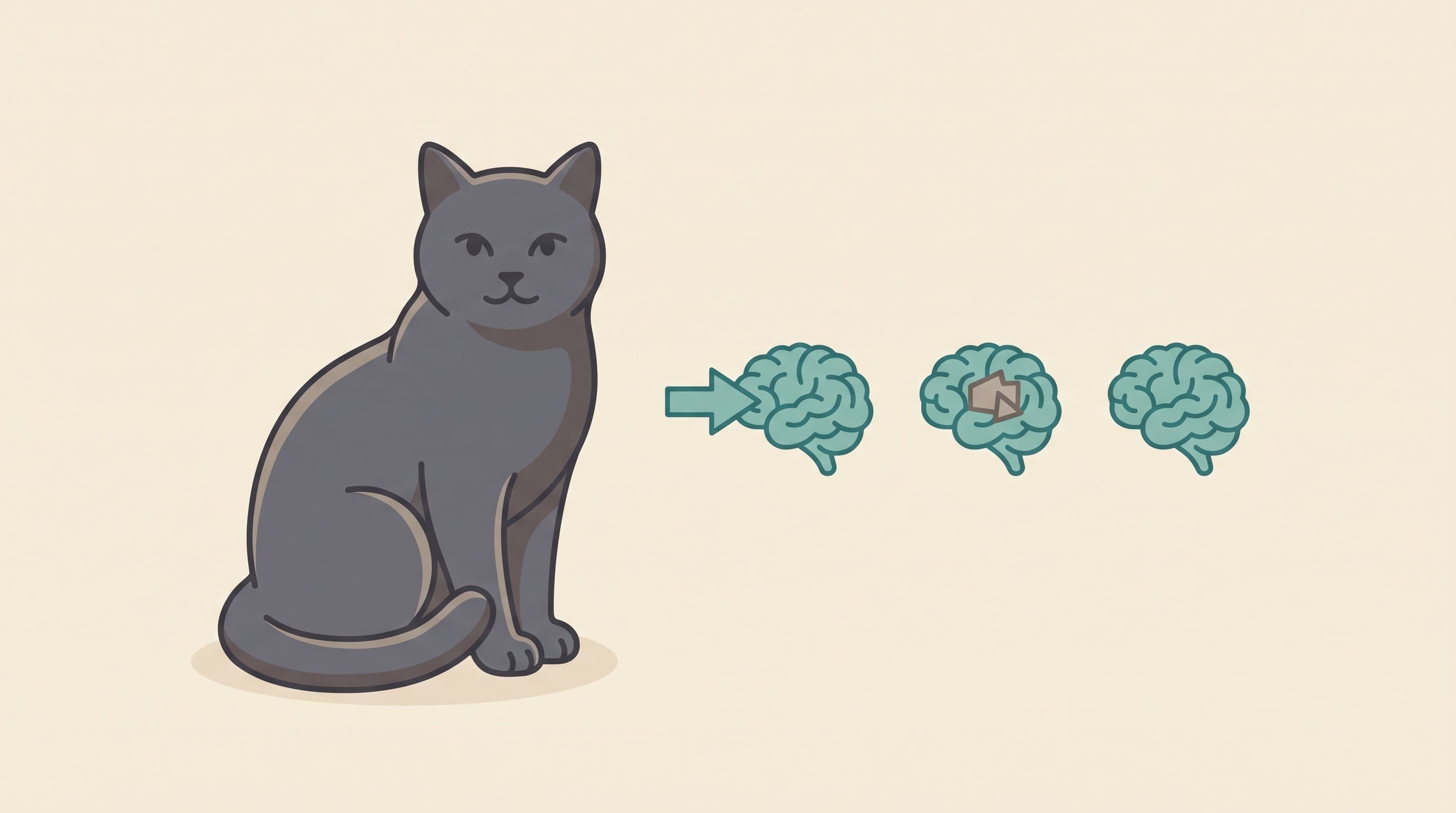
When a cat has a seizure, the first question an owner asks is why, and in cats the answer matters more than most people realise. In dogs, the most likely explanation by a wide margin is idiopathic epilepsy, a seizure disorder with no findable cause. Cats are different. A feline seizure is more often the brain's response to something else, a problem in the brain itself or elsewhere in the body, and that something is often treatable, sometimes dangerous, and occasionally an emergency.
This article is about the causes of feline seizures and why a vet will want to investigate sooner than you might expect. It isn't about what a seizure looks like in a cat, which lives in what seizures look like in cats. If you're not yet sure what you saw was a seizure at all, start there and come back.
Why cats aren't just small dogs here
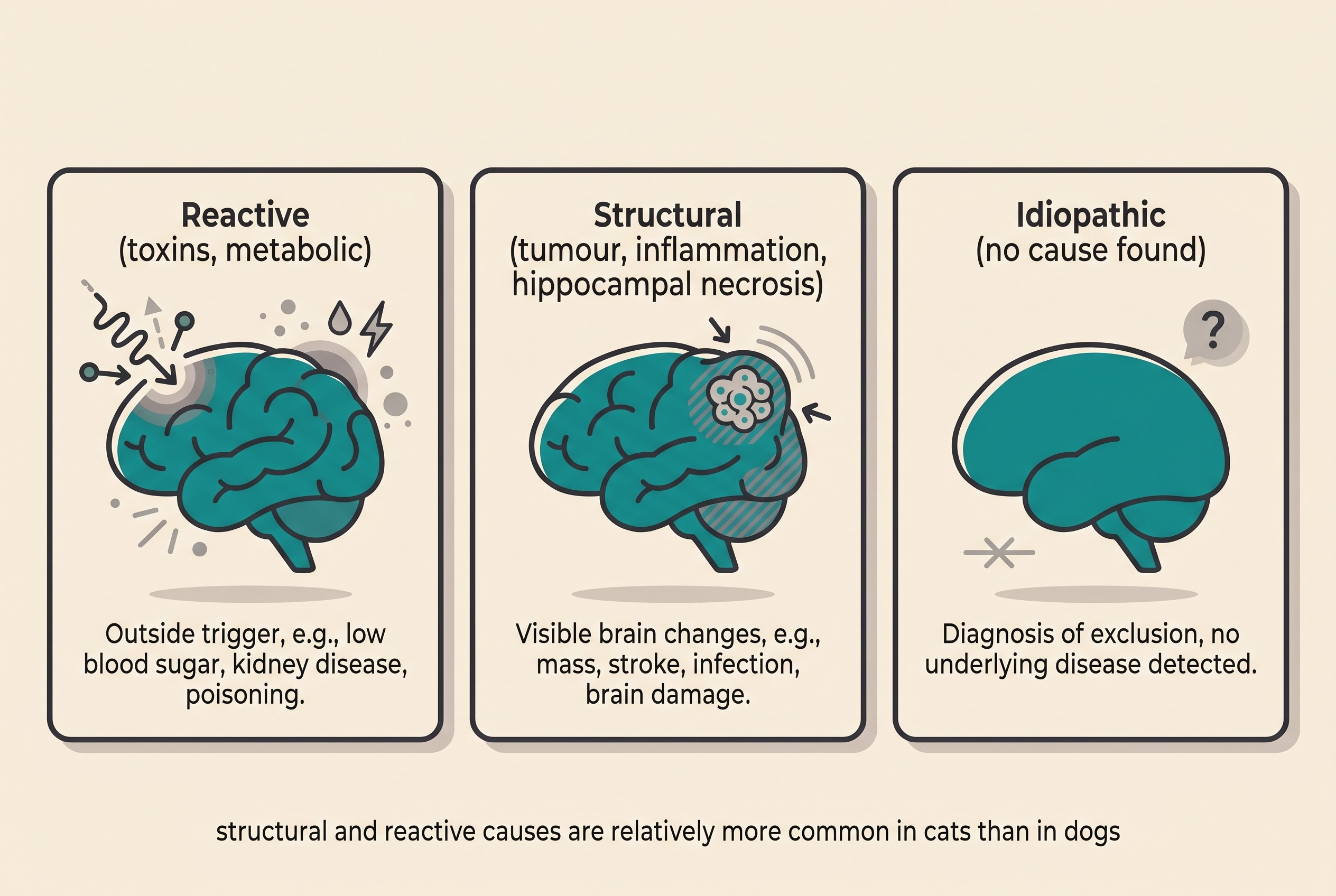
Vets sort seizures into three groups, and the framework is worth holding in your head because it shapes everything that follows. A reactive seizure is a normal brain reacting to a transient, reversible problem, a toxin or a metabolic upset such as low blood sugar. A structural seizure comes from a visible abnormality in the brain itself, a tumour, inflammation, a stroke. And idiopathic epilepsy means recurrent seizures with no structural or metabolic cause found, a presumed genetic or simply unknown origin, reached only by ruling the other two out (Berendt et al., 2015). That last phrase is the heart of why feline seizures are investigated the way they are: idiopathic epilepsy is a diagnosis of exclusion.
So what separates cats from dogs? In cats, structural and reactive causes are proportionately more common, and idiopathic epilepsy correspondingly less common, than in dogs (Moore, 2014; Hazenfratz & Taylor, 2018). The figures vary between studies, but the direction is consistent. In one series of 91 cats, structural disease accounted for around half of cases (50%), reactive causes for about a fifth (22%) and idiopathic epilepsy for roughly a quarter (25%) (Schriefl et al., 2008). A later review put idiopathic epilepsy anywhere from 22% to 57% of cats and intracranial structural disease at 40% to 70% (Hazenfratz & Taylor, 2018), while pooled data from three larger studies suggested roughly a third were idiopathic (Pakozdy et al., 2014).
One caveat is worth flagging. These are referral figures, drawn from cats sick enough to be sent to a specialist, so they over-represent serious disease, and the picture in a first-opinion clinic is probably less alarming. The fair summary is that studies suggest only around a quarter to a half of cats with seizures turn out to be idiopathic, a long way from the dog, and that's why your vet will want to look harder and sooner than a dog-centred article might lead you to expect.
Idiopathic epilepsy in cats is real, but it tends to start younger, with a first seizure typically between about one and seven years of age (Moore, 2014) and a mean onset of around three to five years (Hazenfratz & Taylor, 2018). Cats whose seizures begin later are more likely to have a structural cause, which is one reason age matters so much in how far the investigation goes.
Permethrin: the toxic cause every cat owner needs to know
If there is one cause of feline seizures every cat owner should know, it's this one, because it's common, life-threatening and almost entirely preventable. Permethrin and related pyrethroids, the insecticides in many dog flea spot-on treatments, are toxic to cats. Cats metabolise these compounds poorly, so an amount that's perfectly safe on a dog can poison a cat, and a seizure can be the result.
In a study of 42 cats with permethrin toxicity, a dog spot-on product had been applied in 41 of them, almost every single case (Boland & Angles, 2010). The commonest signs were tremors and muscle twitching (86%), with smaller fractions showing localised twitches (41%), hypersensitivity to touch (41%) and full seizures (33%) (Boland & Angles, 2010). Exposure usually happens one of two ways: an owner applies a dog product to their cat by mistake, or a cat grooms or shares a bed with a recently treated dog and picks up the chemical second-hand (VMD).
The encouraging part is that the outcome is generally good with prompt treatment. In that series of 42 cats, 34 survived to go home and only one was put to sleep (Boland & Angles, 2010). Other case series report higher death rates, so the accurate version is "good outcome when treated quickly", not "almost everyone survives regardless". Treatment can be intensive, using sedatives and anti-seizure drugs to control the tremors and seizures while the body clears the toxin.

The UK's Veterinary Medicines Directorate runs a public-safety message, "Permethrin: don't put your cat at risk", and its advice is worth committing to memory. Never use a dog-only spot-on on a cat, because even a small part of a single pipette can make a cat very unwell or kill it. Keep your cat away from a dog that's just been treated, and stop them grooming or licking it. And if a dog product is applied to a cat by mistake, wash it off with water and a mild detergent and seek immediate veterinary treatment (VMD). Be clear about that last point: permethrin toxicity is an emergency. Don't wait to see if it settles. If you think your cat has been exposed, ring your vet or an emergency clinic now. The same emergency threshold applies as for any feline seizure, which status epilepticus and cluster seizures covers in full.
Structural causes, and a feline-specific one worth knowing
Structural seizures come from something physically wrong inside the brain, and in cats this group is large. It includes brain tumours, with meningioma the commonest feline brain tumour and lymphoma also seen; inflammatory and infectious encephalitis, including feline infectious peritonitis, toxoplasmosis and cryptococcosis; vascular events such as small strokes and ischaemic encephalopathy; head trauma; and developmental abnormalities (Hazenfratz & Taylor, 2018; Moore, 2014). The point isn't to memorise the list. It's to see that a seizure in a cat opens the door to a wide range of brain conditions, which is why imaging the brain is on the table more readily than for many dogs.
One feline-specific pattern deserves a closer look. Some cats present with sudden clusters of strange orofacial signs: drooling and salivation, facial twitching, lip-smacking, chewing, licking or swallowing movements, episodes of staring motionlessly, and changes in behaviour (Pakozdy et al., 2011). This picture has a name, feline complex partial seizures with orofacial involvement, and behind a good number of these cats lies hippocampal necrosis, damage to a region of the brain involved in seizures and memory. In a study of 17 such cats, 11 had it confirmed under the microscope and six more showed suggestive MRI changes, typically a bilateral increase in signal in the hippocampus (Pakozdy et al., 2011). Reassuringly, the long-term outcome in cats that survive the acute phase can be good to excellent (Pakozdy et al., 2011).
And there's a fascinating twist. This syndrome is now understood as a feline form of autoimmune limbic encephalitis, in which the cat's own immune system produces antibodies (anti-LGI1, part of the VGKC-complex) that disrupt a particular part of the brain (Tröscher et al., 2017). The takeaway, beyond the immunology, is that there's a recognised and sometimes-treatable brain condition behind these orofacial seizures, which is precisely why a vet seeing this pattern will want to investigate rather than reach for a tablet and hope.
When the trouble starts elsewhere in the body
Beyond toxins, a cat's brain can be tipped into seizing by problems elsewhere in the body, several of them common feline conditions in their own right. Liver problems come first, particularly in younger cats, where a portosystemic shunt (an abnormal blood vessel that bypasses the liver) lets toxins build up and cause hepatic encephalopathy (Hazenfratz & Taylor, 2018). Hyperthyroidism, one of the commonest hormonal diseases of older cats, can contribute to seizures when severe, and it also drives high blood pressure (Moore, 2014). That blood pressure matters in its own right: systemic hypertension, often secondary to kidney disease or hyperthyroidism, can produce hypertensive encephalopathy, and a substantial minority of affected cats develop neurological signs including seizures, wobbliness and altered behaviour (Moretto et al., 2023). The list continues with end-stage kidney disease causing uraemic encephalopathy, low blood sugar, disturbances of electrolytes and calcium, thiamine (vitamin B1) deficiency and polycythaemia (Hazenfratz & Taylor, 2018; Moore, 2014).
The hopeful thread running through all of these is that they're problems of the body affecting the brain. Most are detectable on straightforward tests and treatable, a reactive seizure isn't epilepsy, and fixing the underlying problem can stop the seizures at their source.
Why prompt investigation matters
Pull all of this together and you can see why the standard recommendation is that every cat with recurrent seizures should have a clinical and diagnostic evaluation to exclude metabolic and intracranial causes before anyone settles on idiopathic epilepsy (Moore, 2014; Hazenfratz & Taylor, 2018). It's not overcaution. It follows directly from the fact that, in cats, the odds of finding a real, treatable cause are genuinely high. A seizure here is a symptom to investigate, not just a condition to suppress. The actual tests and what they cost are covered in the diagnostic work-up.
The single most useful thing you can do to help is something only you can provide. Seizures almost never happen in the consulting room, so film the episode if you safely can, and note when it happened, how long it lasted, what it looked like and what was going on beforehand. Our Seizure Diary is built for exactly this, with a timer, a record of each event and an export you can hand to your vet.
A brief word on treatment, because owners often arrive having read about dog seizure medications, and you mustn't apply that knowledge to your cat. Two points are non-negotiable. Potassium bromide must not be used in cats, because it can cause an idiosyncratic and sometimes fatal lung disease, which is why one study concluded it "cannot be recommended" for feline seizure control (Bertolani et al., 2012). And imepitoin (Pexion) is not licensed for cats. The feline first-line drug is phenobarbital, with levetiracetam as a common second choice, but the specifics belong with your vet and in the anti-seizure drugs compared. Whatever the cause, anti-seizure medication is never stopped abruptly, and the realistic goal is fewer, milder seizures rather than a cure.
Whatever turns out to be behind your cat's seizures, the most powerful step you've already taken is wanting to understand the cause rather than just stop the symptom. In cats more than any other pet, that instinct is right, because so often there's a real, addressable reason underneath. The next move is to get that investigation underway with your vet, and to log what you see from today.
References
- Berendt, M., Farquhar, R. G., Mandigers, P. J. J., Pakozdy, A., Bhatti, S. F. M., De Risio, L., et al. (2015). International Veterinary Epilepsy Task Force consensus report on epilepsy definition, classification and terminology in companion animals. BMC Veterinary Research, 11, 182.
- Bertolani, C., Hernandez, J., Gomes, E., Cauzinille, L., Poujade, A., & Gabriel, A. (2012). Bromide-associated lower airway disease: a retrospective study of seven cats. Journal of Feline Medicine and Surgery, 14(8), 591-597.
- Boland, L. A., & Angles, J. M. (2010). Feline permethrin toxicity: retrospective study of 42 cases. Journal of Feline Medicine and Surgery, 12(2), 61-71.
- Hazenfratz, M., & Taylor, S. M. (2018). Recurrent seizures in cats: diagnostic approach, when is it idiopathic epilepsy? Journal of Feline Medicine and Surgery, 20(9), 811-823.
- Moore, S. A. (2014). Seizures and epilepsy in cats: a clinical and diagnostic approach. (Feline seizures review.)
- Moretto, L., Beckmann, K., Günther, C., Herzig, R., Rampazzo, A., Suter, A., Steffen, F., & Glaus, T. (2023). Manifestations of hypertensive encephalopathy in cats. Journal of Feline Medicine and Surgery, 25(3).
- Pakozdy, A., Gruber, A., Kneissl, S., Leschnik, M., Halasz, P., & Thalhammer, J. G. (2011). Complex partial cluster seizures in cats with orofacial involvement. Journal of Feline Medicine and Surgery, 13(10), 687-693.
- Pakozdy, A., Halasz, P., & Klang, A. (2014). Epilepsy in cats: theory and practice. Journal of Veterinary Internal Medicine, 28(2), 255-263.
- Schriefl, S., Steinberg, T. A., Matiasek, K., Ossig, A., Fenske, N., & Fischer, A. (2008). Etiologic classification of seizures, signalment, clinical signs, and outcome in cats with seizure disorders: 91 cases (2000-2004). Journal of the American Veterinary Medical Association, 233(10), 1591-1597.
- Tröscher, A. R., Klang, A., French, M., et al. (2017). Selective limbic blood-brain barrier breakdown in a feline model of limbic encephalitis with LGI1 antibodies. Frontiers in Immunology, 8, 1364.
- Veterinary Medicines Directorate (VMD). Permethrin: don't put your cat at risk. Cat owner concerns: flea and tick spot-on products. UK Government / Veterinary Medicines Directorate.
Keep track of how your pet is doing
The owners who cope best are the ones who notice changes early. A simple health log shows you what is working, and what is not, before the next vet visit.
Start tracking, freeYou're not doing this alone
Compare treatment journeys and talk to owners managing epilepsy. Free to join.
Join PetsLikeMine