

What Seizures Look Like in Cats
Alastair Greenway
BVM&S MRCVS
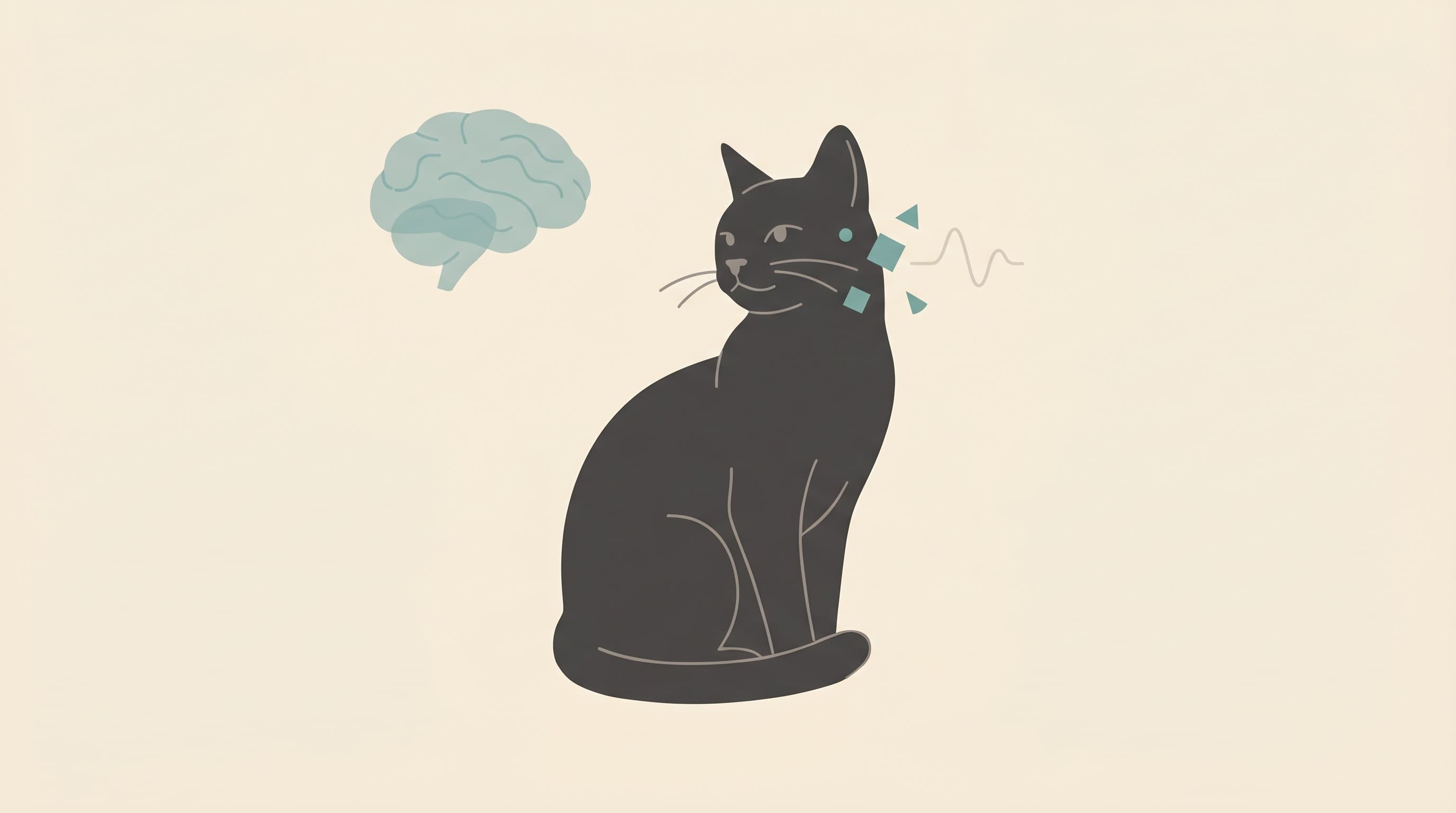
Cats rarely seize the way we expect them to. Most of us picture the dramatic version: collapse, stiff legs, paddling, the whole body taken over. That happens in cats too, but a great many feline seizures are quieter and stranger, so easily mistaken for odd behaviour that owners often don't realise they've witnessed one. A cat who stares through you, whose face twitches, who drools and smacks their lips for no reason, or who bolts across the room as if chased by something invisible, may well be having a seizure. It just doesn't look like the picture in your head.
That recognition gap matters, because most seizure information online is written with dogs in mind. This is the feline one. If you want the plain definition of a seizure first, what a seizure actually looks like is the place to start.
How feline seizures differ from dogs
An epileptic seizure is the outward sign of a sudden burst of abnormal electrical activity in the brain, producing motor, autonomic or behavioural signs (Berendt et al., 2015). Seizures are episodic and brief, in most cases under two to three minutes, and in cats the active part typically lasts no longer than around three minutes (Pakozdy et al., 2014).
You'll often read that "cats have focal seizures, dogs have generalised ones." That's too tidy. In the largest feline dataset, focal and generalised seizures occur with nearly equal frequency in cats, in both idiopathic and structural epilepsy, and 40 to 50% of cats show both types over time (Pakozdy et al., 2014). Seizure type sits on a spectrum. Focal seizures are, though, prominent and characteristic in cats, more so than in dogs (Moore, 2014), and these are the subtle, brief ones that get mistaken for behaviour.
The subtle kind: a focal seizure
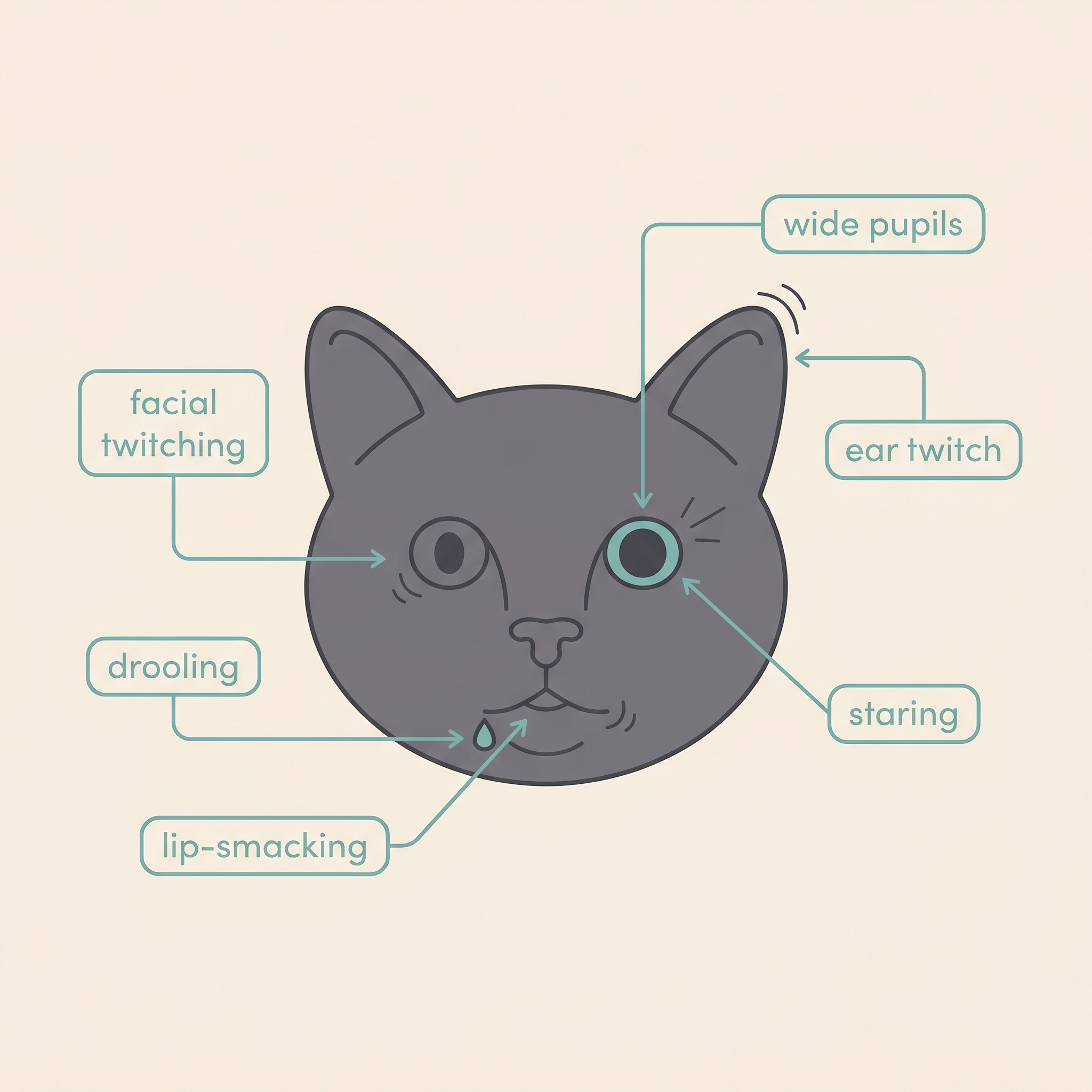
A focal seizure starts in one part of the brain, so it shows up in one part of the body or one slice of behaviour, while your cat may stay partly or fully aware. In cats, the signs cluster around the face and mouth: salivation or frank drooling, facial twitching, lip-smacking, chewing, repeated licking and exaggerated swallowing (Pakozdy et al., 2014; Hazenfratz & Taylor, 2018; Moore, 2014). You may also see an ear or the whiskers twitching, the head turning to one side, rhythmic jerking of a single limb, the pupils blowing wide open even in good light, a sudden frantic run, or urination and defecation during the episode (Pakozdy et al., 2014; Hazenfratz & Taylor, 2018). Some signs look purely behavioural, which is where cases go unrecognised: staring off into space, or a sudden agitated change with awareness clearly altered (Moore, 2014).
A focal seizure can also spread, building from a twitchy face or a single jerking limb into a full-body convulsion as the abnormal activity recruits the rest of the brain (Pakozdy et al., 2014; Berendt et al., 2015). This is secondary generalisation, and it's why an owner sometimes says "his face started going and then he went over."
The dramatic kind: a generalised seizure
This is the version most people would recognise. The abnormal activity involves both sides of the brain at once, so the whole body is affected and your cat loses consciousness. You'll see collapse and stiffening, then paddling or jerking of the limbs, often with chewing of the jaw, heavy salivation and sometimes loss of bladder or bowel control (Hazenfratz & Taylor, 2018; Berendt et al., 2015). It's distressing to watch, but your cat is unaware while it happens, and it's brief, usually over within a couple of minutes (Pakozdy et al., 2014).
Feline hyperaesthesia, the "rolling skin" question
Some owners arrive here after watching their cat's skin ripple along its back, and they deserve a straight answer. Feline hyperaesthesia syndrome, also called rolling-skin syndrome or twitchy-cat disease, is a striking cluster of signs: the skin over the lower back rippling, a sudden burst of frantic activity, tail-chasing or flank-biting, dilated pupils, drooling, vocalising and bouts of self-directed grooming or aggression. Episodes start and stop suddenly, and to an owner they can look very much like a seizure.
So is it one? Honestly, we don't fully know yet. The relationship between feline hyperaesthesia and epilepsy is genuinely unresolved. Epilepsy has been proposed as a possible cause, a case report describes it as a possible mechanism in two cats (Gómez Álvarez et al., 2021), and some affected cats respond to anti-epileptic medication. Most authorities, though, do not classify it as a seizure disorder, those drug responses are inconsistent, and no single underlying cause has been reliably demonstrated. So don't try to settle the debate at home: film an episode and book a vet visit, so they can check for skin disease, pain and parasites and weigh whether the episodes are seizure-like.
Before, during and after: the phases
A seizure isn't only the event itself. There's usually a lead-in and a recovery period either side, and in cats the pre-seizure phase is often hard to spot, while the recovery afterwards is more consistent and recognisable (Pakozdy et al., 2014). That recovery period, the post-ictal phase, is when your cat is "not right" for a while after the seizure ends: common feline signs include disorientation, temporary blindness or deafness, wobbliness, sudden ravenous hunger or thirst, and a spell of being uncharacteristically aggressive (Pakozdy et al., 2014). It can last minutes to hours and usually passes, though it frightens owners as much as the seizure itself. Because it raises its own questions about what's normal, the hours afterwards covers it in depth.
First aid and the emergency line apply equally to cats
The first-aid principles are the same as for a dog. Stay calm, keep your hands well away from the mouth (a seizing cat can bite hard without meaning to, and they cannot swallow their tongue), clear hard objects away, note the start time, film it if you safely can, and don't restrain them. The full do-and-don't checklist is owned by seizure first aid.
The line that marks an emergency is the same across this space and applies to cats exactly as to dogs. A seizure lasting more than five minutes, or two or more seizures within 24 hours (a cluster), or seizures running into each other without your cat recovering in between, is an emergency: get to a vet or emergency clinic now, and ring ahead. That five-minute threshold, with two or more seizures and no recovery of consciousness in between, is the veterinary definition of status epilepticus (Charalambous et al., 2024). A single short seizure your cat recovers from is frightening but not, by itself, an emergency, though you should still log it and tell your vet. The reasoning lives in is this an emergency?.
Why a vet visit matters sooner in cats
Here is the part I most want cat owners to take away. In dogs, the likeliest explanation for recurrent seizures is idiopathic epilepsy, a seizure tendency with no identifiable underlying disease. In cats, that's much less often the answer. Idiopathic epilepsy accounts for only about a third of feline recurrent-seizure cases (Pakozdy et al., 2014), with estimates ranging from roughly 22% to 57% (Hazenfratz & Taylor, 2018) and one review putting it at only about one cat in four (Moore, 2014). So in most cats who seize repeatedly, there is an underlying cause to be found. Structural disease inside the brain, such as tumours, inflammation, or a feline-specific problem called hippocampal necrosis, accounts for roughly 40 to 70% of cases, and reactive causes from outside the brain such as toxins and metabolic upset for about 15 to 25% (Hazenfratz & Taylor, 2018). Age offers a clue: cats with idiopathic epilepsy tend to start seizing younger, on average around three to five years, whereas those with structural brain disease are often older than eight (Hazenfratz & Taylor, 2018). Because an underlying problem is more likely in a cat than a dog, a first seizure in a cat earns a vet visit, not a wait-and-see.
One cause is worth naming here, because it's common, preventable and a genuine emergency: permethrin poisoning. Permethrin is a pyrethroid insecticide in many dog flea spot-ons, and it's dangerous to cats when a dog product is applied to a cat or when a cat grooms a recently treated dog. Cats can't break it down efficiently, so it accumulates and becomes neurotoxic, causing tremors, twitching and seizures. In a London series of 286 feline permethrin exposures, 96.9% of cats became unwell, 87.8% showed increased muscle activity such as twitching, tremors or convulsions, and 10.5% died (Sutton et al., 2007). It is treatable, though: with prompt decontamination by bathing and supportive care, most cats recover within two to three days (Sutton et al., 2007). So never use a dog spot-on on a cat, keep a freshly treated dog separate, and treat any suspected exposure as an emergency. The wider feline cause picture lives in what causes seizures in cats.
A word on treatment, and two feline cautions
The drug guides own seizure medication, but two feline-specific safety points are worth carrying, because they're where dog-focused advice can do real harm. First, potassium bromide, a drug used in dogs, is associated with serious and potentially fatal lower-airway and lung disease in cats and is a last resort in this species (Bertolani et al., 2012; Charalambous et al., 2018). Second, imepitoin (Pexion), another canine option, is not licensed for cats. In fact no anti-epileptic drug is licensed for cats in Europe at all, so feline treatment runs on careful off-licence prescribing, and where medication is needed the usual first choice is phenobarbital, then levetiracetam (Charalambous et al., 2018). One principle holds across species: anti-seizure medication is never stopped abruptly, and the realistic goal is fewer, milder seizures rather than a cure. Feline seizure medicine simply is not canine seizure medicine.
The two things to do right now
Two things matter most right now: time it and film it. Feline seizures are brief, subtle and almost never happen in the consulting room, which makes a video the single most useful diagnostic aid you can give your vet, far more telling than any description you'll manage in the moment (how, and why, to film a seizure covers the technique). So get your phone out the second it's safe, note when it started, and log the episode in the Seizure Diary, which charts how often episodes happen and flags when the count crosses into emergency territory. For cats especially, where episodes are easy to dismiss and the stakes of missing an underlying cause are higher, that record turns a string of "odd moments" into something a vet can act on. Start one the day you see the first episode, even if you're not sure it was a seizure. If it turns out to be nothing, you've lost a minute. If it's something, you've given your vet the one thing they can't get any other way.
References
- Berendt, M., Farquhar, R. G., Mandigers, P. J. J., et al. (2015). International veterinary epilepsy task force consensus report on epilepsy definition, classification and terminology in companion animals. BMC Veterinary Research, 11, 182.
- Bertolani, C., Hernandez, J., Gomes, E., Cauzinille, L., Poujade, A., & Gabriel, A. (2012). Bromide-associated lower airway disease: a retrospective study of seven cats. Journal of Feline Medicine and Surgery, 14(8), 591-597.
- Charalambous, M., Pakozdy, A., Bhatti, S. F. M., & Volk, H. A. (2018). Systematic review of antiepileptic drugs' safety and effectiveness in feline epilepsy. BMC Veterinary Research, 14, 64.
- Charalambous, M., Volk, H. A., Van Ham, L., Bhatti, S. F. M., et al. (2024). ACVIM Consensus Statement on the management of status epilepticus and cluster seizures in dogs and cats. Journal of Veterinary Internal Medicine, 38(1), 19-40.
- Gómez Álvarez, C. M., et al. (2021). Feline hyperesthesia syndrome: epilepsy as possible aetiology in two cats. Veterinary Record Case Reports, 9(3), e132.
- Hazenfratz, M., & Taylor, S. M. (2018). Recurrent seizures in cats: diagnostic approach, when is it idiopathic epilepsy? Journal of Feline Medicine and Surgery, 20(9), 811-823.
- Moore, S. A. (2014). Seizures and epilepsy in cats. Veterinary Medicine: Research and Reports, 5, 41-47.
- Pakozdy, A., Halász, P., & Klang, A. (2014). Epilepsy in cats: theory and practice. Journal of Veterinary Internal Medicine, 28(2), 255-263.
- Sutton, N. M., Bates, N., & Campbell, A. (2007). Clinical effects and outcome of feline permethrin spot-on poisonings reported to the Veterinary Poisons Information Service (VPIS), London. Journal of Feline Medicine and Surgery, 9(4), 335-339.
Keep track of how your pet is doing
The owners who cope best are the ones who notice changes early. A simple health log shows you what is working, and what is not, before the next vet visit.
Start tracking, freeYou're not doing this alone
Compare treatment journeys and talk to owners managing epilepsy. Free to join.
Join PetsLikeMine