

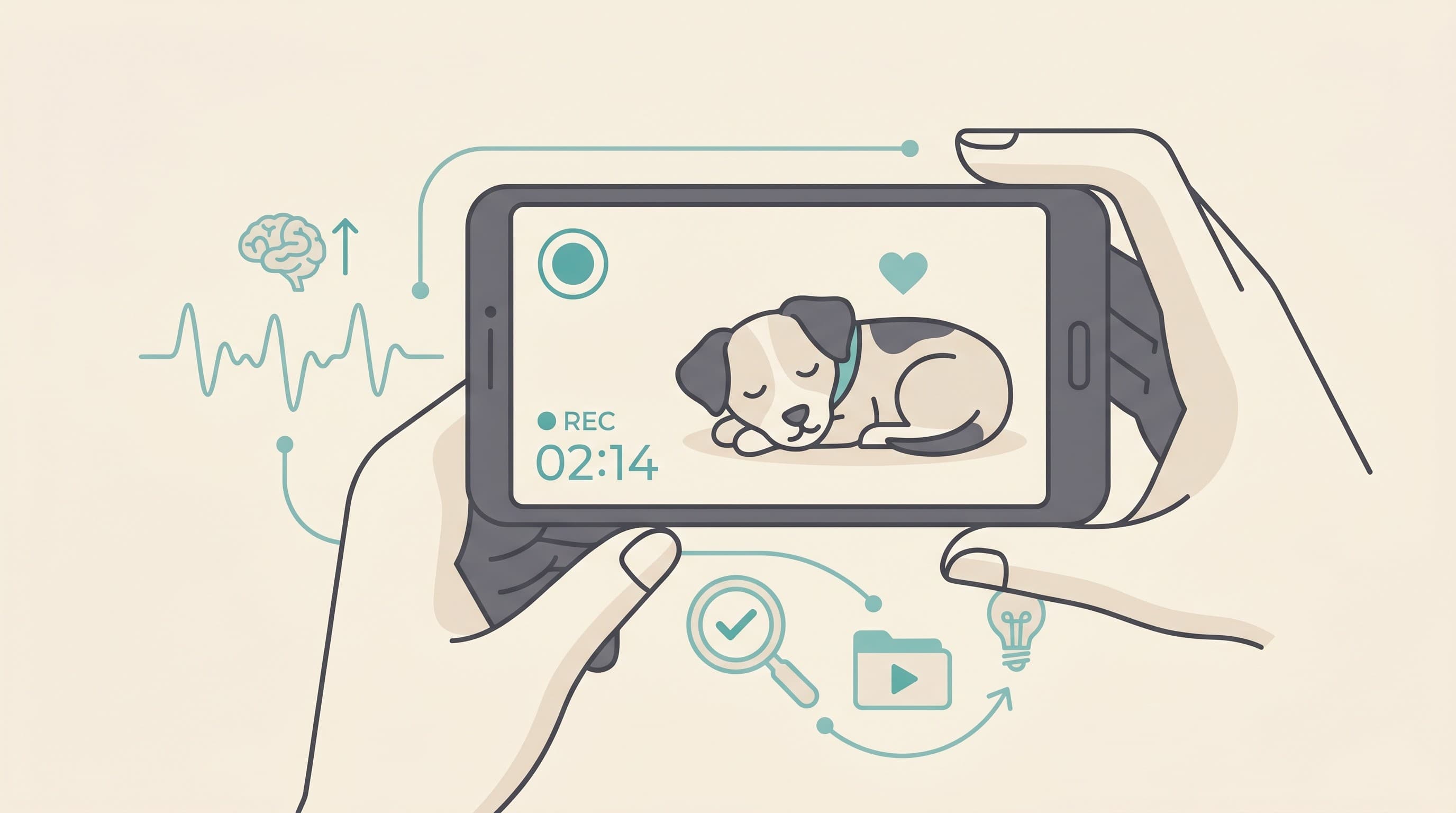
How (and Why) to Film a Seizure for Your Vet
Alastair Greenway
BVM&S MRCVS
The single most useful thing you can bring your vet about your dog's seizures is a video you took on your phone. Not a careful description, not a researched symptom list, not even the timeline you pieced together at three in the morning. A clear recording of the event itself.
I know how that lands when you're frightened, and that a part of you may feel almost ghoulish pointing a camera at a distressed pet. So let me reassure you. Filming never comes before keeping your pet safe, and we'll be clear about that. But when it is safe to do, that video genuinely changes what your vet can do for your dog. The first aid itself belongs to seizure first aid, and how to log everything belongs to keeping a seizure diary. Here I want to make you very good at one thing: filming.
Why a video matters more than you'd think
Your vet will almost never see the seizure. By the time you reach the practice it is over, and your dog is often back to looking perfectly normal in the waiting room. So the diagnosis frequently rests on memory, on a frightened few minutes recalled afterwards. And memory is a fragile thing to build a diagnosis on.
This is not a minor detail. The International Veterinary Epilepsy Task Force, the group whose consensus sets the standard for this field, describes diagnosis as having two fundamental steps: first, working out whether the events even are epileptic seizures rather than something that just looks similar, and second, finding the cause. They are explicit that a detailed, accurate history is "the foundation for investigation of the seizure patient" (De Risio et al., 2015). The bloods, the imaging, the choice of treatment are all built on top of an accurate account of what actually happened.
The same consensus makes a recommendation worth taking seriously, because it turns "film it" from a handy tip into formal best practice. In their words, the owner of a dog with seizures "should complete a standardised epilepsy questionnaire ... and obtain video-footage whenever possible" (De Risio et al., 2015). That footage helps clarify whether the event is an epileptic seizure or one of the many things that mimic one, and what type it is. The guidance is not suggesting you film if you fancy it. It is telling you that video is part of doing this properly.
Why your description, on its own, isn't enough
Your description matters. It is the start of everything. But describing a seizure well is genuinely hard, and it is hard even for experts.
Think about what a seizure asks of you as a witness. It happens fast, often without warning, while you are flooded with fear. You are trying to remember whether the twitching started in the face or a leg, whether one side was affected more, whether your dog was aware of you or somewhere else entirely. Those are subtle observations to make in the calmest of circumstances, let alone while watching your dog collapse. The formal diagnostic criteria rest on "many subjective clinical observations or decisions based on the owner-derived history or video, or both, of an event, a process with low interobserver agreement" (James et al., 2017). Even when clinicians work from the same information they do not always reach the same conclusion.
Consider how slippery this is. One study puts it in proportion. Researchers showed 100 videos of dogs and cats having paroxysmal events, the umbrella term for these sudden episodes, to veterinary neurology specialists and non-specialists, and asked each to judge what they saw. Even with the video in front of them, agreement on the most basic question, was this an epileptic seizure or not, was only fair: a kappa of 0.40, where 1.0 is perfect agreement and 0 is no better than chance (Packer et al., 2015).
Take the right lesson from that, because it cuts both ways. It does not mean classifying seizures is hopeless or your input worthless. It means that if trained specialists watching the same footage reach only fair agreement, a vague spoken description is on even shakier ground, which is precisely why the best possible video matters. You are not being asked to be a perfect witness, only to capture the evidence so the people whose job it is to interpret it have the clearest thing to work from.
What to capture, and why it's exactly these things
That same study tells you not just that filming helps, but what to film. The researchers looked at which features clinicians agreed on most and least, and the pattern is a ready-made checklist (Packer et al., 2015).
Some things were relatively easy. Agreement on seizure type was moderate (kappa 0.44), and the dramatic whole-body collapse-and-paddle kind of seizure had the highest agreement of all (kappa 0.60). But the subtle features were hard. Focal seizures, affecting just part of the body, had the lowest agreement (kappa 0.31). Agreement was only fair for whether the animal was conscious and for autonomic signs such as salivating or wetting itself, and poor for the odd changes in behaviour (kappa 0.16). Which side of the body was affected was also among the less reliably agreed features (Packer et al., 2015).
So the things experts struggle to pin down are the focal signs, the level of awareness, and which side is involved. That is your filming brief, handed to you by the evidence, because those are exactly the things a fleeting memory loses:
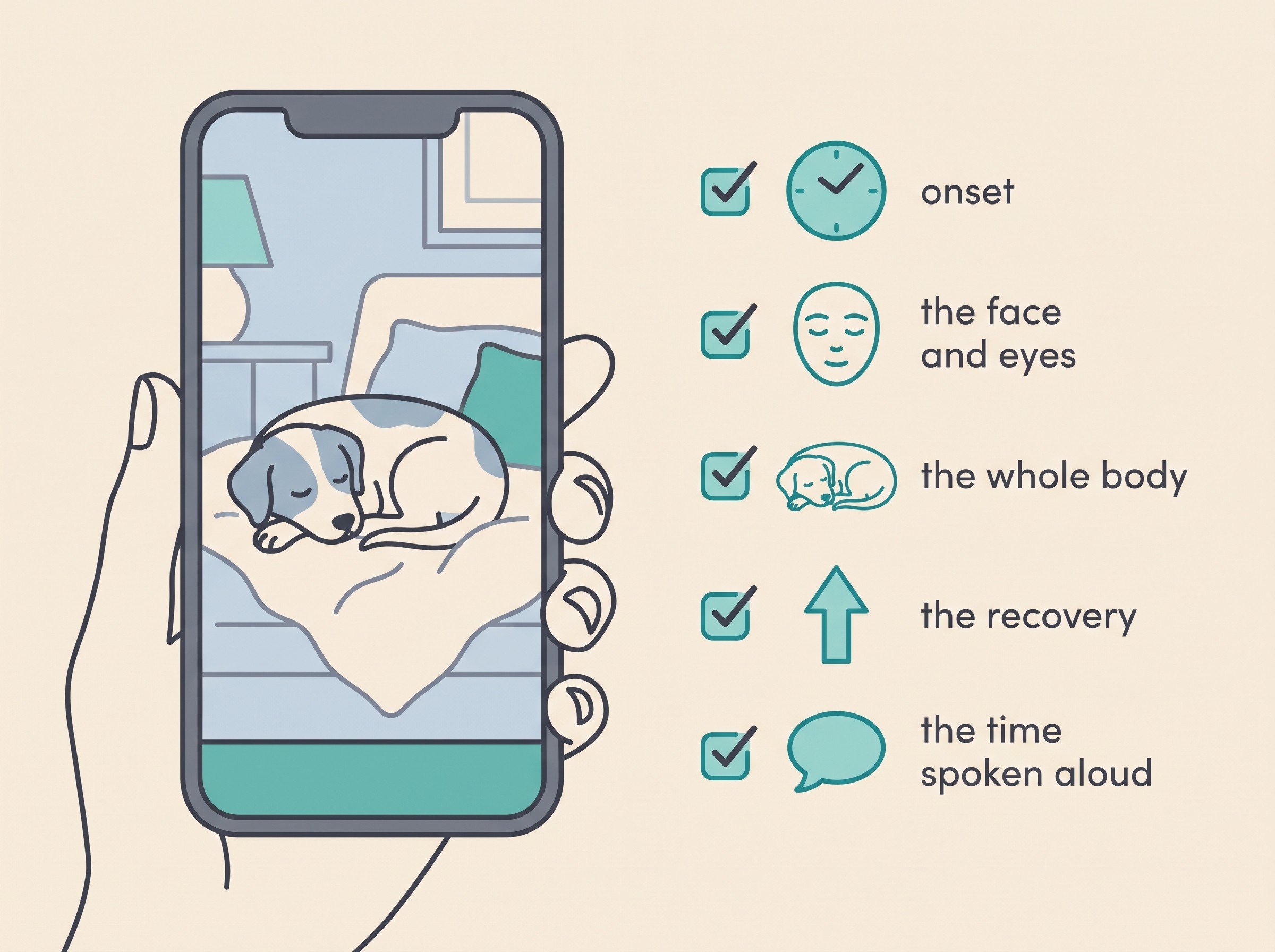
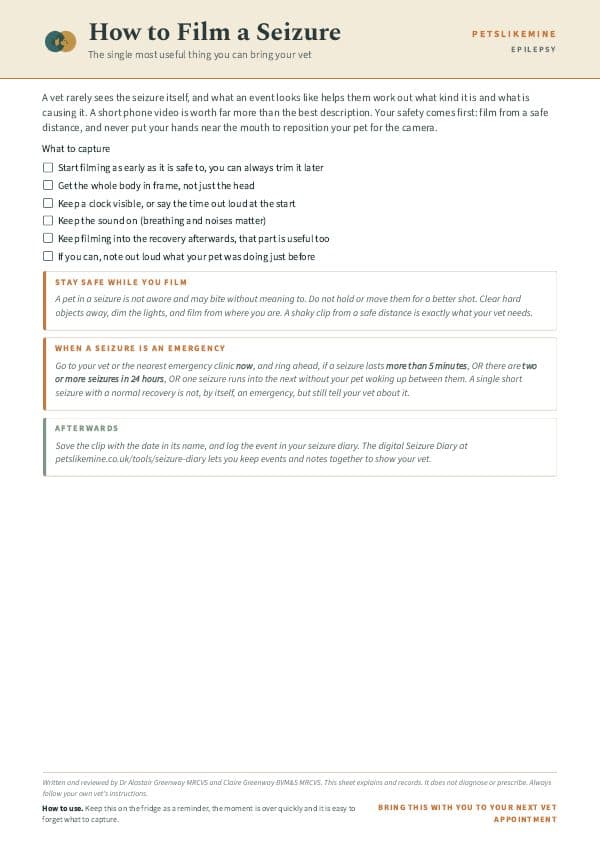
- Get the onset if you can. What moved first, a leg, the face, one side? Seizures are classified largely by what they look like, into generalised, focal, and focal evolving to generalised types (Berendt et al., 2015), so how the event begins and spreads is what lets your vet classify it. It is also the part that is over quickest and remembered worst.
- Film the face and eyes. Twitching of the whiskers, lips or eyelids, a fixed or darting stare, chewing movements. These focal and orofacial signs are subtle and diagnostically rich.
- Get the whole body in frame. Step back so all four limbs and both sides are visible. Is one side worse? Because which side is affected is a low-agreement feature, a wide shot of the whole dog beats a close-up of one twitching leg.
- Show the level of awareness, if you can do it without leaning over your seizing pet. Conscious or not is one of the genuinely hard calls, and the camera sees it better than memory does.
- Don't stop when the jerking does. The recovery, the post-ictal phase, is part of the picture too. We cover what it means in the post-ictal phase; for filming, just keep rolling a while afterwards.
- Say the time aloud and keep the clip running. Narrate it: "it's started, it's just gone twenty past eight." Your phone timestamps the file, but a spoken note and an unbroken clip are what let your vet see how long the event truly lasted, and duration matters more than almost anything.
You will not get all of this every time, and please do not treat the list as a test you can fail. One clear clip of part of an event is enormously more useful than the best description.
Safety comes first, always
Here is the line I will not let you cross. Filming is always secondary to keeping your pet, and yourself, safe. Never put yourself between your dog and harm for a better shot, and never delay first aid to set up the camera. If your pet is near stairs, water, a road or something hard, dealing with that comes first, every time, and the phone waits. The footage is a bonus you collect once the situation is under control. Exactly what to do in those minutes lives in seizure first aid.
There is one situation where the camera goes away entirely. If a seizure runs past five minutes, or your pet has two or more in twenty-four hours, or they run together without your dog properly recovering in between, that is an emergency: ring your vet or the nearest emergency service and go now. You do not stay behind to film an emergency. A single short seizure with a normal recovery is frightening but is not, in itself, an emergency. Where that line sits and why is covered in status epilepticus and cluster seizures. When in doubt, your pet's safety wins and the recording loses.
References
- Berendt M, Farquhar RG, Mandigers PJJ, Pakozdy A, Bhatti SFM, De Risio L, Fischer A, Long S, Matiasek K, Muñana K, Patterson EE, Penderis J, Platt S, Podell M, Potschka H, Pumarola MB, Rusbridge C, Stein VM, Tipold A, Volk HA. International veterinary epilepsy task force consensus report on epilepsy definition, classification and terminology in companion animals. BMC Veterinary Research. 2015;11:182.
- De Risio L, Bhatti S, Muñana K, Penderis J, Stein V, Tipold A, Berendt M, Farquhar R, Fischer A, Long S, Mandigers PJJ, Matiasek K, Packer RMA, Pakozdy A, Patterson N, Platt S, Podell M, Potschka H, Pumarola Batlle M, Rusbridge C, Volk HA. International veterinary epilepsy task force consensus proposal: diagnostic approach to epilepsy in dogs. BMC Veterinary Research. 2015;11:148.
- James FMK, Cortez MA, Monteith G, Jokinen TS, Sanders S, Wielaender F, Fischer A, Lohi H. Diagnostic utility of wireless video-electroencephalography in unsedated dogs. Journal of Veterinary Internal Medicine. 2017;31(5):1469-1476.
- Packer RMA, Berendt M, Bhatti S, Charalambous M, Cizinauskas S, De Risio L, Farquhar R, Hampel R, Hill M, Mandigers PJJ, Pakozdy A, Preston SM, Rusbridge C, Stein VM, Taylor-Brown F, Tipold A, Volk HA. Inter-observer agreement of canine and feline paroxysmal event semiology and classification by veterinary neurology specialists and non-specialists. BMC Veterinary Research. 2015;11:39.
Free downloads
Companion worksheets to put what you've read into practice. Free PDFs, print at home.
Keep track of how your pet is doing
The owners who cope best are the ones who notice changes early. A simple health log shows you what is working, and what is not, before the next vet visit.
Start tracking, freeYou're not doing this alone
Compare treatment journeys and talk to owners managing epilepsy. Free to join.
Join PetsLikeMine