

The Hours Afterwards: Understanding the Post-Ictal Phase
Alastair Greenway
BVM&S MRCVS
The seizure is over. The jerking has stopped and your dog is breathing again, and then comes the part nobody warned you about. They stagger into the furniture, stare through you as if they have never met you, pace the same loop of the kitchen or bump into walls as though the lights have gone out. Maybe they are frantic for food, or hiding, or just not quite themselves.
This is almost certainly not a second emergency. It is the recovery. Vets call it the post-ictal phase, the third and final part of a seizure, and for most owners it is the part nobody mentions. The seizure itself is terrifying but usually mercifully short. This strange afterwards can last far longer, and not knowing what it is makes it much worse than it needs to be.
This article is about that recovery period and nothing else; the seizure itself, what it looks like and its types, belongs to what a seizure actually looks like. Here you will find what is normal in the hours afterwards, what genuinely is not, and one thing most owners never hear: a very severe or very prolonged recovery is not just distressing to watch, it is one of the recognised reasons vets start treatment.
What the post-ictal phase actually is
A seizure has three phases: sometimes a pre-ictal phase or aura beforehand, then the ictal phase, the seizure itself, and then the post-ictal phase, the recovery. The seizure proper is episodic and brief, in most cases lasting less than two to three minutes (Berendt et al., 2015). The recovery can run much longer, which is exactly why it catches people out: the dramatic bit is over, but your dog is far from back to normal.
The precise mechanism in dogs and cats is not fully understood, so be wary of anyone who claims otherwise. The broad picture: a seizure is a burst of abnormal, excessive electrical activity, and the recovery reflects the brain settling back down, its excitability suppressed by its own inhibitory mechanisms. So the pacing, the disorientation and the temporary blindness are a brain coming back online after firing hard, not signs that something new has broken.
One thing is worth knowing early, because it lifts a real weight. There is no reliable link between how dramatic the seizure looked and how long or severe the recovery is: one study found no association between the duration of the seizure and that of the post-ictal phase (Nagendran et al., 2025). A short, mild-looking seizure can be followed by a long, frightening recovery, and that alone does not mean your dog is more in danger.
What counts as normal in the hours afterwards
The range of normal here is wide. In a questionnaire study of dogs with idiopathic epilepsy, owners reported a long list of post-ictal signs, and seeing how common they are is reassuring: these are the recovery itself, not warning signs (Nagendran et al., 2025).
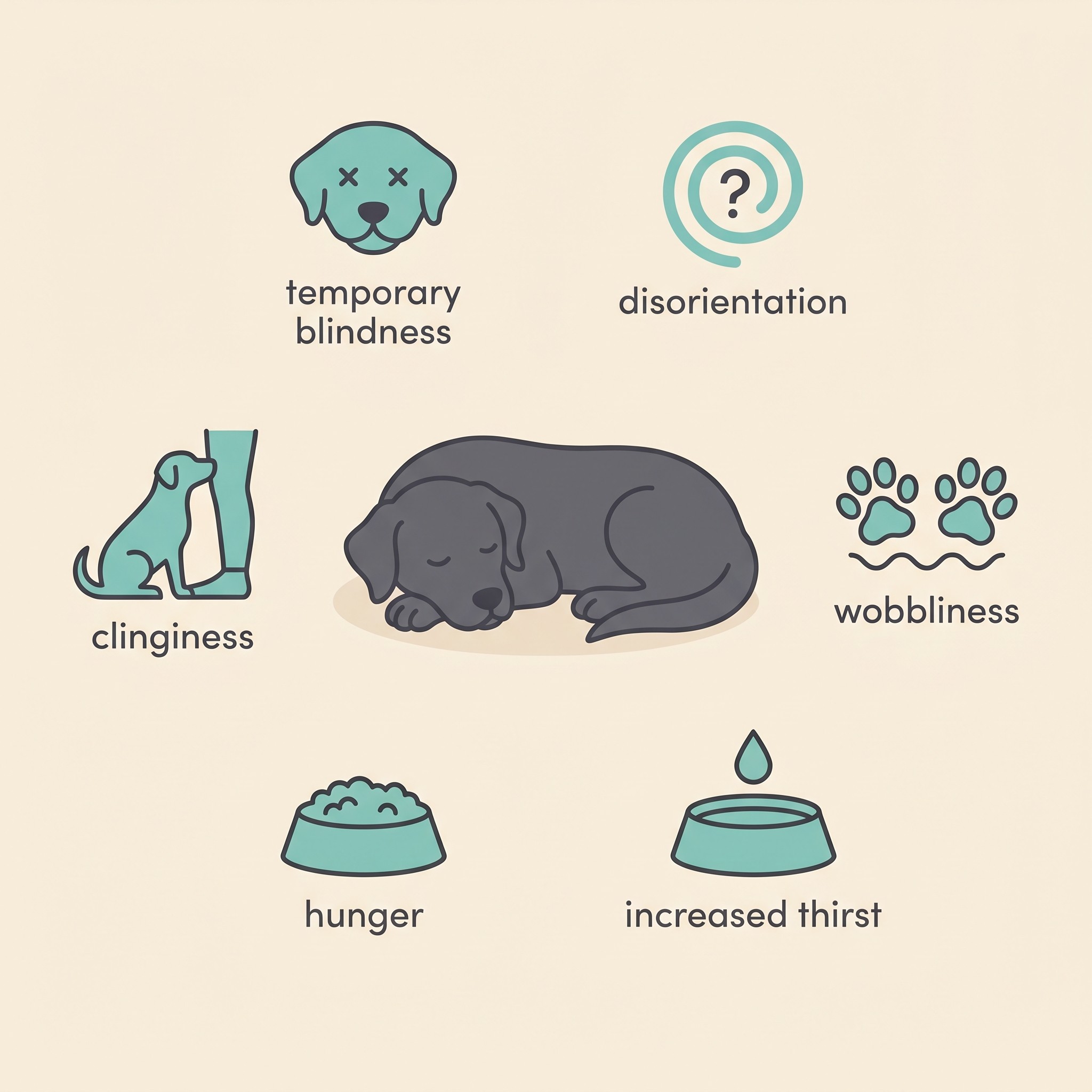
The single most common sign is disorientation or confusion, reported in around 90% of dogs, so your dog may not seem to recognise you or the room (Nagendran et al., 2025). Close behind comes wobbliness and unsteadiness, the ataxia owners describe as drunkenness, in around 85%. About two-thirds (68%) become noticeably thirsty, and around half show weakness in all four limbs (53%), lethargy (53%), clinginess (52%), fearfulness (52%) and increased hunger (51%) (Nagendran et al., 2025). Almost half, around 46%, go temporarily blind, walking into things or unable to find you; deafness can happen too, usually alongside the disorientation and blindness. Compulsive pacing affects around 10% (Nagendran et al., 2025). All of it is temporary: the blindness lifts, the legs steady, the recognition returns. Owners rate disorientation and pacing as the signs that affect quality of life most, not the more dramatic-looking ones (Kähn et al., 2024), so if those are the ones wearing you down, you are far from alone.
One sign deserves a gentler word. A minority of dogs, around 18%, show transient aggression afterwards, and it tends to come somewhat independently of the other signs (Nagendran et al., 2025). This is hard, because it can feel like a betrayal from a much-loved pet. Hold onto two things. It is a brain that has not finished rebooting, not your dog's real temperament, and it will pass. And do not punish or crowd a disoriented animal that is showing it: give them space, keep yourself and any children safely back, and let the fog clear. Reaching in to reassure a frightened, half-aware dog is the likeliest way to be hurt.
How long it lasts
The real answer is a wide one. The median post-ictal phase lasts about 30 minutes, but the recorded range runs from 5 minutes to 4,320 minutes, which is 72 hours, three full days (Nagendran et al., 2025). A separate owner survey lines up with that: around 51% reported the phase lasting 1 to 30 minutes and about 20% reported 31 to 60 minutes (Kähn et al., 2024). So for most dogs, most of the time, you are looking at minutes to an hour, but a minority genuinely take longer, and a recovery that stretches into a day or more is at the far end of normal rather than automatically a crisis. There is, though, a point where duration stops being normal variation and becomes a reason to call your vet.
What actually helps
This is where owners most want something to do, and the evidence points to simple, calm measures. Asked what helped, owners rated most highly rest (219 of 282 owners), quiet physical closeness (184), and a quiet (151) and dark (114) environment, with 77% feeling these improved the signs (Kähn et al., 2024). So in practice:
- Keep it quiet and dim. Lights down, television off, household commotion shooed away. A recovering brain does not need more input.
- Keep them safe while they are impaired. A blind, wobbly, disoriented animal is at real risk from stairs, water, sharp corners and anything they could fall off or into. Gently block hazards rather than wrestling your dog away from them.
- Be present without fussing. Quiet closeness helps; restraining, smothering or repeatedly "testing" whether they recognise you does not.
- Offer water only once they are fully alert and can swallow safely, never while still groggy, because of the choking risk.
One caveat. If your dog has been prescribed at-home rescue medication, that is for the seizure itself or for clusters, not for shortening the recovery: 71% of owners felt rescue medication did not control the post-ictal signs (Kähn et al., 2024). So do not reach for a rescue dose hoping to switch off the pacing, and never stop or change prescribed anti-seizure medication on your own. That protocol belongs to managing cluster seizures at home and your vet's written plan.
When the recovery itself is a red flag
A very severe or very prolonged post-ictal phase is not only upsetting: it is a recognised reason to consider starting treatment. The international veterinary epilepsy consensus on medical treatment lists four triggers for considering maintenance anti-seizure medication, and the post-ictal phase is explicitly one of them. Treatment should be considered when "the postictal signs are considered especially severe (e.g. aggression, blindness) or last longer than 24 hours" (Bhatti et al., 2015). The other three are: two or more seizures within six months; any episode of status epilepticus or cluster seizures; and seizures getting more frequent, longer or more severe over time (Bhatti et al., 2015).
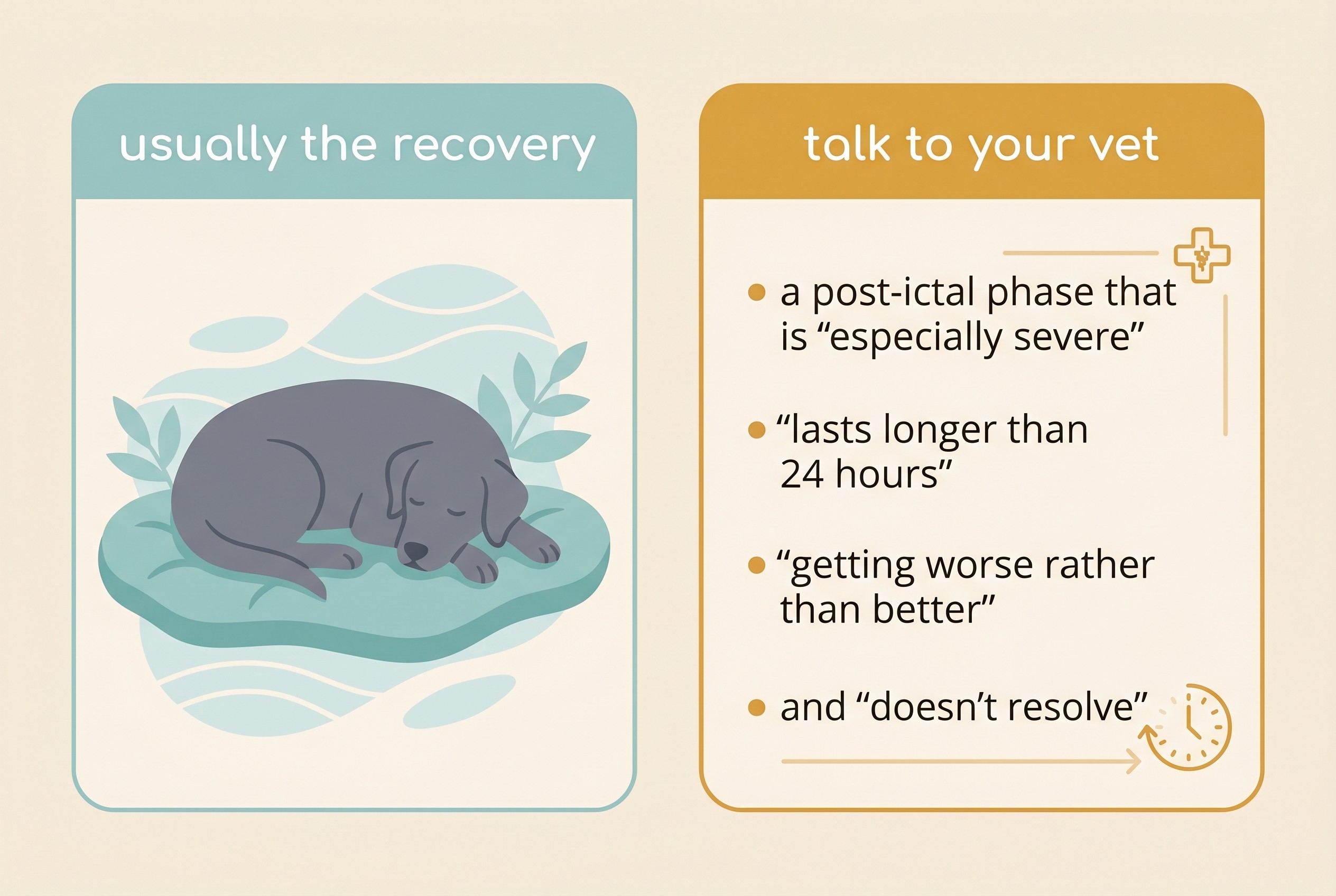
So if your dog's recoveries are especially severe or one runs longer than 24 hours, that is not something to simply endure: it is a genuine, evidence-based reason to talk to your vet about starting treatment. The decision itself, when to start and what starting commits you to, is its own conversation, and when should treatment start covers it.
Owners also ask how to tell ordinary recovery from an emergency. Call your vet or the emergency service rather than waiting if a post-ictal phase is getting worse rather than slowly better, does not resolve, or leaves you unable to tell whether your dog is recovering or sliding into another seizure. The hard emergency line for the seizures themselves, a seizure over five minutes, or two or more in 24 hours, or seizures running into one another without recovery, means you go now and ring ahead; that line is owned in full by status epilepticus and cluster seizures. A single short seizure followed by an ordinary recovery, however unsettling it looks, is not by itself an emergency.
Why logging the recovery is worth the effort
When the worst is over and your dog is dozing it off, writing it down is the last thing you may feel like doing. Do it anyway, even roughly, even just on your phone. Vets dose anti-seizure medication against the seizures' frequency, duration and severity, and the recovery is part of that picture. There is a more specific reason too: over a year, an increase in post-ictal duration was associated with an increase in seizure duration and frequency (Nagendran et al., 2025). A recovery that is quietly getting longer can be an early signal that the epilepsy itself is changing, the kind of trend that is hard to prove unless you have kept track.
That is exactly what the Seizure Diary is built for. Log the date and time, how long the seizure lasted, then how long the recovery took and which signs you saw. Over weeks and months it turns a blur of frightening events into a pattern your vet can act on, so you walk in with evidence not a half-remembered story.
A note for cat owners
Everything above applies in principle to cats. A cat coming out of a seizure can be disoriented, wobbly, hidden away or briefly not themselves in the same way, and the same calm, quiet, safe-space approach helps. Cats do differ from dogs in how their seizures look and what tends to cause them, and that feline-specific picture is covered in what seizures look like in cats.
The most useful thing to take from all of this is permission to breathe. The strange hours after a seizure are, for the great majority of dogs and cats, simply a brain finding its way back to normal, and they pass. Your job in that window is small and kind: keep it quiet, keep them safe, sit nearby, and write down what you saw. Keep half an eye on the two things that change the plan, a recovery that is especially severe or one that runs past a day, and bring those to your vet. The rest is patience, and you are already giving it.
References
- Berendt M, Farquhar RG, Mandigers PJJ, Pakozdy A, Bhatti SFM, De Risio L, Fischer A, Long S, Matiasek K, Muñana K, Patterson EE, Penderis J, Platt S, Podell M, Potschka H, Pumarola MB, Rusbridge C, Stein VM, Tipold A, Volk HA. International Veterinary Epilepsy Task Force consensus report on epilepsy definition, classification and terminology in companion animals. BMC Veterinary Research. 2015;11:182.
- Bhatti SFM, De Risio L, Muñana K, Penderis J, Stein VM, Tipold A, Berendt M, Farquhar RG, Fischer A, Long S, Löscher W, Mandigers PJJ, Matiasek K, Pakozdy A, Patterson EE, Platt S, Podell M, Potschka H, Rusbridge C, Volk HA. International Veterinary Epilepsy Task Force consensus proposal: medical treatment of canine epilepsy in Europe. BMC Veterinary Research. 2015;11:176.
- Kähn C, Meyerhoff N, Meller S, Nessler JN, Volk HA, Charalambous M. The postictal phase in canine idiopathic epilepsy: semiology, management, and impact on the quality of life from the owners' perspective. Animals (Basel). 2024;14(1):103.
- Nagendran A, Nettifee JA, Carter D, Muñana KR. Characterization of post-ictal clinical signs in dogs with idiopathic epilepsy: a questionnaire-based study. Journal of Veterinary Internal Medicine. 2025;39(1):e17302.
Keep track of how your pet is doing
The owners who cope best are the ones who notice changes early. A simple health log shows you what is working, and what is not, before the next vet visit.
Start tracking, freeYou're not doing this alone
Compare treatment journeys and talk to owners managing epilepsy. Free to join.
Join PetsLikeMine