

What a Seizure Actually Looks Like
Alastair Greenway
BVM&S MRCVS
Something happened to your dog or cat. It lasted seconds, or a couple of minutes, and it frightened the life out of you. Maybe they collapsed and went rigid. Maybe they just stared through you, or their face twitched, or they snapped at something that was not there. And now you are trying to answer the one question the internet keeps dodging: was that a seizure?
That is what this article is for. It covers what a seizure looks like across its full range, from the dramatic to the easily missed, and the two things worth doing the moment one happens. It does not cover why seizures occur, what to do with your hands during one, or when a seizure becomes an emergency. Each of those has its own guide, linked as we go.
What a seizure actually is
An epileptic seizure is the outward sign of a sudden burst of excessive, abnormally synchronised electrical activity among the neurons of the forebrain (Berendt et al., 2015; De Risio et al., 2015). Instead of firing in its normal orderly way, a population of nerve cells fires together far too hard and far too fast, and the body shows the consequences. Most seizures are self-limiting, meaning they stop on their own within a short time (De Risio et al., 2015).
One distinction matters before we go further. A seizure is a clinical sign, not a disease in itself (Berendt et al., 2015). It is the brain's equivalent of a cough: something is making it happen, and that something might be a one-off insult like a toxin or low blood sugar, or it might be epilepsy, a tendency to recurrent seizures. Sorting out which is the job of reactive, structural and idiopathic seizures. Here, we are only describing the event itself.
The classic picture: a generalised tonic-clonic seizure
This is what most people picture when they hear the word. A generalised seizure involves both sides of the brain, so the whole body is affected and consciousness is lost (Berendt et al., 2015). Your pet is not "in there" during it. They cannot hear you, and afterwards they will not remember it.
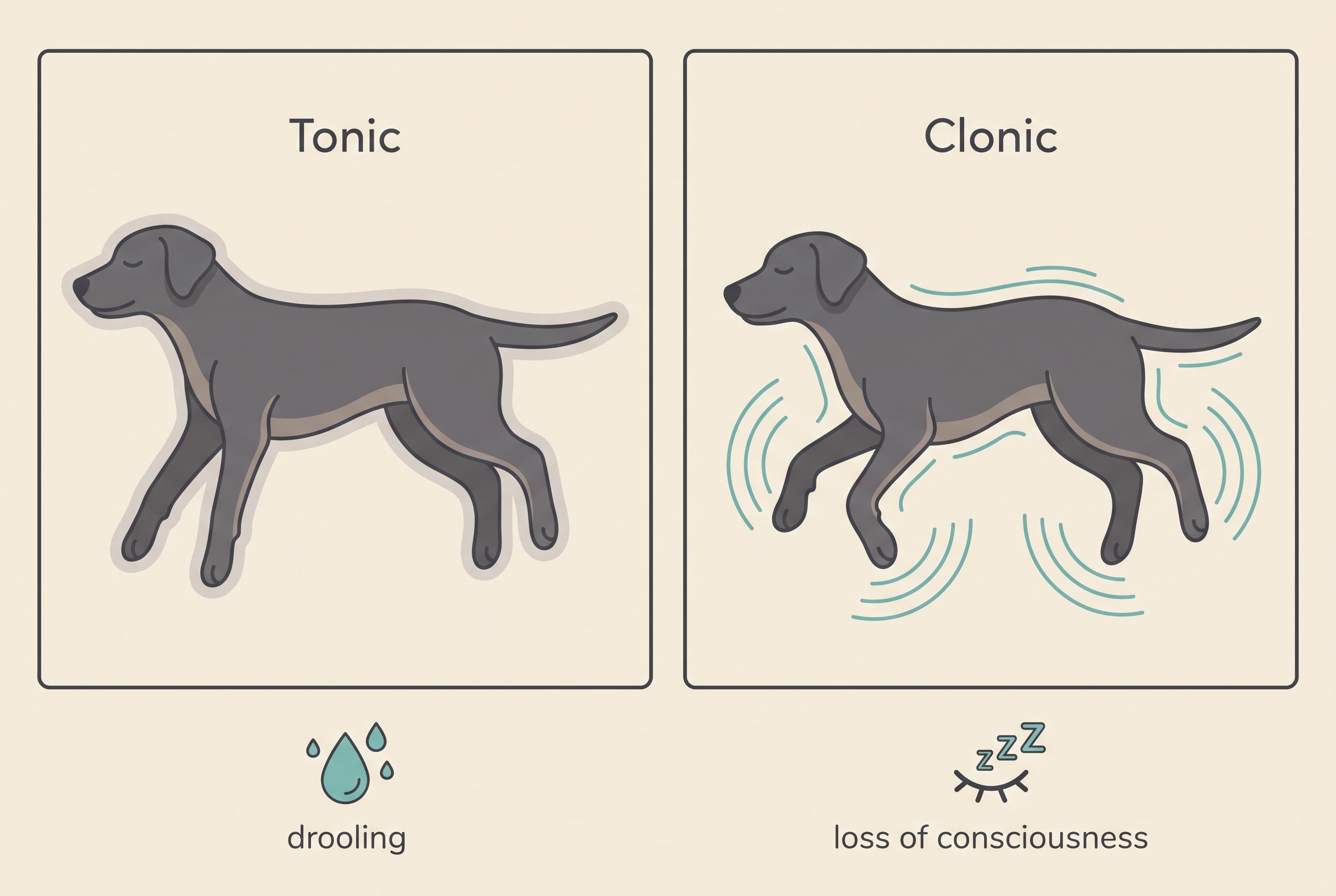
The sequence usually runs in two phases. First the tonic phase: the body goes stiff, the legs often held out rigid, and the animal collapses if not already lying down. Then the clonic phase: the limbs jerk or paddle rhythmically, as though running on their side (Berendt et al., 2015). Alongside the movement you will often see autonomic signs, the involuntary functions the brain normally keeps in check coming loose. Heavy drooling is common, and many animals urinate or pass faeces during the event (Berendt et al., 2015; Mandigers et al., 2024). It looks dreadful, but in that moment your pet is not suffering the way you would imagine, because they are unconscious.
Most generalised seizures are brief, usually over within a couple of minutes, though that can feel like an eternity when you are watching (De Risio et al., 2015). The tonic-clonic pattern is the one to know in detail, but it is not the only generalised form. Neurologists also recognise purely tonic seizures (stiffening alone), purely clonic ones (jerking alone), and brief, shock-like myoclonic jerks, all sharing that same loss of consciousness (Berendt et al., 2015).
Focal seizures, the kind everyone misses
Here is where many seizures slip past unrecognised for months, sometimes years. A focal seizure (you may also hear "partial") arises from one region of the brain, so the signs are localised and often subtle (Berendt et al., 2015). There is no collapse and no full-body convulsion, nothing that screams "seizure", just something a bit odd.
Focal signs sort into three groups (Berendt et al., 2015). There are motor signs: rhythmic twitching of the face or whiskers, repeated blinking, jerking of a single limb, or the head turning to one side. There are autonomic signs: a bout of drooling, vomiting, or one pupil dilating. And there are behavioural signs: a sudden spell of fear or anxiety, restlessness, fixed staring, or out-of-character attention-seeking. Unlike a generalised seizure, consciousness during a focal one may be fully kept or only partly clouded, so your pet might seem half-aware, or aware but unable to stop what their body is doing (Berendt et al., 2015).
Two things make focal seizures especially slippery. The first is that a focal seizure can spread and evolve into a full generalised tonic-clonic seizure, and owners very often notice only the dramatic finale, never the quiet focal overture that came first (Berendt et al., 2015). So if you have seen a convulsion, cast your mind back for subtle signs in the seconds beforehand.
The second is fly-catching, sometimes called fly-biting: snapping at invisible flies. It is confidently listed online as a seizure sign, and it can be a focal seizure manifestation, but the reality is that it is debated and can equally arise from a behavioural or gastrointestinal cause. One reported case resolved on a gluten-free diet (Frost et al., 2024). So treat fly-catching as one possible focal sign worth filming and mentioning to your vet, not as proof of epilepsy.
What surrounds the event: the phases of a seizure
A seizure is often more than the seizure. Many unfold in recognisable phases, and knowing them helps you make sense of the behaviour that bookends the event (Berendt et al., 2015; De Risio et al., 2015). A prodrome can come first: an owner-noticed shift in mood in the hours or even days beforehand, though not every animal shows one. Closer in, seconds to minutes before, comes the aura or pre-ictal phase, often restlessness, clinginess, hiding or pacing, as though they sense something coming. Then the ictus, the seizure itself, and afterwards the post-ictal phase, the recovery period.
That recovery phase is real and common. In a questionnaire study of dogs with idiopathic epilepsy, post-ictal abnormalities occurred in around 91% of them, most often disorientation, wobbliness, thirst, weakness and temporary blindness, with a median duration of about 30 minutes (Lord et al., 2025). So if your pet seems "not right" or is suddenly ravenous after a seizure, that is expected, not a separate disaster. It gets the depth it deserves in the post-ictal phase.
What it is NOT: the things that mimic a seizure
Plenty of frightening episodes look like seizures and are not, and telling them apart matters, because they point to different problems.
Syncope (fainting) is a transient loss of consciousness from a brief drop in blood or oxygen reaching the brain, usually a heart or circulatory cause. The collapse tends to be sudden and flaccid, a floppy crumple rather than a stiff, paddling fit, often triggered by exertion, excitement or a bout of coughing, with rapid, complete recovery and no confused aftermath. Compare that with a true seizure, which brings the stiffening, the autonomic signs and a muddled recovery (Berendt et al., 2015).
Paroxysmal dyskinesias, a group of movement disorders, are perhaps the trickiest mimics. They cause involuntary, hyperkinetic, often twisting (dystonic) movements that can superficially resemble a seizure. The giveaways are telling: the animal stays conscious throughout, there are no autonomic signs (no drooling, urinating or defecating), and there is generally no post-ictal phase afterwards. Video, and sometimes specialist testing, is what lets a neurologist tell the two apart (Mandigers et al., 2024).
Vestibular episodes are a balance problem, not a seizure: head tilt, flicking eyes (nystagmus), circling or rolling, all with consciousness preserved. REM-sleep twitching is the paddling of a dreaming pet, and the tell is that it stops the instant you gently wake them. Isolated tremors or head-bobbing are rhythmic shaking with the animal fully aware.
One rule of thumb is worth carrying. Lost awareness, plus autonomic signs like drooling, weeing or pooing, plus a confused recovery period points towards a true seizure. Staying aware, no autonomic signs, instant recovery, or a clear exertion trigger points away from it (Berendt et al., 2015; Mandigers et al., 2024). It is not foolproof, which is exactly why your vet will want to see footage.
Cats look a little different
Most of the above is dog-led, because that is where most of the research sits. Cats can have the full generalised picture too, but feline seizures are more often focal, frequently with orofacial signs: twitching of the face or whiskers, salivation, lip-smacking, chewing or swallowing movements, which can then secondarily generalise (Pakozdy et al., 2014; Pakozdy et al., 2011). Those subtle facial signs are easy to dismiss as a hairball or a funny mood, so take them seriously. The feline picture has its own guide in what seizures look like in cats.
Two things to do right now
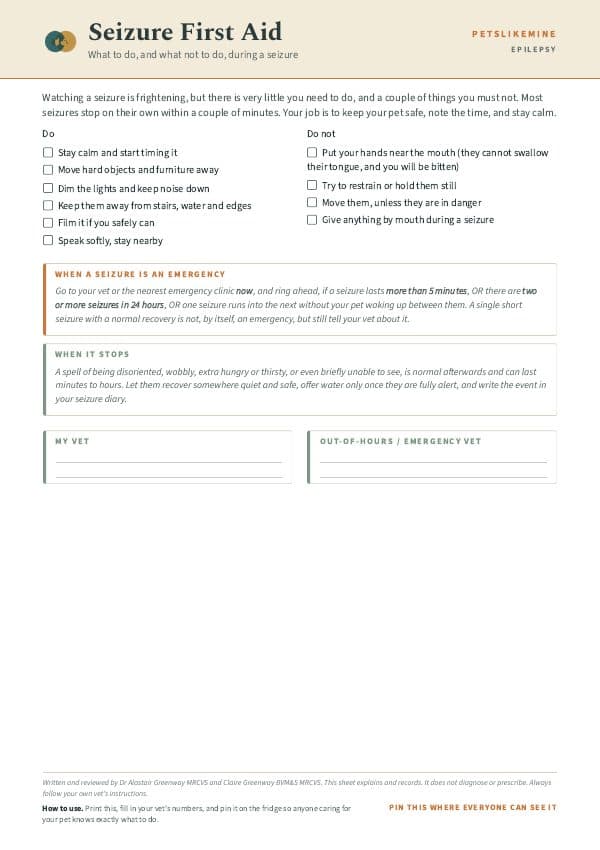
When it is happening, two simple actions turn a helpless moment into something genuinely useful, and neither involves touching your pet. What to do with your hands, and what not to do, is its own piece: see seizure first aid.
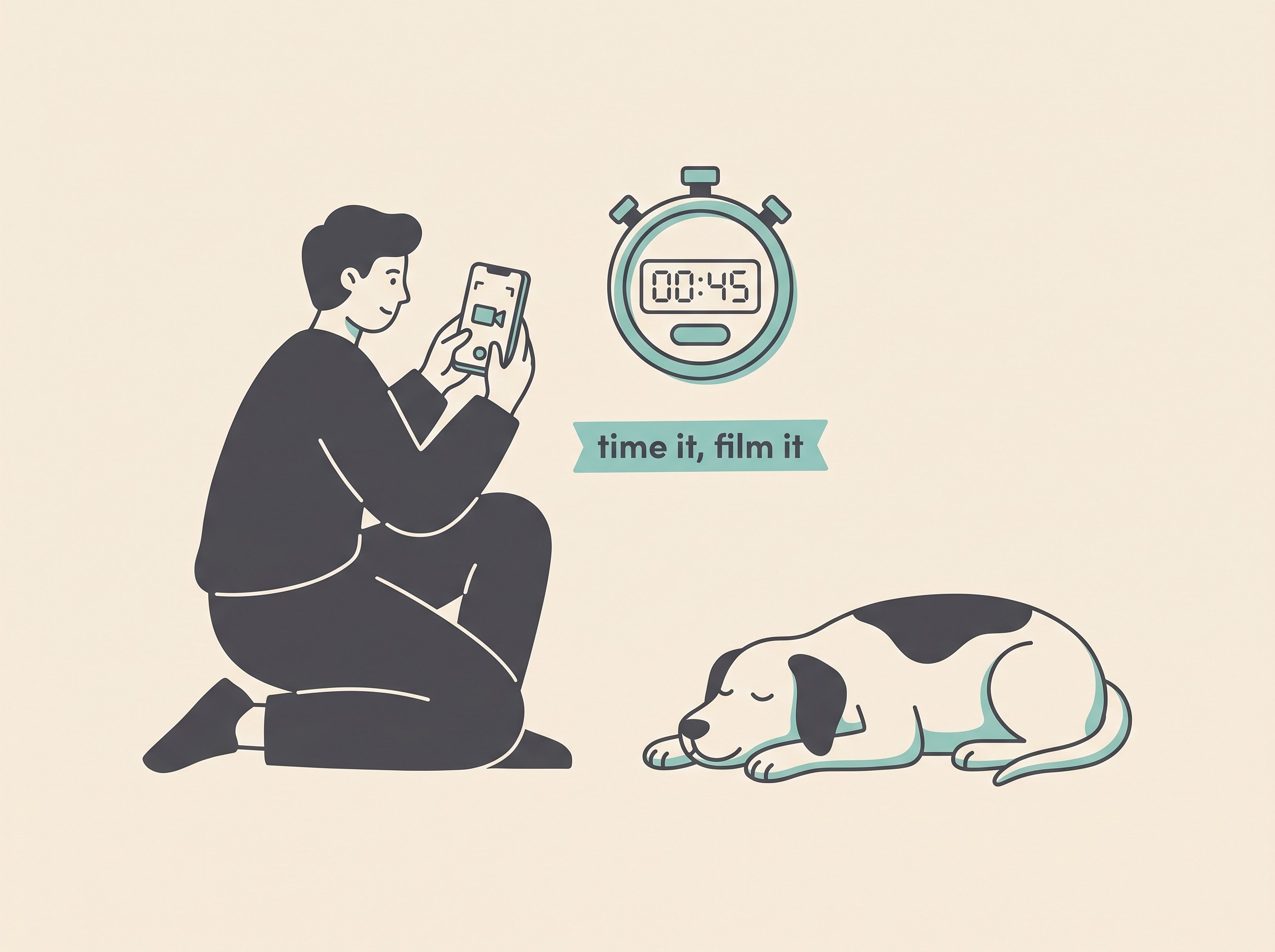
Time it. Note the moment it starts and the moment it stops, glancing at a clock rather than trusting your sense of time, because fear stretches seconds into minutes. Duration is the single fact that separates a frightening-but-ordinary seizure from a true emergency. As a firm line: a seizure lasting more than five minutes, or two or more seizures in 24 hours, is an emergency that needs your vet or an emergency clinic now (De Risio et al., 2015; Charalambous et al., 2024). A single short seizure with a normal recovery is not, by itself, an emergency, though you should still ring your vet after a first-ever one. The reasoning behind that threshold sits in status epilepticus and cluster seizures.
Film it. Seizures almost never happen in front of the vet, and their appearance, the semiology described above, is what guides diagnosis and whether your pet needs referral (De Risio et al., 2015). A clear video is the single most useful thing you can capture, worth far more than a description from memory. Safety comes first, always: never put yourself between your pet and harm for a shot. If filming would mean reaching past flailing limbs or near their mouth, do not.
Those two habits come together in the Seizure Diary, where logging each event, its length, type and recovery, builds the frequency record your vet actually doses against: the difference between "he has had a few" and a clear chart of whether things are getting better or worse. You have just learned to name what you saw, which was the hardest part. Next time, you will know to look at the clock and reach for your phone, and that alone makes you a far better advocate for your pet.
References
- Berendt, M., Farquhar, R. G., Mandigers, P. J. J., Pakozdy, A., Bhatti, S. F. M., De Risio, L., Fischer, A., Long, S., Matiasek, K., Muñana, K., Patterson, E. E., Penderis, J., Platt, S., Podell, M., Potschka, H., Pumarola, M. B., Rusbridge, C., Stein, V. M., Tipold, A., & Volk, H. A. (2015). International veterinary epilepsy task force consensus report on epilepsy definition, classification and terminology in companion animals. BMC Veterinary Research, 11, 182.
- Charalambous, M., Volk, H. A., Van Ham, L., & Bhatti, S. F. M. (2024). ACVIM consensus statement on the management of status epilepticus and cluster seizures in dogs and cats. Journal of Veterinary Internal Medicine, 38(1), 19-40.
- De Risio, L., Bhatti, S., Muñana, K., Penderis, J., Stein, V., Tipold, A., Berendt, M., Farquhar, R., Fischer, A., Long, S., Mandigers, P. J. J., Matiasek, K., Packer, R. M. A., Pakozdy, A., Patterson, N., Platt, S., Podell, M., Potschka, H., Batlle, M. P., Rusbridge, C., & Volk, H. A. (2015). International veterinary epilepsy task force consensus proposal: diagnostic approach to epilepsy in dogs. BMC Veterinary Research, 11, 148.
- Frost, C., et al. (2024). Fly-catching syndrome responsive to a gluten-free diet in a French Bulldog. Journal of the American Veterinary Medical Association, 262(3).
- Lord, J., et al. (2025). Characterization of post-ictal clinical signs in dogs with idiopathic epilepsy: a questionnaire-based study. Journal of Veterinary Internal Medicine, 39(1), e17302.
- Mandigers, P. J. J., Stehr, K., Mari, L., et al. (2024). Canine paroxysmal dyskinesia: a review. Frontiers in Veterinary Science, 11, 1441332.
- Pakozdy, A., Gruber, A., Kneissl, S., Leschnik, M., Halasz, P., & Thalhammer, J. G. (2011). Complex partial cluster seizures in cats with orofacial involvement. Journal of Feline Medicine and Surgery, 13(10), 687-693.
- Pakozdy, A., Halasz, P., & Klang, A. (2014). Epilepsy in cats: theory and practice. Journal of Veterinary Internal Medicine, 28(2), 255-263.
Free downloads
Companion worksheets to put what you've read into practice. Free PDFs, print at home.
Seizure First-Aid Card
PDF · 179 KBWhat to do, and what not to do, during a seizure, on one fridge-ready card. The calm steps that keep your pet safe, the things to avoid (hands away from the mouth), and the clear line for when a seizure becomes an emergency.
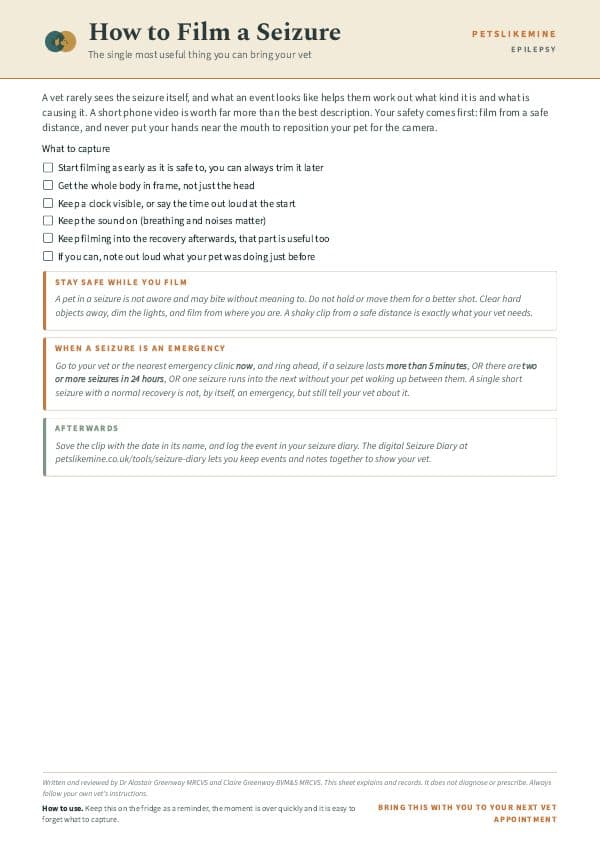
How to Film a Seizure
PDF · 175 KBA short video tells your vet more than any description. What to capture, how to stay safe while you film (never put your hands near the mouth), and why the recovery afterwards matters too.
Keep track of how your pet is doing
The owners who cope best are the ones who notice changes early. A simple health log shows you what is working, and what is not, before the next vet visit.
Start tracking, freeYou're not doing this alone
Compare treatment journeys and talk to owners managing epilepsy. Free to join.
Join PetsLikeMine