


Can a Dog With Epilepsy Live a Normal Life?
Alastair Greenway
BVM&S MRCVS
Of all the questions a new diagnosis raises, this is usually the one owners reach for first, sometimes the same night, with the dog asleep and looking utterly normal. Can he still have a good life? Will this take years off her? It sits underneath all the others, and you deserve a straight answer rather than false comfort or doom.
Many dogs with well-controlled idiopathic epilepsy go on to live full, happy lives of close to normal length. That is genuinely hopeful, and the evidence backs it up. The catch is that "normal" here usually means well managed rather than cured. Most dogs will need daily medication for the rest of their lives, and complete freedom from seizures is the exception rather than the rule (Bhatti et al., 2015). Hold both of those at once and you've got the truthful picture.
What "well controlled" actually means
The word worth recalibrating is "cure", because that's the expectation that sets families up for heartbreak. The realistic goal of treatment is reduction, not cure. The international consensus on treating canine epilepsy puts it plainly: "Seizure eradication is often not likely in dogs. More realistic goals are to decrease seizure frequency, duration, severity..." (Bhatti et al., 2015). That isn't pessimism. It's the frame that lets you recognise success rather than feeling you've failed every time a seizure breaks through.
In practice, vets call a dog a "responder" when treatment achieves at least a 50% reduction in how often the seizures come, and often a drop in their severity or in clusters too (Bhatti et al., 2015). By that measure, most dogs do improve substantially: in a large UK study of dogs treated for idiopathic epilepsy, 64.5% achieved at least a 50% reduction in seizure frequency (Packer et al., 2014). Be a little careful with that figure, though, because it can mislead. The consensus cautions that a halving of seizures, while real on paper, is "often not clinically relevant" to the family living it (Potschka et al., 2015). If your dog was having a seizure a fortnight and now has one a month, the statistician calls that a success; you might not feel it as one. So treat the responder number as encouraging without mistaking it for the finish line. True seizure freedom remains the ideal, even though it's uncommon: only around 14% of treated dogs in that UK study reached genuine seizure-free remission (Packer et al., 2014), and the broader consensus agrees, with drug-induced remission lasting one to three years reported in only about 15 to 24% of dogs (Potschka et al., 2015) and an earlier cohort finding a remission rate of around 15% (Berendt et al., 2007). Most dogs get a lot better, a minority become seizure-free, and "a lot better" is a perfectly good place to build a life. What good control looks like day to day is the subject of realistic goals: control, not cure.
The prognosis: both sides of it
Now to the question you really came for, the one about time. I'll give you the encouraging data and the sobering data side by side, because you'll find both online and deserve to know how they fit together. Start with the encouraging side, because it's stronger than most owners expect. In a Japanese study using the modern criteria, dogs with idiopathic epilepsy had a median survival of 10.4 years from their first seizure and a median lifespan of 13.5 years (Hamamoto et al., 2016). That's strikingly close to the roughly 13.7 years the general dog population lives, and a world away from dogs whose seizures came from a structural brain problem such as a tumour, who managed only 4.5 years of survival and a 10.9-year lifespan (Hamamoto et al., 2016). The headline buried in those numbers is that the type of epilepsy matters enormously. Idiopathic epilepsy, the common kind in young otherwise-healthy dogs, carries a far kinder outlook than seizures driven by visible brain disease.
Now the counterweight, stated just as plainly. Epilepsy does still carry a real risk of premature death. A prospective cohort found a median age at death of only 7.0 years, with the dogs living a median of just 2.3 years from when their epilepsy began, and epilepsy was the direct cause of death or the reason for euthanasia in a large share of them (Berendt et al., 2007).
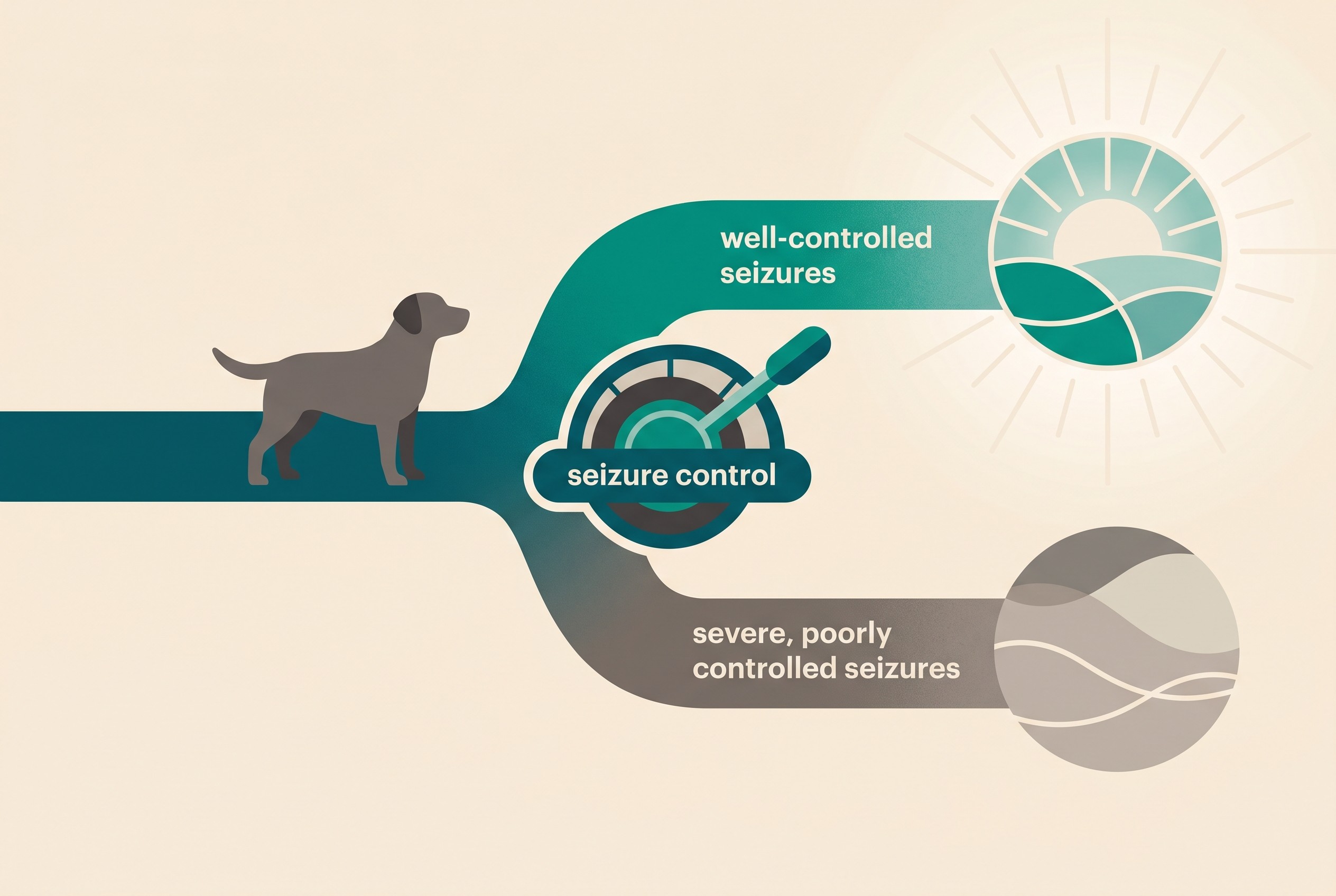
So how can both be true? The gap between the optimistic and the pessimistic figures is explained largely by seizure control and by owner-driven decisions about euthanasia. Dogs whose seizures are well managed cluster toward the near-normal-lifespan end; dogs with severe, poorly controlled disease, the frequent seizures, the clusters, the episodes of status, account for most of the premature deaths and most of the heartbreaking decisions behind them. Epilepsy doesn't hand you one fixed prognosis at diagnosis. It's a spread, and where your dog lands on it is shaped, in large part, by things that can be influenced.
Dogs who are harder to control
I won't pretend every dog is easy to manage. Somewhere between a quarter and a third, up to around 30%, have what's called drug-resistant or refractory epilepsy, where seizures stay poorly controlled despite appropriate medication (Potschka et al., 2015). If your dog is in that harder group, drug-resistant (refractory) epilepsy explained is written for you, and it makes the case that options remain even there.
Certain patterns make a poorer response more likely. In the UK study, the biggest single predictor was cluster seizures: dogs without clusters were over six times more likely to reach remission, and only 17.9% of dogs who had clusters did so. Females were over twice as likely to remit as males, and Border Collies fared worst (none became seizure-free, and only around 40% reached even a 50% reduction) (Packer et al., 2014). One finding cuts the other way, though, and it matters hugely for newly diagnosed owners: a high number of seizures before treatment started was not, in that study, a significant predictor of drug resistance. It was the clustering pattern that mattered, not the raw count (Packer et al., 2014). So don't read a frightening first few months as a verdict. Plenty of dogs who seize a lot early settle well once the right treatment is in place. A rocky start is not a sentence.
Quality of life, and what owners actually report
Length of life is only half of it. The quality of the days matters at least as much, and the news there is reassuring. When owners of dogs with idiopathic epilepsy are asked to rate their dog's quality of life, the average comes out good. In one multi-breed pilot, overall owner-rated quality of life sat at 7.2 out of 10, with some breeds, including Dachshunds, Chihuahuas and Golden Retrievers, scoring around 8.6 to 8.9 and their owners reporting barely any drop at all; Border Collies again scored lower, at 6.4 (Hamers et al., 2023). It's a small study, so take it as indicative, but the direction is clear and heartening.
What drives that quality of life isn't only the seizures themselves. How often the seizures come, and the side-effect burden of the medication used to control them, both weigh on how owners rate their dog's day-to-day life. That second part matters: the goal is the best control at the least cost in side effects, not control at any price, because a heavily medicated, flattened dog with fewer seizures is not automatically a dog living better. And tellingly, when you ask owners what matters most, they rank their dog's quality of life above the raw seizure count (Packer & Volk, 2015). A dog who has the occasional seizure but is otherwise bright, comfortable and themselves is a dog living well.
The toll this takes on you, the worry, the broken sleep, the dread of the next episode, is real and deserves more than a passing mention. It just isn't this article's job. We've given it its own space in the emotional toll of caring for a pet with epilepsy.
Tilting the odds in your favour
If the difference between the two ends of that prognosis is largely about seizure control, the natural question is how much of it you can influence. More than you might think, in partnership with your vet.
The biggest controllable lever is medication, given consistently and never stopped abruptly. Stopping anti-seizure drugs suddenly can itself trigger clusters or status epilepticus, precisely the severe pattern linked to the worse outcomes, so this rule is genuinely non-negotiable (Bhatti et al., 2015). Steady dosing is one of the most powerful things in your hands.
The second lever is information, fed into a partnership with your vet. A good seizure diary, the date, the time, how long it lasted, what the recovery looked like, gives your vet the one thing they can't get in a ten-minute consult: a true picture of how often the seizures really come. Frequency is the number vets dose against, and a diary is how you measure it. It's also how clusters get spotted early, before they spiral. Our Seizure Diary is built for exactly this, with a timer, a frequency chart and an export you can hand straight to your vet, and it's what turns timely dose adjustments and sensible monitoring into real decisions. None of this guarantees a perfect outcome, and I won't pretend it does. But the gap between the near-normal-lifespan dog and the one lost too soon is, in large part, made of things you and your vet do together: control the seizures, catch the clusters early, keep good records, and keep showing up.
A brief word on cats
Almost everything above comes from studies in dogs, and I won't dress dog numbers up as cat ones: the feline data on survival and quality of life are much thinner. The broad principles do carry across. A cat whose seizures are well controlled can live a good life, and the outlook depends heavily on what's causing them. Because structural and toxic causes are relatively more common in cats, the underlying diagnosis drives the prognosis even more than it does in dogs. The short summary for cat owners is: less data, similar principles, and a prognosis that leans hard on the cause.
Where this leaves you
So, the shape of it. Most dogs with well-controlled idiopathic epilepsy live a good, full life, often of close to normal length, on daily medication rather than because the epilepsy went away. The aim isn't a cure that probably won't come. It's the best possible control at the least cost in side effects, judged not by a statistic but by whether your dog is comfortable and themselves.
The sensible next step is to get clear on what "good control" looks like for your dog, which is what realistic goals: control, not cure is for, and to start logging from today with the Seizure Diary so the picture builds while you go. And if your dog turns out to be one of the harder cases, you're not out of road: drug-resistant epilepsy explained lays out what still helps, and quality of life and difficult decisions is there, gently, for the days when the question is no longer about a normal life but about a kind one. Wherever your dog sits on that spread, the work of nudging them toward the good end starts now, and it's work you don't do alone.
References
- Berendt, M., Gredal, H., Ersbøll, A. K., & Alving, J. (2007). Premature death, risk factors, and life patterns in dogs with epilepsy. Journal of Veterinary Internal Medicine, 21(4), 754-759.
- Bhatti, S. F. M., De Risio, L., Muñana, K., Penderis, J., Stein, V. M., Tipold, A., Berendt, M., Farquhar, R. G., Fischer, A., Long, S., Löscher, W., Mandigers, P. J. J., Matiasek, K., Pakozdy, A., Patterson, E. E., Platt, S., Podell, M., Potschka, H., Rusbridge, C., & Volk, H. A. (2015). International Veterinary Epilepsy Task Force consensus proposal: medical treatment of canine epilepsy in Europe. BMC Veterinary Research, 11, 176. Hamamoto, Y., Hasegawa, D., Mizoguchi, S., Yu, Y., Wada, M., Kuwabara, T., Fujiwara-Igarashi, A., & Fujita, M. (2016). Retrospective epidemiological study of canine epilepsy in Japan using the International Veterinary Epilepsy Task Force classification 2015 (2003-2013): etiological distribution, risk factors, survival time, and lifespan. BMC Veterinary Research, 12, 248. https://doi.org/10.1186/s12917-016-0877-3
- Hamers, M. F. N., Plonek, M., Bhatti, S. F. M., Bergknut, N., Diaz Espineira, M. M., Santifort, K. M., & Mandigers, P. J. J. (2023). Quality of life in dogs with idiopathic epilepsy and their owners with an emphasis on breed: a pilot study. Frontiers in Veterinary Science, 9, 1107315.
- Packer, R. M. A., Shihab, N. K., Torres, B. B. J., & Volk, H. A. (2014). Clinical risk factors associated with anti-epileptic drug responsiveness in canine epilepsy. PLoS ONE, 9(8), e106026.
- Packer, R. M. A., & Volk, H. A. (2015). Epilepsy beyond seizures: a review of the impact of epilepsy and its comorbidities on health-related quality of life in dogs. Veterinary Record, 177(12), 306-315.
- Potschka, H., Fischer, A., Löscher, W., Patterson, N., Bhatti, S., Berendt, M., De Risio, L., Farquhar, R., Long, S., Mandigers, P., Matiasek, K., Muñana, K., Pakozdy, A., Penderis, J., Platt, S., Podell, M., Rusbridge, C., Stein, V., Tipold, A., & Volk, H. A. (2015). International Veterinary Epilepsy Task Force consensus proposal: outcome of therapeutic interventions in canine and feline epilepsy. BMC Veterinary Research, 11, 177.
Keep track of how your pet is doing
The owners who cope best are the ones who notice changes early. A simple health log shows you what is working, and what is not, before the next vet visit.
Start tracking, freeYou're not doing this alone
Compare treatment journeys and talk to owners managing epilepsy. Free to join.
Join PetsLikeMine