

When Your Vet Refers You to a Neurologist
Alastair Greenway
BVM&S MRCVS
The word "referral" lands hard. A voice at the back of your mind says it must be serious, or your own vet wouldn't be passing you up the chain. In epilepsy, that voice is usually wrong.
Being referred to a neurologist is not a verdict. It doesn't mean your vet has found something dreadful, or run out of ideas, or failed you. In the great majority of cases it means the opposite: your vet wants your dog assessed by someone with deeper training in exactly this problem, and often wants the advanced imaging and tests that simply aren't available in a normal practice. The system that keeps a list of recognised specialists exists explicitly "to encourage vets to refer cases, as appropriate" to them (RCVS, 2025). Referral is a routine part of careful care, not an alarm bell.
This article covers what referral involves: what a neurologist is, why you've been sent, what happens on the day, what it costs, and how your care is shared afterwards. The tests themselves, what each one shows and how far to take them, belong in the diagnostic workup.
What a "neurologist" actually is
In UK veterinary medicine "specialist" has a protected meaning, and it's worth understanding the title the vet you're about to meet actually holds. A veterinary neurologist has done years of further training beyond the basic degree: typically an internship, then a multi-year residency, then board examinations leading to a postgraduate diploma from the European College of Veterinary Neurology (ECVN) or the American College of Veterinary Internal Medicine in its Neurology specialty (ACVIM-Neurology). A vet holding one of these can become an RCVS Recognised Specialist: someone actively practising and publishing in the field with national or international recognition, completing 250 or more hours of professional development over five years, and available for referral (RCVS, 2025). A step below sits the RCVS Advanced Practitioner, more qualified than a general vet in a defined field but not a full Specialist (RCVS, 2025). Knowing which your referral vet holds tells you exactly what level of expertise you're getting.
Why your vet has referred you
Vets don't refer epilepsy cases at random, and they don't refer every one. There's an evidence-based framework underneath it, drawn from the international consensus on how seizures should be investigated. Once reactive seizures have been ruled out (those triggered by a toxin or metabolic problem rather than a primary brain disorder), the consensus recommends brain MRI and cerebrospinal fluid analysis, both referral-centre procedures, in dogs with any one of four features (De Risio et al., 2015):
- the seizures started when your dog was under six months or over six years old, outside the classic window for inherited epilepsy
- there's something not quite right on the nervous-system examination between seizures, pointing to a problem inside the skull
- the very first presentation was an emergency: a prolonged seizure, or a cluster of seizures in a short space of time
- a previous presumptive diagnosis of idiopathic epilepsy where seizures keep breaking through despite a single anti-seizure drug at the highest dose your dog can tolerate
If your vet has reached for the referral form, it's almost certainly because your dog ticks one of these boxes. That fourth one, poor control despite a good drug at a good dose, is also the most common reason referral comes later rather than at diagnosis, and it's the doorway to a separate conversation about drug-resistant epilepsy.
"But the exam was normal, so why send us at all?"
This is the question I hear most, and it feels contradictory: your vet checked your dog over, said the exam looked fine, then recommended a specialist and a scan anyway. If everything's normal, what are they looking for?
A normal examination between seizures does not rule out a structural problem in the brain. There are parts of the forebrain, sometimes called "clinically silent" regions, where a focal lesion can sit and cause seizures without producing any other neurological signs at all (De Risio et al., 2015). The hands-on exam is genuinely useful, but it has blind spots, and that's exactly why imaging is offered even when the exam reads as normal. The numbers make this concrete: in one set of dogs with confirmed structural epilepsy, 23% (34 out of 146) had a completely normal neurological examination between their seizures (De Risio et al., 2015).
So a normal exam followed by a referral isn't a contradiction. It's your vet being thorough about the roughly one-in-four chance that a normal exam misses something a scan would catch.
What to bring
The most useful thing you can hand a neurologist isn't a symptom you describe from memory. It's evidence. The consensus is blunt about it: "A detailed and accurate history is the foundation for investigation of the seizure patient," and owners should "complete a standardised epilepsy questionnaire" and "obtain video-footage whenever possible," because that footage helps clarify whether an event was genuinely a seizure or something else, and pins down what kind it was (De Risio et al., 2015). A specialist who can watch what actually happened can help you faster than one working from "he sort of went stiff and paddled, I think".
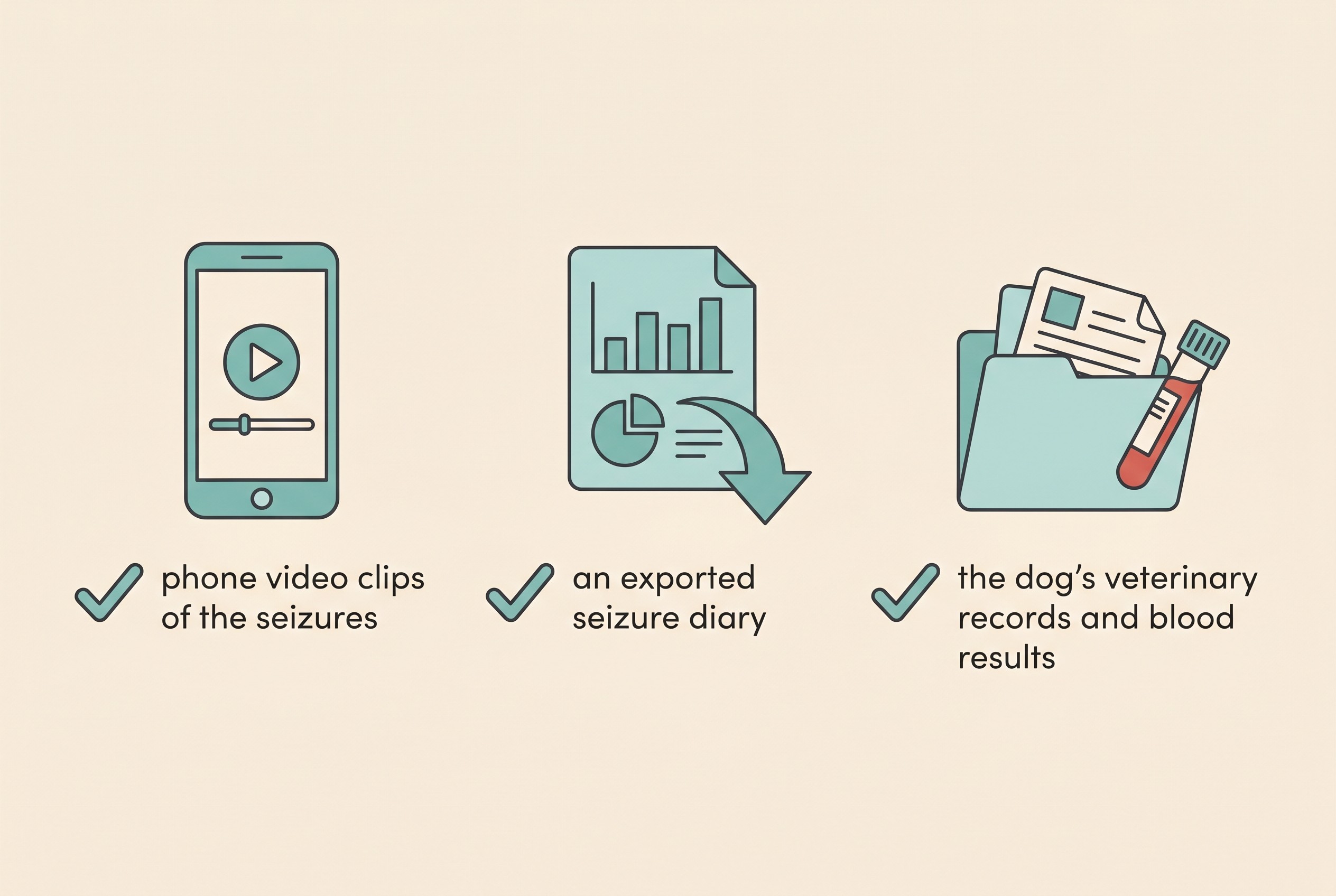
So bring three things:
- Video clips of the episodes. Even short, shaky phone footage is gold. If you've not caught one yet, film the next if it's safe to do so.
- An exported seizure diary: dates, times, how long each event lasted, what type it was, how your dog recovered, and any medication given or missed. Our Seizure Diary is built for exactly this, and the export is designed to be handed across the consulting-room desk. It turns a vague impression into a clear pattern, and it's the highest-value thing you can prepare.
- Your own vet's records and any blood results already done, so the neurologist isn't starting from scratch or repeating tests you've already paid for.
What the consult itself involves
A neurology consultation is longer than a normal vet appointment, and that's a feature, not a delay. Expect an unhurried conversation through the whole history, a careful review of your video and records, then a thorough hands-on neurological examination: your dog's mentation (how aware and bright they are), their gait, their cranial nerves, their postural reactions, reflexes and response to touch (De Risio et al., 2015). The point is localisation, working out whether the problem points to the forebrain or elsewhere.
From there the neurologist draws up a list of likely causes and recommends a plan. For some dogs that means advanced imaging and fluid analysis. For others, particularly a textbook young adult with a normal exam, it may be a discussion about starting treatment without immediately scanning. The investigations themselves, what a blood panel, an MRI and a CSF analysis each show, are owned by the diagnostic workup article, so I'll name them here and send you there.
One detail does shape your whole day. Unlike a person, a dog or cat can't lie still inside a scanner, so brain MRI is done under general anaesthesia, and the fluid sample is usually taken under the same anaesthetic. The expense and risk that come with anaesthesia in animal patients are a real part of the decision (Rusbridge et al., 2015). In practice your pet is usually admitted for the day, possibly starved beforehand, with the scan and any fluid sampling done together while they're asleep. That's why it's a day visit, not a quick scan.
The cost reality
Let me be straight about money, because the silence around it helps no one. What follows are rough, current UK estimates, not peer-reviewed figures, and they vary a great deal by region, by whether the centre is private or university-linked, by your pet's size, and by whether it's planned or an emergency. Treat them as a sense of scale.
A specialist referral consultation typically falls in the region of £200 to £350; one university referral hospital, for example, lists its consultation at around £340 (Langford Vets, 2025). A full seizure investigation, meaning an MRI of the brain plus CSF analysis under anaesthetic, commonly runs to roughly £2,000 to £4,500 or more: a 2025 owner survey put the average UK dog MRI at around £3,800 (NimbleFins, 2026), and that same hospital lists its combined seizure-investigation package at £3,675 to £4,500 (Langford Vets, 2025).
A few things soften this. University and charity-linked centres are often cheaper than private referral hospitals, and some offer interest-free payment plans, so it's worth asking. And importantly, most lifetime UK pet insurance covers referral and MRI when the work is medically necessary and not pre-existing, and a referral from your own vet is almost always required for a claim to be valid (NimbleFins, 2026). The numbers are real, but you're rarely facing them alone or unplanned. The insurance mechanics, lifetime versus annual cover and why the timing of your diagnosis matters, are taken on properly by the cost and insurance article.
Questions worth asking
A good specialist welcomes questions. Asking them doesn't make you a difficult client, it makes you a partner in your dog's care, which is exactly what a neurologist wants. A list to take in with you:
- What do you think is most likely causing the seizures, and what would change your mind?
- Do you recommend MRI and CSF now, or is it reasonable to start treatment and see how we go?
- What are the anaesthetic risks for my pet specifically?
- What will the whole investigation cost, and is there a fixed-price package?
- If we image and it comes back normal, what does that actually tell us?
- Whatever we find, what happens next?
- Who manages the repeat prescriptions and the monitoring afterwards: you, or my own vet?
That last question matters more than it looks, which brings me to how this all works once you've left the building.
Who does what afterwards
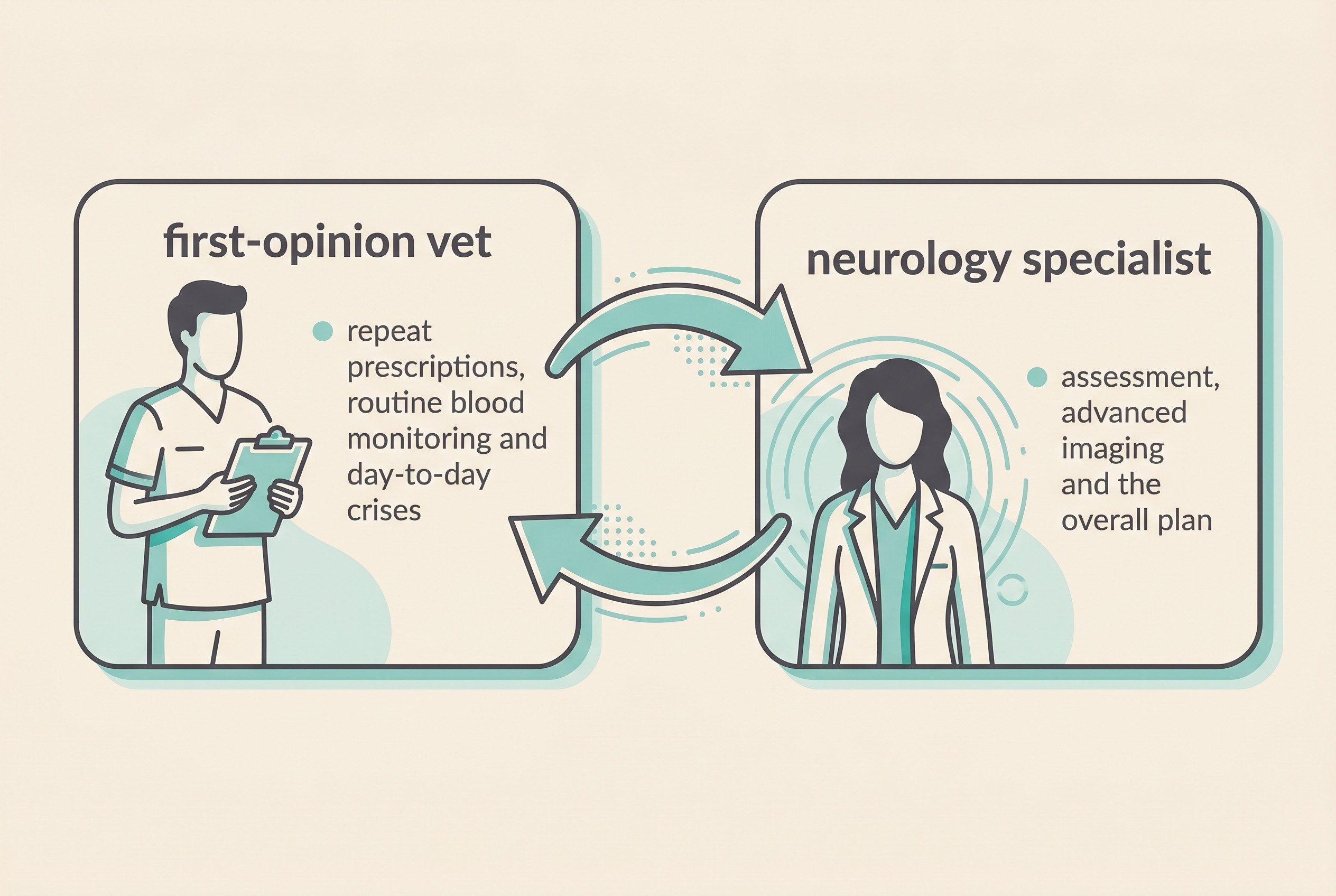
Referral is almost always a shared arrangement, not a handover. Your dog isn't being transferred away from your own vet. The neurologist assesses, investigates and sets the plan, then writes back to your first-opinion vet, who typically resumes day-to-day care: repeat prescriptions, routine blood-level and organ monitoring, and being your first port of call in a crisis. You stay registered with your own practice, with the specialist available again if the seizures escalate or the picture changes. Recognised Specialists are, by definition, "available for referral or consultation by other veterinary colleagues" (RCVS, 2025), and that door stays open. When it works well you end up with two professionals who know your dog rather than one.
A quick word for cat owners
Everything above applies to cats too: the same referral pathway, the same consult, the same shared care afterwards. The one difference is that the threshold to investigate a cat is often reached sooner, because structural and toxic causes of seizures are relatively more common in cats than in dogs, so your vet may be quicker to recommend a specialist look. The feline cause picture lives in the cat articles, but if you've got a cat, you belong in this conversation just as much.
A word on what counts as urgent, whichever species you have. A single short seizure followed by a normal recovery is distressing but not, by itself, an emergency. A seizure lasting more than five minutes, two or more in 24 hours, or seizures running back to back without your pet coming round in between, means a vet or emergency service now. And whatever else happens, never stop an anti-seizure medication abruptly. The goal of all of this is fewer and milder seizures rather than a cure, which is a realistic, worthwhile aim.
So, if a referral letter is sitting on your kitchen table right now, here's what to do with the next few days. Charge your phone and keep it ready to film. Open your Seizure Diary, keep it up to date, and export it the night before. Gather your vet's records, and write your questions on the back of the referral letter so they don't slip your mind in the room. Being sent to a neurologist isn't the system failing your dog. It's the system getting your dog to the right person, at the right time, with your own vet still beside you the whole way.
References
- De Risio, L., Bhatti, S., Muñana, K., Penderis, J., Stein, V., Tipold, A., Berendt, M., Farquhar, R., Fischer, A., Long, S., Mandigers, P. J. J., Matiasek, K., Packer, R. M. A., Pakozdy, A., Patterson, N., Platt, S., Podell, M., Potschka, H., Pumarola Batlle, M., Rusbridge, C., & Volk, H. A. (2015). International veterinary epilepsy task force consensus proposal: diagnostic approach to epilepsy in dogs. BMC Veterinary Research, 11, 148.
- Rusbridge, C., Long, S., Jovanovik, J., Milne, M., Berendt, M., Bhatti, S. F. M., De Risio, L., Farquhar, R. G., Fischer, A., Matiasek, K., Muñana, K., Patterson, E. E., Pakozdy, A., Penderis, J., Platt, S., Podell, M., Potschka, H., Stein, V. M., Tipold, A., & Volk, H. A. (2015). International Veterinary Epilepsy Task Force recommendations for a veterinary epilepsy-specific MRI protocol. BMC Veterinary Research, 11, 194.
- Royal College of Veterinary Surgeons (RCVS). (2025). Specialist status and Advanced Practitioner status (RCVS List definitions, eligibility criteria and purpose; RCVS Specialists Information and Application Guidance Pack 2025–2026). Retrieved June 2026, from and https://www.rcvs.org.uk/lifelong-learning/professional-accreditation/advanced-practitioner-status/
- Langford Vets Small Animal Referral Hospital (University of Bristol). (2025). Neurology procedure prices / Neurology price guide. Retrieved June 2026, from (practical UK estimate, not peer-reviewed)
- NimbleFins. (2026). Average cost of an MRI scan for a dog or cat 2026. Retrieved June 2026, from (practical UK estimate, not peer-reviewed) </content> </invoke>
Keep track of how your pet is doing
The owners who cope best are the ones who notice changes early. A simple health log shows you what is working, and what is not, before the next vet visit.
Start tracking, freeYou're not doing this alone
Compare treatment journeys and talk to owners managing epilepsy. Free to join.
Join PetsLikeMine