

Idiopathic Epilepsy: Breeds, Genetics and Age of Onset
Alastair Greenway
BVM&S MRCVS
Two questions come up again and again once a dog is diagnosed with idiopathic epilepsy. "Did we cause this?" And, with the breeder's paperwork in hand, "Will the rest of the litter get it too?" Both are fair, and both deserve straight answers rather than reassuring fog, whether your own dog has just been diagnosed or you're looking at a breed on a list and wondering what it means.
So here is the plain version. Idiopathic epilepsy in dogs is, in most cases, a genetic condition: a brain that is wired to seize. It shows up at a fairly predictable age, and it runs in certain breeds far more than others. And there's one fact that catches people out: even though it's largely inherited, for nearly every breed there is no DNA test that can confirm or predict it.
A note on scope. This piece owns the breed, genetics and age-of-onset side of the story. It doesn't re-explain why epilepsy is diagnosed by ruling everything else out, that logic lives in why epilepsy is a diagnosis of exclusion, nor the three causal categories, which sit in reactive, structural and idiopathic seizures explained, nor the tests and their costs, which are in the diagnostic workup. And this is a dog article. Cats have their own, quite different, seizure story.
What "idiopathic" actually means
The word sounds like a shrug, and in a sense it is. Idiopathic epilepsy means recurrent seizures with no identifiable structural or metabolic cause, presumed to be genetic or of unknown origin (De Risio et al., 2015). It's a diagnosis of exclusion: your vet reaches it not by finding something on a scan but by finding nothing, and matching that to a very recognisable clinical picture, which the diagnosis-of-exclusion guide is written to make sense of. That picture is what I want to give you here, because once you've seen it your dog's story usually clicks into place.
Age of onset: your single most useful clue
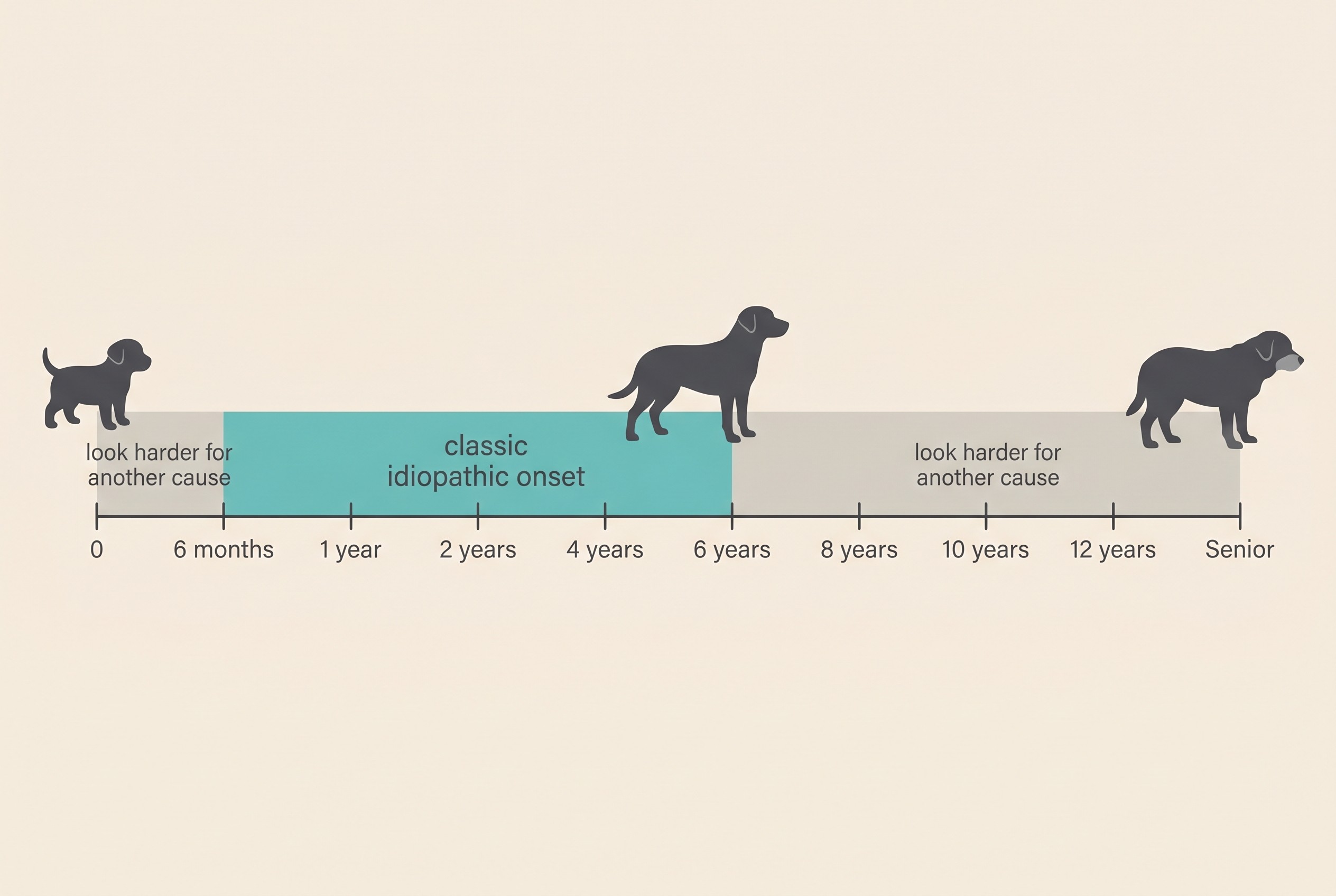
One number is the one to carry with you. The classic age of onset is between six months and six years. In the large diagnostic dataset behind the international consensus guidelines, 89% of dogs with idiopathic epilepsy (230 of 258) had their first seizure before six years of age (De Risio et al., 2015). That window is the textbook signature of the condition.
The second half of the picture is what the dog is like between seizures, which is to say normal. In that same dataset, 84% of these dogs (217 of 258) had a completely unremarkable neurological examination between episodes (De Risio et al., 2015). Put those together and you have the classic idiopathic candidate: a young adult dog, normal between seizures, normal on examination, normal bloodwork, with seizures that began somewhere between six months and six years old.
Age cuts the other way too. A first seizure before six months, or after six years, shifts suspicion towards a structural or reactive cause, and it's one of the specific triggers the consensus guidelines use to recommend an MRI and a sample of cerebrospinal fluid (De Risio et al., 2015). What those tests involve belongs in the diagnostic workup; the point for now is that age is the first thing your vet weighs.
How common it is, and in which breeds
Step back from your own dog and idiopathic epilepsy is genuinely uncommon. Across the general dog population, prevalence is estimated at roughly 0.6 to 0.75% (Hülsmeyer et al., 2015). A grounded UK figure comes from a large primary-care study, which put the prevalence of epilepsy of unknown origin at 0.62%, with a tight confidence interval of 0.57 to 0.67% (Kearsley-Fleet et al., 2013). So fewer than one UK dog in a hundred is affected.
That overall figure hides a lot, because some breeds carry distinctly higher risk. The purebred consensus reports breed-specific prevalence well above the general population: Irish Wolfhound around 18.3%, Border Terrier around 13.1%, Belgian Shepherd around 9.5% (with Tervueren lines alone reported as high as 17%), Petit Basset Griffon Vendéen around 8.9%, Finnish Spitz around 5.4%, Italian Spinone around 5.3%, and Labrador Retriever around 3.1% (Hülsmeyer et al., 2015). The UK data agrees: compared with crossbred dogs, the Border Terrier had 2.70 times the odds of epilepsy of unknown origin (1.57 to 4.62) and the German Shepherd 1.90 times (1.28 to 2.80), while the West Highland White Terrier came out lower-risk (odds ratio 0.23), and males were roughly 1.5 times more likely to be affected than females (Kearsley-Fleet et al., 2013).
The fuller list of predisposed breeds is worth knowing if yours is on it: Australian Shepherd, Belgian Shepherd, Bernese Mountain Dog, Border Collie, Border Terrier, Cavalier King Charles Spaniel, rough and smooth Collie, Dalmatian, English Springer Spaniel, Finnish Spitz, Golden Retriever, Hungarian Vizsla, Irish Wolfhound, Italian Spinone, Labrador Retriever, Lagotto Romagnolo, Shetland Sheepdog and Standard Poodle, among others (Hülsmeyer et al., 2015). If your dog is one of these and started seizing as a young adult, that background is part of why your vet may feel confident in an idiopathic diagnosis without reaching straight for an MRI.
One caution. A breed predisposition is a statement about a population, not a prophecy about your dog. Most Labradors and most Border Terriers never have a seizure in their lives. Being a predisposed breed nudges the odds; it doesn't seal a fate.
What "heritable" does and doesn't mean
It's tempting to imagine epilepsy works like a coat colour: one gene, on or off, testable. For the great majority of breeds, it doesn't. Inheritance is almost always complex, many genes each contributing a little, sometimes in a pattern that looks recessive with incomplete penetrance, so a dog can carry the relevant genetics and never seize. Most pedigree studies point to this polygenic picture rather than a single switch (Hülsmeyer et al., 2015).
How strongly the condition is inherited even varies between breeds. Heritability estimates in the literature range from around 0.22 in the Finnish Spitz to as high as around 0.77 in the Belgian Shepherd and around 0.87 in the Irish Wolfhound (Hülsmeyer et al., 2015). These are breed-specific reported figures, not a universal constant, and the higher ones come from summaries of individual breed studies, so hold them as "reported in this breed" rather than hard law. The genetic contribution is real, often substantial, and different from breed to breed.
The Border Collie shows how varied the picture can be at the difficult end. In a study of 49 affected Border Collies, 49% had a severe clinical course with a high rate of cluster seizures and status epilepticus, drug resistance affected 71% of those treated with two or more medications, and only 18% achieved remission; survival was shorter when seizures started before two years of age or the course was severe, and the pedigrees suggested a founder effect resembling autosomal recessive inheritance (Hülsmeyer et al., 2010). I include this not to frighten anyone but to be straight: breed influences not only whether a dog develops epilepsy but sometimes how hard it is to control. That's why logging seizure frequency and pattern from day one, in something like the Seizure Diary, matters so much.
The real state of genetic testing
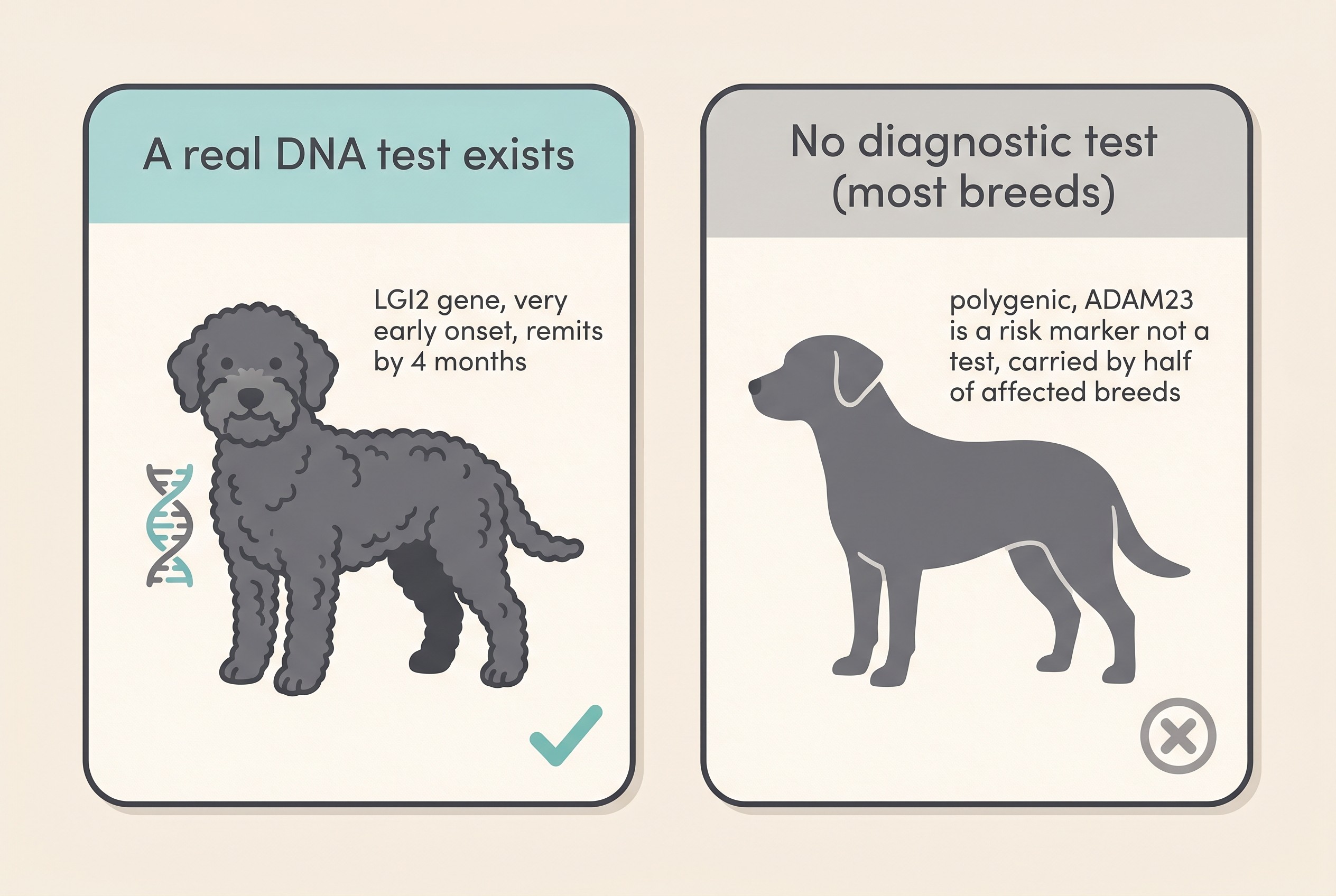
This is where good intentions and clever marketing collide. For nearly every breed, no causative gene for idiopathic epilepsy has been identified, and there is no DNA test that can diagnose or predict it in an individual dog (Hülsmeyer et al., 2015; Belanger et al., 2020). Better to hear that plainly than discover it after paying for a panel that can't deliver. The genetics are real but diffuse, and "heritable" has not yet become "testable" for the typical adult-onset case.
There is one genuine exception, and it's instructive precisely because it's so unusual. The Lagotto Romagnolo carries a truncating mutation in a gene called LGI2 that causes a benign familial juvenile epilepsy. The seizures start very early, at five to nine weeks of age, then spontaneously remit, typically by around four months old. It's inherited in a clear autosomal recessive pattern, and the discovery allowed a carrier DNA test to be developed for breeders (Seppälä et al., 2011). See how different that is from the typical idiopathic story: it appears in tiny puppies rather than young adults, it goes away on its own, and it has a single identifiable gene. When we can find a clean genetic cause, it tends to look nothing like ordinary adult-onset epilepsy.
What about the gene names owners find online? The most prominent is ADAM23. There genuinely is a two-marker risk haplotype in ADAM23 associated with idiopathic epilepsy across several breeds, with a combined odds ratio of roughly 1.9 and higher risk in dogs carrying two copies (Hytönen et al., 2017). It still isn't a test, though, and the reason is the maths: that same risk haplotype is carried by somewhere between about 49% and 70% of dogs in affected breeds (Hytönen et al., 2017). Something that common in healthy and affected dogs alike cannot tell you whether an individual dog will develop seizures. It's a shared risk marker that helps researchers understand the biology, not a screening tool.
Even the best-mapped breed makes the point. In a genome-wide study of Belgian Shepherds, researchers identified associated regions on two chromosomes (one near ADAM23), and still concluded that "even in the presence of the highest risk alleles for each of these two loci, only a portion of dogs would be predicted to express" the condition, adding bluntly that "application of these findings in any type of selection scheme is premature" (Belanger et al., 2020). If the most intensively studied breed can't yet offer a usable predictive test, that tells you how far off one is for the rest.
Breeding, and the "did we cause this?" question
For breeders, the message is straightforward even without a test for most breeds. Because the condition is heritable in predisposed breeds, affected dogs, and ideally their close relatives, should not be bred from (Hülsmeyer et al., 2015). We can't always screen the genetics directly, but we can avoid propagating obviously affected lines. It isn't about blame; it's about not knowingly passing on a brain wired to seize.
For the worried owner sitting at home, the message is gentler and just as true. You did not cause this. Idiopathic epilepsy isn't the result of something you fed, a fright you allowed, a vaccine, or a walk you shouldn't have taken. It's most often a genetic predisposition that was there from birth, and seizures appearing in a young, otherwise perfectly normal dog is exactly what the condition does, not a sign of neglect. The day the seizures started, your dog's brain didn't change because of anything you did. It revealed something it had carried all along.
Where this leaves you
Knowing the genetic picture clearly is oddly freeing: the absence of a DNA test is the genuine state of the science rather than your vet dodging the question, and the guilt so many owners carry has no foundation in the biology. What the genetics don't determine is how your individual dog will do, and that's the more hopeful part. Most dogs with idiopathic epilepsy can be managed well and many live full lives; the goal is control rather than cure, which is its own frank conversation in realistic goals: control, not cure and can a dog with epilepsy live a normal life?.
The single most useful thing you can do from today is start a record: the age the seizures began, how often they happen, what they look like, how your dog recovers. Those are exactly the details your vet leans on, and the Seizure Diary keeps them in one place for your next appointment. Your dog's genes set the starting point. What you and your vet do next shapes the years ahead.
References
- De Risio, L., Bhatti, S., Muñana, K., Penderis, J., Stein, V., Tipold, A., Berendt, M., Farquhar, R., Fischer, A., Long, S., Mandigers, P. J. J., Matiasek, K., Packer, R. M. A., Pakozdy, A., Patterson, N., Platt, S., Podell, M., Potschka, H., Batlle, M. P., Rusbridge, C., & Volk, H. A. (2015). International veterinary epilepsy task force consensus proposal: diagnostic approach to epilepsy in dogs. BMC Veterinary Research, 11, 148.
- Hülsmeyer, V. I., Fischer, A., Mandigers, P. J. J., De Risio, L., Berendt, M., Rusbridge, C., Bhatti, S. F. M., Pakozdy, A., Patterson, E. E., Platt, S., Packer, R. M. A., & Volk, H. A. (2015). International Veterinary Epilepsy Task Force's current understanding of idiopathic epilepsy of genetic or suspected genetic origin in purebred dogs. BMC Veterinary Research, 11, 175.
- Hülsmeyer, V., Zimmermann, R., Brauer, C., Sauter-Louis, C., & Fischer, A. (2010). Epilepsy in Border Collies: clinical manifestation, outcome, and mode of inheritance. Journal of Veterinary Internal Medicine, 24(1), 171-178.
- Hytönen, M. K., Arumilli, M., Lappalainen, A. K., Kallio, H., Snellman, M., & Lohi, H. (2017). ADAM23 is a common risk gene for canine idiopathic epilepsy. BMC Genetics, 18, 8.
- Kearsley-Fleet, L., O'Neill, D. G., Volk, H. A., Church, D. B., & Brodbelt, D. C. (2013). Prevalence and risk factors for canine epilepsy of unknown origin in the UK. Veterinary Record, 172(13), 338.
- Belanger, J. M., Famula, T. R., Gershony, L. C., Palij, M. K., & Oberbauer, A. M. (2020). Genome-wide association analysis of idiopathic epilepsy in the Belgian shepherd. Canine Medicine and Genetics, 7, 12.
- Seppälä, E. H., Jokinen, T. S., Fukata, M., Fukata, Y., Webster, M. T., Karlsson, E. K., Kilpinen, S. K., Steffen, F., Dietschi, E., Leeb, T., Eklund, R., Zhao, X., Rilstone, J. J., Lindblad-Toh, K., Minassian, B. A., & Lohi, H. (2011). LGI2 truncation causes a remitting focal epilepsy in dogs. PLoS Genetics, 7(7), e1002194.
Keep track of how your pet is doing
The owners who cope best are the ones who notice changes early. A simple health log shows you what is working, and what is not, before the next vet visit.
Start tracking, freeYou're not doing this alone
Compare treatment journeys and talk to owners managing epilepsy. Free to join.
Join PetsLikeMine