


CBD for Dogs With Epilepsy: What the Evidence Actually Says
Alastair Greenway
BVM&S MRCVS
Spend any time in epilepsy forums and you'll meet the same two voices. One owner whose dog "hasn't seized since we started CBD." Someone underneath insisting "the drugs are poison, get him off them." Between those poles sits a real question that deserves a real answer, and that's what this page is for.
So let me be straight with you. There is some real, peer-reviewed research into CBD for canine epilepsy. It is also early, small in scale, and decidedly mixed. CBD is not a cure, and it is not a replacement for conventional anti-seizure drugs. Every published trial studied it as an add-on, something given on top of existing medication, never instead of it (McGrath et al., 2019; Rozental et al., 2023; Di Salvo et al., 2023). I'm not here to sneer at the hope that brought you, because the hope is reasonable. I'm here to give you a clearer, better-cited picture than any forum thread or any company selling you a bottle.
This article owns the full evidence-and-safety picture for CBD, plus one safety message that matters more than anything else on the page. It doesn't re-describe the prescription drugs themselves: that fair comparison lives in the anti-seizure drugs compared. Diet as an adjunct is covered in diet and epilepsy, and the deeper reason you never stop medication suddenly sits in giving medication reliably. My job here is CBD, told straight.
The yardstick CBD has to meet
Before we touch the trials, hold onto the frame the rest of this space uses, because CBD deserves to be measured by it too. In epilepsy, the realistic goal is reduction, not cure. A "responder" usually means a dog whose seizure frequency falls by at least half, and complete freedom from seizures is uncommon whatever you use (Bhatti et al., 2015). Keep that 50% threshold in mind as we go: it's the difference between a result that sounds impressive and a result that changes a dog's life, and a lot of CBD marketing quietly swaps one for the other.
Two trials, one story told twice
The two trials worth knowing share a punchline, which is that they tell the same story twice.
The landmark study came out in 2019: a randomised, blinded, placebo-controlled trial, the kind of design that can actually tell you something. It enrolled 26 dogs with intractable (drug-resistant) idiopathic epilepsy, every one already on conventional anti-seizure medication. Twelve received a CBD-infused oil and fourteen a placebo oil, with CBD given at 2.5 mg/kg by mouth twice daily for twelve weeks (McGrath et al., 2019).
The result has two halves, and you need both. The dogs on CBD had a statistically significant reduction in seizure frequency compared with placebo, a median reduction of around 33%. That's real and measurable. But the proportion of dogs who reached "responder" status, that meaningful 50% drop, was similar between the CBD and placebo groups (McGrath et al., 2019). In plain terms: CBD shaved an average off the seizure count, but it did not get significantly more dogs over the line that actually matters to a household. This is the single most-misquoted finding in the whole subject. Most pages give you one half and stop.
Then came a larger follow-up in 2023, built to test the first: a double-blinded, placebo-controlled crossover study of 51 dogs with drug-resistant idiopathic epilepsy, again all on at least one anti-seizure drug. The researchers started at 5 mg/kg per day, but that dose showed no treatment effect and was abandoned for futility after the first twelve dogs, so the remaining 39 were studied at a higher 9 mg/kg per day (Rozental et al., 2023).
At that higher dose, the signal returned. The change in total seizure frequency was significantly better on CBD than on placebo, and the number of seizure days fell by roughly 24% on CBD while rising slightly on placebo (Rozental et al., 2023). Encouraging. And then, once again, the other half: the proportion of dogs achieving a 50% or greater reduction was not significantly different between CBD and placebo (Rozental et al., 2023). The bigger, newer, better-powered trial landed in exactly the same place as the first. A genuine group-level effect. No clear win on the number of dogs reaching a response that changes daily life.
That consistency is the takeaway. A recent review of the whole field put it without spin: the published studies are few, almost all carry a risk of bias, sample sizes are small, long-term data are lacking, and results are not always consistent, so the findings must be read with caution and larger trials are needed (Di Salvo et al., 2023). That isn't a reason to dismiss CBD. It's a reason to be clear-eyed about it.
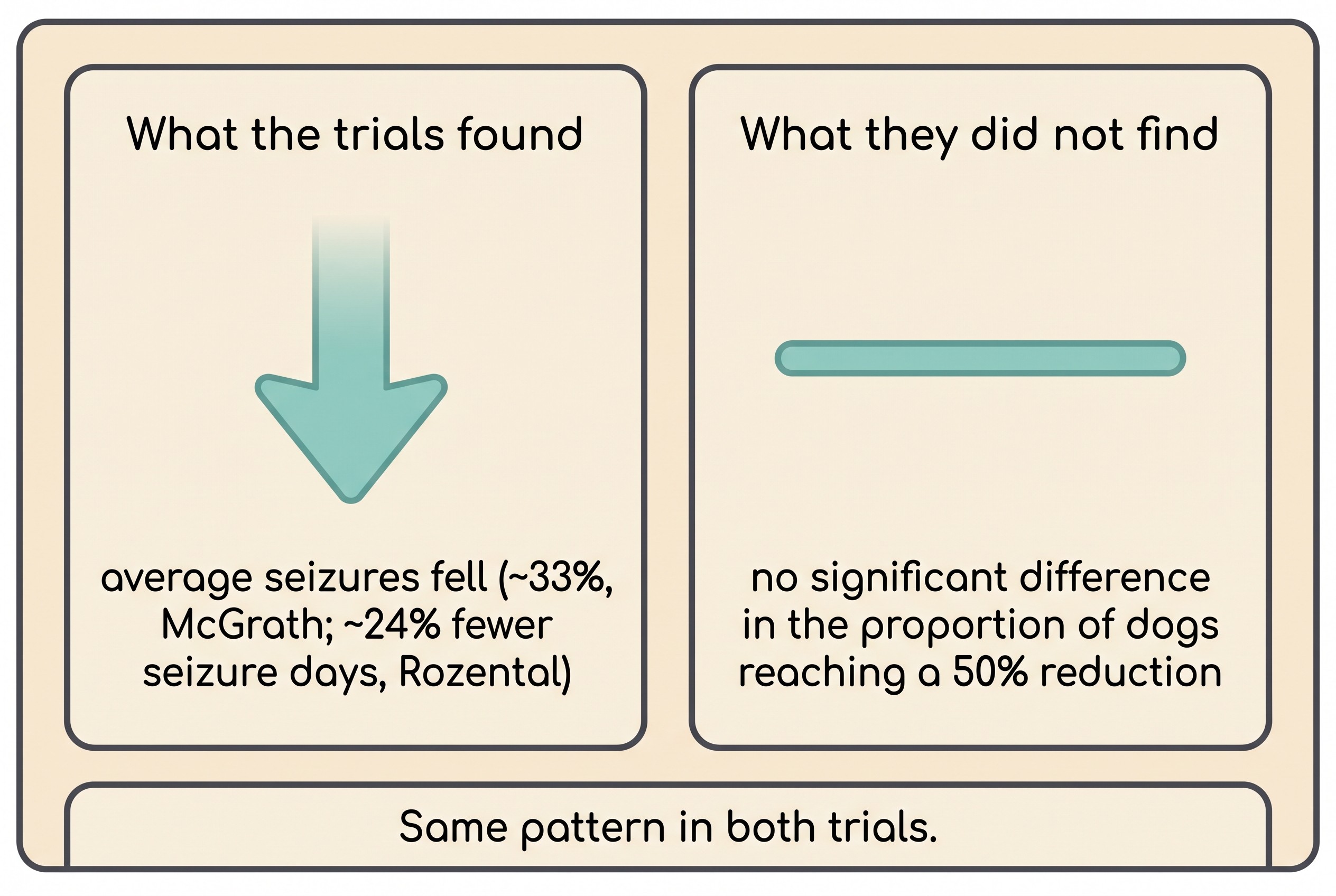
So when a product page tells you "the studies show CBD reduces seizures," that's true and incomplete. The same studies show it did not reliably get more dogs to a meaningful response than placebo did. A good decision needs both halves.
Safety realities the marketing pages skip
"Natural" is not the same as "harmless," and CBD is not side-effect-free. The most consistent finding across the studies is a rise in liver enzymes, especially alkaline phosphatase (ALP), with chronic dosing. It showed up in the landmark trial as a significant rise in ALP, and again in the larger follow-up, where both ALP and ALT rose significantly on CBD (McGrath et al., 2019; Rozental et al., 2023). The reassuring part is that this enzyme rise generally reverses once the CBD is stopped (Di Salvo et al., 2023). The non-negotiable part is that it means a dog on CBD needs proper monitoring with the vet, not a bottle bought quietly and given without anyone checking.
The other common adverse effects are worth knowing before you start. In the landmark trial, two of the CBD dogs developed ataxia, a wobbly, unsteady gait, and had to be withdrawn (McGrath et al., 2019). In the larger trial, decreased appetite and vomiting were both significantly more common on CBD than on placebo (Rozental et al., 2023). None of these is necessarily a reason not to try CBD under guidance, but each is a reason to do it carefully and watch closely.
The phenobarbital question, told accurately
You'll often read, stated as flat fact, that "CBD raises phenobarbital levels." The careful version is more useful than the scary one.
In the larger epilepsy trial, phenobarbital concentrations rose by an average of about 11% during the CBD phase, against roughly no change on placebo, but that difference was not statistically significant (Rozental et al., 2023). Separately, a study designed specifically to look for this interaction in healthy dogs found no significant pharmacokinetic interaction between CBD and phenobarbital in either direction, and concluded that adjusting either drug's dose on the basis of a CBD and phenobarbital interaction is not recommended (Doran et al., 2021).
So the accurate message is not "CBD dangerously spikes phenobarbital." It's that the data don't show a strong, established interaction, while a small effect can't be completely ruled out. And because both CBD and phenobarbital can raise liver enzymes (Doran et al., 2021; Rozental et al., 2023), combining them is exactly where your vet's monitoring earns its keep. Your vet already tracks phenobarbital with blood tests, so this is a conversation to have openly, not a change to make alone.
Why the bottle itself is a safety issue
Now for the part that genuinely worries vets, and it has nothing to do with CBD's pharmacology. The quality and contents of CBD products vary enormously. Independent testing has repeatedly found inaccurate labelling, with many products containing materially more or less CBD than the label claims, detectable THC even in products marketed as "THC-free," and contaminants such as heavy metals in a meaningful share of products (Di Salvo et al., 2023). Your dog can't tell you the bottle was mislabelled, and finding out from how they respond is no way to find out.
That matters because THC, the intoxicating compound in cannabis and a different molecule from CBD, is toxic to dogs, who are more sensitive to it than people are. Signs of cannabis toxicity include depression, wobbliness, dribbling urine, dilated pupils, vomiting, tremors, a low body temperature and, at higher doses, agitation or even seizures (Di Salvo et al., 2023). The point is narrow but important: a poorly made or mislabelled "CBD" product that actually contains THC is a real risk, which is exactly why provenance and lab testing are not optional extras.
The one message that matters most
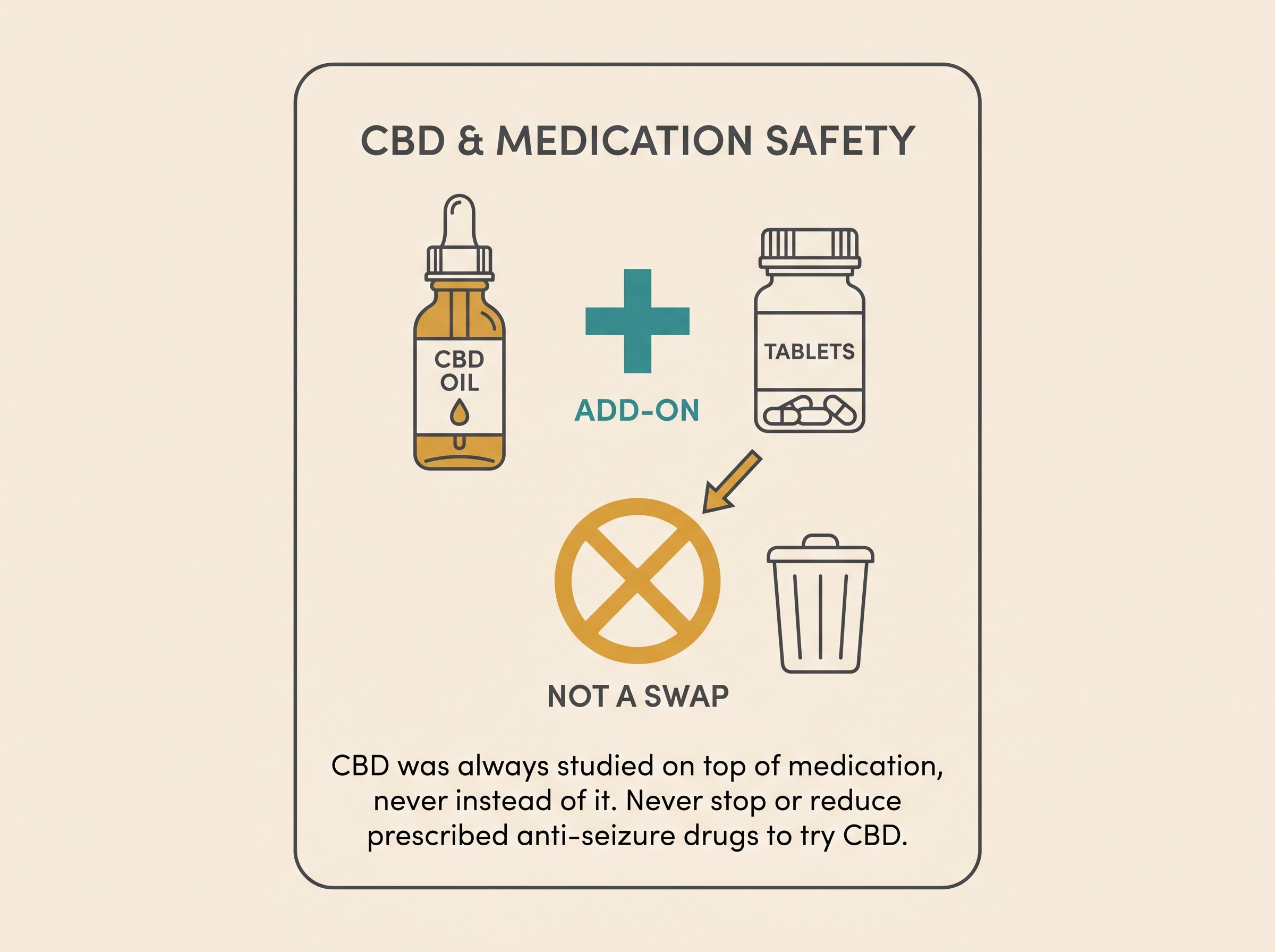
Never stop or reduce your dog's prescribed anti-seizure medication in order to "try CBD," and never make any change to those drugs without your vet.
I'm saying it this firmly because of those forum stories. Abruptly stopping or cutting an anti-seizure drug can trigger withdrawal seizures, cluster seizures, or status epilepticus, which is an emergency (Bhatti et al., 2015). And remember what every single trial actually did: they added CBD on top of the existing medication, never in place of it (McGrath et al., 2019; Rozental et al., 2023). There is no published evidence that CBD can safely replace conventional anti-seizure drugs, because that isn't how it was studied. The dogs who "improved on CBD" in these trials were on their prescription medication the whole time.
While the emergency line is on the page: a seizure lasting more than five minutes, or two or more seizures in 24 hours, or seizures running into each other without recovery, is an emergency. Get to your vet or an out-of-hours clinic now (Bhatti et al., 2015). A single short seizure with full recovery is frightening, but not by itself an emergency. The full detail of why those thresholds matter, and what to do, lives in status epilepticus and cluster seizures.
Raising it with your vet, and the UK legal picture
None of the above means CBD is off the table. It means it's a vet conversation, not a supermarket or vape-shop purchase, and in the UK there's a legal reason for that, not just a clinical one.
No CBD product is currently authorised for veterinary use in the UK. The Veterinary Medicines Directorate treats CBD products for animals as veterinary medicines, and giving your pet an unauthorised CBD product obtained without a veterinary prescription is an offence under Regulation 8 of the Veterinary Medicines Regulations (VMD, 2022). What a vet can do, under the prescribing cascade, is prescribe a legally obtained human CBD product if they judge it appropriate, then advise on the right product and dose and watch for side effects (VMD, 2022). So the lawful, sensible route runs through your vet by design.
Bring it up openly. A good vet would far rather you raised CBD than gave it in secret. Ask about a quality product that comes with a certificate of analysis or third-party lab testing, so you're not relying on a label that independent testing tells us is often wrong (Di Salvo et al., 2023). Agree on liver-enzyme monitoring up front. And track any trial properly, because impressions are unreliable when you're frightened and hopeful, and a quiet fortnight can fool anyone. The way to see whether a CBD trial is changing anything is to log every seizure in the Seizure Diary and let the frequency chart tell you the truth, rather than your memory. If you'd rather weigh up a different adjunct, dietary therapy is covered in diet and epilepsy, and the wider landscape of experimental options is mapped in new and emerging treatments.
A short, candid note for cat owners
If you have a cat, the picture is even thinner than for dogs, and I won't pretend otherwise. There are no controlled feline epilepsy efficacy trials of the kind that exist for dogs. The feline research is largely single-dose pharmacokinetic and preliminary safety work, which tells us cats absorb and handle CBD differently from dogs and that far more research is needed before anyone can make a therapeutic claim (Di Salvo et al., 2023). So the plain position for cats is: even less is known, the same caution applies, and it is vet-led only. Feline drug choices and feline-specific seizure causes are different again, and they belong in the cat articles rather than here.
Where this leaves you
CBD for canine epilepsy isn't a miracle and it isn't a fraud. It's an early, modest, add-on therapy with a real but limited evidence base, genuine side effects worth monitoring, a product-quality problem that's larger than most owners realise, and one absolute rule attached to it: it goes on top of the prescribed drugs, never in their place. If, after reading all that, you and your vet decide a carefully sourced, properly monitored trial is worth running, that's a reasonable, eyes-open choice. Start the conversation, insist on a lab-tested product and liver monitoring, and let the Seizure Diary show you both whether it's actually working. That's how you turn a hopeful story into something you can trust.
References
- - Bhatti SFM, De Risio L, Muñana K, Penderis J, Stein VM, Tipold A, Berendt M, Farquhar RG, Fischer A, Long S, Mandigers PJM, Matiasek K, Packer RMA, Pakozdy A, Patterson EE, Platt S, Podell M, Potschka H, Rusbridge C, Volk HA. International Veterinary Epilepsy Task Force consensus proposal: medical treatment of canine epilepsy in Europe. BMC Veterinary Research. 2015;11:176.
- - Di Salvo A, Conti MB, della Rocca G. Pharmacokinetics, efficacy, and safety of cannabidiol in dogs: an update of current knowledge. Frontiers in Veterinary Science. 2023;10:1204526.
- - Doran CE, McGrath S, Bartner LR, Thomas B, Cribb AE, Gustafson DL. Drug-drug interaction between cannabidiol and phenobarbital in healthy dogs. American Journal of Veterinary Research. 2021;83(1):86-94.
- - McGrath S, Bartner LR, Rao S, Packer RA, Gustafson DL. Randomized blinded controlled clinical trial to assess the effect of oral cannabidiol administration in addition to conventional antiepileptic treatment on seizure frequency in dogs with intractable idiopathic epilepsy. Journal of the American Veterinary Medical Association. 2019;254(11):1301-1308.
- - Rozental AJ, Weisbeck BG, Corsato Alvarenga I, Gustafson DL, Kusick BR, Rao S, Bartner LR, McGrath S. The efficacy and safety of cannabidiol as adjunct treatment for drug-resistant idiopathic epilepsy in 51 dogs: a double-blinded crossover study. Journal of Veterinary Internal Medicine. 2023;37(6):2291-2300.
- - Veterinary Medicines Directorate (VMD). Can I buy CBD oil (cannabidiol) for my pet? GOV.UK / VMD blog, 2022.
Keep track of how your pet is doing
The owners who cope best are the ones who notice changes early. A simple health log shows you what is working, and what is not, before the next vet visit.
Start tracking, freeYou're not doing this alone
Compare treatment journeys and talk to owners managing epilepsy. Free to join.
Join PetsLikeMine