

Routine, Exercise and Quality of Life
Alastair Greenway
BVM&S MRCVS
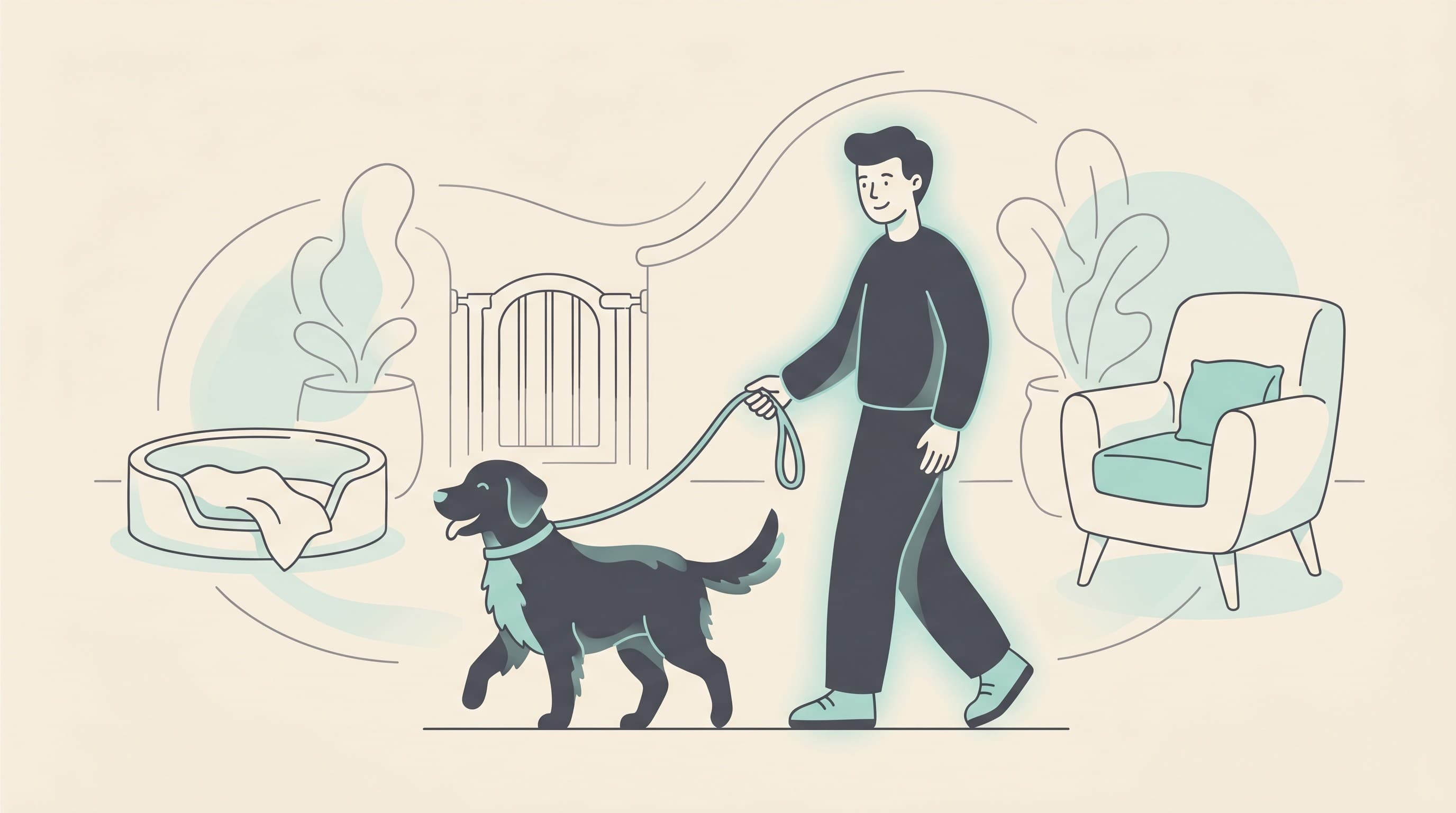
A new epilepsy diagnosis often brings a quiet fear in alongside it: that ordinary life is over, that the walks have to shrink, that you can never leave the house again. I understand where that comes from, but it isn't true, and living as though it were can cost your pet the very thing all of this is for.
So this is about building a good, safe, full daily life around epilepsy: routine, exercise, swimming, being left alone, travel, and briefing the people who help you. It doesn't cover hunting down seizure triggers, which lives in identifying seizure triggers, nor whether your dog can live a normal life, which lives in can a dog with epilepsy live a normal life, nor the hardest decisions, which belong to quality of life and difficult decisions. What I want to leave you with is a sense that quality of life, not seizure count, is the thing you're actually managing.
Routine as gentle medicine
The cheapest, most reassuring intervention there is happens to be a steady routine, and there's genuine evidence behind it. In a study of dogs with idiopathic epilepsy, 74% (37 of 50) had at least one factor their owners felt could precipitate a seizure, and the most commonly reported were strikingly ordinary: visitors at home, a change in life situation, a change in daily routine, altered sleep patterns, unfamiliar places and weather (Forsgård et al., 2019). Those are exactly the bumps a predictable day smooths out, so consistent mealtimes, bedtimes and medication timing aren't fussy. They're a low-cost, low-risk way to unsettle an epileptic brain a little less.
I'll be straight about the evidence, though: these are owner-reported associations, not proof that routine prevents seizures. The case for reducing stress and increasing predictability as an adjunct to medication has been made formally, alongside dropping any punishment-based training, but the same authors are candid that much of this is extrapolated from human epilepsy and lacks controlled trials in dogs (Packer, Hobbs & Blackwell, 2019). So hold routine as sensible and low-risk, not as a cure, and don't blame yourself if a seizure breaks through a perfectly steady week. It often will. Medication timing is part of that routine, and one rule sits above all others: never stop anti-seizure medication abruptly, because withdrawal can trigger cluster seizures or even life-threatening status epilepticus (Bhatti et al., 2015). The how-to of reliable dosing lives in giving medication reliably.
Keep moving, within sensible limits
A dog with well-controlled epilepsy does not need to be wrapped in cotton wool. There's no good canine evidence that exercise itself either triggers or prevents seizures, so I won't oversell walks as therapy, but there's equally no reason to shrink your dog's world. A full, active, sniffy, social life is the normal life that good treatment is meant to protect.
Two physical cautions are really all this comes down to. The first is heat. Hot weather was the single most common environmental precipitant in that study, with eight of the nine weather-reactive dogs reacting specifically to heat (Forsgård et al., 2019), and a seizing or recently seized animal overheats dangerously easily. So in summer, walk in the cooler parts of the day, skip the midday heat, and avoid hard exercise when it's warm. The second caution is common sense layered on the first: aim for "pleasantly tired", not "flattened".
Water and swimming: the one rule that really matters
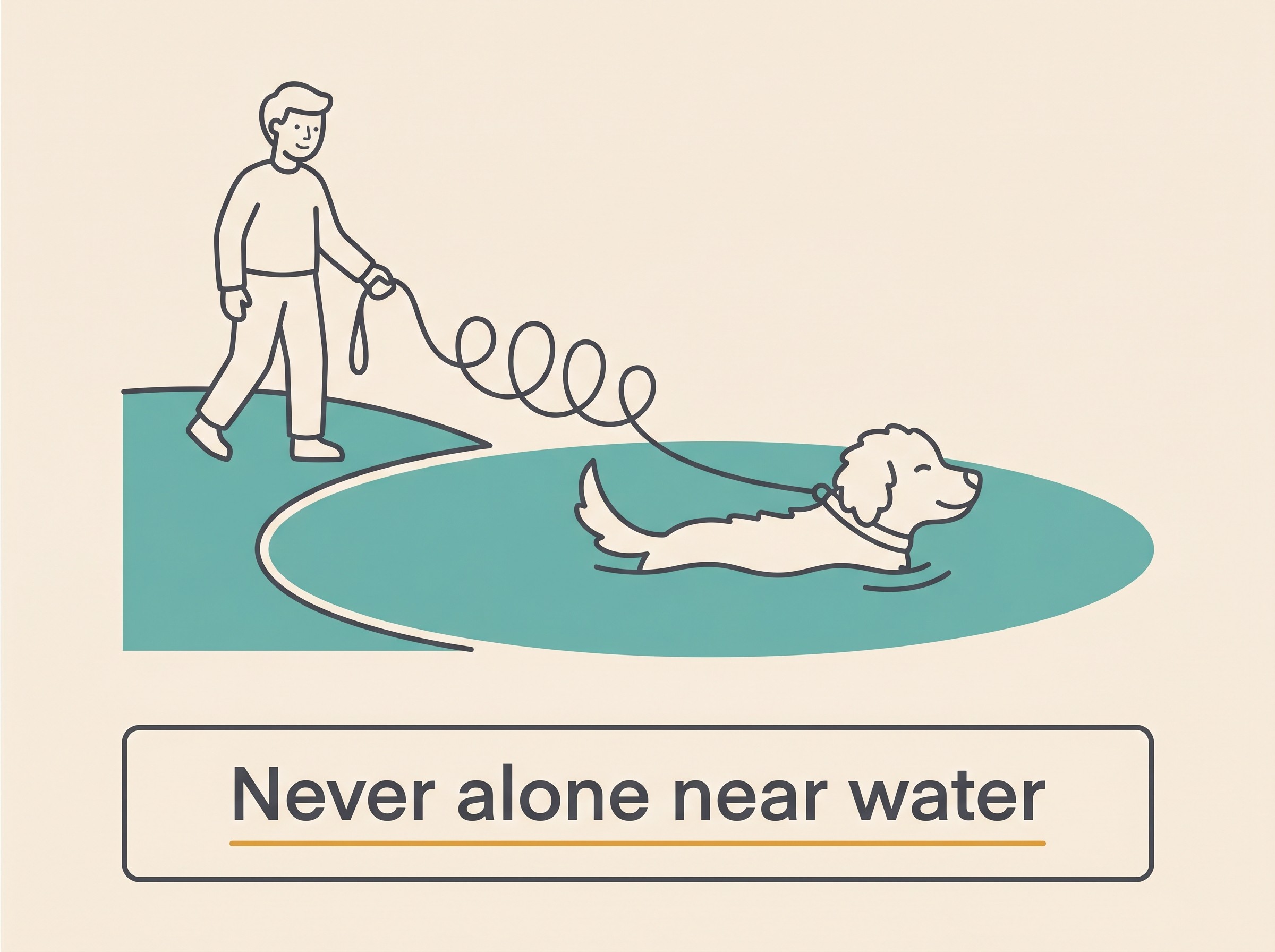
A pet with active epilepsy should never swim, or be left unsupervised near water, full stop.
The reason is worth understanding, and the clearest evidence comes from human epilepsy. During the tonic phase of a seizure the chest muscles contract and force air out, so the body becomes denser than water and sinks quickly; when those muscles then relax underwater, it's water rather than air that's drawn into the airway (Besag, 2001). It can happen in seconds. Compared with people without epilepsy, the relative risk of drowning was around 96 in the bath and 23.4 in the swimming pool (Diekema et al., cited in Besag, 2001). The encouraging flip side is that supervision is protective: in that work, no child drowned while swimming under supervision (Besag, 2001).
This is human data applied to dogs and cats by extension, but the precaution is uncontroversial and standard veterinary advice. In practice: never let an epileptic pet swim alone, stay within arm's reach near water, and consider a long line by ponds, rivers or pools. And "water" includes the unglamorous hazards: the bath, the garden pond, a full water trough, a pool you're walking past. A seizure gives no warning, so the supervision has to be there before it's needed.
Safety-proofing the home
Seizures arrive without warning, so most of your practical wins are environmental. The big ones are falls and water. Block or gate stairs your pet could tumble down mid-seizure, be cautious around balconies and raised decking, and keep them away from open water and roads when they're not directly supervised. Cats need the height point taken seriously, given how much of their world is up high.
Then create one calm, low, padded resting spot your pet already likes, where a seizure would do the least harm. During and right after a seizure your pet may be disorientated or even transiently blind; that's the post-ictal phase, whose full story belongs to the post-ictal phase. It matters here because in one study, 77% of owners reported that non-pharmacological measures, rest, physical closeness and a calm, dark environment, helped their dog recover (Kähn et al., 2023). So that quiet, dim, familiar spot does double duty: it limits injury during a seizure, and it's exactly what helps afterwards.
Being left alone, and briefing your carers
In my experience, this is the single biggest pressure point of living with an epileptic pet. In a qualitative study of owners in England, people described cancelling social events, not holidaying unless the dog could come, cutting their working hours, even giving up work entirely, almost all driven by the fear of leaving the dog alone (Pergande et al., 2020). If you've reshaped your life around being home, you're not overreacting. But here's a calmer way to hold it: most pets with epilepsy are not in constant danger between seizures, and a single short seizure that resolves with a normal recovery is frightening but not, in itself, an emergency. The realistic goal is sensible risk reduction, not house arrest, and the heavier emotional side has its own home in the emotional toll of caring for a pet with epilepsy.
The flip side of not having to be home every minute is that anyone left in charge, a sitter, a kennel, a walker, a family member, needs three things. First, the medication plan: the exact schedule, and the absolute rule never to skip a dose, double up to "catch up", or stop the medication, because abrupt withdrawal can trigger clusters or status (Bhatti et al., 2015). Second, what a seizure looks like and the emergency line: a seizure lasting more than five minutes, or two or more seizures in 24 hours, or seizures running into each other without recovery means vet or emergency clinic now. Third, where any vet-prescribed rescue medication is kept and the agreed plan for using it. The Seizure Diary gives you a shareable record to hand over, and the written, personalised emergency steps belong in your status epilepticus emergency plan. A briefed sitter is what turns "I can never leave" into "I can leave, because the plan goes with them."
Travel and boarding: plan it, don't avoid it
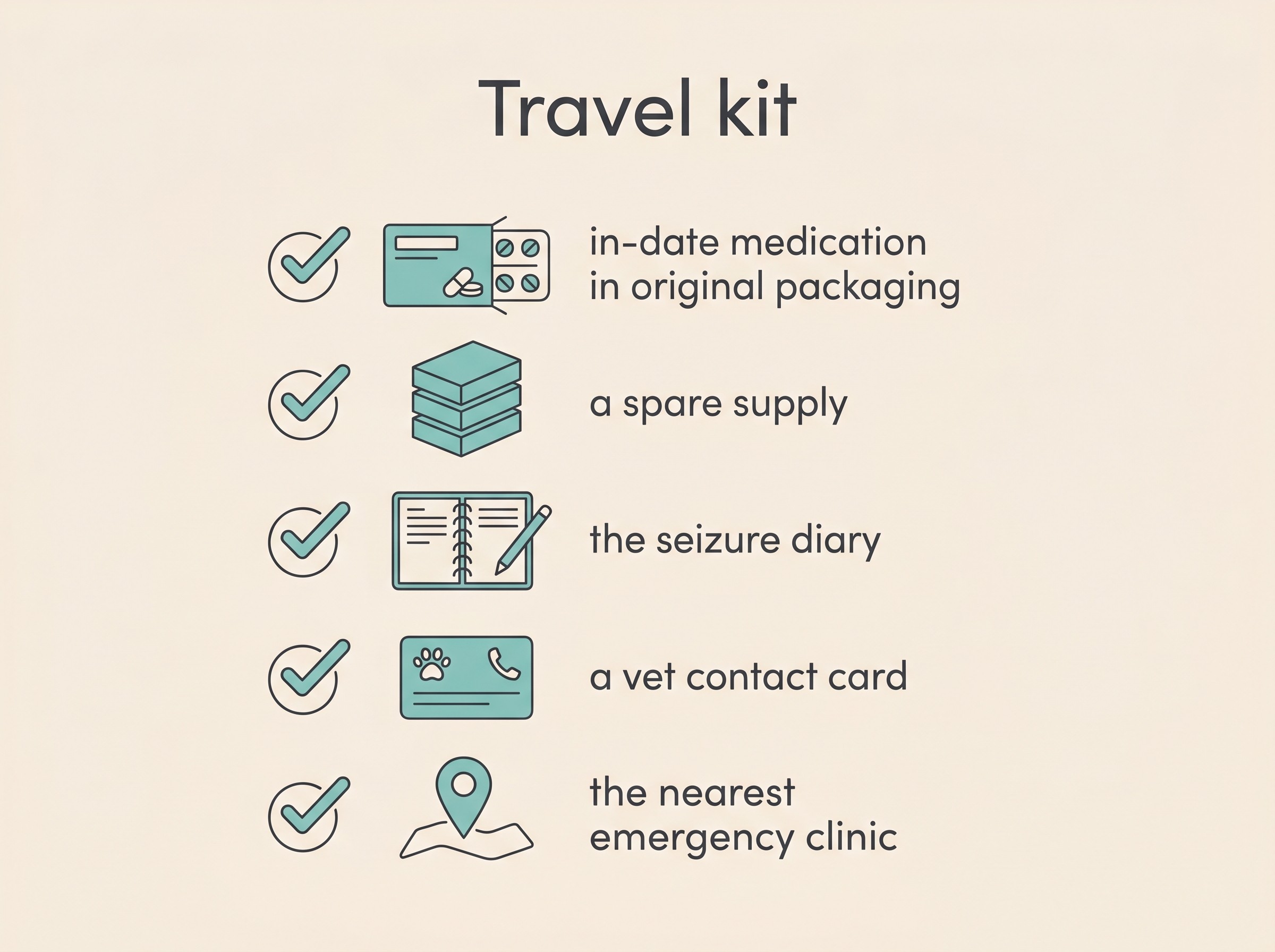
Travel is doable; it just needs a checklist rather than a leap of faith. Pack enough in-date medication for the whole trip plus a spare, kept in its original packaging with the dosing instructions on it. Take your vet's contact details and your pet's seizure diary, and, before you go, note a vet or emergency clinic near your destination so you're not searching in a panic. Travel does stack several known precipitants at once, new places, disrupted sleep and heat in a car all line up together (Forsgård et al., 2019), so keep meal and medication timing as steady as you can on the move.
For boarding, the deciding question isn't luxury, it's competence: choose somewhere genuinely willing and able to give medication on time and to recognise a seizure. A good kennel will be glad of your written instructions and your diary. If a place seems put off by the responsibility, that tells you what you need to know.
Quality of life is the whole point
Everything above, the freedom to walk, the safe corner, the trip you didn't cancel, supports one idea. Owners consistently rate their pet's quality of life as more important than seizure frequency alone, yet most research has chased seizure counts instead (Packer & Volk, 2015). The veterinary consensus has caught up: the impact of treatment on quality of life "must be considered as a major factor for the evaluation of outcome", and the owner's perception of it plays a major role in management decisions (Potschka et al., 2015). So the daily-life choices here aren't trivial extras layered on top of the "real" management. They are the point of it.
That's why the real goal is a good life with the fewest seizures achievable at an acceptable cost, rather than a seizure-free life at any price. Control, not cure: a "responder" is conventionally at least a 50% reduction in seizure frequency, and complete freedom from seizures is uncommon (Potschka et al., 2015; Bhatti et al., 2015). If chasing zero seizures means a flat, sedated, joyless pet, the maths has gone wrong. The harder questions about that balance are handled with care in quality of life and difficult decisions.
A note for cat owners
Almost everything here applies to cats: a steady routine, a safe space, supervision near heights and water, carefully briefed carers. A cat's quality of life is significantly higher when their seizures are well controlled, when they aren't suffering medication side effects, and when the epilepsy began before five years of age, and a close cat-and-owner relationship is linked to both better quality of life for the cat and a lighter load for the owner (Henning et al., 2021). The drug detail differs for cats and belongs in the medication articles, but flag this with your vet: sedation is a common feline side effect, and a permanently dopey cat is a cat with a dented quality of life (Henning et al., 2021). The goal for your cat is the same as for any dog here: a good life, not just a low number.
A steady routine and a safety-proofed home put a surprising amount of control back into your hands, on the days between seizures when it can otherwise feel like you have none. And the daily life you build becomes useful in its own right: logged in the Seizure Diary, the patterns, the recoveries and the good stretches turn into real evidence your vet can act on. If what you're really chasing is the reassurance that your dog can still have a full, happy life, that question is waiting in can a dog with epilepsy live a normal life. The short version: yes, very often, they can.
References
- Besag, F. M. C. (2001). Tonic seizures are a particular risk factor for drowning in people with epilepsy. BMJ, 322(7292), 975-976.
- Bhatti, S. F. M., De Risio, L., Muñana, K., Penderis, J., Stein, V. M., Tipold, A., Berendt, M., Farquhar, R. G., Fischer, A., Long, S., Löscher, W., Mandigers, P. J. J., Matiasek, K., Pakozdy, A., Patterson, E. E., Platt, S., Podell, M., Potschka, H., Rusbridge, C., & Volk, H. A. (2015). International Veterinary Epilepsy Task Force consensus proposal: medical treatment of canine epilepsy in Europe. BMC Veterinary Research, 11, 176.
- Forsgård, J. A., Metsähonkala, L., Kiviranta, A.-M., Cizinauskas, S., Junnila, J. J. T., Laitinen-Vapaavuori, O., & Jokinen, T. S. (2019). Seizure-precipitating factors in dogs with idiopathic epilepsy. Journal of Veterinary Internal Medicine, 33(2), 701-707.
- Henning, J., Nielsen, T., Nettifee, J., Muñana, K., & Hazel, S. (2021). Understanding the impacts of feline epilepsy on cats and their owners. Veterinary Record, 189(11), e836.
- Kähn, C., Meyerhoff, N., Meller, S., Nessler, J. N., Volk, H. A., & Charalambous, M. (2023). The postictal phase in canine idiopathic epilepsy: semiology, management, and impact on the quality of life from the owners' perspective. Animals, 14(1), 103.
- Packer, R. M. A., Hobbs, S. L., & Blackwell, E. J. (2019). Behavioral interventions as an adjunctive treatment for canine epilepsy: a missing part of the epilepsy management toolkit? Frontiers in Veterinary Science, 6, 3.
- Packer, R. M. A., & Volk, H. A. (2015). Epilepsy beyond seizures: a review of the impact of epilepsy and its comorbidities on health-related quality of life in dogs. Veterinary Record, 177(12), 306-315.
- Pergande, A. E., Belshaw, Z., Volk, H. A., & Packer, R. M. A. (2020). "We have a ticking time bomb": a qualitative exploration of the impact of canine epilepsy on dog owners living in England. BMC Veterinary Research, 16, 443.
- Potschka, H., Fischer, A., Löscher, W., Patterson, N., Bhatti, S., Berendt, M., De Risio, L., Farquhar, R., Long, S., Mandigers, P., Matiasek, K., Muñana, K., Pakozdy, A., Penderis, J., Platt, S., Podell, M., Rusbridge, C., Stein, V., Tipold, A., & Volk, H. A. (2015). International Veterinary Epilepsy Task Force consensus proposal: outcome of therapeutic interventions in canine and feline epilepsy. BMC Veterinary Research, 11, 177.
Keep track of how your pet is doing
The owners who cope best are the ones who notice changes early. A simple health log shows you what is working, and what is not, before the next vet visit.
Start tracking, freeYou're not doing this alone
Compare treatment journeys and talk to owners managing epilepsy. Free to join.
Join PetsLikeMine